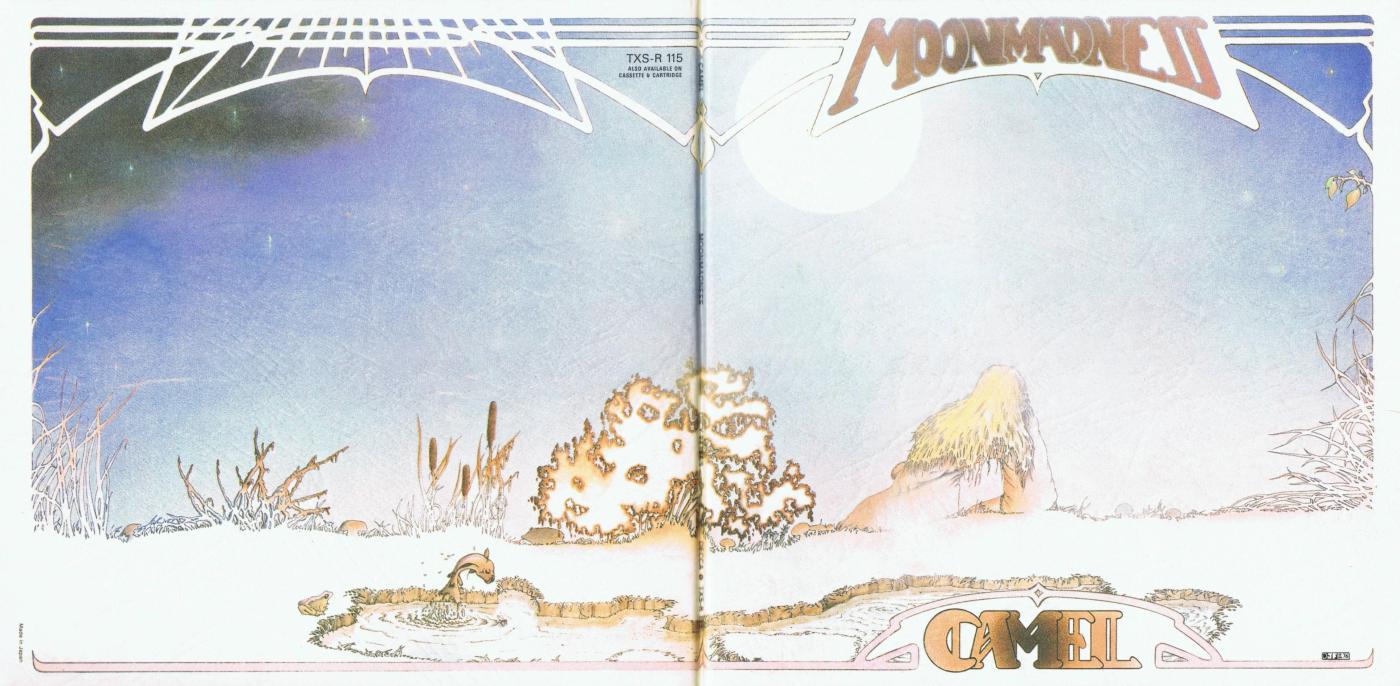
Moonmadness is the fourth studio album by Camel, which was formed in 1971.
Camel, that likable second-tier British prog band, nearly managed to join the ranks of superstars like Yes and ELP with their 1975 album The Snow Goose, which exceeded all expectations. The Snow Goose was a completely instrumental album, enhanced by a small symphony orchestra, but on their fourth album, Camel returns to more conventional prog rock with vocals.
Following the laid-back and serene The Snow Goose, Moonmadness is clearly a more rocking and energetic album, bearing some resemblance to the band’s second album, Mirage. Moonmadness is, in a way, an updated and slightly polished version of the raw-sounding Mirage. Moonmadness is also the band’s final album to feature the entire original quartet: Andrew Latimer (guitar, flute, vocals), Peter Bardens (keyboards, vocals), Doug Ferguson (bass, vocals), and Andy Ward (drums).
Composed primarily by Latimer and Bardens (with one track credited to the entire band), this album was built around a somewhat vague concept. Whereas The Snow Goose used music to tell the story from Paul Callico’s book, this time Latimer and Bardens decided to base the album’s songs on the personality traits of the four band members. Well, there are four members in the band and Moonmadness has seven tracks, meaning three of the songs fell completely outside the theme. Probably not many listeners are even aware of the album’s half-baked theme in the first place. The main point of such a somewhat vague concept, however, is whether it inspires the band to make good music or not. In the case of Moonmadness, the effects were clearly positive, as it is definitely one of Camel’s best albums.
Moonmadness opens with a rather unusual two-minute instrumental titled “Aristillus” (the name comes from one of the moon’s craters). Built primarily around the piercing sound of a Mini-Moog and a strangely buzzing electric piano (Wurlitzer?), the track is a fascinating miniature and highly atypical of Camel’s music. It’s just a shame it wasn’t developed further. As it stands, it remains little more than a charming curiosity.
From the rumbling of “Aristillus,” the mood shifts to a much more typical Camel vibe—melodically melancholic and slightly languid—with the arrival of “Song Within A Song.” Latimer plays a beautiful flute interlude in the intro, after which we hear bassist Doug Ferguson’s lazily sung vocals, which make the listener wonder if perhaps Camel should have remained an instrumental band after all… Well, the vocals play only a minor role in the song and don’t ruin what is otherwise an excellent track. In the latter half, we hear an almost disco-like beat over which Barden delivers a tasty synthesizer solo. The lackluster vocals on “Song Within A Song” are a good example of why Camel never quite made it into the A-list of progressive rock in a commercial sense, despite their generally accessible music. The fact that the band wasn’t quite as musically distinctive as its competitors is one thing, but an even more significant factor was probably that Camel never had a charismatic frontman or even a vocalist who could be called really competent with a straight face.
The album’s third track, “Chord Change,” is one of its highlights. This song, which captures the essence of Barden, begins with a complex, meandering section that settles into a melodic groove as Latimer’s clear guitar work takes center stage. Toward the end, the atmosphere intensifies again and the tempo picks up as the vibe shifts slightly toward something reminiscent of Santana’s Latin jazz-rock. Unfortunately, this otherwise impressive track ends somewhat abruptly with a fade-out.
After “Chord Change,” the mood settles down with the beautiful and simple “Spirit Of Water,” which is built largely around Bardens’ piano and Latimer’s recorder. Not even Bardens’ vocals, drenched in effects, manage to spoil this delicate two-minute interlude.
Moonmadness’s most straightforward rock track is “Another Night,” featuring bassist Doug Ferguson, whose tasty, chugging riffs—both on keyboards and guitars—bring to mind Mirage’s most rock-oriented moments. In particular, the instrumental section that begins just before the three-minute mark, with its oddly rumbling synth sounds, is entertaining. The track features Latimer’s roughest guitar work on the album, and since it has a distinctly jam-like vibe, it’s no wonder it’s credited to the entire band. Unfortunately, no proper ending has been devised for this song either, and Camel again resorts to a dull fade-out.
“Air Born,” which opens with flute and piano and aims to reflect Latimer’s personality, features some of the album’s most beautiful electric guitar moments. On “Air Born,” the vocal duties fall to Latimer himself, but it really doesn’t matter which band member sings, since all three Camel vocalists sound equally unremarkable. After a promising start, the song ultimately fails to really take off and is clearly the weakest track on the album.
Read also:
- Review: Camel – Moonmadness (1976)
- Review: Gong – Gazeuse! (1976)
- Review: Mike Johnson – The Gardens Of Loss (2026)
- Levyarvio: Mike Johnson – The Gardens Of Loss (2026)
- Levyarvio: Led Zeppelin – Presence (1976)
- Vuosi vuodelta : Parhaat levyt 2000 – Sijat 11-20
- Review: Univers Zero – Ceux Du Dehors (1981)
- Levyarvio: Steve Walsh – Glossolalia (2000)
- Year by Year : Best Albums of 1976 – 21-29
The album’s closing track, the fierce and fast-paced instrumental “Lunar Sea,” captures Andy Ward’s personality, which was apparently quite explosive (and later led him into trouble in the form of substance abuse). The nine-minute “Lunar Sea” is Camel at its most complex and features some fiery instrumental performances with many interesting twists. The driving force behind the track is Ferguson’s bassline, which moves in 5/4 time. One would have liked to hear more of this kind of stuff from Camel. Latimer has said the song was inspired by Soft Machine, with whom Camel was touring at the time, and the song is, in a way, the band’s take on jazz. Well, the song isn’t really jazz at all, but it’s still one of Camel’s best tracks and a truly fine conclusion to the album.
“It (”Lunar Sea”) had some complexities in it, absolutely. We’d just been on a tour supporting Soft Machine for a week and that had made quite a big impression on Andy (Ward) and I. We used to sit at the side of the stage because they had John Marshall on drums, who Andy really liked, and Allan Holdsworth on guitar. Obviously I was just thinking, ‘Oh my God, what is he doing?’ I wrote that end riff, which is really quite Soft Machine.”
Andrew Latimer
Moonmadness didn’t initially do as well as The Snow Goose, but it still peaked at number 15 on the UK album chart and, over the years, has ultimately become the band’s best-selling album.
Moonmadness is an outstanding album in the realm of light and melodic progressive rock, and also one of the absolute highlights of Camel’s career. After Moonmadness, the artistic quality of Camel’s music began to decline gradually, eventually collapsing outright at the turn of the 1970s and 1980s. Fortunately, the band’s (which has essentially been the Andy Latimer show since the 1980s) most recent albums have been better, and especially the 1999 Rajaz is even excellent.
Best tracks: ”Song Within A Song”, ”A Chord Change”, ”Another Night”, ”Lunar Sea”
Author: JANNE YLIRUUSI
Tracks
- ”Aristillus” Andrew Latimer 1:56
- ”Song Within a Song” Latimer, Peter Bardens 7:16
- ”Chord Change” Latimer, Bardens 6:45
- ”Spirit of the Water” Bardens 2:07
- ”Another Night” Latimer, Bardens, Andy Ward, Doug Ferguson 6:58
- ”Air Born” Latimer, Bardens 5:02
- ”Lunar Sea” Latimer, Bardens 9:11
Musicians
Andrew Latimer: guitars, flute, vocals (5, 6) Peter Bardens: keyboards; vocals (4) Doug Ferguson: bass guitar, vocals (2) Andy Ward: drums, percussion, spoken word (1)
 Pienemmät Purot
Jätä kommentti