The Gardens Of Loss is Mike Johnson’s first solo album.
American guitarist and composer Mike Johnson is best known for the avant-prog band Thinking Plague. Johnson founded Thinking Plague in Denver together with Bob Drake in 1982. Johnson was always the band’s main composer, and Drake contributed to the songwriting from time to time. Starting with the 1998 album In Extremis, however, Thinking Plague became primarily Johnson’s band, even though Drake continued to contribute as a guest musician. After that, under Johnson’s leadership, Thinking Plague released three albums, each more impressive than the last, at a leisurely pace, with the latest, Hope Against Hope, appearing in 2017.
And now, after a total of seven Thinking Plague albums, 73-year-old Mike Johnson has released his first album under his own name. An album that sounds deceptively like… well, Thinking Plague. So why wasn’t it released under that brand? Johnson himself has said he wanted to free himself from the expectations associated with the Thinking Plague name, and on the other hand, after a long career, to take full blame or credit for the results. Quite understandable and acceptable, though I have to admit that I personally don’t believe any fan of the band would be particularly disappointed or shocked by any of the choices heard on The Gardens Of Loss.
So The Gardens Of Loss sounds like Thinking Plague, but what does that actually mean? A quick recap for the uninitiated: Thinking Plague’s music sits at the intersection of avant-prog, chamber rock, and modern art music. At the core of the music lies a tight and strong compositional vision: the songs are meticulously written, structurally complex, and full of rhythmic and harmonic twists, where individual virtuosity gives way to a collective fabric. Nothing is left to chance, and especially in the band’s later work, there is hardly any room left for improvisation. Even the guitar solos are, as far as I understand, often fully composed. The influence of the Rock In Opposition tradition is evident in the dissonant expression and sudden contrasts, but the band often takes this aesthetic even further toward a dense and controlled contemporary musical expression.
All of this still holds true on The Gardens Of Loss, and why wouldn’t it, since it’s the work of the man who composed most of Thinking Plague’s music as well. The Gardens Of Loss isn’t, however, just a carbon copy of the past; it also features some fresh twists. Johnson’s compositions are, once again, mostly highly complex, yet somehow more accessible than on many of Thinking Plague’s earlier albums. Perhaps because the music never becomes particularly noisy or jarring, even though the boundaries of conventional tonality are frequently pushed. Generally speaking, the compositions aren’t quite as dense as on previous Thinking Plague albums either. The music doesn’t shift at such a frantic pace; instead, the development of themes is slower and more airy, which reduces the sense of chaos and makes it easier for the listener to keep up.
For a layman like me, the most obvious change on the album is, of course, the broader instrumentation. Johnson has certainly used a wider range of instruments than traditional rock instrumentation in the past, but now he has at his disposal flutes, brass instruments, woodwinds, violins, cello, double bass, and others, with which he crafts sophisticated orchestrations that sometimes take center stage and sometimes blend seamlessly into more conventional band instrumentation. These instruments, familiar from classical music, appear in various combinations depending on the song, and at times, through the use of overdubs, they even create the feel of a large orchestra.
The album features familiar faces from Thinking Plague’s earlier albums, as well as notable new musicians. Of the old Thinking Plague members, vocalist Elaine diFalco takes on the largest role; her clear, unadorned vocals can be heard on nearly every track, at least in the instrumental sections. Among the other veterans, guitarist Bill Pohl, who plays on one track, and Dave Willey (The Hamster Theater), who plays drums and bass guitar on one song, take on smaller roles. The most notable new members are the album’s Swedish rhythm section: bassist Simon Steensland and drummer Morgan Ågren. Steensland and Ågren previously played together on JG Thirlwell and Steensland’s excellent collaborative album Oscillospira (2020). The virtuoso duo, who play on most of the album, bring just the right dose of rhythmic agility and power to the record.
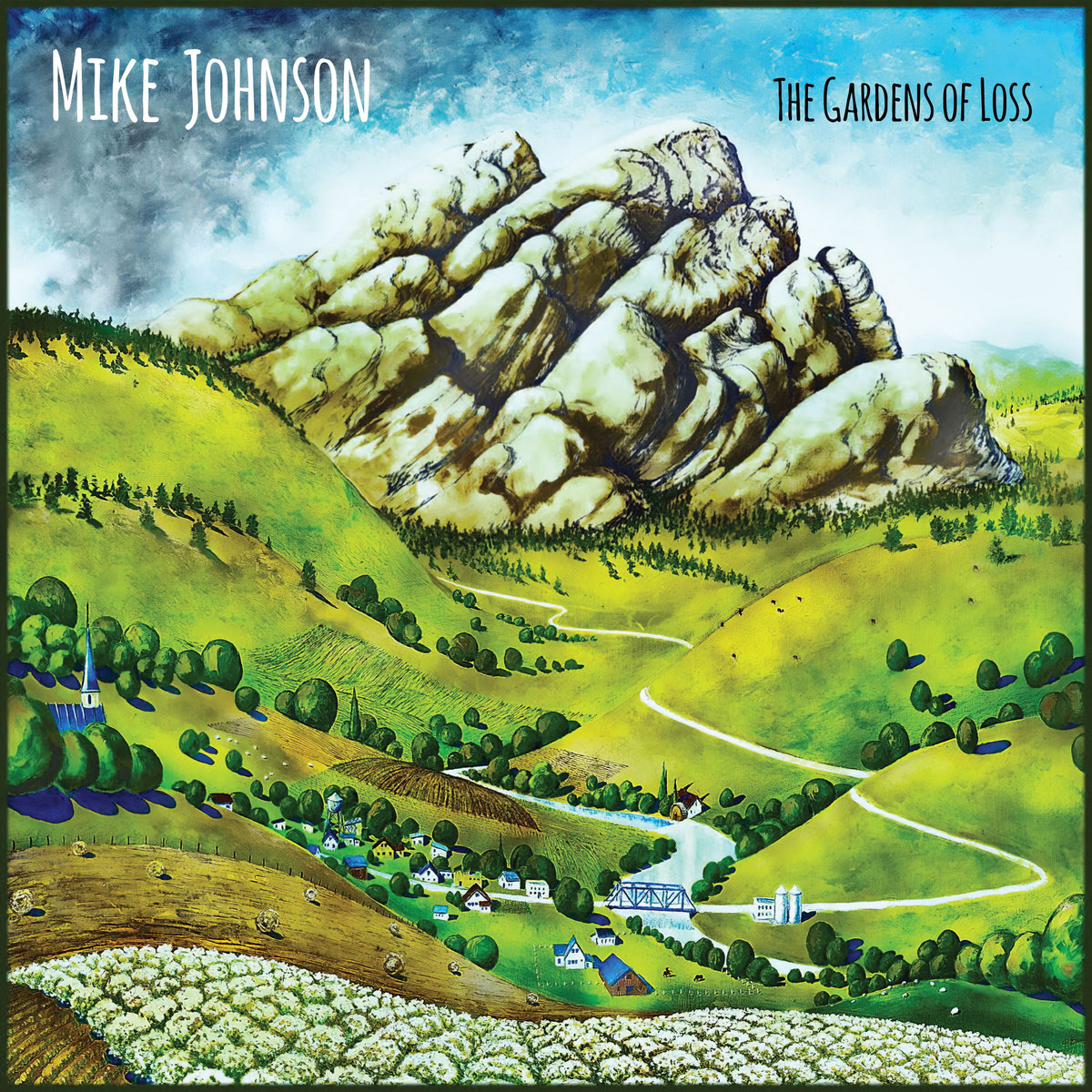
Johnson’s lyrics are usually quite dark, so at first glance, the idyllic cover art of The Gardens Of Loss seems surprisingly bright. Upon closer inspection, however, it becomes clear that the picture’s Eden-like valley is under threat, and the dark clouds looming in the background foreshadow the imminent end of an era of innocence.
Johnson doesn’t explicitly state his political stance in the lyrics this time either, but it becomes quite clear that he is far from pleased with the direction in which the current wave of cold-hearted right-wing ideology is taking the world. The lyrics are at their most direct in the song “Boys With Toys,” which sarcastically comments on “boys with their toys”—that is, today’s warlords who strut about with their war machines, unconcerned about who falls under their destructive power. As I write this, with Donald Trump and “War Minister” Pete Hegseth waging their ill-considered, illegal war of aggression in Iran, and Vladimir Putin’s brutal adventure in Ukraine entering its fourth year, the song could not be more timely. Unfortunately.
Read also:
- Levyarvio: King Crimson – The ConstruKction Of Light (2000)
- Review: Camel – Moonmadness (1976)
- Review: Gong – Gazeuse! (1976)
- Review: Mike Johnson – The Gardens Of Loss (2026)
- Levyarvio: Mike Johnson – The Gardens Of Loss (2026)
- Levyarvio: Led Zeppelin – Presence (1976)
- Vuosi vuodelta : Parhaat levyt 2000 – Sijat 11-20
- Review: Univers Zero – Ceux Du Dehors (1981)
- Levyarvio: Steve Walsh – Glossolalia (2000)
The album’s opening tracks, “Dies Irae” and the aforementioned “Boys With Toys,” are most reminiscent of Thinking Plague’s work. The crisp-sounding “Dies Irae,” just over three minutes long, features sparkling guitar and synthesizer textures, superb drumming by Kimara Sajni, and a cold, cool, and deliberately emotionless vocal performance by Elaine di Falcon, which immediately creates a continuity with Johnson’s earlier work. The under-two-minute “Boys With Toys,” on the other hand, is a fast and aggressive track driven forward by a powerful bass riff and frenzied drumming. Johnson’s electric guitar cuts through the intense rhythmic texture here and there, while di Falco’s electronically processed voice delivers the lyrics at a breathless pace. If “Dies Irae” is reminiscent of Thinking Plague’s later work, “Boys With Toys” takes you back to the band’s early days, when there was still a hint of post-punk influence.
The first two tracks are followed by an increasing amount of instrumentation that is atypical for rock bands, and at the same time, the music increasingly takes on the character of contemporary classical music.
The opening section of “The Lords Of Creation” features vocals reminiscent of the Canterbury scene, but the sound soon takes a stranger turn and would be right at home on a classic 20th-century experimental music album. The vibrating bassoon on the same track channels Steve Reich’s phasing effects, but the electric guitar patterns—played here and there with a bright yet powerful sound—bring to mind Robert Fripp and remind us that this is, after all, a form of strange rock music. The strings are used most effectively on the track “Transcience,” where dramatic string patterns are accompanied by a delightful piano that pushes the boundaries of tonality and a wobbling electric guitar that was likely recorded in reverse.
The nearly eight-minute title track brings a chamber-music feel to the surface. The music on “The Gardens Of Loss” is mostly acoustic, with drums making only a few brief cameo appearances, and Johnson himself playing a short, creamy electric guitar solo. The strings take center stage, playing long notes to create otherworldly, mystical harmonies that are by turns ethereal and dramatic.
The final track, the over-eight-minute instrumental “Soulless In Gaza,” brings everything full circle. It features the complex and precise rhythms typical of Johnson, combined with versatile orchestration that demonstrates that the sound of modern art music can indeed be seamlessly integrated with the power of a rock band. It would be extremely interesting if Johnson were ever to have an entire symphony orchestra at his disposal. Unfortunately, this is likely a rather unrealistic hope, given how far on the fringe his music is.
The Gardens Of Loss was produced, at least in part, through crowdfunding, which means the recording budget is likely larger than it ever was for Thinking Plague. This is evident not only in the music’s more expansive orchestration but also in the truly excellent sound quality. Produced by Johnson himself and mixed in collaboration with Colin Bricker, the album sounds magnificent. The sound is clear, precise, and at the same time rich, thick, and powerful. There’s plenty of dynamics, and even though some of the music is intense and aggressive, the album doesn’t strain the ears even at high volumes. The Gardens Of Loss sounds better than any of Thinking Plague’s albums.
The 46-minute The Gardens Of Loss draws on the techniques of rock and art music in such a natural, powerful, and exquisite way that I can’t help but call it a masterpiece of modern avant-prog. The Gardens Of Loss is the culmination of Mike Johnson’s long musical career. Hopefully only for now, because I want more of this.
Best tracks: ”Boys With Toys”, ”The Lords Of Creation”, ”Transience”, ”The Gardens Of Loss”, ”Soulless In Gaza”
Author: JANNE YLIRUUSI
Read also: Mike Johnson interview: Thinking Plague: Beyond the Frontier of Rock Music
Tracks
- Dies Irae 03:24
- Boys With Toys 01:59
- The Lords Of Creation 06:08
- Destitution Meal 02:54
- Transience 07:23
- Dumbstruck 07:53
- The Gardens Of Loss 07:48
- Soulless In Gaza 08:28
Musicians:
Mike Johnson: guitars, lap steels, fiddle, fretless banjo, sampler-synthesizer programming and ”pencil guitars” (7) Simon Steensland: bass (except 7) Morgan Ågren: drums and percussion (3–6) Kimara Sajn: drums and percussion (1, 2, 8) Jeremy Kurn: piano Elaine diFalco: vocals Dave Willey: bass, drums (7) Bill Pohl: guitars (8) Elise Roy: flutes Caitlin Hilzer: oboe, English horn Nuno Mourão: bassoons (3) Mark Harris: clarinets, bass clarinet, alto saxophone Shane Endsley: trumpets Jon Stubbs: trombones Oene van Geel: violins, ”concertmaster” Pablo Rodriguez: violins George Dumitriu: violas Pau Sola Masafrets: cellos César Puente Sandoval: double basses
Producer: Mike Johnson
Label: Cuneiform
 Pienemmät Purot
Jätä kommentti