
Kätkävaaran lohikäärme is Pekka Pohjola’s fifth album released under his own name.
Kätkävaaran lohikäärme is not Pohjola’s solo album, but rather the first and last studio album by the Pekka Pohjola Group. The Pekka Pohjola Group was a direct continuation of the jazz-rock band The Group, in which Pohjola played alongside Vesa Aaltonen, Olli Ahvenlahti, and Seppo Tyni.
Kätkävaaran lohikäärme is usually retrospectively counted among Pohjola’s solo albums, and I myself will treat the album as part of Pohjola’s solo catalog in this text. In my opinion, this is justified because, even though Kätkävaaran lohikäärme differs stylistically to some extent from his other albums, the material is almost entirely composed by Pohjola himself, and its melodic language in particular is unmistakably Pohjola.
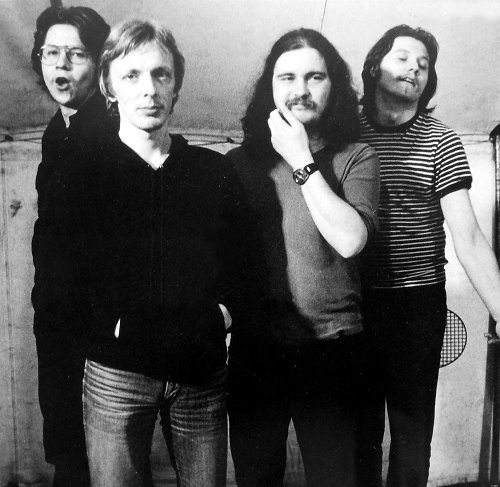
The Pekka Pohjola Group was formed at the end of 1979 after Ahvenlahti left The Group. This was a natural moment to change the band’s name, as the responsibility for leading the band now fell entirely on Pohjola’s shoulders. The Pekka Pohjola Group’s lineup was unstable in the early days, with drummer Aaltonen and guitarist Juha Björninen, who had been with the band for a short time, soon leaving. By the time they recorded Kätkävaaran lohikäärme (The Dragon of Kätkävaara), the lineup had stabilized with Pohjola, guitarist Seppo Tyni, keyboardist Pekka Tyni (Seppo’s brother), and Ismo Paavo Matias Kätkä, better known as Ippe Kätkä, who had previously played in the rock band Royals.
Kätkävaaran lohikäärme is a significant departure from Pohjola’s previous album. Released in 1979, Visitation was very precisely and carefully composed music that was also arranged in a grand style. Whereas Visitation used a rock band backed by a large number of wind instruments and even an entire string orchestra, Kätkävaaran lohikäärme has the most minimal instrumentation of Pohjola’s career to date. Kätkävaaran lohikäärme Pohjola relies on a simple quartet lineup (bass, drums, guitar, keyboards).
The change in direction was not necessarily just an artistic decision by Pohjola, but was probably also partly dictated by economic realities. Progressive rock began to lose popularity in Finland in 1980, and Love Records, the record label that had been the strongest supporter of the genre, had gone bankrupt in 1979, which had already caused difficulties for Pohjola. Love Records had been unable to pay the costs of Visitation, and the situation was ultimately saved by Finnlevy. Kätkävaaran lohikäärme was also released by Finnlevy’s sub-label Dig It, but the album was certainly made on a much tighter budget than Visitation, which had originally been launched under Love Records.
Read also:
- Review: Wigwam – Lucky Golden Stripes And Starpose (1976)
- Review: Rain Tree Crow – s/t (1991)
- Review: John G. Perry – Sunset Wading (1976)
- Levyarvio: Black Sabbath – Master Of Reality (1971)
- Review: Henry Cow – Concerts (1976)
- Levyarvio: Spock’s Beard – V (2000)
- Review: Cos – Viva Boma (1976)
- Levyarvio: King Crimson – The ConstruKction Of Light (2000)
- Review: Camel – Moonmadness (1976)
Ippe Kätkä played a significant role in pioneering new, more free-form recording sessions. Kätkä and apparently the other band members (perhaps with the exception of Pekka himself) were fans of free jazz, and a hint of this spirit is also brought to Kätkävaaran lohikäärme, even though the songs are not free improvisations. I don’t know exactly what the inside joke behind the album’s title is, but it’s probably clear that it refers to drummer Kätkä. Kätkävaaran lohikäärme is also the first Pohjola album for which he came up with the song titles himself. The names of the first albums were written by Hector (Finnish pop star), and the names for Visitation were thought up by Mike Oldfield’s accountant Oldield during the Exposed tour.
Whereas Visitation’s music is easy to imagine as having been written down precisely in musical notation, Kätkävaaran lohikäärme is a much more relaxed album, probably created largely on the basis of the quartet’s joint jamming sessions in their rehearsal space. Of course, it is mainly based on Pohjola’s ideas, as can be seen from the composition credits: all the songs on the album are credited to Pohjola, with the exception of ”Sampoliinia,” which also features Seppo Tyni.
Kätkävaaran lohikäärme sounds more like a band album than any of Pohjola’s previous albums. The music is rougher and more straightforward, and it sounds as if the band had already thought about upcoming gigs when recording it. Now they made music that was meant to work well at gigs played by the quartet. The songs also stretch out longer than usual when the band is allowed to jam. There are only four long songs on the album, the shortest of which lasts over seven minutes and the longest over 14 minutes.
The album kicks off with the title track, which lasts over 14 minutes. ”Kätkävaaran lohikäärme” starts off fairly simple, but with a captivating and powerful, almost hypnotic rhythmic section carried by Kätkä’s tight and economical playing. Soon, a strong melodic theme is introduced, under which Pohjola pumps out a persistent bass guitar ostinato, over which Seppo Tyni finally unleashes a hell of a guitar solo. Tyni’s wild and fiery guitar squeals and wails are mostly great to hear, but a little less might have been enough.
Guitar parts also generally get a lot of space on Kätkävaaran lohikäärme. Perhaps a little too much, as Tyni’s solos sometimes stretch out for a really long time. Keyboardist Pekka Tyni, on the other hand, remains somewhat in his brother’s shadow, and his playing throughout the album is mostly accompanying rhythm. It would have been nice to hear a little more of his synthesizers, as there are a few moments on the album where you can tell he has the potential to be a proper soloist.
In the third track, “Sampoliini,” the keyboards are given a little more space. On the other hand, “Sampoliini” is also the weakest track on the album, relying too much on improvised solos and Pohjola’s jazz-inspired walking bass line (quite unusual for Pohjola). The song also features a bass solo by Pohjola, even though he had mostly left those behind at this point. “Sampoliini” is probably the closest Pohjola ever came to so-called generic jazz-rock on his own albums. ”Sampoliini” is by no means a bad song in terms of generic jazz rock, but it is difficult to consider it particularly interesting as Pekka Pohjola music.
The second track on the album, ”Tehdasmusiikkia” (Factory Music), which precedes ”Sampoliini,” begins playfully and offers a pleasant lightening of the mood after the solemnity of the first song. Tyni’s playful guitar melody carries the song, and Kätkä’s tapping drumming accompanies the cheerful atmosphere. Later, the song takes on a more emphatic tone with a rougher guitar riff. Halfway through the seven-minute song, Tyni plays a majestic-sounding melodic guitar solo that is truly uplifting to hear. The solo sounds carefully considered and was probably composed by Pohjola. I don’t find the song ”Tehdasmusiikkia” particularly factory-like, and the name remains a mystery to me.
The album’s final track, ”Inke ja mä,” begins in a dark and downright oppressive tone, featuring Pohjola’s characteristic grand, heart-wrenching, emotional melodies, which this time around are perhaps more poignant than ever before. Perhaps this is because Pohjola channels the emotions aroused by his divorce from Inkeri Pohjola. ”Inke ja mä” does not sink into one-dimensional angst; despite its melancholy, the nine-minute song also contains quite lively moments and offers a diverse range of emotions, from despair to wistful hope. As a composition, the ten-minute ”Inke ja mä” is probably the most polished work by Kätkävaaran lohikäärme, and the entire quartet plays it with extreme stylistic sensitivity. During the final minutes, Pohjola’s bass sounds truly massive, rumbling physically in the background like some kind of doomsday trumpet.
Read also: Review: Pekka Pohjola – Harakka Bialoipokku (1974)
Everyday life in Pekka Pohjola Group was not easy due to the band’s unstable frontman, and after touring Europe for a while, the band fell into crisis. Tired of Pohjola’s excessive drinking, the band fired their leader or, depending on your point of view, left the band themselves. In any case, the end result was that the Pekka Pohjola Group came to an end.
However, Pekka Pohjola Group was revived as a name for Pohjola’s later live bands, but no new music was ever recorded under that name. Pohjola’s drinking escalated dangerously for a while after the band broke up, but in 1982 he pulled himself together, gave up alcohol completely (unfortunately only temporarily) and made the album Urban Tango, which is one of his best. With Urban Tango, the sound of Pohjola’s albums clearly shifted to the 1980s, and Kätkävaaran lohikäärme was his last album that still had a clear foot in the more organic sound of the 1970s. Towards the very end of his career, Pohjola, who died in 2008, returned to a more acoustic and natural soundscape.
Kätkävaaran lohikäärme is not, in my opinion, one of Pekka Pohjola’s most significant albums, but it is a very interesting curiosity thanks to its more lively band sound. Of course, the music itself is also of high quality, even though it does not include Pohjola’s sharpest compositions.
Best tracks: ”Kätkävaaran lohikäärme”, ”Tehdasmusiikkia” ja ”Inke ja mä”
Author: JANNE YLIRUUSI
Tracks
- Kätkävaaran lohikäärme – 14.33 (Pohjola)
- Tehdasmusiikkia – 7.34 (Pohjola)
- Sampoliini – 12.08 (Pohjola, Seppo Tyni)
- Inke ja mä – 9.53 (Pohjola)
Pekka Pohjola Group
Pekka Pohjola: bass guitar Ippe Kätkä: drums Seppo Tyni: guitars Pekka Tyni: keyboards
 Pienemmät Purot
Jätä kommentti