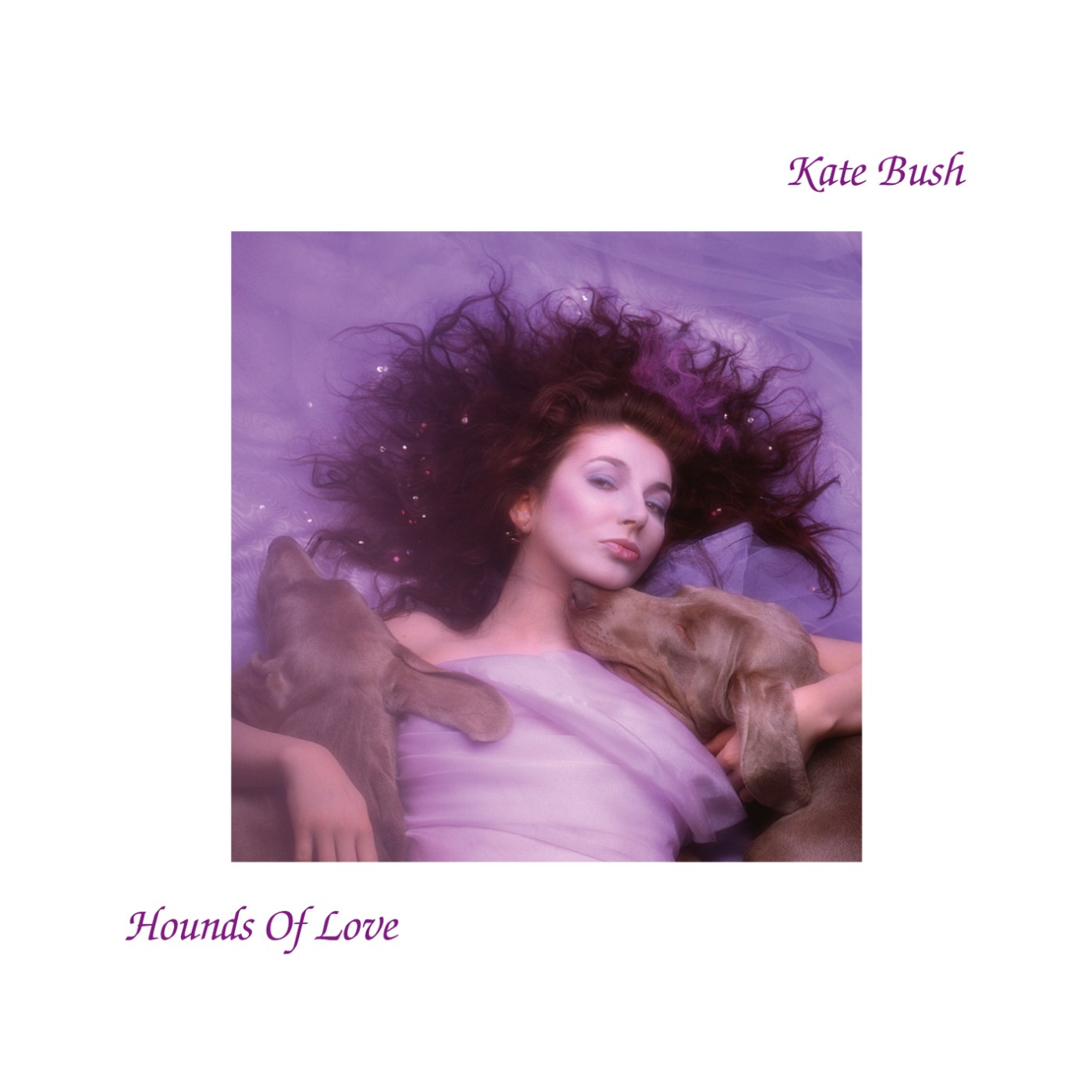
Hounds Of Love is Kate Bush’s fifth studio album.
At just 19 years of age, Kate Bush released her debut album, The Kick Inside (1978), and spent the first few years of her career going from strength to strength. Her albums were praised not only for their artistic merit and originality, but also for their commercial success. The release of The Dreaming in 1982 changed the situation somewhat. This highly experimental and strange album (which happens to be my personal favorite) sold poorly, especially compared to its predecessors. The situation was complicated by the fact that Bush, known as a perfectionist, worked very slowly, which of course meant that the album was very expensive to produce.
After The Dreaming, Bush had, to put it simply, two options: either she could continue deeper into experimental music, gradually losing her popularity with the mainstream, or she could return to making more accessible pop music, as her record company EMI fervently hoped. In the end, Bush managed to navigate between these two extremes with his album Hounds Of Love, which was released exactly three years after The Dreaming. This was the longest break in Bush’s career so far, and at least part of this quiet period was spent building a new professional home studio. With her own studio, Bush was freed from the huge bills of commercial studios, which gave her the opportunity to spend an exceptionally long time working on her albums while continuing to take risks.

Hounds Of Love, which took two years to complete, is divided into two parts. The first half is called ”Hounds of Love” and the second half ”The Ninth Wave.” The first half offers a collection of hits, one after another. Four of the five songs reached high positions on the singles charts. The second half of the album contains more experimental material that has been woven into one large conceptual song cycle. Bush seems to have chosen a strategy for the album that is somewhat similar to the one used by Mike Oldfield in the early 1980s. For example, Oldfield’s albums Five Miles Out and Crises both contained one long, progressive, multi-part song that he said he made ”for himself” and a bunch of shorter, more commercial songs that were intended to appeal to the general public (and thus also to the record company). The songs on the first half of Hounds Of Love are, in a similar way, like tamed versions of the wild experimentation of The Dreaming. However, Bush has not diluted his music too far, and even the poppiest songs on the album always contain little surprises that lift them well above the level of run-of-the-mill pop. It is clear, however, that the commercial failure of The Dreaming prompted Bush to sharpen his pop pen. On the other hand, ”The Ninth Wave” provides him with a platform to realize his experimental side without being constrained by the pop format.
Read also: Review: Pink Floyd – Wish You Were Here (1975)
The opening track, ”Running Up That Hill (A Deal with God),” effectively introduces the overall style of the A-side. The sound is very synthetic. Fortunately, there are always some ”real” instruments mixed in with the digital sounds, so that the soundscape doesn’t become too cold and mechanical.
”Running Up That Hill” is dominated by a pleasantly rolling sequenced rhythm (which, however, becomes unnecessarily monotonous over the course of the entire song) and Bush’s downright grandiose vocals. Amidst the synthetic soundscape created mainly with the Fairlight CMI sampler synthesizer, Stuart Elliot’s electronic drums explode impressively from time to time, and Alan Murphy’s electric guitar growls here and there like a wounded animal. Bush herself sings convincingly, with particularly unique phrasing in the verses. The chorus of the song, which is about changing gender roles, is unusually catchy, although perhaps not the easiest to sing along to. ”Running Up That Hill is an impressive song, although I think it could have been even better with a slightly more organic production.
”Running Up That Hill (A Deal with God)” rose to number three on the UK singles chart, making it Bush’s most successful single since the breakthrough of her debut album, ”The Wuthering Heights”. With ”Running Up That Hill,” Bush also entered the US singles chart’s top 40 for the first time. In 2022, the song became a phenomenon again thanks to Netflix’s popular series Stranger Things, climbing back to the top of the charts around the world.
The title track features Jonathan Williams’s grinding cello riff and massive, very 80s-sounding drums. Bush’s voice floats effortlessly and theatrically above these elements.
”The Big Sky”, one of the album’s most upbeat tracks, is a delightful song in which Bush sings about the innocent, childlike joy that can be found in watching the clouds and letting your imagination run wild as you try to see familiar shapes in their formations. ”The Big Sky” combines beautifully programmed rhythms, Murphy’s rocking electric guitar riff, and, towards the end, Morris Pert ’s massive percussion, reminiscent of the rhythms on Peter Gabriel’s fourth album.
The fourth track, ”Mother Stands for Comfort,” is the most experimental offering on the A-side and the only one that did not become a hit. It returns to using Fairlight-created glass-breaking sounds as part of the rhythms. Bush had already experimented with this on The Dreaming. The end result is still effective, but since many other artists had also used the Fairlight to break glass, the effect is starting to become a bit cliché. On the other hand, ECM veteran Eberhard Weber’s low, melodically warm double bass provides a wonderful contrast to the cold and sharp sounds of breaking glass. Bush herself sings gently and softly somewhere between these two extremes.
”Cloudbusting,” which concludes the first half of Hounds Of Love, beautifully combines the strings of The Medici String Sextet with an otherwise synthetic soundscape. Underneath the verses, the song is carried by a simple, stomping rhythm, and in the choruses, it is accompanied by the string sextet’s insistent, grinding ostinato (the string arrangements are by Dave Lawson, familiar from Greenslade). In the first half, a single violin gets to solo for a moment, and later on, a Fairlight string sample takes over. At the end, we hear a great crescendo as Stuart Elliott and Charlie Morgan drum a warlike march in duet.
The A-side of Hounds Of Love is a true celebration of art pop. It offers an almost uninterrupted stream of sophisticated hits that not only make the casual listener dance and sing along, but also offers enough nuances and details to withstand concentrated listening, even decades after its release.
Read also: Review: Peter Gabriel – s/t (1980)
Filling the B-side, ”The Ninth Wave” is a seven-part suite, a series of songs that are more or less seamlessly woven together.
The lyrics of ”The Ninth Wave” tell the story of a person hovering between life and death. The starting point for these delirious lyrics is a situation in which a person is floating on a life raft in the middle of a vast, dark sea. The narrator tries to stay awake by any means necessary, as falling asleep would mean certain drowning in the waves surging around him.
Jos a-puoliskon pophelmet olivat hillitympi versio The Dreamingin musiikista niin ”The Ninth Wave” tarjoilee hyvin luontevaa jatkoa tuolle levylle. Laulusarja vapauttaa Bushin perinteisistä popkaavoista ja säkeistöjen ja kertosäkeiden sijaan kappaleet kulkevat vapaina niiden oman sisäisen logiikkansa mukaan. Kertosäkeitäkin kuullaan mutta toisaalta välillä säkeistöt jos niitä edes on johtavat vain abstrakteihin äänikuviin tai Fairlightin avulla luotuihin musique concrete -kollaaseihin joissa helikopterit pärisee, tunnistamattomiksi käsitellyt ihmisäänet messuavat tai aallot pauhaavat uhkaavasti. Kaiken kokeellisuuden seassa on kuitenkin myös todella puhtaan musikaalisia hetkiä kuten minimalistisen taustan varassa sykkivä kaunis ”Watching You Without Me” (joka tuo mieleeni David Sylvianin yhtyeen Japanin) tai sen unisen eteerinen ja intiimi ensimmäinen osa ”And Dream Of Sheep”
If the pop songs on the first half were a more subdued version of The Dreaming’s music, then ”The Ninth Wave” offers a very natural continuation of that album. The series of songs frees Bush from traditional pop formulas, and instead of verses and choruses, the songs flow freely according to their own internal logic. There are choruses, but sometimes the verses, if there are any, lead only to abstract soundscapes or Fairlight-created musique concrete collages featuring the whirring of helicopters, unrecognizable human voices chanting, or waves crashing menacingly. Amidst all the experimentation, however, there are also moments of pure musicality, such as the beautiful ”Watching You Without Me” (which reminds me of David Sylvian’s band Japan), pulsating against a minimalist backdrop, or the dreamy, ethereal, and intimate first part of ”And Dream Of Sheep.”
Overall, ”The Ninth Wave” remains somewhat elusive (perhaps intentionally!), but it is an interesting and fascinating take on progressive rock from Bush. There is nothing backward-looking or stale about its style; it is technologically up to date and, more importantly, it embodies the central idea of progressive rock: anything is possible, and there are no boundaries or rules in music that cannot or should not be broken.
Read also:
- Review: Cos – Viva Boma (1976)
- Levyarvio: King Crimson – The ConstruKction Of Light (2000)
- Review: Camel – Moonmadness (1976)
- Review: Gong – Gazeuse! (1976)
- Review: Mike Johnson – The Gardens Of Loss (2026)
- Levyarvio: Mike Johnson – The Gardens Of Loss (2026)
Propelled by several singles, Hounds Of Love became a huge hit. In England, it rose to number one on the album charts, displacing Madonna, who had previously topped the charts there. Bush managed to return to the top without watering down her music with excessive compromises. It would be interesting to know what the average listener who was attracted to the album ”Running Up That Hill” thought of ”The Ninth Wave”. I would like to believe that it made at least some of them more receptive to experimental music and that perhaps some of them, guided by Bush, ended up exploring very small and strange musical streams.
Hounds Of Love marked the end of Kate Bush’s first golden age. Unfortunately, her next album, The Sensual World, eagerly awaited for four years, was musically disappointingly cautious and conventional. An even weaker performance was 1993’s The Red Shoes, on which Bush seemed completely lost and, for the first time, appeared to be following rather than leading. After The Red Shoes, a weary Bush announced that she was taking a long break. That break ended up lasting 12 years, after which she made a triumphant return with the excellent double album Aerial.
Best tracks: ”Running Up That Hill (A Deal with God)”, ”Cloudbusting”, ”Mother Stands for Comfort”, ”Under Ice” Watching You Without Me”, ”Jig of Life”, ”The Morning Fog”
Author: JANNE YLIRUUSI
Keywords: Kate Bush, art pop, progressive rock, 1985
Tracks
- ”Running Up That Hill (A Deal with God)” 5:03
- ”Hounds of Love” 3:02
- ”The Big Sky” 4:41
- ”Mother Stands for Comfort” 3:07
- ”Cloudbusting” 5:10
- ”And Dream of Sheep” 2:45
- ”Under Ice” 2:21
- ”Waking the Witch” 4:18
- ”Watching You Without Me” 4:06
- Jig of Life” 4:04
- ”Hello Earth” 6:13
- ”The Morning Fog” 2:34
Musicians
Kate Bush: vocals, Fairlight CMI synthesizer, piano Alan Murphy: guitar (1, 3, 8) Del Palmer: LinnDrum programming, bass guitar (1, 10, 12) claps (3) backing vocals (5), Fairlight bass (8) Paddy Bush: balalaika (1), backing vocals (5), didgeridoo (3), harmony vocals (7), violins (12), fujara (12) Stuart Elliott: drums (1, 2, 4, 5, 9, 10, 11) Charlie Morgan: drums (2, 3, 5, 8, 10) handclaps (3) Jonathan Williams: cello (2) Martin Glover: bass guitar (3) Morris Pert: percussion (3) Eberhard Weber: double bass (4, 11) The Medici Sextet: strings (5) Brian Bath: backing vocals (5), guitar (11) John Carder Bush: backing vocals (5), narration (10) Dónal Lunny: bouzouki (6, 10, 11), bodhrán (10) John Sheahan: whistles (6, 10), fiddle (10) Kevin McAlea: synthesizer, sequencer (8, 12) Danny Thompson: double bass (9) Liam O’Flynn: Irish bagpipes (10, 11) The Richard Hickox Singers: choir (11) Richard Hickox: vocals (11), choirmaster (11) John Williams: acoustic guitar (12)
 Pienemmät Purot
Jätä kommentti