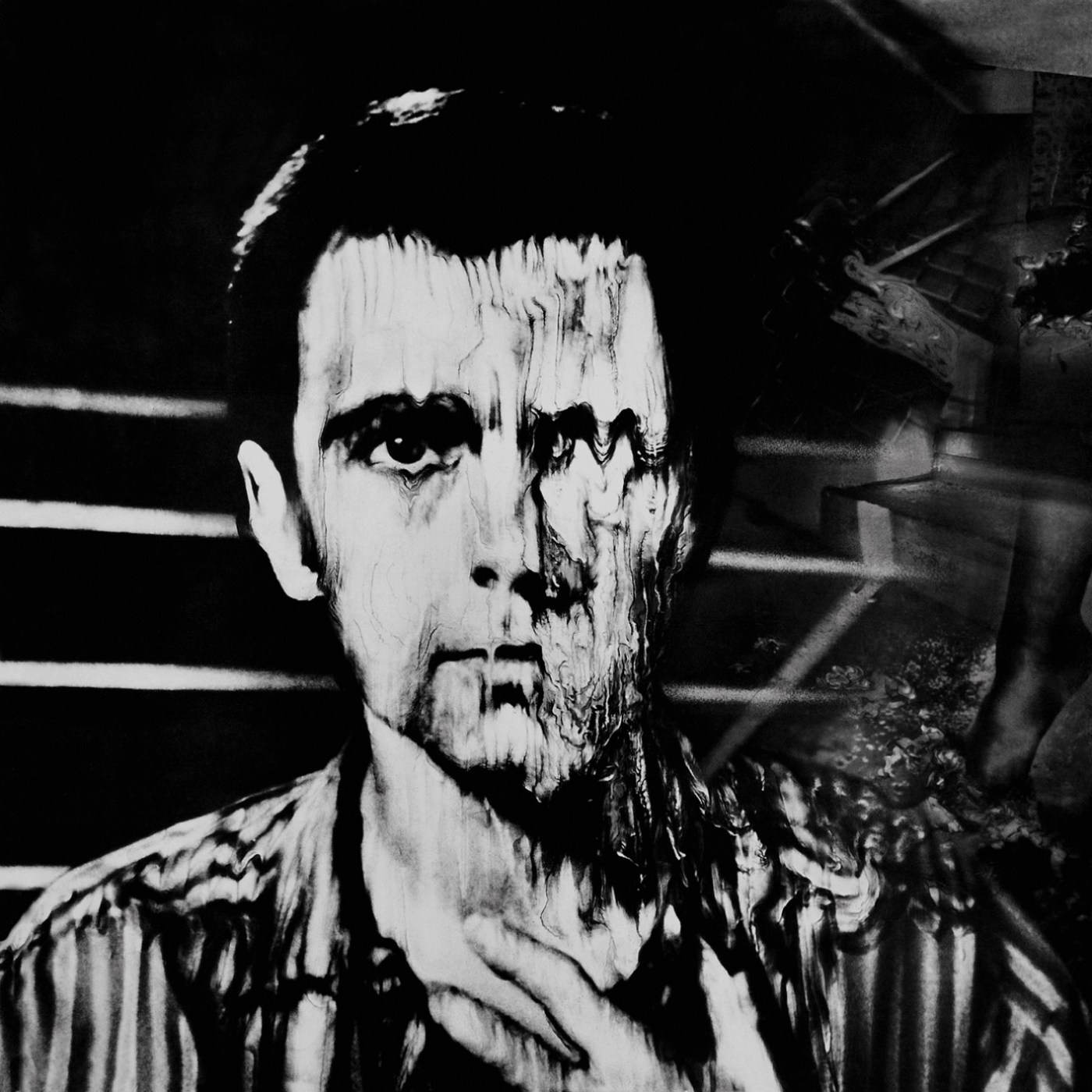
Peter Gabriel is the third eponymous studio album by Peter Gabriel.
Gabriel’s third untitled album is sometimes referred to as Peter Gabriel III or Melt. The latter name was inspired by the black-and-white cover designed by Hipgnosis, which shows half of Peter Gabriel’s face melting in a grotesque manner. For the sake of simplicity, I will refer to the album as Melt throughout this article.
Peter Gabriel, who left Genesis in 1975, launched his solo career in 1977 with his self-titled debut album. The debut was stylistically diverse and Bob Ezrin’s grandiose production made for a rather uneven whole. His second album, released in 1978 and often referred to as Scratch, was produced by King Crimson mastermind Robert Fripp and was a much more subdued album on which Gabriel flirted with new wave rock.
Scratch received a mixed reception and sold poorly upon its release. Gabriel himself was not entirely satisfied with the hastily recorded album (which, incidentally, I think is excellent and much better than the debut) and decided that the next album would be made with time and care.
For his third album, Gabriel recruited some young blood to his backing band. The producer chosen was the 24-year-old Steve Lilywhite (Gabriel himself was already a 30-year-old old fart at this point!), who had produced trendy bands such as Ultravox and Siouxsie & the Banshees. The young Hugh Padgham, who had worked as Lilywhite’s engineer on XTC’s album Drums and Wires and had previously recorded prog greats such as Yes and Gentle Giant, was chosen as the engineer.
Together with Lilywhite, Padgham and his excellent team of musicians, Gabriel conjured up a completely new sound world for his album, the influence of which reverberated far and wide throughout the 1980s.
Gabriel and his technicians used the studio as a composing tool for Melt. The songs were actually more like sculptures, built up layer by layer in the studio, rather than being composed in the traditional way. However, the biggest influence on the sound of the album came from decisions made regarding the drums. Gabriel decided that the drummers on the album, Jerry Marotta and his old Genesis colleague Phil Collins, were not allowed to use any cymbals when playing the drums. This forced the drummers to think about their playing in a whole new way, as the constant crashing of the cymbals was no longer an option. More importantly, however, the frequencies normally taken up by the cymbals in the soundscape were freed up and could be used for different exciting textures. Melt is full of all kinds of little crackles, squeaks, whistles, etc., creating a unique atmosphere and often taking on an equal role with the more traditional instrumentation.
Musically, Melt sounds quite unique, but lyrically it is also powerful work. On the album, Gabriel simplifies and condenses his lyrics, sometimes in a very drastic way. The convoluted lyrics Gabriel wrote for Genesis are now just a distant memory. On the other hand, although Melt is a very serious, at times even dark album, Gabriel’s unique humour, clearly related to his earlier lyrics for Genesis, blossoms here and there.
Melt is not strictly speaking a concept album, but its songs are linked by a loose theme that Gabriel himself called ‘the history of a decaying mind’. The songs on Melt seem to tell the stories of broken individuals living on the margins of society, but also of a society that has itself gone off the rails and is in a kind of free fall after losing its old values. Interestingly, Melt seems to examine these themes in a somewhat dichotomous way, with the songs on side A dealing with the issue from the perspective of the individual and side B taking a broader social perspective.
Read also: Review: Peter Gabriel – i/o (2023)
Melt begins impressively with a track that directly showcases its most radical innovations. Combining gated reverb with drums may have been an accident on the part of Padgham and Collins, but Gabriel has generally been credited with ensuring that it did not remain a random studio experiment, but was properly highlighted and incorporated into the music. Gabriel was so enthusiastic about the effect that he asked Collins to hammer out a simple drum pattern with gated reverb, on top of which an entire song was then built.
I’m certain you know I am there… I like the touch and the smell of all the pretty dresses you wear.
The end result, ‘Intruder,’ which begins with a simple, dry drum beat and strange squeaks and creaks, is a truly mesmerising song. David Rhodes’ guitar crackles here and there, and Gabriel sings the lyrics about a pervert breaking into random people’s homes in an almost spoken-word style. The xylophone, beautifully played by Morris Pert (Brand X, Mike Oldfield), plays playfully, counterbalancing the gloom that pervades the song.
Intruders happy in the dark
Intruder come
Intruder come and leave his mark
Leave his mark
Leave his mark
I am the intruder
‘Intruder’ manages to be both disturbingly and perversely creepy and sexy art rock song at the same time. A truly magnificent start to the album and one of Peter Gabriel’s best songs overall.
The next track, the faster-paced ‘No Self-Control’, also kicks off with Pert on percussion, this time on the marimbas. Gabriel’s dramatic vocals, brimming with despair, are supported by Phil Collins’ menacingly rolling, massive drum fills. Kate Bush’s clear backing vocals and Pert’s light but insistent marimbas create a lighter contrast. Pert’s marimbas are reminiscent of Steve Reich“s music, which is no surprise, as Gabriel has said that Reich’s ’Music For 18 Musicians” had a big influence on him. The influence of this minimalist composition can be heard here and there throughout Melti, especially in Pert’s percussion.
After ‘No Self-Control’ comes a short, barely minute-long instrumental interlude called ‘Start’. Dick Morrisey’s old-fashioned bluesy saxophone intro doesn’t really seem to fit in with the otherwise extremely modern and cold-sounding album. But maybe that’s why it works in the end: the whole theme of Melt is a kind of disorientation, and that’s also what this surprisingly romantic interlude is about, leading straight into the jagged “I Don’t Remember”.
“I Don’t Remember” is a continuation of the punk-influenced songs on Gabriel’s previous album and was already performed on Gabriel’s 1978 tour. The rhythm section plays a central role. Marotta’s tight and simple drum beat is supported by Tony Levin’s rubber-like bass groove played on the Chapman Stick, which is mixed delightfully to the surface. Robert Fripp’s electric guitar also moans here and there throughout the song. Tony Levin had played all the bass parts on Gabriel’s two previous albums, but ‘I Don’t Remember’ is the only track on this album where he can be heard. This was because Levin was busy working with Paul Simon during the Melt sessions. John Giblin fills in admirably for Levin on the other tracks on the album.
Giblin’s fretless bass guitar takes centre stage in ‘Family Snapshot’, which, alongside “Intruder” and ‘I Don’t Remember’, is one of the finest tracks on the album.
Gabriel already demonstrated his storytelling skills in Genesis, and ‘Family Snapshot’ may be the culmination of that trend for him.
The three-part mini-suite tells a story based on the book An Assassin’s Diary, a true story about wannabe assassin Arthur Bremer. Bremer attempted to assassinate politician George Wallace, mainly to gain attention and fame. Gabriel sings the lyrics from the perspective of the protagonist planning the assassination. The result is truly impressive. And even touching.
In the first part of ‘Family Snapshot,’ Gabriel describes the situation accompanied by an electric piano. A politician approaches in a motorcade, and the narrator waits with a sniper rifle for his chance. Giblin’s melancholic and melodic bass line creates a wonderful contrast to Gabriel’s electric piano. Morrisey’s saxophone creeps in, after which the tempo quickens and the atmosphere becomes intense as the politician’s car approaches within range of the killer’s rifle on the roof. The narrator declares that he does not hate his victim, but just wants to be someone. To be known by everyone. The middle section ends when a bullet is fired from the rifle towards its target. Or is it fired after all? The song’s delicate ending suggests that perhaps the whole story was just the violent fantasy of a lonely little boy neglected by his parents. ‘Family Snapshot’ is a truly ingenious song.
After the psychodrama of ‘Family Snapshot’, Gabriel returns to the new wave vibe of his second album, and ‘And Through The Wire’ represents the most straightforward rock track on the album. The song features guitar work by The Jam’s Paul Weller. The song itself is not particularly interesting, but Gabriel’s rough vocal performance is truly impressive.
From rock, we move on to pop and the album’s biggest hit, “Games Without Frontiers,” where Gabriel once again benefits from Kate Bush’s backing vocals, this time in a slightly larger role.
‘Games Without Frontiers’ begins with Bush’s magical ‘Jeux Sans Frontières’ slogan. The French phrase Jeux Sans Frontières (games without borders) refers to a television game show of the same name in which teams representing different countries or cities competed against each other. It was a milder version of the currently popular Squid Game, but the theme of the game’s opposition inspired Gabriel, and the playful, almost Dadaist lyrics can be interpreted as a critique of nationalism, or at least an attempt to present international diplomacy in a ridiculous light by comparing it to children’s games.
Kate Bush is said to have been greatly inspired by Melt’s sessions and Gabriel’s way of using the studio as an aid to composition. Bush put her lessons to good use on her excellent third solo album, Never For Ever, which was released less than six months after Melt. Bush is said to have been particularly enthusiastic about the Fairlight CMI synthesiser’s sampling capabilities, which is a little strange because, at least to my ears, the Fairlight is not heard much on Melt, and Bush’s own Never For Ever ultimately showcases the device much more.
‘Not One Of Us’, which deals with racism, includes a magnificent drum finale in which Marotta, who initially fought against the lack of cymbals, gives his best and ultimately proves that he has adapted perfectly to Gabriel’s demands.
The penultimate track on the album, ‘Lead a Normal Life’, begins with another pseudo-gamelan intro reminiscent of Reich, which is wonderful to hear. The song, which tells of a mental hospital and feelings of isolation, remains a floating, fragmented interlude that would have worked better as part of the album as a whole if it had been a little shorter.
The last track on the album brings together the dark themes of the album on a personal and universal level. On the one hand, it tells the story of Steve Biko, a South African opponent of apartheid, in a very straightforward and personal way, but at the same time it deals with racism and discrimination on a more general level. Biko died in prison after being beaten by police in 1977.
The charm of ‘Biko’, which is quite simple in structure and repetitive, is largely based on different textures and a pseudo-African hypnotic rhythm. I have always found the song’s refrain a little annoying. The bagpipe sound throughout ‘Bikon’ brings a funeral march-like atmosphere that fits the song’s theme perfectly. The bagpipe track, apparently created on a Fairlight, is really well done.
‘Biko’ marks the beginning of Gabriel’s human rights activism, and the song beautifully highlights a structural problem that was still unfamiliar to many in the West in the early 1980s through the lens of an individual tragedy.
Read also: Review: Peter Gabriel – Passion (1989)
When the finished album was sent to Gabriel’s US record company Atlantic, the company’s big shot Ahmet Ertegun questioned Gabriel’s mental health and condemned the album as too uncommercial to be released in America. Ertegun probably soon regretted his decision, as Mercury Records picked up Melt, which became Gabriel’s most successful album to date. Melt sold well and received almost unanimous praise from critics. Melt did not make Gabriel a superstar, but it cemented his position as one of the artists of the 1970s who seemed to have retained their creativity even as they entered a new era.
Melt was a bold step forward for Gabriel. Melt emphasises textures, sounds and, above all, rhythms, elevating them to equal status alongside melodies and traditional rock instrumentation. However, the ultimate greatness of the album lies in how seamlessly Gabriel manages to combine avant-garde elements with beautiful melodic hooks and catchy choruses. Gabriel’s storytelling skills also flourish on the album, with more tightly written lyrics conjuring up fascinating and disturbing details and human destinies.
Melt is not only Peter Gabriel’s masterpiece, but also one of the best and most important albums of the 1980s.
Best tracks: ”Intruder”, ”No Self-Control”, ”Family Snapshot”
Author: JANNE YLIRUUSI
Tracks
- ”Intruder” 4:54
- ”No Self Control” 3:55
- ”Start” 1:21
- ”I Don’t Remember” 4:42
- ”Family Snapshot” 4:28
- ”And Through the Wire” 5:00
- ”Games Without Frontiers” 4:06
- ”Not One of Us” 5:22
- ”Lead a Normal Life” 4:14
- ”Biko” 7:32
Musicians:
Peter Gabriel: vocals, piano, synthesizer (3,4,7,8), bass synthesizer & whistles (7), drum machine programming (10) Kate Bush: backing vocals (2,7) David Rhodes: guitar, backing vocals Robert Fripp: guitar (2,4,8) Dave Gregory: guitar (4,5) Paul Weller: guitar (6) Larry Fast: synthesizer, bass synthesizer (7), synthesised bagpipes (10), programming Dick Morrissey: saxophone (2,3,5,9) John Giblin: bass guitar Tony Levin: Chapman Stick (4) Jerry Marotta: drums, percussion (7,8) Phil Collins: drums (1,2), drum machine programming (1), percussion (5,10) Morris Pert: percussion (1,2,9) Steve Lillywhite: whistles (7 Hugh Padgham: whistles (7) Peter Vogel: Fairlight CMI David Ferguson: vocal scratches (10)
 Pienemmät Purot
Jätä kommentti