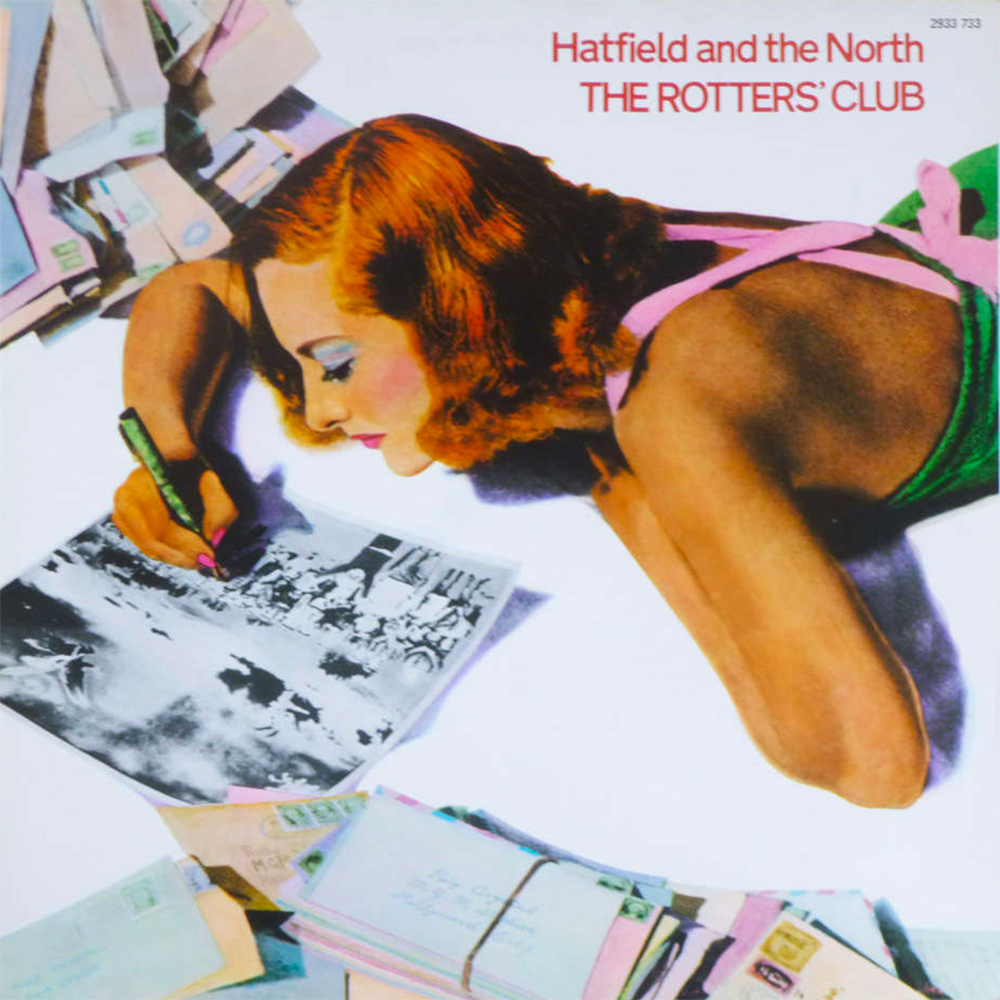
The Rotter’s Club is Hatfield And The North’s second studio album.
Hatfield And The North was founded in 1972 by Phil Miller (1949-2017), guitarist in Delivery and Matching Mole, and Pip Pyle (1950-2006), ex-drummer of Gong. After a few swift changes, the band was joined by Caravan bassist/vocalist Richard Sinclair and Egg keyboard virtuoso Dave Stewart. This first ”supergroup” of the Canterbury scene made its excellent debut album in 1974.
The debut was indeed brilliant, but The Rotters’ Club , made 13 months later with the same line-up, is actually an improvement on that album in every way. The songs are a little better, the playing more skilful, the sounds more muscular and even the album cover this time is not only aesthetically beautiful but also quite witty and funny.
The Rotters’ Club’s music is a rare combination of musical complexity, gentle melodic moments and humour. Frank Zappa is to some extent on the same lines as the Hatfields in terms of complexity and humour, but his wicked and downright hostile humour towards many groups of people too often gets in the way of the music itself, in my opinion. This is not the case with the Hatfields, and at the same time there is something very sympathetic and warm about their style (these are qualifiers that even Zappa fans hardly associate with Frank…).
The Rotters’ Club is characterised by a friendly and warm atmosphere. Even when the music is at its most complex, the band’s approach is mostly a winking encouragement: ’Yeah, we know, it’s a bit confusing, but don’t worry, just relax and you’ll be fine’.

The Rotters’ Club is a consistently strong whole from start to finish, but I’ll focus on a few highlights from the album. The album starts off with perhaps the most upbeat track on the album, ”Share It”, which brings to mind Caravan’s best pop tunes. Another song on the lighter side of the album that deserves a mention is Sinclar’s beautiful and wistful ”Didn’t Matter Anyway” which gently floats along with a melancholic melody and some great Hastings flute soloing.
On the more upbeat side, the first song to stand out is Phil Miller’s ”Lounging There Trying”, which comes immediately after ”Share It”. The song relies heavily on Miller’s long and complex guitar melody. In a way, you could say that Miller solos throughout the song, but somehow the word ”solo” seems like an understatement for what Miller does in the song. Miller’s long winding guitar solo is a work of sheer genius. The man seems to be able to fly effortlessly with his guitar in just about any direction, and Miller’s sense of harmony is something quite unique. His playing is at once wild, yet elegant.
”Nobody played guitar like Phil Miller. He was a fearsome improviser: having carved out a piece of musical territory, he would investigate its more abstruse harmonic possibilities like a man cataloguing alien life forms.”
– Dave Stewart”As a guitarist he was one of kind. Really. A unique sense of melody, improvised or composed. I always liked the way that the boisterous, belligerent Pip would write seductive, dreamy pieces while Phil, the quiet man, came up with the tough stuff to make your skeleton quake.”
– John Greaves (Henry Cow, National Health)
If Miller shines in ”Lounging There Trying”, then in ”The Yes No Interlude” Dave Stewart lets loose with his keyboards. Stewart makes the most of his synthesizers and organ rhythmically (I think Stewart’s old love of Igor Stravinsky shines through in the staccato parts) in an excitingly groovy song. Drummer Pip Pyle and bassist Richad Sinclair are also on fire. The song includes a great sax solo from Jimmy Hastings. The song also features guest appearances from Henry Cow’s Tim Hodgkinson (clarinet) and Lindsay Cooper (bassoon).
The album closes with Stewart’s epic ”Mumps”, which is divided into four parts and lasts over 20 minutes. Even on a track of this scale, the Hatfields don’t indulge in any of the bloat often typical of symphonic prog, instead the song is more of a delicately complex piece. The song begins with a wordless vocalization by The Northettes ”girl choir” (i.e. Barbara Gaskin, Amanda Parsons, Ann Rosenthal) over a rather strange-sounding chord progression in the short intro ”Your Majesty Is Like a Cream Donut” (Quiet).
From the intro we move into the more boisterous and long ”Lumps” section of over 12 minutes, where we hear great solos from both Stewart and Miller. Sinclair’s intricate bass patterns are also a delight to listen to! The Northettes also return here and there and their vocals work beautifully in support of the music.
Towards the end of ”Lumps” Sinclair is also allowed to sing briefly, after which the atmosphere becomes a bit more jazzy for a while with a tasty saxophone solo by Hastings (has Hastings ever played anything unstylish in his life? Well, no!), which leads to a somewhat annoying fade-out in the third section ”Prenut”. This section is characterised by Pyle’s restrained but rhythmically wobbly, tension-building drum beat, the ethereal vocals of The Northettes and a slightly spacerock-like floating atmosphere. The section could almost be from a Gong album. Finally, the tension is released with Stewart’s Hammond solo and a brave uplift that is the closest thing to pomposity you’ll hear from Hatfield. Finally we hear a sort of recap of the intro of the song, ”Your Majesty Is Like a Cream Donut” (Loud), but with more powerful instrumentation as the witty title suggests.
”There was no better flute player in England at the time than Jimmy Hastings. He was another (toim. huom. Dave Stewartin lisäksi) person with perfect pitch”
– Phil Miller
The Rotters’ Club is packed from start to finish with great music from great musicians. It’s a shame the band’s career was cut so short. After The Rotters’ Club , the band called it quits for the usual reasons that slightly weirder prog bands usually end up in, namely financial difficulties. Fortunately, the band was sort of continued a few years later in the form of National Health, where Stewart, Miller and Pyle joined forces again.
- Levyarvio: Steve Walsh – Glossolalia (2000)
- Year by Year : Best Albums of 1976 – 21-29
- Levyarvio: Jimmy Page – Outrider (1988)
- Review: Brian Eno + David Byrne – My Life in the Bush of Ghosts (1981)
- Levyarvio: Gong – Zero To Infinity (2000)
- Review: Michael Oldfield – Heaven’s Open (1991)
- Review: Talk Talk – The Colour Of Spring (1986)
- Levyarvio: Jeff Wayne – Jeff Wayne’s Musical Version Of The War Of The Worlds (1978)
- Review: Gong – Shamal (1976)
Although Hatfield And The North’s journey was short-lived, its legacy is strong and enduring. Indeed,The Rotters’ Club couldwell be considered the definitive Canterbury album, seamlessly combining all the best aspects of that sub-genre of progressive rock. Richard Sinclair has said that Hatfield And The North’s music was four times the challenge of his former band Caravan, but also four times more fun and satisfying. As a listener, I wouldn’t dare say that The Rotters’ Clubis four times better than Caravan at its best,butit is a masterpiece nonetheless.
The Rotters’ Club is one of the greatest albums of all time, regardless of genre.
R.I.P. Pip Pyle (1950-2006) ja Phil Miller (1949-2017)
Key tracks: ”Share It”, ”Lounging There Tryingissa”, ”The Yes No Interlude”, ”Mumps”, ”Didn’t Matter Anyway”
(Quotes from the musicians are from Mike Barnes’ book A New Day Yesterday: UK Progressive Rock & The 1970s)
Author: JANNE YLIRUUSI
Tracks:
1. Share It (3:02)
2. Lounging There Trying (3:10)
3. (Big) John Wayne Socks Psychology on the Jaw (0:46)
4. Chaos at the Greasy Spoon (0:30)
5. The Yes No Interlude (7:02)
6. Fitter Stoke has a Bath (7:38)
7. Didn’t Matter Anyway (3:03)
8. Underdub (3:55)
9. Mumps (20:06)
– a) Your Majesty is Like a Cream Donut (quiet) (1:59)
– b) Lumps (12:35)
– c) Prenut (3:55)
– d) Your Majesty is Like a Cream Donut (loud) (1:37)
Hatfield And The North:
Phil Miller: guitars Dave Stewart: Hammond organ, Fender Rhodes, piano, MiniMoog, tone generator Richard Sinclair: bass, lead vocals, guitar (7) Pip Pyle: drums, percussion
Quests:
Mont Campbell: French horn (3,4) Lindsay Cooper: oboe, bassoon (3,5) Jimmy Hastings: flute (6-8,9), soprano & tenor saxophones (5,9) Tim Hodgkinson: clarinet (3,5) Amanda Parsons: backing vocals (6,9) Ann Rosenthal: backing vocals (6,9) Barbara Gaskin: backing vocals (6,9)
 Pienemmät Purot
Jätä kommentti