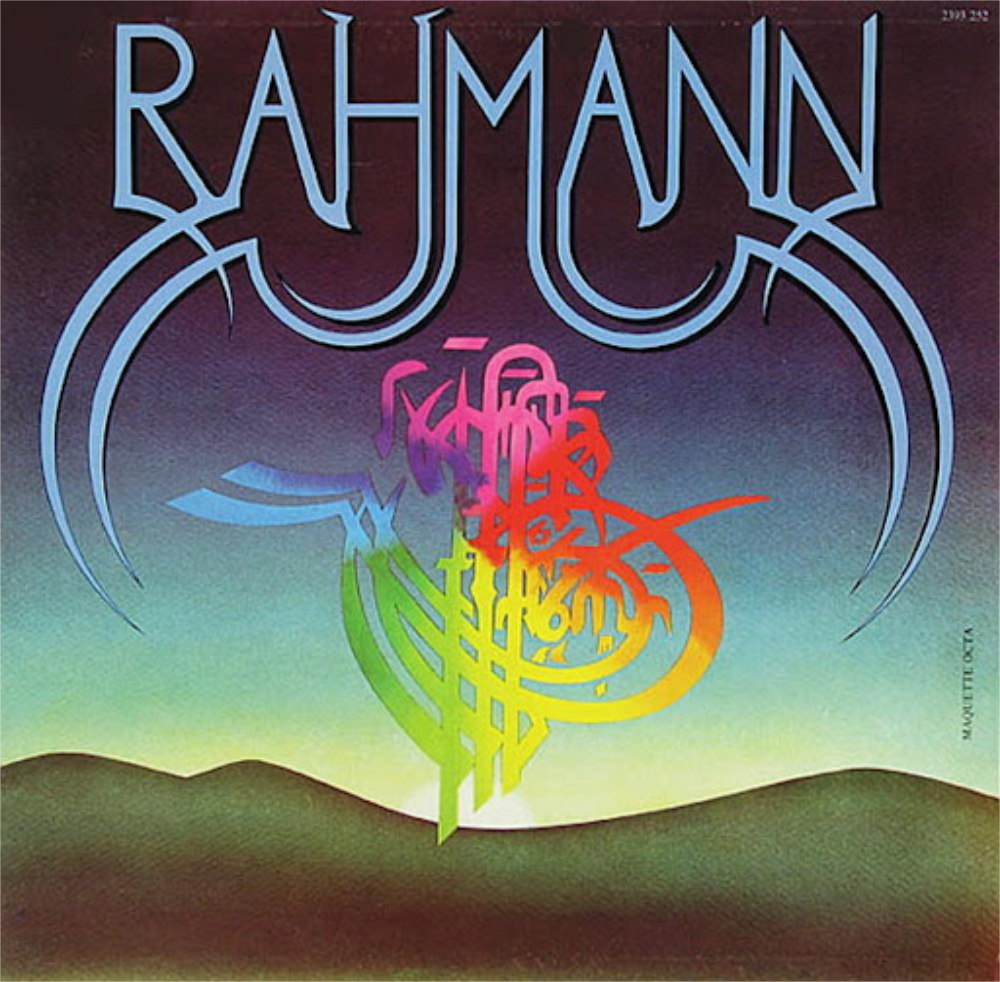
Rahmann is the first and only studio album by the French/Algerian band of the same name.
Although the Algerian-born guitarist Mahamad Hadi founded Rahmann in 1975, the five-piece band only reached the studio in 1977. Rahmann’s untitled debut album was assembled in fragmented sessions that stretched over almost a year. The band recorded the album whenever they could get into the studio. The debut was finally released three years after the recording sessions began when the band finally, after much adversity, secured a contract from Polydor, which released the album under its Ramses label in January 1980.
Rahmann’s music is the easiest to categorise as jazz-rock, but it’s not quite basic stuff. Rahmann’s virtuoso jazz-rock playing is not only influenced by the French band Magma’s Zeuhl, but also by the band leader’s own North African heritage. The band’s electrifying polyrhythmic energy is an interesting combination of North African and Asian instrumentation, Zeuhl-like vocals and thickly growling bass lines. Rahmann’s style is therefore quite unique, even though it is clearly influenced not only by Magma but also by The Mahavishnu Orchestra and even Santana at times. Rahmann’s way of combining ethnic instruments with jazz-rock is also somewhat reminiscent of Gong’s great Shamal album.
Rahmann’s instrumentation is quite rich. Hadi, who composed all but one of the songs on the album, plays electric guitars, guitar synthesizer, bouzouki, mandolin and oud. Keyboardist Michel Rutigliano plays mostly piano and electric piano, but also occasionally plays the ARP Odyssey synthesizer. The band is completed by bassist Gérard Prevost, formerly of the Zeuhl band Zao, drummer Amar Mecharaf and percussionist Louis César Ewandé. The album also features a large number of guests (including a Persian flute ney player and a tabla player), the most famous of whom is Didier Lockwood, an electric violinist who has also appeared in Magma. Lockwood had also been a member of Hadi Rahmann’s pre-Hadi band for a while.
The album opens with ”Atlante”, a more minimalist and subdued track than any of its other compositions. The song is carried by a snaky, slithering bass riff played on an fretless bass, reminiscent of the Middle East, and Hadi solos on top of it with a rhythmically sounding oud. The enigmatically sounding Persian ney-flute and Lisa Deluxe’s (Magma) wordless vocals further enhance the ethnic vibe. After a promising beginning, the song remains a bit monotonous and ”Atlanta” would have been better as a kind of intro for the whole album if it had been a bit shorter.
After ”Atlanta”, the energy levels rise dramatically on the next track, ”Nadimiana”, a joint composition by Hadi and keyboardist Rutigliano. Opening with some kind of hand drums, ”Nadiamina” is a downright furious song in places, featuring strange and intricate guitar riffs, wild bass patterns and frenzied drumming from Amar Mecharaf. Mecharaf’s drumming is absolutely stunning throughout the album and one has to wonder where a musician of this calibre disappeared to after Rahmann. I could not find any information about the man’s later stages. Perhaps he returned to North Africa to play as a local musician? Who knows, but for the western jazz-rock scene, his disappearance is a sad loss.
The album’s third track ”Ab” begins with a stubborn electric piano ostinato accompanied by an eerie synthesizer. The electric piano starts to solo wildly, while the drummer and percussionist weave a tight polyrhythmic tangle in the background. Hadi’s electric guitar joins in and his playing intertwines nicely with the synthesizer and electric piano so that at times it is difficult to discern who is playing what sound. The pace changes towards the end of the track as the electric guitar wails atonally and the synth sounds become more futuristic. For the last couple of minutes, we return to the slightly Middle Eastern-sounding theme of the beginning and move into the ethereal section with Hadi playing oud and the synthesizer playing a cyclical pattern. A really great song!
The six-minute ”Danse Sacrée” that follows ”Abi” is perhaps the best thing on the album. ”Danse Sacrée” kicks off with electric piano building tension for just under two minutes before exploding with Hadi’s wild electric guitar playing and intense polyrhythmic rhythm section into a roar somewhat reminiscent of The Mahavishnu Orchestra. The effect is accentuated by Didier Lockwood’s sharp violin solo. A strong hand drum role also adds a bit of Santana vibes. The ensemble’s playing is delightfully muscular. Rahmann gallops through ’Danse Sacré’ with extreme confidence despite the fast tempo and complex rhythm.
Read also: Review: The Mahavishnu Orchestra – The Inner Mounting Flame (1971)
The album’s penultimate track, ”Leila”, is its most zeuhl-like offering. ”Leila” begins with an upbeat acoustic rumble and quickly rises to a world-embracing crescendo, after which Hadi’s electric guitar introduces the song’s fateful main theme, whose dramatic quality is reminiscent of Magma, amidst a cymbal chime. ”’Leila” also contains some quite delicious atonal sections and is also the album’s most avant-garde piece. The rhythm section’s work is astonishing on this track too, but also well done by Rutigliano, who tinkles his electric piano in a rhythmic manner, and Hadi, who shreds wild runs on his guitar.
The album ends with the elegant ”Marche Funèbre” which, as its name suggests (”Funeral March”), is a slow and dark atmospheric tune with keyboards, bass guitar and at the end Hadi’s clean sounding electric guitar. ”Marche Funèbre” is not the album’s best offering, but it’s a very effective cool down after all the fiery music you’ve just heard.
Rahmann’s way of combining jazz-rock, North African music and zeuhls is really refreshing and original. The whole band plays very well and especially the drummer Mecharafi’s playing is absolutely stunning. To top it all off, the quality of the sound is very good, surprisingly good considering that this is fringe music recorded in very fragmented sessions in France.
Rahmann’s debut, released in January 1980, sold surprisingly well in its own league, around 10 000 copies, which is about the same as Henry Cow sold around the same time. For some inexplicable reason, however, Polydor destroyed the unsold copies of the first edition, which broke the morale of Rahmann, who had started to plan a new album. The band broke up. Hadi tried to restart the band a little later with keyboardist Benoit Widemann, who had played in Magma, but in the end this new Rahmann line-up failed to make it beyond a few rehearsals when the tour they had been promised was cancelled.
So the Rahmann story was sadly cut short. It’s a shame that although the band was full of really great musicians, nothing much has been heard from them since. The band’s main man Mahamad Hadi, who sometimes went by the stage name Mad Sheer Khan, at least ended up playing on a couple of solo albums by Nico (ex-Velvet Underground) in the 80s, but even he remains most famous for this fine Rahmann debut, one of the best jazz-rock albums of all time. Not a bad legacy in itself.
Best tracks: ”Atlanta”, ”Nadiamina”, ”Ab”, ”Danse Sacrée”
Author: JANNE YLIRUUSI
Tracks
- Atlanta (5:26)
- Nadiamina (6:23)
- Ab (8:00)
- Danse Sacrée (6:35)
- Leila (9:38)
- Marche Funèbre (5:00)
Rahmann:
Mahamad Hadi: electric guitar, fretless guitar, guitar synthesizer, oud, bouzouki, snitra Michel Rutigliano: piano, electric piano, ARP Odyssey synthesizer Gérard Prevost: acoustic bass, fretless bass Amar Mecharaf: drums, percussion Louis César Ewandé: percussion
Other musicians:
Lisa Bois: vocals (1) Nadia Yamina Hadi: vocals (2) Didier Lockwood: electric violin (4) Joël Loviconi: electric piano (4) Sylvin Marc: fretless bass (2) Richard: ney (1) Gérard Kurdjian: tabla (1) Abdelmadjid Guemguem: darbuka (1)
 Pienemmät Purot
Jätä kommentti