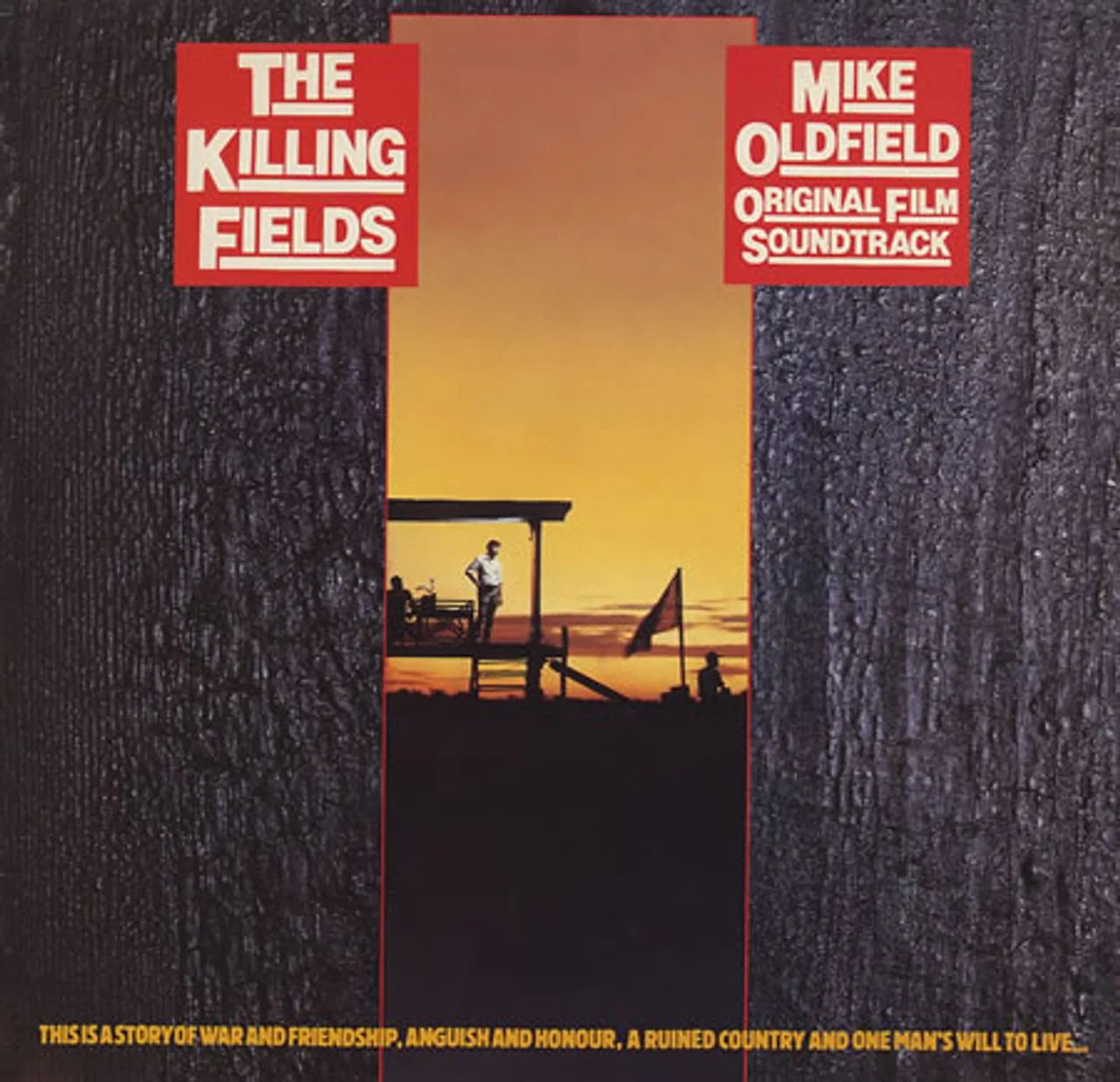
The Killing Fields is Mike Oldfield’s first film score.
1984 was a productive year for Mike Oldfield, and he released no less than two new albums. Both of these were somewhat new ventures into uncharted territory. The first, Discovery, was Oldfield’s first full pop album and the second, The Killing Fields, his first film score.
Oldfield’s music had already been used in films before. The most famous case is of course William Friedkin’s horror classic The Exorcist (1973), with its chillingly effective Tubular Bells theme. Oldfield’s music played a much bigger role in Tony Palmer ’s The Space Movie (1980). That space documentary, commissioned by NASA, made extensive use of Oldfield’s early compositions (including excerpts from the orchestral Hergest Ridge, which has never been released on disc). However,The Killing Fields is the first time Oldfield composed new music specifically for the film.
It is unclear where the impulse to make film music came from. Was Oldfield himself interested in this direction? Or was it perhaps a sensible trend for his management in the 80s when there was no longer the same demand for Oldfield’s progressive music as there had been in the 70s? Or perhaps the spark came directly from the filmmakers and they inquired about Oldfield’s interest? In any case, the project got off the ground when Virgin record company owner Richard Branson introduced Oldfield to producer David Puttnam, possibly the most influential man in the British film industry in the early 80s. He had under his belt as a producer in recent years the notable and successful films Midnight Express and Chariots Of Fire. The latter, incidentally, had an iconic Oscar-winning score by another progressive musician and one-man band, Vangelis. Perhaps Branson and Puttnam thought they would repeat the same trick with Oldfield.
When rock musicians try their hand at film music, they often have to start with fairly low-budget films. For example. Rick Wakeman, Keith Emerson and Jimmy Page started their film music careers on projects that can be classified as b-movies. Puttnam and director Roland Joffé’s The Killing Fields, on the other hand, was not only a big-budget production ($14.4 million was big money in 1984), but also a thematically worthy one, as if directly destined to win the film industry’s most prestigious awards. The Killing Fields was a serious war drama based on Cambodian journalist Dith Pran ’s real-life experiences under the yoke of the Khmer Rouge’s violent regime in the 1970s. During the few years of communist rule by the Khmer Rouge, more than a million Cambodians died of malnutrition, disease and summary executions.
Read also: Review: Mike Oldfield – Earth Moving (1989)
Oldfield started working on the score in England, thinking he had it finished, and moved to Switzerland to work on Discovery when the filmmakers asked for more music. Discovery was put on hiatus and Oldfield returned to work on the process, which he found very arduous. When making music for a film, it wasn’t enough for the music to please itself, it had to work on the terms of the story and still please the fickle stakeholders working on the film.
The Killing Fields ’ music was supposed to be all electronic, but in the end they decided to add orchestral parts. I don’t know if the original concept was Oldfield’s and/or the director’s vision or if it was perhaps a budgetary decision. The orchestral side was added at the point when the producers demanded more music. There are different stories about how this solution was arrived at. In one version, the producers wanted to include more traditional symphony orchestral music for the film, while in another, the orchestra and chorus were Oldfield’s requirement to continue with the project at all. However, Oldfield did not have the skills to produce a final score for a symphony orchestra so help was needed. The obvious choice was the classically trained composer David Bedford (1937-2011).
Trained at the Royal Academy Of Music and with a very open-minded approach to music, Bedford had, alongside his own art music career, been involved in the new progressive rock scene since the late 60s. Bedford even went so far as to join Kevin Ayers’ short-lived band The Whole World. It was in that raucous band that he met the young Oldfield, who was the band’s bassist and, a little later, guitarist. In the years to come, Bedford wrote orchestrations for several of Oldfield’s albums and also arranged fully orchestral versions of Tubular Bells and Hergest Ridge.
Besides Oldfield, Bedford also worked for many other artists such as Roy Harper and Camel. However, Oldfield was by far Bedford’s most important collaborator in the rock world and the pair even released a few humorous singles together in the mid-70s, such as ”Don Alfonso” (1974) and ”Speak (Tho’ You Only Say Farewell)” (1976). With Oldfield’s help, Bedford was also able to release his own solo albums through Virgin, with music somewhere between avant-garde art music and progressive rock. A major attraction for Virgin on these albums was that their superstar Oldfield appeared on guitar. In 1983 Oldfield went so far as to help Bedford that he set up his own label, Oldfield Music, just to release Bedford’s Star Clusters, Nebulae and Places in Devon / The Song of the White Horse. So it’s not too surprising that when Oldfield needed help with orchestral music on The Killing Fields that Bedford was called in to help.
Bedford does a great job in the orchestrations of The Killing Fields. The orchestral pieces on the album are much more conventional music than Bedford’s own compositions and naturally they creep into the realm of ’conventional’ film music to some extent. But not too much and, most importantly, the themes Oldfield has composed for the songs are at their best truly hauntingly beautiful and powerful.
The addition of orchestral music was probably a good solution, especially for the film. Indeed, the opening orchestral ’Pran’s Theme’ is the beating heart of the album, and the music would probably have remained too emotionally cold and experimental if it had been purely electronically constructed by Oldfield. Elements of ”Pran’s Theme” also appear here and there throughout the album in other tracks which adds a sense of unity. Of the orchestral tracks, the dramatic ”Requiem for a City” which makes great use of a large choir is also a real success. And listening to it on the album, you always wish that a larger work had been constructed from a composition of only two minutes. There would have been potential for that.
The electronic and orchestral sides of the album are hardly mixed. One of the few exceptions is ”Pran’s Escape” / ”The Killing Fields”, where the questions of the sawing sharp synthesizer sounds are answered by darkly sounding wind instruments. The same track also features a György Ligeti-esque choral vocal with an eerie echo effect.
In the electronic tracks of the album, the instrumentation is mainly based on the Fairlight CMI synthesizer. There is very little guitar on the album and hardly any of Oldfield’s trademark electric guitar sound (except for ”Etude”), the guitar vibrating with the Fairlight and other synthesizers is mainly a sound effect. Here and there, percussionists Morris Pert and Preston Heyman rattle various percussion instruments, often of ethnic origin. This aspect is used to particular effect on the track ”Blood Sucking”, where Heyman’s Indonesian percussion creates a hypnotic soundscape that I would have liked to have listened to for longer.
The most impressive of the electronic tracks is the oppressively beeping and humming ”Evacuation”. It offers fast-paced, pulsating rhythms and a simple but intriguing enigmatic melody. Another particularly strong track is the percussive ”Capture” which makes great use of dynamics and aggressively surging synthesizer and electric guitar waves. A snippet of ”Evacuation” was later used in a headache tablet commercial to describe an epic migraine attack. It’s up to each individual to decide whether this is a flattering image for the music, but I think it speaks well for how ”Evacuation” managed to create a nightmarish atmosphere.
In general, the electronic music of The Killing Fields is very interesting and distinctive. And the most avant-garde music ever released by Oldfield. In many places the compositions function as much as music as sound effects. The songs clang, scream and growl, sometimes animalistically and sometimes creating images of some kind of industrial nightmare. It would be easy to imagine many of the songs on the album fitting into a dark sci-fi film. The textures Oldfield creates on the album are often as important as the notes he chooses. In this respect, Oldfield can even be seen as something of a pioneer, as film music in the 21st century has become increasingly textural and sound-effect-like.
Paradoxically, the only song that nods towards pop music or even more typical Oldfield music is the closing cover song ”Étude”. The instrumental heard during the closing credits of the film was originally composed for solo guitar by Francisco Tárrega and originally known as ’Recuerdos de la Alhambra’ (1899). Oldfield’s gentle-sounding and detailed, but at the same time understated, arrangement is a prime example of a successful cover song in which the source material is reworked in a way that is entirely his own. But as much as ”Étude” sounds like Oldfield, it also brings me back to the music of Ryuichi Sakamoto.
In typical Oldfield style, ”Étude” is built up little by little with the addition of new instruments. The music begins with a synthesizer melody simulating an ethnic wind instrument, surrounded by sparse but massive drum beats. A bell-like voice plays a counter-melody and finally the emotional climax of the song is reached when Oldfield’s electric guitar takes a real leading role for the first time on the album with a typically tense sound. Oldfield effectively interrupts his solo with short breaks on several occasions, cleverly building tension. Behind the guitar, the rest of the music is also insidiously swollen into a small synthesizer symphony, and there is something very soothing, but also exhilarating, about its bell-like sound. The beautiful ’Étude’ offers a catharsis after the often very nightmarish soundscapes of the past.
”Étude” was also released as a single with a stylish (probably Oldfield’s best music video) music video, but it didn’t make the charts.
Read also
- Levyarvio: Steve Walsh – Glossolalia (2000)
- Year by Year : Best Albums of 1976 – 21-29
- Levyarvio: Jimmy Page – Outrider (1988)
- Review: Brian Eno + David Byrne – My Life in the Bush of Ghosts (1981)
- Levyarvio: Gong – Zero To Infinity (2000)
- Review: Michael Oldfield – Heaven’s Open (1991)
It’s been a very long time since I’ve seen The Killing Fields so I’m not the right person to judge how well Oldfield’s music works in it. As I recall, the music plays only a minor role in the film, but I could be wrong and perhaps I have watched, and listened to, the film too much with Oldfield glasses on. As a listening experience, however, the album is largely rewarding, even though it is typically fragmented listening with short tracks for many soundtracks. This is further emphasised by the stylistic ambiguity of the music. The Killing Fields has also aged gracefully; where many other scores created with 80s synthesizers now sound very corny and too obviously ”child of their time”, Oldfield’s music is still genuinely menacing and atmospheric.
As is typical, not all the music heard in the film made it onto the disc and it’s a shame that this was not corrected in the 2016 remastered release.
The Killing Fields was only a moderate commercial success when it was released, but it was even more critically acclaimed. The film received seven Oscar nominations, three of which it won. At the British Academy Film Awards, organised by the British film industry, The Killing Fields fared even better, receiving no fewer than 12 nominations, 8 of which turned into wins. Oldfield’s score was also nominated, but the award went to Italian maestro Ennio Morricone. And of course, losing to Morricone is never a disgrace. Especially for a first-timer! As a side note, in his next film The Mission, director Roland Joffe worked with Morricone.
With few exceptions, film music does not sell very well and the experimental The Killing Fields was no exception. It was probably, by a large margin, Oldfield’s lowest selling album at this stage of his career. It did, however, sell a silver record in the UK. So at least 60 000 copies were sold.
Oldfield’s comments on his first and only score have been controversial. On the one hand, he has said that he found the process frustrating, difficult and inappropriate for him. However, in his biography Changeling (2007), Oldfield says he enjoyed working with talented people in the film industry and regrets not having had the opportunity to write more film music. He also said that he believed he had been vilified by influential producer David Puttnam in industry circles and warned that he was a troublemaker. Apparently, Oldfield and Puttnam had a strained relationship while making the film. Perhaps the timing was just wrong; a first film project and working on your own album in a different country at the same time was not necessarily the best possible situation. In any case, for one reason or another,The Killing Fields remains Oldfield’s only film music project. It’s a pity, because I for one would have preferred to hear more film music of this quality from him rather than the forced and superficial pop music of Islands (1987) or Earth Moving (1989).
Best tracks: ”Requiem For A City”, ”Evacuation”, ”Capture”, ”Pran’s Theme 2”, ”Pran’s Departure”, ”Blood Sucking”, ”Etude”
Kirjoittaja: JANNE YLIRUUSI
Read also: Review: Mike Oldfield – Exposed (1979)
Tracks
- ”Pran’s Theme” 0:44
- ”Requiem for a City” 2:11
- ”Evacuation” 5:14
- ”Pran’s Theme 2” 1:41
- ”Capture” 2:24
- ”Execution” 4:47
- ”Bad News” 1:14
- ”Pran’s Departure” 2:08
- ”Worksite” 1:16
- ”The Year Zero” 0:28
- ”Blood Sucking” 1:19
- ”The Year Zero 2” 0:37
- ”Pran’s Escape” / ”The Killing Fields” 3:17
- ”The Trek” – 2:02
- ”The Boy’s Burial” / ”Pran Sees the Red Cross” 2:24
- ”Good News” 1:46
- ”Étude” 4:37
Musicians
Mike Oldfield: guitars (Gibson Les Paul Junior, SG Junior), synthesizers (including Sequential Circuits Prophet 5, Oberheim OB-Xa, DMX, Roland VP-330), Fairlight CMI Preston Heyman: Eastern percussion Morris Pert: percussion Eberhard Schoener: conductor Bavarian State Orchestra: orchestra Tölzer Boys Choir: choir David Bedford: orchestration
 Pienemmät Purot
Jätä kommentti