
King Crimson, formed in 1968, returned in the early 80s with a completely revamped line-up. In the end, the 80s Crimson lasted only three years, during which time they made three groundbreaking albums, the first of which, Discipline (1981), is an absolute prog classic. However, tensions within the band grew and after a tour following Three Of A Perfect Pair (1984), guitarist Robert Fripp pulled the plug again. King Crimson was no more and Fripp, Adrian Belew (guitar), Tony Levin (bass guitar) and Bill Bruford (drums) went their separate ways.
After King Crimson, Fripp focused on more small-scale projects. He made a duo album called Bewitched with The Police guitarist Andy Summers, founded his eccentric guitar school The Guitar Craft and the associated performing and recording guitar group The League Of Crafty Guitarists.
However, the crimson flame did not leave Fripp alone and he has said that he ”started hearing” King Crimson music again in 1987. But it was years before this floating music made it to the shelves of record shops. In the meantime, Fripp set about curating the history of King Crimson. This was appropriate, as interest in the band was probably at an all-time low as the late 80s approached. In 1991, King Crimson’s studio albums began to be released as remastered CDs. The same year also saw the release of an excellent four-CD compilation box set of studio material, Frame by Frame: The Essential King Crimson. And the very next year saw the release of perhaps an even more significant four-disc set, The Great Deceiver, which focused on live material from 1973-74. These releases raised King Crimson’s profile considerably and coincided with a small-scale revival of progressive rock at grassroots level. The early 90s saw the formation of many new progressive bands, and the Crimson albums of the 70s in particular were important models for many of them.
Fripp’s musical projects gradually began to take shape again on a larger scale in the early 90s. And also the music Fripp was composing at that time started to give hints of King Crimson. Both the album Kneeling At The Shrine (1991), made with Toyah (Fripp’s wife) under the name Sunday All Over The World, and The First Day (1993), a collaboration with David Sylvian, contained music that sounded at least remotely like King Crimson. Both of these projects made for Virgin Records were also significant for the next King Crimson line-up.
So King Crimson music was floating in the air. It was time to get the band together to play it. The first musician Fripp contacted was soft-voiced vocalist David Sylvian, with whom Fripp had collaborated on a few occasions. Sylvian was flattered by the offer, but the vocalist, who was just recovering from depression, certainly didn’t want to take King Crimson’s long history on his shoulders. Sylvian politely declined. Instead, Fripp and Sylvian ended up doing a short tour with Fripp’s Guitar Craft student Trey Gunn. The tour in turn led to the aforementioned studio album The First Day. If Sylvian had taken Fripp up on his offer, it is quite possible that King Crimson would have been launched a year or two earlier than it eventually was. In this scenario, the interesting question is what would have happened to vocalist/guitarist Adrian Belew? Would he have left the bandwagon altogether (this is my bet) or would he and Sylvian have been able to work together in Crimson?
Although Fripp’s Crimson dreams were postponed, he continued to push the project forward during the Sylvian & Fripp project. In December 1992, the first rehearsals were held to play sketches of the new King Crimson repertoire. In addition to Fripp, the rhythm section of The First Day included Trey Gunn (Chapman Stick) and Jerry Marotta (drums). In 1993, the Crimson’s patterns apparently made little progress and the first ”real” rehearsals were held in January 1994. Now, in addition to Gunn and Marotta, Tony Levin and Adrian Belew were also involved. However, the sessions went so badly that after only a few days Marotta was thrown off the team. He was replaced by two drummers. One was Crimson veteran Bill Bruford and the other was the new kid on the block, American Pat Mastelotto who had played on the Sylvian & Fripp tour (which resulted in the excellent album Damage).
There had been rumours of a new King Crimson for a few years and those rumours had made it very clear that there would be no place for Bruford. Bruford was furious and made bitter statements in the media, but behind the scenes he had been lobbying hard to be reinstated. It is not entirely clear what finally turned Fripp’s head, but after the Marotta fiasco he apparently ’saw the vision’ of two drummers. Fripp had long been fed up with Bruford’s stubbornness and a certain mischievousness about his drumming. Fripp wanted a drummer who could reliably and accurately keep rhythm alongside Bruford’s wild drumming, and the ideal man for the job was the young and strong-handed Mastelotto. Bruford and Mastelotto would hopefully complement each other.
After these twists and turns, a new King Crimson finally came together. Fripp called this sextet a ”double trio”; there were two guitarists, two bassists (both of whom also played Chapman Stick) and two drummers. This new exciting and unusual line-up allowed, at least in theory, the typical King Crimson trick of radical renewal.
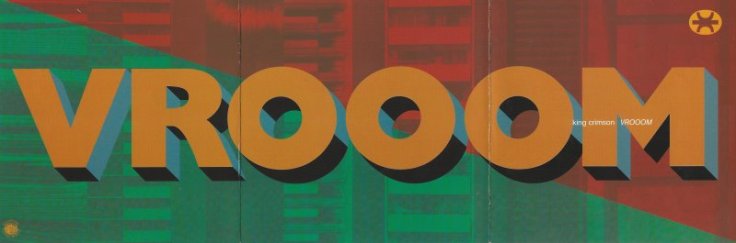
Before making a full-length album, Fripp decided that the new double trio would try their hand at a shorter release. Recorded in early May, the album, called VROOOM, clocked in at just under 31 minutes. VROOOM is often classified as an EP, but as such it’s actually quite long so perhaps a more apt term would be mini-album. VROOOM was recorded in just four days, so it was done on the cheap and one of the purposes of the album was to raise funds to make the ”real” album. However, VROOOM is not a run-of-the-mill ”money-grubbing” exercise, it is a quality recording and performance. David Bottrill, who had just recently produced The First Day, was hired to produce the album.
VROOOM contains six tracks (seven if you count the 17-second soundscapes intro mixed almost inaudible), four of which were eventually redone for the full-length THRAK album recorded the following year.
Read also: Levyarvio: Sleepytime Gorilla Museum – Of The Last Human Being (2024)
We present VROOOM as a calling card, rather than a love letter, to those generous enough to give it ears.
The first song ”VROOOM” introduces King Crimson in a new style. Or a new style with a hint of the old. The very heavy and brutal ”VROOOM” leans more towards Red (1974) than Discipline. The more upbeat sound of the 80s, relying on guitar synths and electric drums, has been pushed aside for a darker and dirtier sound. ”VROOOM” certainly doesn’t sound like grunge, but it’s likely that the rougher, heavier rock sound brought back by that Seattle upstart style has also inspired Fripp’s change of direction. At just over seven minutes long, ”VROOOM” alternates between heavy, pounding riffs and Fripp’s lighter-sounding, snapping arpeggio sections. I particularly enjoyed the song’s extended coda where the band imbues the riffs with a great sense of fateful inevitability. The heavy polyrhythmic style of the song has certainly been a major influence on the so-called brutal prog bands of the 2000s.
Red Hot Chili Peppers meet King Crimson… a horrible thought, isn’t it? Nevertheless, I have to admit that it’s the first thought that comes to my mind from time to time when I listen to the second track of VROOOM ”Sex Sleep Eat Drink Dream”. Despite this unpleasant connotation, the song, which is driven by Levin’s really thick bass pattern, is a rather delicious, dirty-sounding prog-funk. Fripp and Belew’s guitars riff in a edgy way and Mastelotto and Bruford’s double drumming takes a nice central role. Bruford breaks the rhythm here and there in a delightful way while Mastelotto keeps the groove going.
If the funk of the previous song was something new in the Crimson context, it’s not easy to find a precedent for the third song ” Cage ” in the band’s catalogue either. Mostly apparently the brainchild of Belew, ”Cage” is an extremely fast-paced miniature lasting only a minute and a half. Belew’s fast-paced, socially critical vocals (the song starts amusingly with Belew’s inhale as he prepares to erupt) are reminiscent of Primus, while the hyper-fast, aggressive and angular playing seems to point in the direction of John Zorn’s Naked City avant-garde.
”Cage” was not remastered for the THRAK album and was not played live until the early 2000s with a quartet. At that time, a much slower version of the song was successfully arranged and stretched to almost four minutes.
Halloween, every other day of the week
Living in a cage in the USA
Living in a cage in the USA
Holy smoke, somebody blew up the pope
Living in a cage in the USA
All around us the rules are changing
Taller walls and stronger cages
Nothing is sacred or too outrageous
Taller walls and stronger cages
If the album opener ”VROOOM” was a heavy song, so is ”THRAK”. It’s a downright bruising seven-minute instrumental that makes effective use of dissonance. The song contains some absolutely amazing chaotic sections that sound as if each band member is playing a different song without knowing about the others. However, it was obviously all very carefully planned. So it’s a controlled chaos that creates some really interesting tensions. Especially the frantic clanging of the two drummers makes a big impression. It is also difficult to find direct examples for ”THRAK” from Crimson’s past. Perhaps it, in all its industrial clatter, connects a bit with the great ” Industry ” from the Beat album.
The penultimate track on the album, ”When I Say Stop, Continue”, is a slow and controlled, simmering instrumental improvisation that contains a variety of buzzes and rattles that are often hard to tell which instrument they come from. It’s not until the very end of the five-minute song that the drummers really kick up a tasty groove, which is cut off by Belew’s exclamation ”OK, now come to a dead stop / One, two, three, four”. Like ”Cage”, ”When I Say Stop, Continue” was not reinterpreted on THRAK.
The album ends with the somewhat surprisingly light ballad ”One Time”, which one might imagine to have come mainly from Belew’s pen, but apparently its origins can be traced back to Fripp, Marotta and Gunn’s 1992 sessions when Belew wasn’t even in the picture yet. ”One Time” is an atmospheric song sung beautifully by Belew in a high-pitched voice that nevertheless remains a little disconnected on an otherwise very raucous album. Especially as the song is placed at the end of the album. King Crimson have been playing ballads since the beginning of their career, but I think ”One Time” lacks that mysterious Crimson gene that would make it truly King Crimson music.
Read also:
- Review: Cos – Viva Boma (1976)
- Levyarvio: King Crimson – The ConstruKction Of Light (2000)
- Review: Camel – Moonmadness (1976)
- Review: Gong – Gazeuse! (1976)
- Review: Mike Johnson – The Gardens Of Loss (2026)
- Levyarvio: Mike Johnson – The Gardens Of Loss (2026)
I’ve heard opinions that THRAK, coming out the following year, would make VROOOM obsolete. I disagree. The versions of VROOOM are different enough and in some cases even better than THRAK to make this mini-album still worth listening to. Especially since the two songs unique to it are both excellent as well. It is true, however, that VROOM is not even intended as a definitive statement, but as a sort of calling card or storm warning of things to come. King Crimson was back again. And in a powerful way!
Best tracks: ”VROOM”, ”Cage”, ”Thrak”
Author: JANNE YLIRUUSI
Read also: Review: King Crimson – Starless and Bible Black (1974)
Tracks
- ”VROOOM” – 7:34
- ”Sex Sleep Eat Drink Dream” – 4:42
- ”Cage” – 1:36
- ”THRAK” – 7:19
- ”When I Say Stop, Continue” – 5:20
- ”One Time” – 4:25
Robert Fripp: guitar, soundscapes Adrian Belew: guitar, vocals Tony Levin: bass guitar, Chapman Stick, backing vocals, didgeridoo Trey Gunn: Chapman Stick Bill Bruford: acoustic and electric drums, percussion Pat Mastelotto: acoustic drums, percussion
 Pienemmät Purot
Jätä kommentti