
Red is the seventh studio album by King Crimson, formed in 1969.
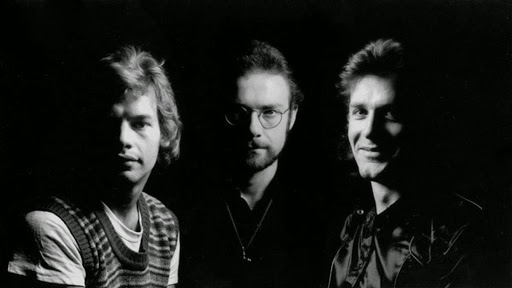
Violinist David Cross was sent packing just before the Red recordings so Crimson continues on the album as a trio of Robert Fripp (guitar/Mellotron), Bill Bruford (drums) and John Wetton (bass/vocals). Although, where on the previous couple of albums no extra guests were heard, on Red the sound is reinforced by several additional musicians. Most of whom already had a history with King Crimson.
Whereas Red’s predecessors Larks’ Tongues In Aspic (1973) and Starless And Bible Black (1974) were quite avant-garde, experimental and angular albums, Red is a somewhat more straightforward and even conventional album. This may be due to the fact that Fripp took a smaller role on the album after having some kind of nervous breakdown in the middle of the sessions, which left Wetton and Bruford with more responsibility to steer the album to the finish line. The song structures are a bit more conventional, but on the other hand the rhythms are still complex. Even the complex time signatures are somehow more naturally woven into the music. For example, on ”One More Red Nightmare” the music alternates through at least four different time signatures, but the changes are almost imperceptible and the band grooves beautifully no matter how overwhelming the rhythm gets. Improvisation also plays a lesser role on Red than on the previous album. This time there is only one improvisation recorded on a previous tour.
”Red”
The album starts with the heavy riffing title instrumental ”Red”. The 6 minute song is very popular among Crimson fans (and more occasional heavy metal fans), but it has never fully convinced me. ”Red” remains a bit too one-dimensional a rumble and could have done with some extra depth. The leading interlude by a cello (the cellist remains unknown) and Mellotron is interesting, though. ”Red” is by no means a bad song, but far from Crimson’s best. I’m not alone in my opinion, by the way, as Bruford somewhat reluctantly accepted the song, telling the rest of the band; ”Well if you think it’s good…”. Fortunately, after the title track, the Red album is a real treat.
”Fallen Angel”
”Fallen Angel” sounds lush and full-bodied. It’s a richly arranged ballad with a real kick. The song features a couple of sidemen from Crimson’s past. Oboist Robin Miller and cornetist Mark Charig, who had previously appeared on Crimson’s Islands (1971) in relatively significant roles, bring a hint of the pastoral atmosphere of that album to ”Fallen Angel”. Speaking of pastoralism: ”Fallen Angel” is the last time Fripp plays acoustic guitar on a King Crimson song. After Fripp’s gentle guitar playing, Charig’s rather violent cornet playing leads the song into heavier moods very effectively. John Wetton’s powerful and authoritative vocal performance also deserves a special mention. Wetton has grown in a couple of years from a bassist who also sings to a really impressive real singer. And ”Fallen Angel” is an excellent platform for him: ”Fallen Angel” is the perfect prog SONG. It’s a song where the intricate arrangements and skilful instrumental performances typical of prog are balanced with a catchy and touching melodic vocal part. An absolutely stunning song.
”One More Red Nightmaren”
If ”Fallen Angel” was Wetton’s golden moment, the third track ”One More Red Nightmare” is Bruford’s moment to shine. Bruford’s drumming throughout the album is absolutely divine, but he particularly impresses with his superb syncopation on the irregularly paced instrumental sections of the album’s third track ”One More Red Nightmare”. Also playing an important role are the now legendary, slightly damaged symbals that Bruford dug out of the studio trash. They give off a great dirty, slightly broken sound which is a perfect contrast to Bruford’s otherwise tight playing. ”One More Red Nightmare” is also noteworthy in the sense that Crimson founding member Ian McDonald, who left the band after the debut album, makes a guest appearance on it, playing two quite outstanding alto saxophone solos. There was talk around the time of Red that McDonald would rejoin the Crimson for the next album. Well, that didn’t happen when Fripp put the whole band on ice and McDonald went on to form the slick middle-of-the-road rock outfit Foreigner. A pity.
”Providence”
”Providence” is one of Crimson’s finest improvisations. The song begins in a subdued, ghostly way with David Cross’s quiet violin (the song was recorded live on tour before Cross was fired) David Cross strums and squeaks his violin melancholically Fripp responds with Mellotron’s flute sounds and Wetton kicks in the back with occasional roaring bass lines. Bruford accentuates the action with ringing percussion in a restrained manner. The band patiently sets the mood, and it’s not until around five minutes in that the whole foursome starts to play together more powerfully. Wetton’s raucous bass riffing begins to drive the song forward with Bruford snapping and pounding drums around it and eventually the song explodes as Fripp solos inventively on electric guitar amidst the chaos. Wetton, however, doesn’t give Fripp the spotlight without a fight and pushes back with a really fierce sounding aggressive bass riff. Finally, Cross’s violin returns once more and the song dies with a whimper. Once again, one has to marvel at the almost telepathic interplay of this King Crimson line-up in unplanned improvisations and their ability to pull almost magical music out of a thin air.
”Starless”
Red peaks with the 12 minute ”Starless” which is not only one of King Crimson’s best songs but also simply some of the most beautiful and impressive music I’ve ever heard. ”Starless” begins with a wistful and bittersweet vocal section where Wetton is accompanied by Bruford’s drum beat and Mellotro’s strings and Mel Collins’ saxophone, creating a wonderful atmosphere. Around the four-minute mark, a twist occurs when Fripp begins to strum his now legendary two-note guitar solo, with an ominous atmosphere created by the 13/4 bass riff played by Wetton and composed by Bruford. Fripp’s two-note sounds get more and more intense and Bruford’s drum rolls all around, creatively making the most of his drum set. At the 9 minute mark a third turn occurs when Collins’ soprano saxophone begins a solo followed by Miller repeating the melancholy theme of the song on the oboe and then the rest of the band kicks into high gear again. The main theme then returns once more with the whole band, backed by Mellotron, swelling magnificently in the background.
A bit like ”Fallen Angel”, ”Starless” is a great combination of beautiful vocals and progressive instrumentation, but even more epic than its predecessor. Not that ”Starless” per se is particularly grandiose music, but more about subtly taking all the power out of a beautifully composed base material.
And above all, ”Starless” is also an emotional song. Probably on an emotional level the most touching Crimson music since ”Epitaph” (1969) and where ”Epitaph” portrayed grief and horror on a more universal level the more personal touch of ”Starless” feels even more poignant. The fact that ”Starless” is the last song on the last King Crimson album of the 70s adds to the depth of the poignancy of ”Starless”. It feels like a farewell, not only to the lost friend the song sings about, but also to this groundbreaking band.
Read also: Review: King Crimson – In The Court Of The Crimson King (1969)
Red is King Crimson’s last studio album of the 70s and a very high quality album. Over the years it has gained a special reputation as a classic, not only for the piercingly beautiful ”Starless” but also for the hard-hitting rumble of the title track, ”Red”, which starts the album at a fast pace. Although the latter is not one of the brightest Crimson highlights for me, I have to admit that it is a significant song that has influenced a lot of King Crimson’s future music and also inspired many younger bands.
To the shock of Bill Bruford and especially John Wetton, Robert Fripp announced immediately after the album was finished that he was breaking up King Crimson permanently. But just as we know that no comic book superhero ever dies permanently, no prog band stays in the grave forever: King Crimson returned triumphantly seven years later, completely renewed, with the album Discipline.
Best tracks: ”Fallen Angel”, ”One More Red Nightmare”, ”Starless”
Author: JANNE YLIRUUSI
Read also: Review: King Crimson – Three Of A Perfect Pair (1984)
Tracks:
1. ”Red” 6:20
2. ”Fallen Angel” 6:00
3. ”One More Red Nightmare” 7:07
4. ”Providence” 8:08
5. ”Starless” 12:18
Robert Fripp: guitars, Mellotron John Wetton: bass guitar and vocals Bill Bruford: drums and percussion
Guests:
David Cross: violin and Hohner pianet Mel Collins: soprano saxophone Ian McDonald: alto saxophone Mark Charig: corner Robin Miller: oboe
Producer: King Crimson
Label: Island
 Pienemmät Purot
Jätä kommentti