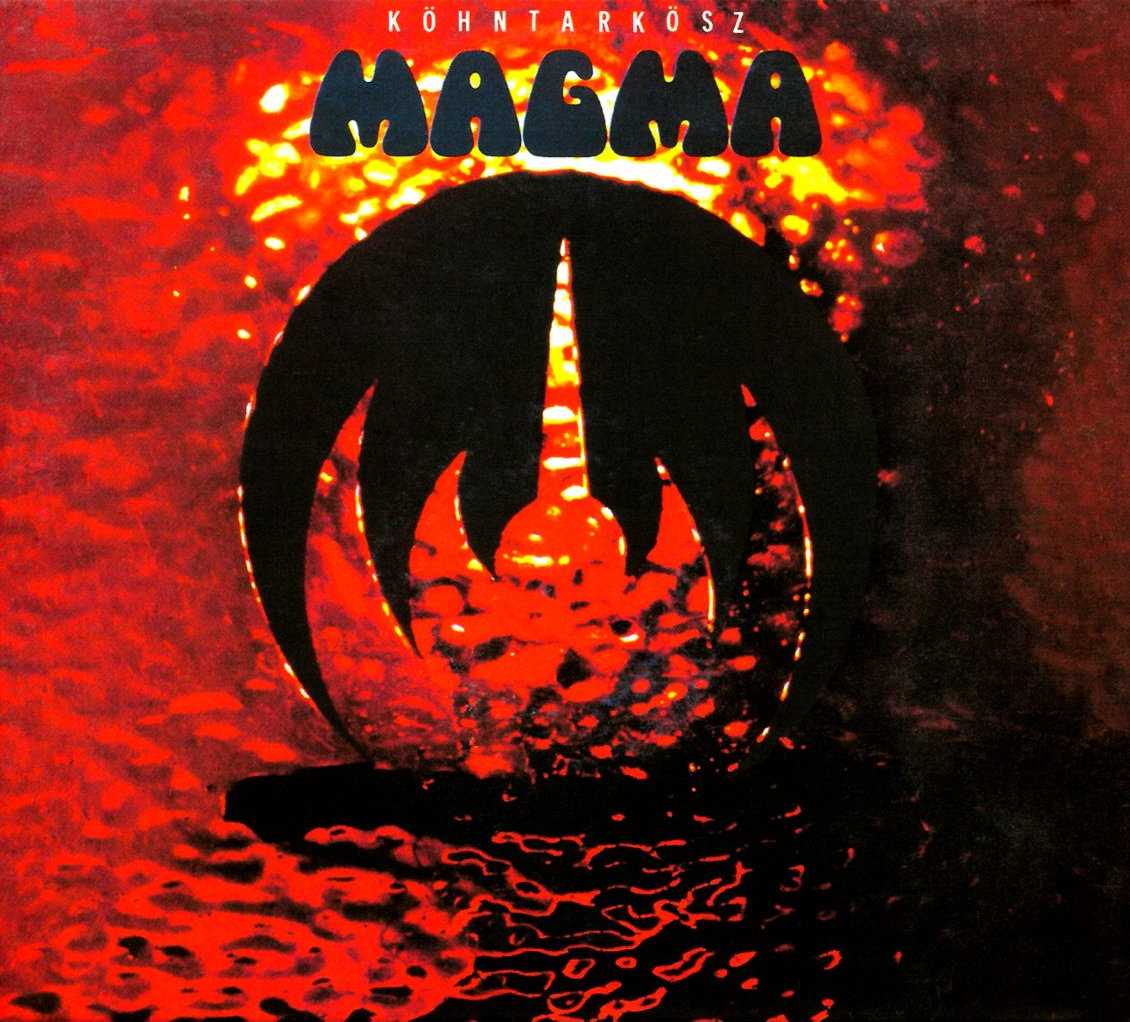
Magma made a breakthrough with their previous album Mëkanïk Dëstruktïw Kömmandöh and really found their own style. MDK’s follow-up Köhntarkösz continues to build on that style in a subtle way, but doesn’t remain a prisoner of it. Köhntarkösz is the middle part of the Köhntarkösz trilogy. The first part of the series is K.A (Köhntarkösz Anteria) from 2004 and the final part is Ëmëhntëhtt-Ré from 2009.
The biggest difference compared to MDK is that Köhntarkösz is a mostly instrumental album where the predecessor’s fiercely pronounced Kobaian language played a central role. Of course, there is plenty of wordless singing on this album as well.
The core of Köhntarkösz is the title track, divided into two parts, which takes up 31 minutes of the 41-minute album. The song, which is hypnotic and sometimes for long periods of time relatively minimalist, starts with a slow, bubbly build-up of tension. The atmosphere is downright ghostly and chilling. Jannick Top’s bass starts to growl in earnest somewhere around the four minute mark, while Christian Vander’s drums keep adding intensity and the whole thing becomes really hypnotic and magical.
The first part is relatively minimalist in style and even seems surprisingly simple on the surface. Harmonically, it is relatively simple, but the rhythm of the piece is very complex and seems to be constantly changing. I can’t really get a grip on whether the time signatures are changing or if Vander is just subtly syncopating his playing. In any case, the song’s concept of time feels really flexible and alive. The band slows down and speeds up their playing with incredible skill and seamlessness with Vander. Sometimes the song feels as if it stops strangely and then slowly picks up speed again. Every beat of Vander’s drum feels perfectly thought out. Unfortunately, the first part gets a bit stale towards the end and sort of fades away instead of ending properly. Probably part of the reason has to be put on the shoulders of the vinyl’s duration limit (one half of the vinyl is a maximum of about 25 minutes) and without them parts one and two of ”Köhntarkösz” would be a more natural whole.
”Köhntarkösz Pt. II” begins with a beautiful vocal part accompanied by electric piano, but soon moves on to build up the tensions familiar from the first part. When the music finally really explodes in part two at around the six-minute mark, with the intensity building and Top’s bass growling more aggressively than ever before, it is one of the most stunning moments in Magma’s entire output. The music continues to grow and the keyboards buzz angrily like the world’s largest swarm of wasps. In fact, in Köhntarkösz, the keyboards play a much bigger role than before and there are no wind instruments on the album. The star of the piece, however, is Vander and his astonishingly controlled, yet consistently interesting, drumming. Vander feels more like an unstoppable force of nature than just a drummer during the last ten minutes of the song. Absolutely stunning playing!
Köhntarkösz Pt. II is 16 minutes of complete zeuhl bliss. I find ”Köhntarkösz Pt. II is Magma at its best and sums up zeuhl precisely in the sense that the genre has been shaped by the music of bands following in Magma’s footsteps.
After the spectacle of ”Köhntarkösz” there are two shorter songs on the album. The first of these, bassist Top’s five-minute composition, ”Ork Alarm”, is the most vocal-heavy track on the album, but even here the human voice is used more as a ghostly effect. ”Ork Alarm” progresses in a twitchy, saw-toothed manner, led by Top’s cello, in a rather interesting way, and ends with an atonal section and a ghostly laugh at the end.

The album ends with Christian Vander’s tribute to jazz saxophonist John Coltrane, by far Vander’s greatest role model. Vander worships Coltrane, and the beautiful elegy of ”Coltrane Sündïa”, with only keyboards and occasional electric guitar vibrations, brings to mind some of Coltrane’s more ethereal and spiritual moments. A touching song that captures something really profound that is very difficult to put into words. And that’s what music is at its best. Something that words alone are not enough or even capable of expressing.
”Coltrane Sündïa” is an elegant end to the album and also perhaps a farewell to the first two eras of Magma. With his first two albums, Magma developed his distinctive jazz-rock style, followed by two (or three if you count Ẁurdah Ïtah) albums heavily inspired by 20th century art music, which also gave birth to a mature Zeuhl style. Magman’s music then underwent another change and the band’s music moved in a more funky and straightforward direction.
Köhntarkösz is a masterpiece and much of its music is so subtle that even some Magma fans seem to have missed the true greatness of it. For me, Köhntarkösz is Magma’s best album and one of the greatest albums of all time.
Best tracks: ”Köhntarkösz Pt. I” ja ”Köhntarkösz Pt. II
Author: JANNE YLIRUUSI
Read also: Review: Magma – Kãrtëhl (2022)
Tracks
- ”Köhntarkösz (Part I)” (Christian Vander) – 15:22
- ”Köhntarkösz (Part II)” (C. Vander) – 15:55
- ”Ork Alarm” (Jannick Top) – 5:28
- ”Coltrane Sündïa” (C. Vander) – 4:11
Magma:
Klaus Blasquiz: vocals, percussion Stella Vander: vocals Gerard Bikialo: piano, organ Michel Graillier: piano, clavinet Brian Godding: kitara Jannick Top: bass guitar, cello, vocals, piano Christian Vander: drums, vocals, piano, percussion
Producer: Giorgio Gomelsky
Label: A&M
More reviews can be found here.
 Pienemmät Purot
Jätä kommentti