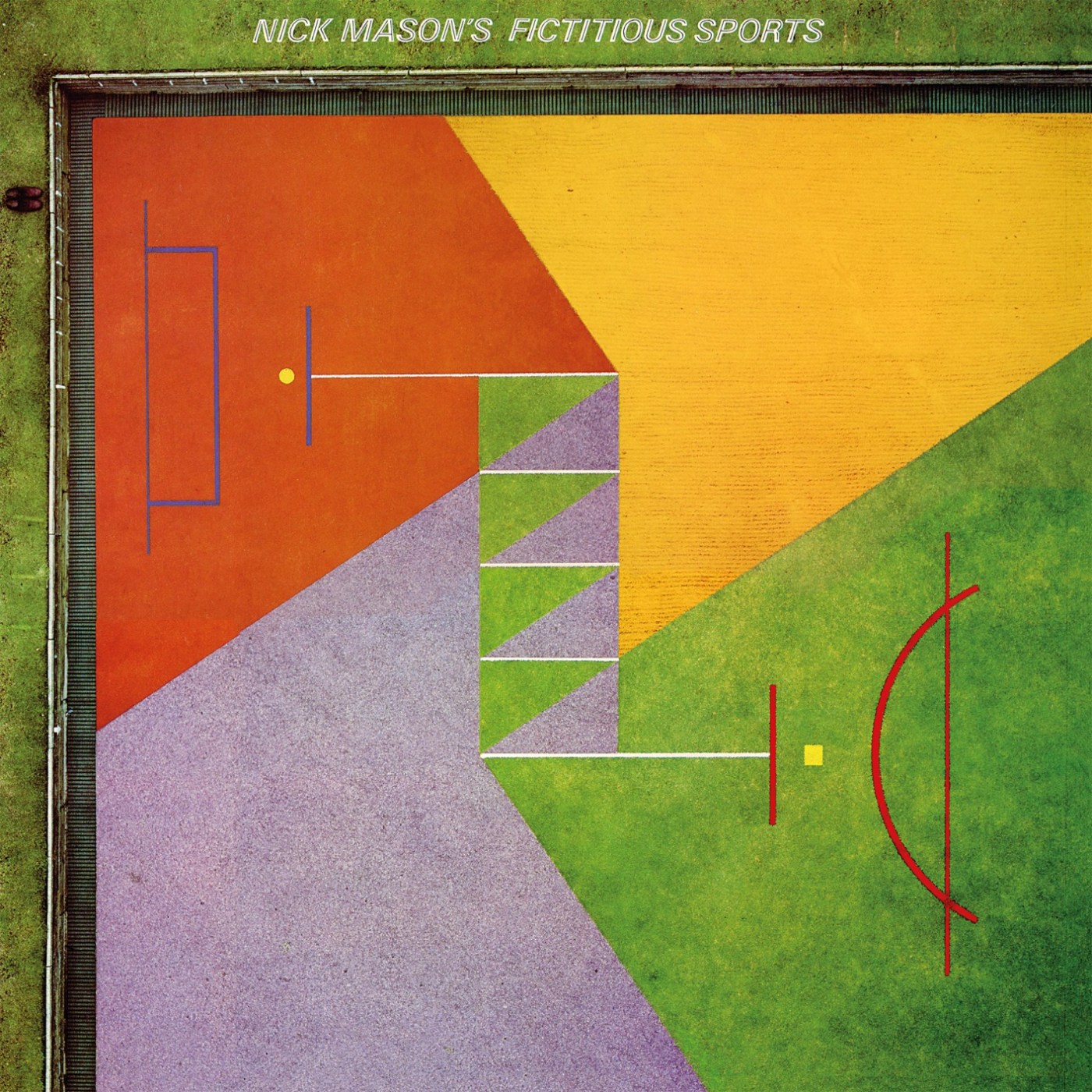
Nick Mason’s Fictitious Sports is the first solo album by Pink Floyd drummer Nick Mason. Or is it really?
When is a solo album not really a solo album? Nick Mason did not write or write lyrics for any of the songs on Fictitious Sports, nor does he sing on them. Mason does bang the drums on the album and he also co-produced the album. If there is one auteur for Fictitious Sports, it is pianist/composer Carla Bley, best known for her avant-garde jazz recordings, the most famous of which is Escalator Over The Hill (1971).
There are slightly different stories about the genesis of the album. In one version, Nick Mason was planning his first solo album when Bley contacted him and offered his own songs to Mason. In the other version, which I understand to be the most plausible story, Fictitious Sports began as a project of Carla Bley’s own which Mason just happened to be involved in and which was then called Mason’s album, mainly for commercial reasons. Apparently the record was shopped to record companies (Bley’s jazz records were usually released by her and Michael Mantler’s own company Watt and distributed by ECM), but no takers were found. The situation changed when a Pink Floyd member’s name was stamped on the cover. As an added bonus, the Pink Floyd members’ recording contract guaranteed a large advance on any member’s solo album.
The collaboration between Mason and Bley did not come out of nowhere, as they had already crossed paths on Mantler’s (Bley’s husband at the time) 1976 album The Hapless Child And Other Inscrutable Stories, which Mason mixed and had a small voice part on. The vocalist on the same album, Canterbury legend Robert Wyatt, was also lured to sing for Fictitious Sports. Mason and Wyatt’s relationship goes back even further, however, as Mason produced Wyatt’s masterful 1974 solo album Rock Bottom. Mason has occasionally called that album the greatest achievement of his career.
“Carla Bley made me work when I wasn’t working. She said: ‘Come on, who do you think you are? Some fucking pop star? You’ve never had a hit record, you’re not good-looking enough. You’re just a musician like the rest of us, so get on with it!’ So she shamed me back into the studio and I enjoyed it.”
Robert Wyatt
Incidentally, the musicians of Fictitious Sports also come mainly from the circle of Bley and Mantler. Their trusted bassist Steve Swallow plays bass and British guitarist Chris Spedding played on Mantler’s album Silence (1977). Wind player Gary Windo, who usually plays mostly in the English avant-garde jazz scene, had played on Bley’s European Tour 1977 (1978). Tuba player Howard Johnson was familiar from Gary Burton’s album A Genuine Tong Funeral (1967), for which Bley provided the music. Trombonist Gary Valente was a newcomer to the scene, but went on to become a regular on Bley’s albums. In addition to the musicians mentioned above, there are three backing vocalists and Karen Kraft who sings lead vocals on the opening track of the album.
Fictitious Sports was recorded at Bley and Mantler’s Grog Kills studio in October 1979. This was an appropriate time for Mason as, at the same time, Pink Floyd’s Roger Waters and David Gilmour were wrestling with producer Bob Ezrin over the mixing of the mammoth The Wall album, and they didn’t need their drummer in the equation.
And what kind of music is Fictitious Sports? Carla Bley has said that she was fascinated by the punk scene at the time of making the album and has said that it inspired the compositions on Fictitious Sports. She herself has called the album ”punk jazz”. In my opinion, the music of Fictitious Sports, which is mostly quite controlled and mostly rather restrained, does not really fit this description, but I see it as a combination of jazz, new wave and progressive rock, which resulted in a very distinctive art rock album.
”Those songs on the Fictitious Sports album were heavily influenced by the whole punk-rock thing. I was infatuated with it, and you know what people do under the influence of infatuation – crazy things. But I’m no longer infatuated with it; I’m bored to tears by the whole thing. My new songs aren’t influenced at all by that scene.”
Carla Bley in 1981
The sound of Fictitious Sports is crisp and pared down. The songs are mostly quite fast and have their moments of brashness which helps to explain a bit of the definition of ”punk-jazz”. As well as perhaps that the songs are relatively simple. At least by the general standards of Bley’s output. Typically for Bley, brass instruments play a rather large role. On the other hand, more uncharacteristically for Bley, all eight short (3-6 min) tracks on the album feature vocals. And with choruses to boot! The lyrics written by Bley are quite strange and humorous. And the humour they contain is very dry. Fictitious Sports is actually a hilarious album. The lyrics are a mixture of witty (sometimes not so witty) puns and a few outright WTF? moments.
A particularly hilarious song is ”I Am Mineralist” (minimalist, you know? chuckles), a parody of Philip Glass’ music, where the protagonist of the song wrestles with his sexual fetish for rocks and minerals. The hallucinatory sounding track is also musically interesting and contains a few clear hats off to Glass in the form of a cyclical organ ostinato and intermittent aaaaaaaaaaaa vocals.
Erik Satie gets my rocks off, Cage is a dream
Phillip Glass is Mineralist to the extreme
I like tickling ivories and fingering stones
When my mercury goes up I play with my bone
Along with ”I Am Mineralist”, ”Hot River” is another example of the musical humour that Fictitious Sports cultivate. ”Hot River” is a clear Pink Floyd pastiche that contains many Floyd characteristics. The most obvious of these are Spedding’s very gilmour-esque guitar playing, female vocals reminiscent of ”Great Gig in the Sky” and of course Mason’s own drumming which seems to deliberately channel his style from the The Dark Side Of The Moon days. Stylistically, ”Hot River” is probably the only track on the album that offers some satisfaction to those Mason followers who listen to the album in the hope of hearing some Pink Floyd-like music.
My single favourite of all the songs on the album is ”I Was Wrong” which is Wyatt’s debut on the album after the opening ”Can’t Get My Motor to Start” sung by Karen Kraft. The rest of the songs are sung by Wyatt and it is on ”I Was Wrong”, which tells the story of a UFO sceptic’s mistake, that he is at his best. Wyatt sings with a rhythmic, breathy sincerity and his vocals combined with the wild, riffy, chugging brass and Mason’s smooth but tight drumming make for a truly charming and original mix.
Read also: Review: Pink Floyd – A Momentary Lapse Of Reason (1987)
In the end, Nick Mason’s name didn’t seem to make much of an impact on Fictitious Sports’ sales. The album didn’t chart and didn’t make much of a splash in the music world when it was released. However, Fictitious Sports, which nowadays enjoys a rather cautious cult reputation, is, in my opinion, by far one of the best solo albums (let’s call it that) to come out of the Pink Floyd camp.
After Fictitious Sports, Carla Bley returned to jazz (with the excellent 1981 album Social Studies) and Nick Mason returned to Pink Floyd under the reign of Roger Waters. After The Wall tour, Pink Floyd lived in a state of uncertainty for a while until 1983, when, under Waters’ leadership, they released The Final Cut, the band’s last album.
However, David Gilmour and Nick Mason revived the name in 1987 with A Momentary Lapse Of Reason and a huge tour. Shortly before this, Mason had done more solo work with guitarist Rick Fenn, who had played in 10cc and Mike Oldfield’s band. Unfortunately, the duo’s album Profiles (1985), which sank into a clichéd 80’s sound, falls far short of the appeal of Fictitious Sports. Since Profiles, apart from a few soundtracks, Mason has not attempted to forge a musical career of his own outside Pink Floyd.
Best tracks: ”I Was Wrong”, ”Siam”, ”Do Ya?”, ”I Am Mineralist”, ”Wervin’”
Author: JANNE YLIRUUSI
Tracks
- Can’t Get My Motor To Start (3:35)
- I Was Wrong (4:10)
- Siam (4:46)
- Hot River (5:11)
- Boo To You Too (3:24)
- Do Ya? (4:29)
- Wervin’ (3:55)
- I’m A Mineralist (6:14)
Musicians
Nick Mason: drums, percussion Robert Wyatt: vocals Karen Kraft: vocals (1-lead) Chris Spedding: guitars Carla Bley: keyboards Terry Adams: harmonica & clavinet (1), piano (5) Gary Windo: tenor saxophone, bass clarinet, flute, backing vocals Gary Valente: trombone, backing vocals Michael Mantler: trumpet Howard Johnson: tuba Steve Swallow: bass guitar Carlos Ward: backing vocals D. D. Sharpe: backing vocals Vincent Chancey: backing vocals Earl McIntyre: backing vocals
 Pienemmät Purot
Jätä kommentti