So-called minimalist music emerged in the early 1960s in the USA. It is characterised by repetition and a deliberately simplified rhythmic, melodic and harmonic language. Minimalist music was in a sense a reaction to the increasingly complex and intricate atonal and serialist tendencies represented by Arnold Schoenberg and his followers.
The four key composers of the minimalist movement in its early days were La Monte Young, Terry Riley, Philip Glass and Steve Reich. After a rocky start, the latter two became the new superstars of art music. While Glass’s music gradually became more and more grandiose, Reich remained more faithful to the idea of minimalism.
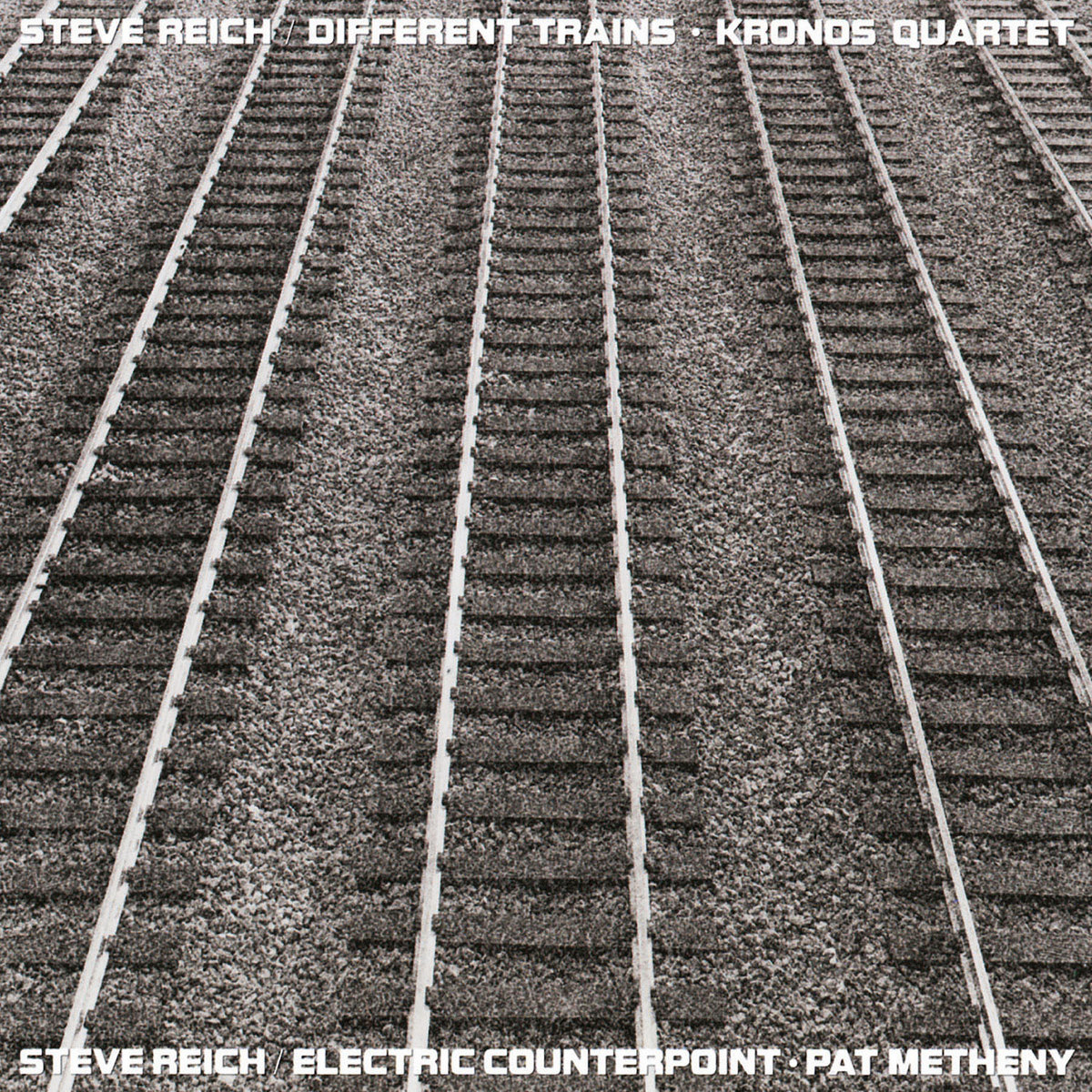
Nonesuch’s Different Trains / Electric Counterpoint, featuring two extensive compositions, is one of the most significant and celebrated recordings of Steve Reich’s career.
Read also: Review: Fred Frith And Ensemble Musiques Nouvelles – Something About This Landscape For Ensemble (2023)
The album opener ”Different Trains” is a three-part work of about 27 minutes, performed with the string quartet Kronos Quartet, based on loops of tape constructed from human voices and strings played around them. Sound effects are also used effectively.
”Different Trains” is based on Reich’s childhood memories. As a child during World War II, he often travelled by train from Los Angeles to New York and back with his governess because his parents had divorced and settled in different parts of the United States. For the young Reich, these journeys across the continent were exciting and interesting adventures, but later the composer of Jewish background had a chilling realisation; if he had happened to be born in Germany instead of the United States, he and his family would have ended up travelling on very ’different trains’.
”Different Trains” traces the journey from the pre-war period of optimism and growth to the Holocaust, and from there to the post-war period of rebuilding the world with mixed emotions after the fall of the Nazis.
In its execution, Reich combines two of the key methods of his career in ”Different Trains”. The essential role is played by the various speech fragments from which he constructs fascinating, repetitive and often rhythmic loops of tape. It was on such tape loops that Reich based some of his early groundbreaking works such as ’It’s Gonna Rain’ and ’Come Out’ in the mid-1960s. On the other hand, the song also highlights Reich’s phasing technique which he had used not only in his later compositions ”Piano Phases” and ”Violin Phases” but also in ”Music for 18 Musicians”. In Reich’s trademark phasing technique, musical patterns are gradually moved out of sync with each other, creating a mesmerizing and pulsating effect.
The only real instruments in ”Different Trains”, alongside loops of tape with speech and sound effects, are two violins, a viola and a cello from the world-famous Kronos Quartet. The quartet’s strings are at times subdued and at times oppressive, with a delightful jaggedness and intensity throughout the composition. The Kronos Quartet has never been afraid to sound ”ugly”.
The first part of ”Different Trains”, ”America – Before The War”, kicks off the densely-paced work with an intense grip. The strings roar, the bells chime, and the train whistles squeal energetically with optimism. World progress is inevitable, everything will be better! Soon, however, a more serene and complex section is introduced, which seems to already contain doubts about the future. At times the music seems almost to stop, the strings plucking the steadily rotating ostinato. In the background, the conductor’s voice plays intermittently, and the train whistle increase the tension. The Kronos Quartet’s strings play through the composition with a delightfully jagged intensity.
The second movement, ”Europe – During The War”, is the slowest and understandably darkest part of the composition. The sounds of train whistles are interspersed with the sound of air-raid sirens. The patterns of the strings become increasingly mournful, haunting and slow. The soundscape effectively and hauntingly depicts the confusion and terror of the Jews as they were transported in cattle cars towards their unknown but ominous fate. Snippets of speech interspersed with music sealed the horror: ’no more school’ and ’They shaved us, They tattooed a number on our arm, Flames going up to the sky – it was smoking’.
The last part, ”After The War”, plays faster, and again has a much more optimistic sound. The string ostinato at the beginning is almost playful. In the background you can hear a male voice declaring ”War is over!” Soon, however, a note of doubt creeps into the music, and a gentle woman’s voice asks, ”Are you sure?” The last part of the composition seems to alternate between a sense of restrained elation and uncertainty. Is it over after all? Have we learned anything from the horrors of the Holocaust and the Second World War, or will we inevitably repeat the same mistakes?
Lue myös
- Levyarvio: Steve Walsh – Glossolalia (2000)
- Year by Year : Best Albums of 1976 – 21-29
- Levyarvio: Jimmy Page – Outrider (1988)
- Review: Brian Eno + David Byrne – My Life in the Bush of Ghosts (1981)
- Levyarvio: Gong – Zero To Infinity (2000)
- Review: Michael Oldfield – Heaven’s Open (1991)
The second track on the album, the 15-minute ”Electric Counterpoint”, provides an exciting contrast to ”Different Trains”. It is a very different composition, both in mood and execution. Where the strings sound dark and dense in the previous work, the electric guitars layered on several levels of the airy ”Electric Counterpoint” are like sunbeams on a calmly wavering sea.
Written for jazz superstar guitarist Pat Metheny (20 Grammy awards in ten different categories!), ”Electric Counterpoint” is a hypnotic minimalist plinking that sounds either boring or brilliant, depending on your mood. Most of the time, thankfully, leaning towards the latter. The only instrumentation on the track is the electric and bass guitars recorded on top of each other by Metheny. I understand that there are a maximum of 11 guitars and two basses overlapping.
Divided into three sections (1. Slow, 2. Fast, 3. Slow), ”Electric Counterpoint” is based on simple guitar phrases layered on top of each other and overlapping. In between, the guitars play the same pattern in succession before the previous one has reached the end of the pattern, thus forming a canon. Metheny strums his electric guitars with a subtle, very clean sound with only a little echo and delay.
It was interesting to see Finnish guitar virtuoso Marzi Nyman perform the song live in Helsinki’s Musiikkitalo some years ago. As I understand it, concerts usually use Metheny’s original recordings as backing tracks and the soloist then plays what he can on top. Radiohead guitarist Jonny Greenwood has also played ”Electric Counterpoint” and has a recording of it on the excellent album Radio Rewrite (2012).
Steve Reich’s ”Different Trains” won a Grammy Award for Best Contemporary Music Composition and it has become one of the composer’s most celebrated works. For me, too, ”Different Trains” has always been the most moving of Reich’s compositions because of its exceptionally strong emotional charge.
When I was first introduced to Different Trains / Electric Counterpoint, I thought the two compositions were a bit odd couple and even incompatible, but since then I’ve realised that in fact perhaps they complement and support each other in just the right way. ’Different Trains’ is a darkly oppressive nightmare, while ’Electric Counterpoint’ is like a gentle summer rain that washes away the horrors of its predecessor.
Different Trains / Electric Counterpoint is one of Reich’s most significant albums and demonstrates his ability to compose music that resonates on both an emotional and intellectual level.
Best tracks: ”America – Before The War”, ”Europe – During The War”
Author: JANNE YLIRUUSI
Read also: Review: Jack O’ The Clock – The Warm, Dark Circus (2023)
Tracks
Different Trains
- America – Before The War 8:59
- Europe – During The War 7:31
- After The War 10:20
Electric Counterpoint
- Fast 6:51
- Slow 3:21
- Fast 4:29
Muusikot
David Harrington: violin John Sherba: violin Hank Dutt: viola Joan Jeanrenaud: cello Pat Metheny: guitar, bass guitar
Producer: Judith Sherman
Label: Nonesuch

 Pienemmät Purot
Jätä kommentti