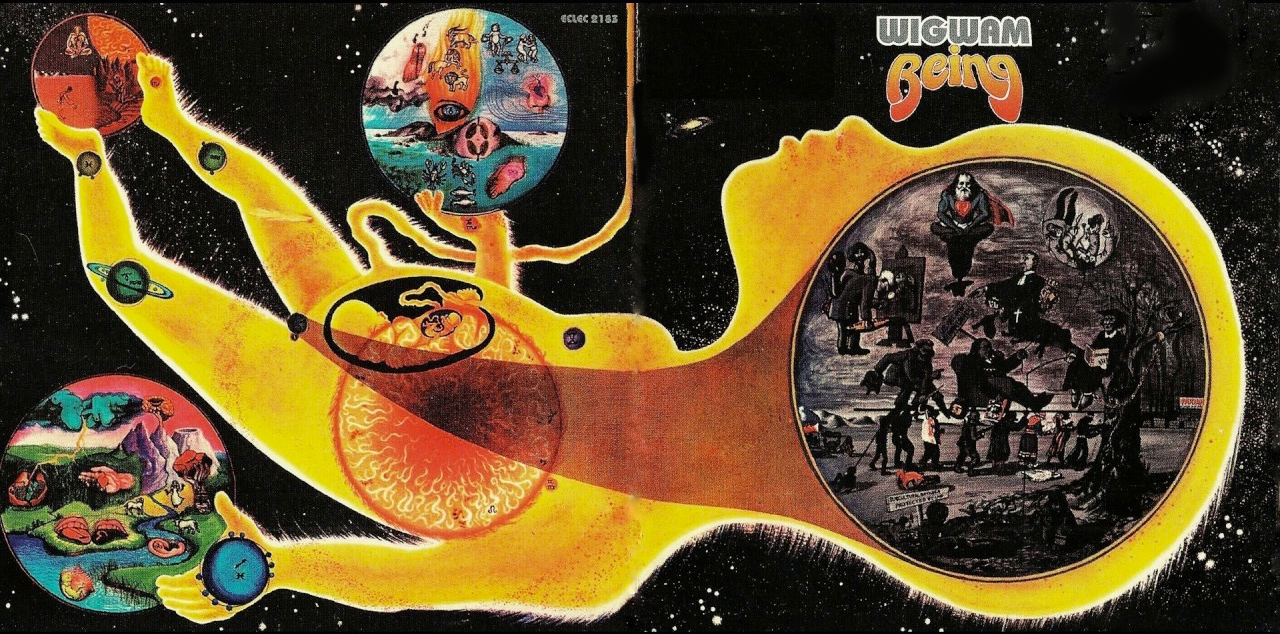
Being is the fourth studio album by Wigwam, founded in Finland in 1968.
Wigwam’s first three albums contain many great moments, but each of them is rather uneven as a whole.
Being transforms all of this into a full set of one exquisite composition after another, forming a very coherent whole. Being is a theme album, but it represents the section of concept albums where the actual theme is very difficult to sum up in a few words. It is a kind of study of the clashes between different social classes and ideologies. With a strong sarcastic and black humour touch. Some of the lyrics, which mocked communism, were rejected by the Love Records label, which had a very strong left-wing slant.
The mastermind behind the whole concept of Being was keyboardist/vocalist Jukka Gustavson, but he did not write and compose all the songs on the album alone, but shared the workload with bassist Pekka Pohjola and keyboardist/vocalist Jim Pembroke, who wrote the songs according to Gustavson’s loose instructions. Some of the compositions had been written before the concept of Being was conceived, but Gustavson then modified them as best he could to make them fit better into the whole.

The lyrics on the resulting album are very cynical and dark. Mankind, destroying itself and its environment in its stupid greed, is given little mercy in Gustavson’s lyrics. Pembroke’s ’Petty-Bourgeois’, ’Maestro Mercy’ and ’Marvelry Skimmer’ at least lighten the atmosphere a little.
The darkest track on the album is Pohjola’s ”Pride of the Biosphere” where Gustavson’s lyrics have a military chaplain telling stories in a squeaky voice about how officers used to rape the waitresses in a military canteen and then shoot them. In the background, the devout organ theme of the Pohjola plays in sarcastic contrast. Pohjola later recycled the same melody in a less haunting mood on his own album Keesojen lehto (1977).
Being was a major project for Wigwam, carefully built over the course of a year. Although the actual studio time was only about a month. Which was a lot for a Finnish rock band at that time. Usually, Finnish rock albums were recorded in a week or even less.
Wigwam had already taken clear steps towards more progressive music with their previous album Fairyport (1971) and this trend is only confirmed with Being. The songs are more complex and the instrumental performances more virtuosic.
However, like many other progressive bands, Wigwam didn’t set out to build songs of colossal length, but Being consists mostly of short 2-4 minute songs. The only exceptions are the 9 minute ”Pedagogue” and the 6 minute ”Prophet”. On the other hand, some of the songs form suites of their own, i.e. some of the songs are tied together by seamlessly stitching them together.
Being’s compositions are so dense and full of musical information and ideas that many a mediocre prog band would have built a 20 minute epic out of them. Indeed, Being’s short but extremely complex pieces are more akin to the music of Gentle Giant and especially Henry Cow than to the more leisurely symphonic arcs of, say, Yes or Genesis.
Jukka Gustavson’s beloved soul influences add their own piquant flavour not often heard in prog. Being sounds a bit like what Henry Cow might sound like if Stevie Wonder had been a member of the band. The respected British music critic Ian Mcdonald went further than me in his comparison and wrote in praise of the album, describing the music as sounding like the aforementioned Stevie Wonder meets Frank Zappa’s Mother Of Invention and Robert Wyatt, all directed by composer Arnold Schoenberg. Yes, I could subscribe to that too.
The more complex compositions by Gustavson and Pohjola alternate in a balanced way with Pembroke’s slightly lighter pieces (which are not simple tunes either). It’s a really effective solution and the whole thing even feels surprisingly coherent. Although the original composition of the songs can be clearly traced back to one man, all the songs, after going through the arrangement/recording grinder, have become specifically Wigwam music.
The most challenging aspect of Being is represented by Gustavson’s compositions, especially ”Pedagogue” and ”Prophet”, which are not only rhythmically complex, but also constantly evolving and deftly evading the normal pop formula of musical repetition.
”Pedagogue” has its roots in the three-minute single ”Pedagogi”, released a couple of years earlier, but on Being Gustavson modified and expanded the composition significantly and the link to the original version is barely recognisable. The beautifully sounding ”Pedagogue”, which is full of changes in tempo, features brass arrangements by Pekka Pohjola that are a treat to listen to and bring to mind not only Pohjola’s idol Frank Zappa, but also Pohjola’s own first solo albums. In the context of Being, the arrangements could have worked a bit more sharply, though. Gustavson’s effervescent and nimble-fingered soloing on a Fender electric piano is also particularly stunning in ’Pedagogue’. The song also features a soprano saxophone solo from Pekka Pöyry.
Read also: Henry Cow – Leg End (1973)
Along with ”Pedagogue” and ”Prophet”, the third purely musical highlight on the album is the instrumental track ”Planetist”, composed by Pohjola, where Pohjola plays not only a clever bass pattern but also violin and Mini-Moog. The very Pohjola-like composition also includes a brilliantly played saxophone finale, from which the intense song finally changes on the fly to Pembroke’s gentle ballad ”Maestro Mercy”, which is a little reminiscent of The Beatles.
At the end of the album, Wigwam repeats the trick they had already performed with great success earlier in the album, a smooth transition from difficult to easy as Gustavson’s sparkling ”Prophet” turns into Pembroke’s ”Marvely Skimmer”. ”Anthemic Marvely Skimmer” is the perfect end to the album and brings with it at least a hint of optimism after all the gloom and doom.
Pohjola and Gustavson are right at home with Being’s complex music, but although the material was challenging for Pembroke and especially Österberg to play, they are up to the challenge with flying colours.
However, due to the intricate nature of the songs, with the exception of a couple of Pembroke’s pieces, Being’s songs never made it into Wigwam’s repertoire of gigs. Especially for drummer Österberg, who was rock-minded and stylistically aware, they were too difficult, but also Gustavson himself found it challenging to play and sing such complex music live at the same time.
Wigwam had already previously ignored their own compositions and played a lot of cover songs at gigs. In Finland, where there was a general shortage of good live rock, this might have worked, but it hardly helped the band’s profile and world conquest, which was attempted starting in England with a few short tours both before and after the release of Being.

Alongside the seamless union of music and lyrics, the album’s rich cover artwork, which is absolutely stunning, adds a strong sense of a Gesamtkunstwerk to Being. Perhaps the finest ever seen on a Finnish rock album. The cover was designed by Jukka Gustavson and executed by Jorma Auersalo. The painting on both the front and back of the vinyl features a cosmic baby floating in space (reminiscent of Stanley Kubrick’s ”starchild” from 2001 A Space Odyssey), incubating the album’s theme characters in his head.
The recording of Being can’t be described as particularly distinctive and the sound is more of a dull, muffled kind of thing. But mainly in a positive sense. The sound is warm and inviting and certainly makes otherwise densely complex music a little more approachable.
In all its uncompromising defiance, Being was not only a critically acclaimed album but also Wigwam’s biggest commercial success to date. The album peaked at number 11 in the Finnish album charts, which, given the modest Finnish album sales in 1974, was not a huge financial success for the Wigwam men, but a good achievement for such a challenging album.
Jukka Gustavson left Wigwam in June 1974 almost immediately after the band’s tour of England. Gustavson was frustrated by many things, such as the lack of a common artistic direction, the excessive alcohol consumption of the rest of the band, and the ambitions of Pembroke and Österberg for commercial success, which, in the opinion of the determined Gustavson, inevitably drove the band towards compromise. Soon after Gustavson’s departure, Pohjola also decided to leave the band. Partly for the same reasons, but especially because after Gustavson’s departure it was clear that the band would no longer be able to put the same emphasis on artistically ambitious and skilfully played music that Pohjola wanted to make and play.
Shortly after leaving Wigwam, Pohjola started working on his second solo album Harakka Bialoipokku. Pohjola had a long and prolific solo career, making a remarkable series of high quality and very original progressive music recordings. Pohjola’s musical career continued until his death. Pekka Pohjola died in 2008. His music will live on forever.
Jukka Gustavson retired from the music world for several years and only started his solo career in 1978 with the album …jaloa ylpeyttä yletän… ylevää nöyryyttä nousen. Gustavson’s albums were of a more uneven quality than Pohjola’s, but the best of them were made with great ambition. Gustavson’s career in music was also more intermittent, sometimes working long periods as a janitor. Since retiring from his day job in the 2010s, Gustavson has again been an active music maker and performer.
After Pohjola and Gustavson left the band, Wigwam streamlined their style considerably and moved into more conventional rock with their next album Nuclear Nightclub. However, Wigwam’s music still had a hint of the prog spirit. Wigwam himself called this new style deep pop. Deep pop brought the band many new fans, but although the band’s albums of the second half of the 1970s contain a lot of very good music, I don’t think they ever quite achieved the magic of their best album, Being.
Being is not only Wigwam’s best album but also quite possibly the best Finnish prog album of all time.
Best tracks: ”Proletarian”, ”Petty-Bourgeois”, ”Pedagogue”, ”Planetist”, ”Marvelry Skimmer”
Kirjoittaja: JANNE YLIRUUSI
(Mikko Meriläinen’s excellent book Wigwam (2006) was an important source for this article.)
Find more reviews here
Kappaleet:
- ”Proletarian” Jukka Gustavson 2:10
- ”Inspired Machine” Gustavson 1:28
- ”Petty-Bourgeois” Jim Pembroke 2:58
- ”Pride of the Biosphere” Gustavson, Pekka Pohjola 3:17
- ”Pedagogue” Gustavson 9:12
- ”Crisader” Gustavson 4:50
- ”Planetist” Pohjola 3:08
- ”Maestro Mercy” Pembroke 2:34
- ”Prophet” Gustavson 6:11
- ”Marvelry Skimmer” Pembroke 2:32
Pekka Pohjola: bass, violins, piano (4th), mini-moog (7th), notation Jukka Gustavson: vocals, pianos, organ, mini-moog, VCS 3 synthesizer Ronnie Österberg: drums, percussion, backing vocals (3rd) Jim Pembroke: vocals, preaching, piano (3rd, 10th)
Guests:
Pekka Pöyry: soprano saxophone, flute Pentti Lasanen: clarinet, flute Paavo Honkanen: clarinet Ilmari Varila: oboe Aale Lindgren: oboe Juhani Tapaninen: bassoon Unto Haapa-aho: bass clarinet Juhani Aaltonen: solo flute Seppo Paakkunainen: flute Erik Dannholm: flute Pentti Lahti: flute Kari Veisterä: flute Taisto Wesslin: acoustic guitar Erkki Kurenniemi: VCS 3 accompaniment Jukka Ruohomäki: VCS 3 accompaniment
Producers: Måns Groundstroem ja Paul Jyrälä
Label: Love Records
 Pienemmät Purot
Jätä kommentti