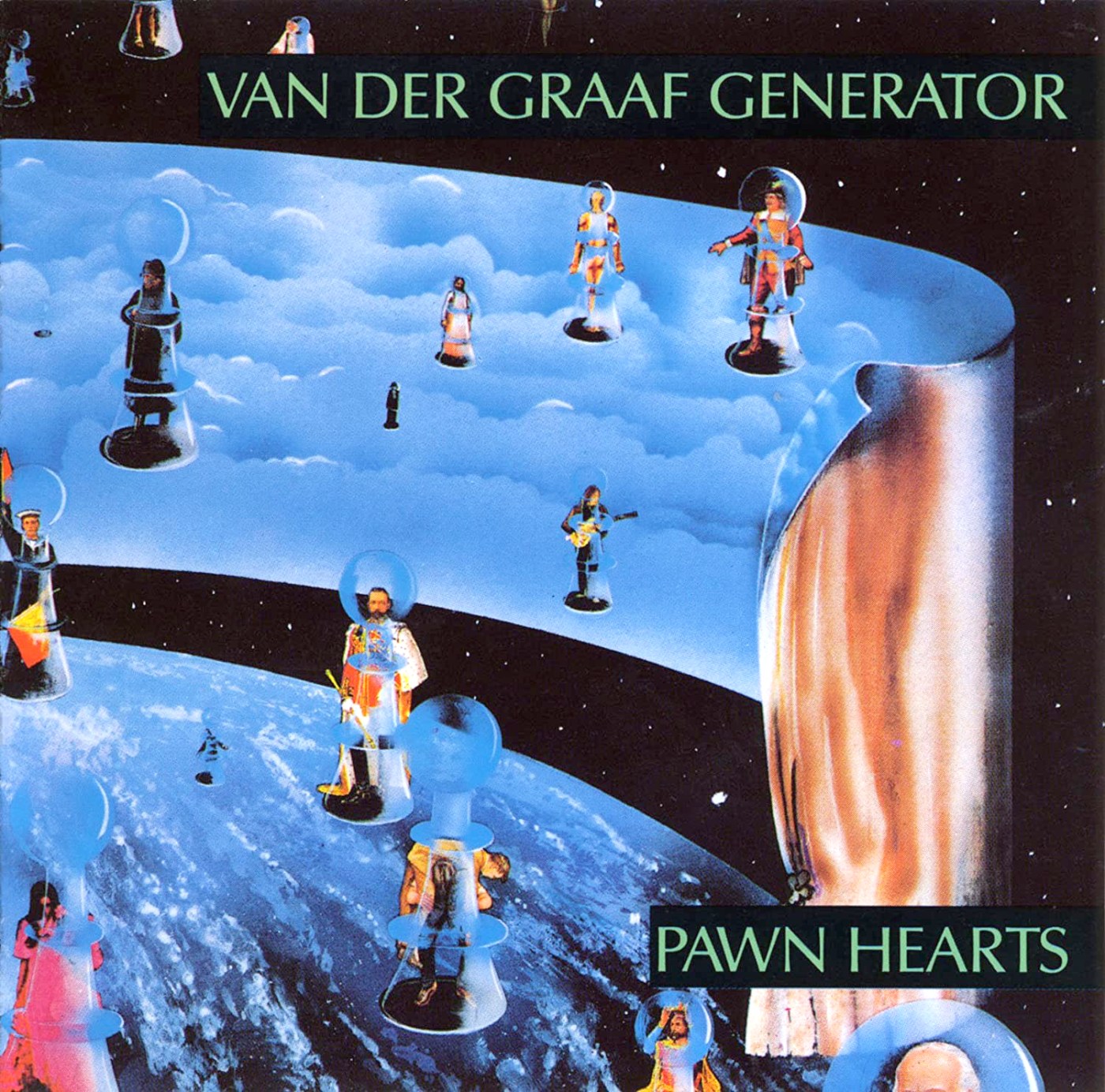
Pawn Hearts is the fourth studio album by Van Der Graaf Generator, founded in 1967. Their first masterpiece.
Where Pawn Hearts’ predecessor H to He, Who Am the Only One (1970) was a good but somewhat cautious album, this time VdGG indulges in a completely unrestrained way and ends up in very deep waters. In short: Pawn Hearts is an album gone completely bonkers.
A tour of 21 cities in 23 days, in difficult circumstances and with almost no money, drove the four members of the band (Peter Hammill, David Jackson, Guy Evans, Hugh Banton) to the brink of madness. In these conditions, the band shut themselves away for several months at Trident Studios with producer John Anthony to create a new album. In the studio, the band occasionally took acid to stimulate the imagination and the result is a manic mix of touring madness, chemical influences and the band’s extreme musicality. Whereas previous VdGG songs were mostly recorded in the studio in a relatively simple style, the songs on Pawn Hearts are studio recordings where the band and Anthony use the studio as one instrument among others.
King Crimson guitarist Robert Fripp’s electric guitar is also heard here and there throughout the album, but at no point does his playing really stand out, only playing a minor supporting role in the band’s turbulent and kaleidoscopic music.
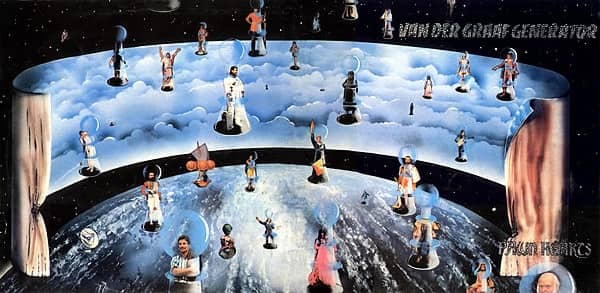
Pawn Hearts contains only three long (10-23 minutes) tracks. The first of these, ”Lemmings (including Cog)”, which begins beautifully and melodically, soon becomes a manic sound wall of sound. Extremely intense instrumental parts alternate with calmer vocal parts in a clever way. Hammill varies his voice in the song with extreme skill, taking it from one extreme to the other with effortless ease. Hammill’s lyrics, which initially describe a hopeless situation in which the lyrics’ protagonist seems to be contemplating suicide, eventually end with a fateful (and cautiously hopeful) intensity:
What choice is there left but to live
In the hope of saving
Our children’s children’s little ones?
What choice is there but to live?
What choice is there but to live?
What choice is there but to live?
To save the little ones?
What choice is there left but to try?
Maybe there is no hope for humanity and the planet, but what else can you do but try your best? A strong and timely message, still relevant today. Perhaps especially today.
Introduced by an extremely wistful and beautiful vocal melody, the ten-minute ”Man-Erg” is a song about the struggle between the good and evil angels in the soul of the narrator. The song’s pathos grows to staggering heights without the music feeling corny at all. At the three-minute mark, the song undergoes a sudden change of mood as the band moves into the complicated and tight riffing. Hammill roars in a vicious voice
How can I be free?
How can I get help?
Am I really me?
Am I someone else?
David Jackson’s double saxophones (yep, he played two saxophones at the same time) roaring in competition with him. Just a great scene. The rest of the song varies and cleverly develops a mix of beautiful melodic sections and more experimental and rhythmic instrumental sections. ”Man-Erg” is one of VdGG’s finest tracks.
”A Plague Of Lighthouse Keepers”, the album’s closing track, is the band’s 23-minute magnum opus. A patchwork of ten different sections, it contains numerous tempo and time signature changes and is probably the band’s most complex song. Although the band didn’t play the song as a whole in the studio once, but assembled it from separate pieces, the whole works surprisingly well.
In the vein of Hammill, this song is also about existential pain, telling a surrealistic story of a lighthouse keeper who loses his mind as he watches powerlessly from his lighthouse as the stormy sea around him kills shipwrecked sailors.
The music, which surges forward with maniacal intensity, is more than stormy enough to do justice to the lyrics. At times, the listener feels as if they have been caught in the middle of an electric maelstrom as the whole band plays at full blast. On the other hand, like the previous tracks on the album, VdGG understands how to give room for contrasts and lighter touches in ”A Plague Of Lighthouse Keepers”. With this classic prog trick, even the heavier parts always feel all the more brutal as they segue into the serene, dreamy and beautiful sections.
Read also: Van der Graaf Generator : The Least We Can Do Is Wave to Each Other (1970)
Pawn Hearts was originally going to be a double album with new versions of the band’s old songs and solo tracks by the band members. However, the record label Charisma objected to the idea and in the end only three long tracks ended up on the album. And I must say that for once the label made a wise decision! Pawn Hearts is a perfect album just as it is and any extra material would have only diluted the power of the whole.
The US and Canadian editions did include the band’s arrangement of ”Theme One” by Sir George Martin, best known as The Beatles producer. ”Theme One” was the theme tune for BBC Radio One and VdGG had taken to playing their own interpretation of it as an encore. The song was very popular with live audiences and rightly so, as this snappy, downright jubilant, fanfare-like instrumental is a treat to listen to.
The 2005 CD re-release included not only ”Theme One” but also a bunch of other songs planned for the original double album. The standard of this surplus material is quite varied.
Pawn Hearts is probably VdGG’s best-loved album overall. For me, this great album is pretty much tied with Godbluff and Still Life for the title of the band’s best album. It is a unique masterpiece in any case.
Pawn Hearts was no more successful in the band’s home country of England than their previous albums, but surprisingly in Italy, where progressive rock was on the rise, it reached number one on the album charts. The members of VdGG briefly became stars in Italy and received a hysterical reception from their fans on the Italian tour. Eventually, the band did three heavy tours of Italy in the course of a year. Excessive touring, combined with the fact that the fruits of their success would not reach the band’s pockets, eventually broke the band’s morale and in the summer of 1972 Van Der Graaf Generator ceased to exist. For a while…
Best tracks: ”Lemmings”, ”Man-Erg”, ja ”A Plague of Lighthouse Keepers”
(2021 Pawn Hearts was remastered and remixed by Stephen W. Tayler. These versions are highly recommended listening.)
Author: JANNE YLIRUUSI
Tracks
- ”Lemmings (Including ’Cog’)” 11:35
- ”Man-Erg” 10:19
- ”A Plague of Lighthouse Keepers” 23:03
a. ”Eyewitness” – 2:25
b. ”Pictures/Lighthouse” 3:10
c. ”Eyewitness” – 0:54
d. ”S.H.M.” – 1:57
e. ”Presence of the Night” – 3:51
f. ”Kosmos Tours” 1:17
g. ”(Custard’s) Last Stand” – 2:48
h. ”The Clot Thickens” 2:51
i. ”Land’s End (Sineline)” 2:01
j. ”We Go Now” 1:51″
Van der Graaf Generator:
Peter Hammill: vocals, piano, Hohner pianos, acoustic guitar, slide guitar David Jackson: tenor, alto and soprano saxophones, flute, backing vocals Hugh Banton: Hammond E & C and Farfisa Professional organ, piano, Mellotron, ARP synthesizer, bass pedals, bass guitar, psychedelic razor, backing vocals Guy Evans: drums, drum kit, percussion, piano
Guests
Robert Fripp: electric guitar
Tuottaja: John Anthony
Levy-yhtiö: Charisma

 Pienemmät Purot