Yes’s previous album, The Yes Album, released just nine months earlier, was a major breakthrough for the band. Commercially even more than artistically. With The Yes Album, the band moved, if not quite into the A-category of rock bands, then firmly into the B-category. But the band wanted more. Leaders Jon Anderson and Chris Squire were not only hungry for more success, but also wanted to make their band even more perfect musically.
The duo denounced keyboardist Tony Kaye as the weak link in the band. Kaye’s main weakness was said to be that he was not interested in the latest synthesizer technology and stubbornly stuck to his Hammond roots. Kaye was also not perceived to be on a par with the rest of the band in terms of playing skills. Anderson and Squire wanted one more virtuoso in the band. Goodbye Kaye and welcome Rick Wakeman.
Born in 1949, Rick Wakeman had made a name for himself in the London studio scene in previous years, playing a huge number of sessions, the most famous of which are ”Space Oddity” and ”Life On Mars?” with David Bowie and ”Morning Has Broken” with Cat Stevens.
Rick Wakeman, who studied piano and orchestration for a while at the Royal College Of Music in London, was not only a virtuoso pianist but also an enthusiastic pioneer of new synthesizers. The previous year, Wakeman had joined progressive folk band Strawbs, where he had shown himself to be a charismatic live performer with his long blond hair.

The perfect man to be the new ruler of the Yes keyboard booth. Wakeman was somewhat reluctant to leave Strawbs as he was enjoying his time with the band and their star was on the rise. On the other hand, the prospect of a solo career had already begun to tempt Wakeman. However, after a little persuasion, Wakeman gave in to the temptation of Yes and the band’s dreamteam was finally assembled. Anderson and Squire were ready to take their music to the next level with drummer Bill Bruford, guitarist Steve Howe, who had joined on the previous album, and a new keyboardist brother.
On Fragile, Yes made the somewhat questionable decision to give each band member a solo number. The album thus features five solo performances of varying levels (some of which also feature other band members) and four more collective songs. Bill Bruford had originally pitched the idea that each member would compose their own song which the band would then arrange into a finished piece. However, apparently due to scheduling pressures, the concept turned into a solution where each member would put together their own song however they could, and in some cases even ask other band members to help out. Although these solo songs are mostly interesting cases, it is not surprising that the actual band songs are more successful and more elaborate.
Roundabout
The album opener ”Roundabout” is a masterpiece of arranging skills. Arranging was one of Wakeman’s important contributions to Fragile. Although he did not compose much music for Yes at this stage (and did not become a major composer in Yes’ ranks later on) his classical music studies were an important aid in soldering together the various sections of Yes’ sprawling songs. Especially as the music was becoming increasingly complex. With Wakeman’s help, the seams in the songs were less and less glaring and the music flowed along more smoothly and sophisticatedly.
”Roundabout” is a stunning combination of pop-like catchiness and progressive instrumental sections with delicious little details. And on top of that, it even manages to rock out nicely! The song opens dramatically with Wakeman’s backwards piano note that echoes, on top of which Howe begins to compose ornate patterns on acoustic guitar that take the listener’s thoughts inevitably towards the world of classical music. The song really explodes into life when Squire’s bass riff comes in, accompanied by Bruford’s particularly snappy drum beats.
Squire’s bass sounds at the same time exceptionally high, a bit guitar-like but at the same time also satisfyingly raw and bassy full-bodied. Squire’s bass sound in ”Roundabout” is downright magical. It feels like it shouldn’t work on a theoretical level, but it does. Of course, Squire’s role in Yes is much more than just being a rhythmic anchor, he is a soloist among the others, at the same time acting as the band’s conductor. When Squire slows down the tempo, the whole band organically slows it down. Yes breathes to Squire’s rhythm. Squire’s peculiar bass sound caused a chain reaction that led to Bruford’s higher tuned snare sound. Bruford realised that to cut through Squire he would have to play even sharper. Of course, this had been part of Yes’ style to some extent from the beginning, but with Fragile the development of this overall sound reached a kind of peak.
Along with Squire and Bruford, Howe and Wakeman also get a nice solo space on ”Roundabout” and especially Wakeman’s Hammond solos are really fiery. However, Yes weave all the solos in the song nicely into the composition and at no point do they sound like soloing for the sake of soloing.
One important part of ”Roundabout” is its stunning vocal harmonies. Jon Anderson takes the lead vocals, of course, but Squire and Howe support him in the background throughout the song.
”Roundabout” sounds absolutely perfect in terms of sound, and it seems that producer Eddie Offord and the whole band have put a lot of effort into it. The song is so perfect in its studio format that I’ve never been too keen on the live versions of ”Roundabout”, even though it became a big concert favourite. Composed by Jon Anderson and Steve Howe, the over eight-minute song was cut into a three-minute single and became Yes’ biggest hit to date, reaching number 13 in the American charts.
Cans and Brahms
After the stunning ”Roundabout”, the mood is a little dampened by Wakeman’s Brahms arrangement of ”Cans And Brahms”. Originally, Fragile was supposed to feature Wakeman’s own composition, but the A&M label, which he was signed to for his solo career, prevented this and Yes had to settle for this somewhat hastily cobbled together cover version. The less than two-minute piece, played by Wakeman alone with its numerous keyboards, is a rather embarrassing piece of work, reminiscent of the cheesy synthesizer sounds of the straightforward classical arrangements of Tomita and similar synth pioneers. Rick Wakeman has shown a questionable sense of style numerous times in his career and this was the first taste of it on a Yes album. Fortunately, however, the song is short enough not to seriously damage the album as a whole.
We Have Heaven
From Wakeman’s song we move to Jon Anderson’s solo number (accompanied by the rest of the band) ”We Have Heaven”. In his song, Anderson spins a kind of messianic message with his cryptic lyrics, which he sings with many overlapping vocals. One Anderson masses in the background with the unbroken verse ”Tell the moon dog, tell the march hare” over which a couple of other Andersons sing other vocal parts. At under two minutes, the track is an interesting experimental interlude and can be seen as something of an appetizer for Anderson’s first solo album Olias Of Sunhillow (1976).
South Side Of The Sky
”South Side Of The Sky”, which is credited to Anderson and Squire, but to which Howe and Wakeman also contributed, is one of the album’s highlights. Dramatically and angularly rocking, the darkly atmospheric, downright menacing-sounding track features handsome guitar work from Howe and a fine interlude where, over Wakeman’s piano parts, you can hear polyphonic wordless vocals from Anderson, Squire and Howe. ”South Side Of The Sky” is another good example of Yes’ ability to make musically sophisticated material rock out nicely. The lyrics of the song, which tell of man’s inevitable battle against death doomed to failure, are also a good indication that Yes’ music and lyrics are about more than just flowers and sunshine as is the common misconception.
Five Percent For Nothing
”Five Percent For Nothing” is a miniature composition that rushes by in 35 seconds, with Bruford’s drums taking centre stage. What’s interesting about the song is how the drums are on the surface and completely in the lead, but Bruford’s controlled tapping still doesn’t really sound like a drum solo. Due to its short duration, however, the track remains a rather meaningless stop-gap and it would have been very interesting to hear Bruford develop the track further.
Long Distance Runaround
Then back to the music played by the whole band. Anderson’s playfully poppy, three-minute-only ”Long Distance Runaround” is energized by the polyrhythmicity of the verses (Bruford plays in a different time signature than the rest of the band) and the major/minor juxtaposition. A great song.
The Fish (Schindleria Praematurus)
Squire’s ”The Fish (Schindleria Praematurus)” features not only bass guitar but also vocal harmonies and percussion, but the main focus is on Squire’s clever bass orchestration which crams many interesting themes into a short space. Built around several overlapping 7/4 time signature bass lines/riffs recorded by Squire, the interesting couple of minutes ”The Fish (Schindleria Praematurus)” continues seamlessly from ”Long Distance Runaround” and works nicely as its outro.
Mood For A Day
As on The Yes Album, Fragile also features Howe on solo acoustic guitar. ”Mood For A Day” is a subtle, light-hearted composition for classical guitar with a mood that takes the listener somewhere Spanish. A beautiful piece and, in my opinion, one of the brightest gems in Steve Howe’s extensive solo guitar repertoire.
Heart Of The Sunrise
The 11-minute ”Heart Of The Sunrise” is not only Fragile’s longest song, but also its most complex. The song, with its numerous time signature changes and great solos, is especially known for its fast riff section written by Squire, repeated a few times during the song and played in unison by the whole band with extreme tightness. The section is reminiscent of King Crimson’s ”21st Century Schizoid Man”, and Yes has since admitted that this Crimson song indeed was the inspiration for ”Heart Of The Sunrise”. And although the fast section comes dangerously close to ”Schizoid Man”, Yes takes the song in a very different direction. The delicate vocal part where Anderson sings about the power of the sunrise and getting lost in the big city is a great contrast to the more hectic parts of the chant. The Bruford/Squire rhythm section plays very tastefully and especially Bruford is on fire in his own parts, syncopating and sharing rhythms in a virtuosic and inventive way. ”Heart Of The Sunrise” is one of the tracks where Bruford proved himself to be one of the most skilled drummers in progressive rock. ”Heart Of The Sunrise” was perhaps the best Yes music to date and a fine climax to Fragile.
Despite its unevenness, Fragile is a rewarding listening experience and even its weakest moments surprisingly don’t disturb the whole. They are easy to pass over as light interludes between the great main program. The Yes Album is perhaps a more cohesive album, but Fragile’s brightest moments shine so brilliantly that I think it’s just a whisker ahead of its predecessor.
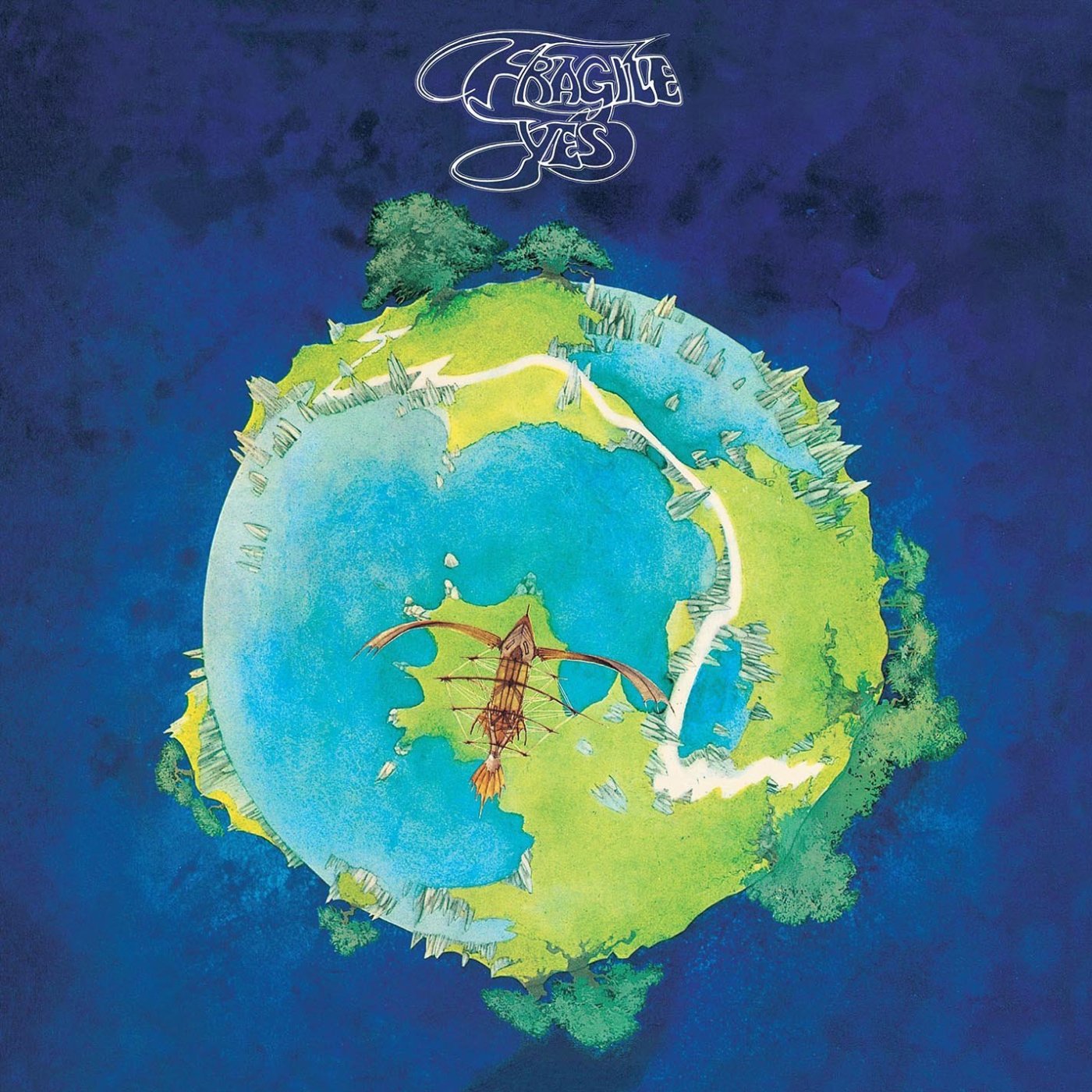
Fragile is the album that started the collaboration between Yes and cover artist Roger Dean. Dean’s painting of a miniature planet with some sort of wooden spaceship gliding above has become downright iconic. Dean’s circular Yes logo, though, is only seen as a sort of prototype version.
Fragile received mostly positive reviews in the music press when it was released and also won the hearts of the buying public. ”Roundabout”, chopped up as a single by the label against Yes’ wishes, gained a whole new audience for the band and sent the band’s popularity soaring. Fragile reached the top ten on the album charts in both the UK and US supermarkets. Fragile eventually sold over two million copies and remains one of Yes’ most successful albums. The Yes dreamteam was on a roll and next year would be the year of the quintet’s true masterpiece.
Best tracks: ”Roundabout”, ”South Side Of The Sky” ja ”Heart Of The Sunrise”
Author: JANNE YLIRUUSI
Read also: Review: Yes – Mirror To The Sky (2023)
Kappaleet
Side A
- ”Roundabout” (Anderson, Howe) 8:30
- ”Cans and Brahms” (Johannes Brahms, arr. Wakeman) 1:38
- ”We Have Heaven” (Anderson) 1:40
- ”South Side of the Sky” (Anderson, Squire) 8:02
Side B
- ”Five Per Cent for Nothing” (Bill Bruford) 0:35
- ”Long Distance Runaround” (Anderson) 3:30
- ”The Fish (Schindleria Praematurus)” (Squire) 2:39
- ”Mood for a Day” (Howe) 3:00
- ”Heart of the Sunrise” (Anderson, Squire, Bruford ) 11:27
Bändi:
Jon Anderson: vocals Steve Howe: electric guitars, acoustic guitars, backing vocals Chris Squire: bass, backing vocals, electric guitar Rick Wakeman: Hammond organ, grand piano, RMI 368 Electra-Piano, harpsichord, Mellotron, Minimoog Bill Bruford: drums, percussion
Producer: Yes & Eddie Offord
Label: Atlantic
More reviews can be found here.
 Pienemmät Purot
Jätä kommentti