
Tarkus is the second studio album by Emerson Lake & Palmer.
ELP got off to a flying start with their first album which was a huge success. So the band headed back into the studio again at the strong urging of the record company just six months after the release of their debut album.
Recorded at Advision Studios with engineer Eddie Offord, Tarkus consists of the legendary title epic, lasting almost 21 minutes, and six short tracks, the longest of which is only four minutes long.
The fairly general consensus on the album is that the title track is excellent and the short songs covering the second half of the album not so much. ”Tarkus” does dominate the album, but the songs on the b-side are also of high quality and are underrated. Only one of the short tracks is really unworthy.
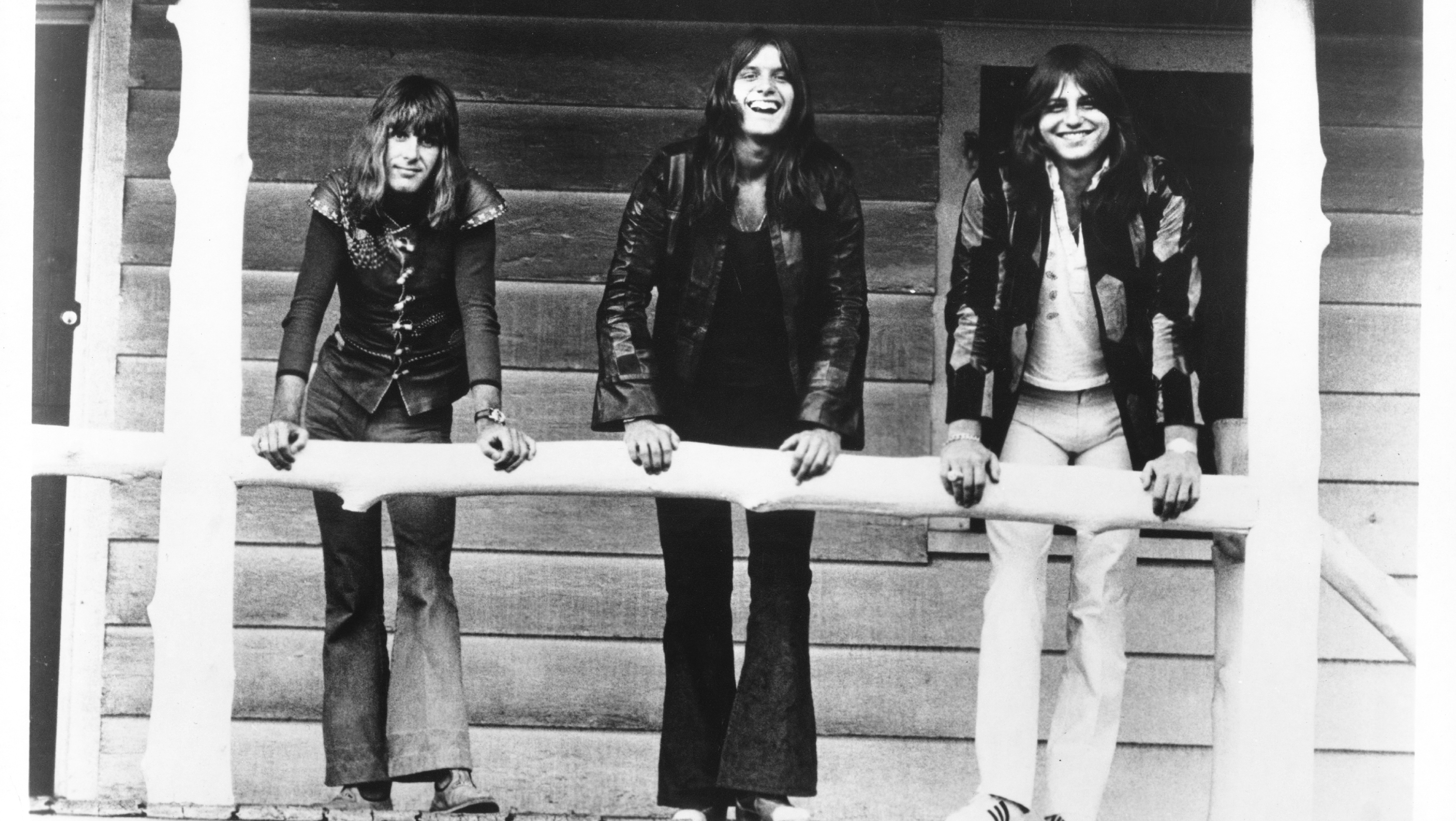
Tarkus
Keith Emerson (1944-2016) was very enthusiastic about the music of Bela Bartók and Alberto Ginastera in the early 70s and saw that Tarkus would be his chance to compose music that would exploit some of the techniques used by those composers, such as irregular rhythms and atonality.
While Emerson was presenting his ideas for the ” Tarkus ” composition, which he had developed partly inspired by Carl Palmer’s (b.1950) 5/4 drum exercises, vocalist/bassist Greg Lake (1947-2016) unexpectedly announced that he was not at all interested in playing the music. It was too complicated, alien and un-melodic for Lake.
Lake declared that if Emerson wanted to do that kind of music, he should get other musicians to play it. Emerson was shocked by Lake’s reluctance, but he believed so strongly in the music he was making that he was prepared to break up the band to get on with his work. So Emerson saw through Lake’s bluff and responded with an ultimatum: either ELP would record ”Tarkus” or he would really change musicians. That would be the end of a supergroup that had started off promisingly.
Eventually Lake gave in, apparently partly due to pressure from his manager. In the process, Lake also became at least somewhat passionate about music, writing lyrics and also composing music for one of the seven parts of the epic, ”The Battlefield”.
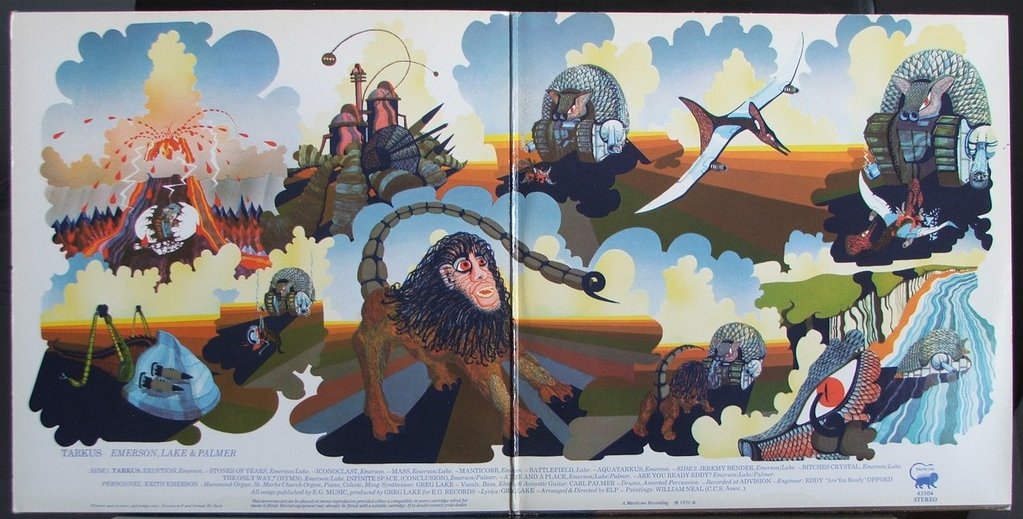
Lake managed to write the lyrics of ”Tarkus” quite nicely, with a mysterious menace and aggression. The cryptic and pleasingly ambiguous lyrics have developed a variety of interpretations over the years and have been mirrored in the cartoonish imagery of the album covers, in which a tank-like and cybernetic armadillo battles various mechanical creatures, destroying them but being defeated by a manticore in the end.
One popular theory is that the mechanical cybernetic armadillo, or Tarkus, represents a corrupt society in power, while the natural and unnatural manticore represents an emerging counterculture that eventually succeeds, not necessarily in defeating Tarkus once and for all, but at least in driving him away (the booklet shows Tarkus, wounded by the manticore, floating in a river).
William Neal’s colourful pop art cover art, which has made its way to the walls of New York’s MoMa, is thus a central part of the album’s title track, in the spirit of a good old Wagnerian Gesamtkunstwerk.
””Tarkus” begins with a virtuosic instrumental section in 5/4 time called ”Eruption” where Emerson really shows off his skills with percussive keyboard parts. The intro was a collaboration between Emerson and Palmer and Palmer plays that part superbly too. The intro to ”Tarkus” is one of ELP’s bravest moments and the mood doesn’t wane as Lake’s majestic vocal voice finally enters at around the three minute mark with the ”Stones Of Years” section.
From the slightly jazzy atmosphere of ”Stones Of Years”, the massive rhythmic outburst moves at six and a half minutes into ”Iconoclast” which is the most harmonically unusual material on the album, approaching atonality.
The manic drumming of the short ”Iconoclast” by Palmer is somewhat reminiscent of the rhythmic nature of Brazilian music. Palmer’s drumming is otherwise stunning throughout the epic ’Wisdom’, especially in the instrumental sections of the work which tend to run in irregular time signatures. Palmer deftly doubles Emerson’s melodic lines with drums in several sections and the result is a fascinating combination of melodicism and a rhythmic quality that insistently whips the music forward. Occasionally Palmer indulges in a little overplaying when beating the drums so damn hard that a little less would have sufficed.
Muita ELP-aiheisia kirjoituksia löydät täältä >
”Wisdom” alternates interestingly between harmonically and rhythmically complex instrumental sections and simpler vocal sections. The whole feels satisfyingly considered and the transitions from one section to the next natural. The piece repeats and varies themes skilfully. As for the atonality, ”Tarkus” ultimately only slightly hints in that direction, but the harmonic development of the music is still quite exceptional and well-developed for rock music.
”Wisdom” was by far the finest work of symphonic prog in the epic 20-minute category when it first appeared, and it is still a truly impressive listen today and definitely one of the highlights of its genre.
Jeremy Bender
The album’s undeservedly underrated b-side opener ”Jeremy Bender” is an upbeat humorous boogie-woogie with piano and slightly vulgar lyrics. The song can by no means be considered a major ELP song, but it is an entertaining interlude of a couple of minutes after the epic ”Tarkus”.
Vaudeville-style humorous ramblings like ”Jeremy Bender” became a staple on ELP albums from Tarkus onwards. The band probably used them to bring out their lighter side and fight against the ”artifice” critics. And I guess the band genuinely enjoyed playing them! Many serious proge fans downright loathe them. Personally, most of ELP’s ”humour” bits don’t bother me much, but they do add a certain inconsistency to the band’s albums.
Bitches Crystal
”Bitches Crystal”, which deals with black magic, is a powerful and rhythmically compelling song that seems to rush forward with inexorable force and fury. In this sense, the song is somewhat reminiscent of the instrumental parts of ”Tarkus”. The arrangement is a handsome combination of an intense rock roll and baroque intricacies. Emerson’s fast piano runs, rhythmic stabs and, on the other hand, Lake’s aggressive and intense vocal performance are great to listen to. ”Bitches Crystal” is the best song on the album after the title track.
The Only Way
”The Only Way” is a cynical anthem about organised religion. The song begins with a massive church organ intro in which Emerson initially borrows from Bach and then moves into his own beautifully contrapuntal organ theme. Lake’s brave and ironically appropriate choir boyish vocal performance is impressive. And of course, in a piece denouncing organised religion, a tritone (’diabolus in musica’) sneaks in, fittingly enough!
Infinite Space
Straight from The Only Way, the band continues without a break with the frenetic Emerson and Palmer composed short instrumental ”Infinite Space”.
Again, the track is rhythmically interesting and features several clever time signature changes. Unlike many ELP tracks, ”Infinite Space” does not contain any upbeat virtuosic solo sections but is more of a surprisingly controlled collaborative piece, even suggestive of minimalist art music. Like the epic pastoralism of debut album ”Take A Pebble”, ”Infinite Space”, which reaches towards minimalism, is a fascinating departure from ELP’s normal repertoire and a trend that the band unfortunately did little to explore further later on.
Time And A Place
”Time And A Place” is an upbeat track co-written by Emerson, Palmer and Lake in the vein of ”Knife Edge” and is characterised by Emerson’s slashing Hammond grooves and Greg Lake’s breathtakingly furious vocal performance. What a shame that Lake lost significantly in the years to come the magnificent intensity that he displays on Tarkus at several points. ”Time And A Place” doesn’t quite live up to its promise as the successor to ”Knife Edge” as at only three minutes it doesn’t quite fit in as fine a musical development. It’s a good song, though, and perhaps it could have been something more.
Are You Ready Eddy?
At the end of the album, the mood is returned to the anticlimactic boogie-woogie rock roll already introduced by ”Jeremy Bender”. It’s hard to say much positive about the fast-paced closing ”Are You Ready Eddy?” other than that Emerson’s Jerry Lee Lewis pianism is quite clever and that the song is only two minutes, which is consolingly short. The song title ”Eddy” is of course a reference to Eddie Offord who recorded Tarkus as well as ELP’s debut the previous year.
Offord did another good job (Lake has the producer’s credit), even if Tarkus doesn’t sound quite as good as the debut album. Perhaps the reason is that on Tarkus the band got carried away with overdubbing and as a result the overall brightness of the recording suffered and especially the low end of the sound gets a bit choked up at times.
Like its rival Fragile by Yes from the same year, Tarkus is also a flawed masterpiece, so to speak. Tarkus has a few moments that risk damaging the album dramatically, but in my book, the good points outweigh the few weaknesses immeasurably.
Tarkus received slightly weaker reviews than the debut album, but commercially ELP was unstoppable at this point which is amazing considering how far much of the music on the album was (and still is) from mainstream rock music. Tarkus reached number nine on the US album charts and number one in the UK. ELP had proved that it was not just a one-hit wonder. A few more years of glory and success were in the offing…
Best tracks: “Tarkus” ja “Bitches Crystal”
Rating: *****
Author: JANNE YLIRUUSI
Tracks:
- ”Tarkus”
”Eruption” (Emerson) – 2:43
”Stones of Years” (Emerson, Lake) – 3:43
”Iconoclast” (Emerson) – 1:16
”Mass” (Emerson, Lake) – 3:09
”Manticore” (Emerson) – 1:49
”Battlefield” (Lake) – 3:57
”Aquatarkus” (Emerson) – 3:54 -
”Jeremy Bender” (Emerson, Lake) – 1:41
-
”Bitches Crystal” (Emerson, Lake) –3:54
-
”The Only Way (Hymn)” Emerson, Lake –3:50
-
”Infinite Space (Conclusion)” Emerson, Carl Palmer – 3:18
-
”A Time and a Place” (Emerson, Lake, Palmer) – 3:00
-
”Are You Ready, Eddy?” (Emerson, Lake, Palmer) – 2:09
Duration: 38:55
Band:
Keith Emerson: Hammond organ, piano, church organ, celesta, Moog modular synthesizer Greg Lake: vocals, bass guitar, acoustic guitar and electric guitar Carl Palmer: drums, percussion
Label: Island / Atlantic
Read more reviews here
 Pienemmät Purot
Jätä kommentti