
Tales From Topographic Oceans is Yes’ sixth studio album.
With 1972’s Close To The Edge, Yes had climbed to the highest peak of progressive rock, but of course it wasn’t enough for our heroes. Jon Anderson’s and Steve Howe’s ambition levels reached even higher, and the duo led the somewhat reluctant rest of the band towards music even more epic than Close To The Edge.
”Close To The Edge” was one song that lasted half the length of the entire album. Tales From The Topographic Oceans would contain four tracks of similar length (Steve Howe enthused to Jon Anderson ”Let’s do four Close To The Edge’s!”). Topographic Oceans was thus released as a double album with only one track on each half of the album.
The central inspiration for Tales From Topographic Oceans was Paramahansa Yogananda’s (1893-1952) book Autobiography Of A Yogi, recommended to Jon Anderson by, who else but the eccentric percussionist Jamie Muir, bandmate of Bill Bruford, who had just recently left Yes. The book recommendation, incidentally, was given at Bruford’s wedding. Anderson was deeply impressed by Yogi’s biography, which also inspired Apple’s Steve Jobs, and has even called it a life-changing experience. The Yogi’s biography describes a spiritual journey, referring to the levels set by Hindu scriptures on the way to enlightenment. For Anderson, who sang about a similar theme in ”Close To The Edge”, this was fertile ground. Amusingly, however, Anderson was ultimately inspired not so much by the actual content of Yogananda’s book as by its lengthy footnotes to the Shastric scriptures.
Anderson and Howe sketched out rough versions of four songs in hotel rooms on the Close To The Edge tour and convinced the rest of the band to get behind their vision. Apparently Anderson even threatened to leave the band if things weren’t done his way. No wonder he was given the nickname ”Napoleon” in those days, a reference not only to his small size but also to his tendency to make his own case with dictatorial style when necessary.
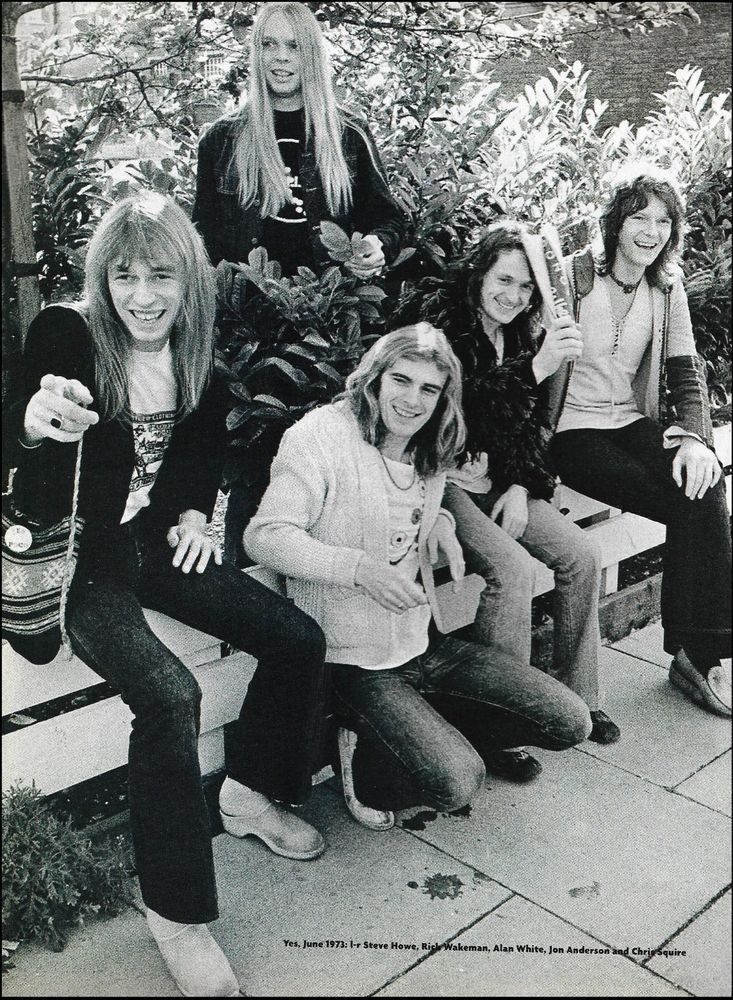
Yes spent 5 months working on the album at Morgan Studios with the help of old friend Eddie Offord. Costing £90,000 (well over a million pounds in today’s money), the sessions were certainly one of the most expensive recording projects of their era. Anderson would have wanted the album to be recorded in the middle of nature in the woods. And at night, of course. The other members of the band didn’t like the idea, but to Anderson’s delight(?) a few cardboard cows and bales of hay were erected in the studio. And because Anderson thought that his singing voice always sounded best when he sang in the shower, they also built him a recording booth with tiles simulating a bathroom…
As the surface scrape above shows, Tales From Topographic Oceans has a lot of all the eccentricities, but at the end of the day, Anderson and Howe were genuinely making art. How well they succeed at it is then for others to judge, but I believe the duo genuinely and seriously devoted themselves to this album more than to any other they’ve made (perhaps in Anderson’s case with the exception of his first solo album Olias Of Sunhillow).
The lofty aspirations to the highest possible level are also delightfully visible and audible in the album as a certain seriousness. Topographic Oceans, for all its Sturm und Drang, never once wink eye to the audience, but is completely humourless and devoid of any lighter elements (which ELP, for example, always sprinkled on their albums). And I find that something very charming. Sometimes it’s good to be serious.
On the other hand, it’s easy to add unintentional humour if you want to. Jon Anderson’s increasingly abstract lyrics, for example, are an easy target. This time it is almost impossible to make any real sense of the message of the lyrics, but the album is full of individual lines that spark my own imagination at least, or otherwise just thrill me. And Jon Anderson’s sincere space cadet charisma helps sell the lyrics. You get the feeling that Anderson believes in his words even if he doesn’t fully understand them himself. Of course, Anderson has admitted that he often uses singing as an instrument among others. It is more important how you sing than what you sing.
”We’ve must have waited all our lives for this moment”
What about music? If the lyrics are more abstract then so is the music. At least from a pop and rock perspective. Topographic Oceans largely rejects the verse-chorus structures of normal popular music, and the songs on the album are more inclined in form to the symphonic expression of classical music. While most of the long prog songs are, after all, just stretched out songs, the same cannot be said of the four songs on Topographic Oceans. There are a few more song-like parts embedded within them, though, which could perhaps be separated from the whole and would work almost as such without their original framework.
”The Revealing Science Of God”
The album’s first track ”The Revealing Science Of God” begins anthemically with Anderson’s snappy rhythmic vocals and constantly changing time signatures, then moves into a steady 4/4 rhythm. Perhaps the worst criticism that can be thrown in Topographic Oceans’ direction is that rhythmically it’s not always as energetic or supple as its predecessor Close To The Edge. Part of the blame for this can certainly be laid at the door of drummer Bill Bruford’s protégé Alan White. Within a few years, White was shaping up to be a great drummer for Yes, but by the time of Topographic Oceans he may not have been fully comfortable with the complex music the band was making. It would have been extremely interesting to hear what Topographic Oceans would have sounded like under a more imaginative and technically adept Bruford. In the same breath, however, it has to be said that White performs much better on the last two tracks, ”The Ancient” and ”Ritual”, and shows in the rich percussive sections of those songs that he is in fact quite a skilled orchestrator of drum parts.
”The Revealing Science Of God” is a great song anyway. It’s full of moments of beauty and the music progresses naturally and with a somewhat effortless feel. It is at the same time ethereal and abstract, but still has an intense and angular sound. The highlight of the song comes just after ten minutes when Anderson sings
”Getting over overhanging trees, let them rape the forest
Thoughts would send our fusion
Clearly to be home”
It is a truly majestic moment that never fails to give me chills.
Throughout Topographic Oceans, keyboardist Rick Wakeman stays mostly in the background, creating elegant orchestral tones, but occasionally wakes up to play some pretty wacky solos. On ”The Revealing Science Of God” he plays one of the most stunning Moog solos of his career at around 17 minutes. The solo is short but very intense. Wakeman is not a musician necessarily known for his good taste, but on Topographic Oceans his contribution is understatedly stylish and extremely effective. In itself perhaps ironic, as Wakeman was not very enthusiastic about the music on the album and perhaps therefore retreated to a smaller role than usual, which in the end worked to the music’s advantage.
The Remembering (High the Memory)
The Remembering (High the Memory) is the most melodic and perhaps the lightest song on the album. ”The Remembering” starts with an almost folk-like sound, but in 20 minutes it goes through a wide range of moods. ”The Remembering” undulates forward with an organic sound and again Yes avoids choruses in the song and the repetition typical of pop/rock music is hardly audible. Bassist Chris Squire plays unusually fretless bass on this track and at times he really comes out with some stunning performances. And his bass riff around the 14 minute mark is absolutely amazing.
The Ancient (Giants Under the Sun)
”The Ancient (Giants Under the Sun)” is Yes at its avant-garde best. ”The Ancient” is easy to relate to the Stravinskian primitive-modernist continuum. The song is at once ancient and primitive in its rhythm, as its name suggests, but also avant-garde and modern in all its dissonance. ”The Ancient” has great sudden stops and quick turns that the band unravels with breathtaking skill. Steve Howe’s stinging guitar playing makes a big impression at many points. Steve Howe is the absolute star of the song instrumentally, along with Alan White, who finally comes to life in ”The Ancient”. Howe’s playing throughout the song is stunningly skilful. At times hauntingly beautiful and at others shatteringly energetic and aggressive. White, on the other hand, shines especially in the tribal-like opening section where he also plays vibraphone to support the drums.
”The Ancient” is an important part of Topographic Oceans, being a more atonal contrast, especially to the first two more melodic and slightly more subdued tracks on the album. I also like the fact that ”The Ancient” gives more space to the instrumental parts than the other songs where Anderson sings almost all the time.
Towards the end, ”The Ancient” grows away from its brash and angular primitivism and moves into a more melodic and ”classical” style, boosted by Steve Howe’s fine acoustic guitar playing.
Ritual (Nous Sommes du Soleil)
”Ritual (Nous Sommes du Soleil)” is the ”hit song” of the album, containing its catchiest melodic snippets. ”Ritual” is also the song from Topographic Oceans that Yes has probably returned to the most in decades of live performances. The song starts with an energetic instrumental section (Anderson can’t help but chant along, of course), and from the instrumental section we get into the beautiful ”Nous Sommes du Soleil” which is probably one of Yes’ most stunning moments. Anderson sings beautifully on this song and in the familiar Yes style also gets great support from Howe and Squire’s backing vocals.
Chris Squire gets to play a great bass solo in the middle of the song, although you might not notice it as a solo because it’s so ingeniously integrated into the composition in all its melodiousness. Absolutely stunning work from Squire!
Shortly after Squire’s bravura, a wild percussion section lasting several minutes begins, with Anderson and Squirea pounding various percussion instruments with intense energy, while White leads the way with his tight drumming. The section is a fine return to the primitive, pagan atmosphere of ”The Ancient”. Wakeman successfully spices things up with futuristic keyboard hits. Eventually the forging subsides and Howe’s electric guitar melody returns the band to more tonal waters. The song then culminates in perhaps the most beautiful section of the album, repeating the ”Nous Sommes du Soleil” theme with a new intensity. During the final couple of minutes of the concluding section, Howe plays another heartbreakingly gorgeous electric guitar solo.
Tales From The Topographic Oceans went straight to number one in the UK album charts on its release and quickly went gold in America too. However, often album chart positions are more about the overall status of the band and the success of the previous album, which is echoed in the release of the next album. Topographic Oceans received a mixed reception from critics, the public and even the band members. Rick Wakeman, in particular, did not care for the album and decided to leave the band in May 1974 in the aftermath of the Topographic Oceans tour when he found the new Yes material too much avant-garde jazz-rock. The aforementioned tour was also challenging for the audience and drew accusations of Yes’ arrogance as the band decided to play the entire Tales From The Topographic Oceans live to audiences who, for the most part, had not even heard the album on record. Arrogant, but respectable!
Tales From The Topographic Oceans still divides opinion to this day, even among the most ardent Yes and prog fans. The Topographic Oceans may not be as brilliantly perfect in every minute as its predecessor Close To The Edge, but then again, there are twice as many treats on offer! Personally, I love the strange and magical atmosphere of the album and for me it is one of the most important albums of all time.
Best tracks: ”The Revealing Science of God (Dance of the Dawn)”, ”The Ancient (Giants Under the Sun)”
Author: JANNE YLIRUUSI
Tracks:
- The Revealing Science of God – Dance of the Dawn – 20:27
- The Remembering – High the Memory – 20:38
- The Ancient – Giants Under the Sun – 18:34
- Ritual – Nous Sommes du Soleil – 21:35
Muusikot:
Jon Anderson: vocals, percussion Steve Howe: guitar and vocals Rick Wakeman: keyboards Chris Squire: bass, percussion and vocals Alan White: drums, vibraphone and percussion
Producer: Yes ja Eddie Offord
Label: Atlantic
 Pienemmät Purot
Jätä kommentti