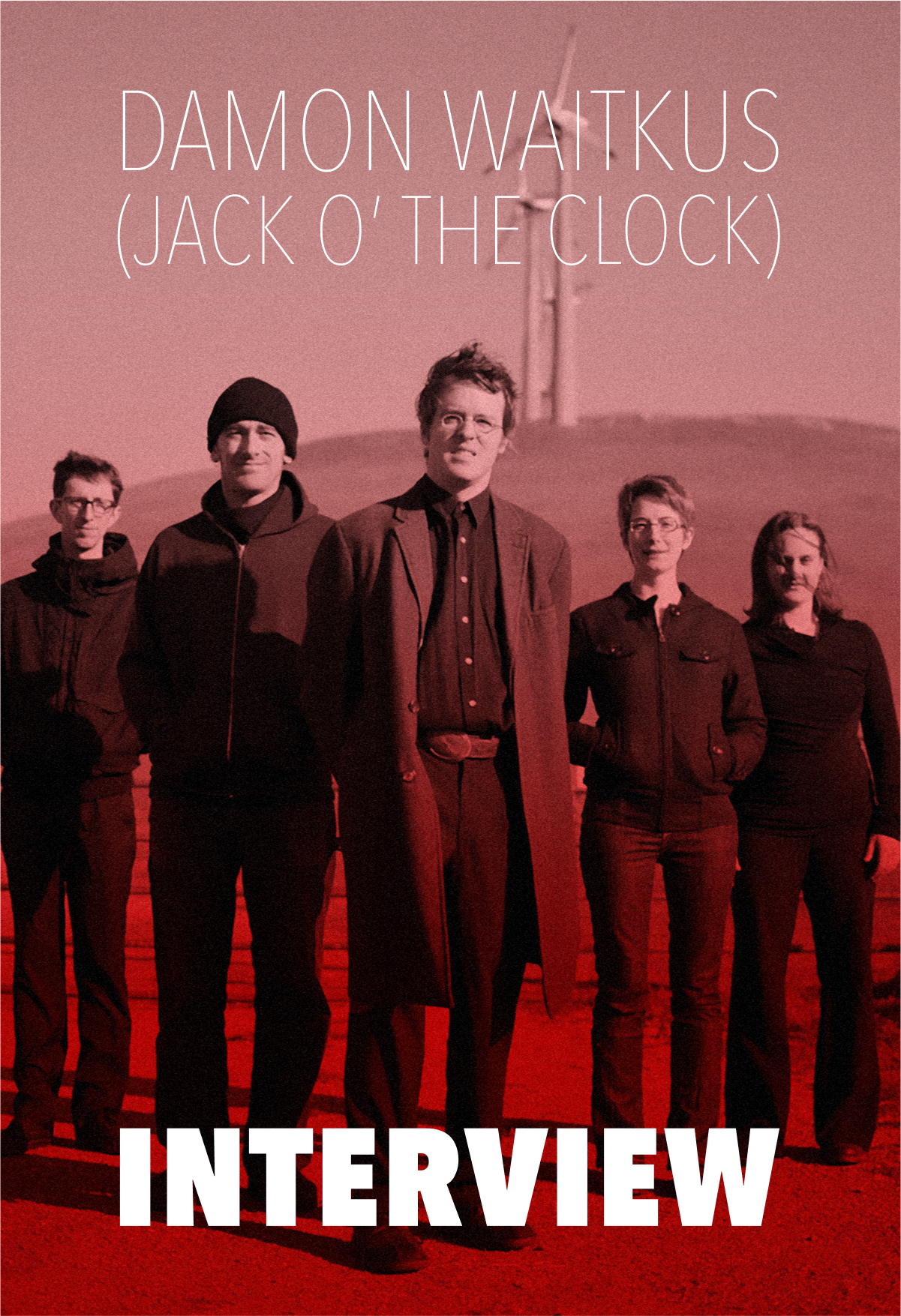
American Damon Waitkus is a true multi-talented artist. He is not only a composer, lyricist, singer and multi-instrumentalist, but also an accomplished producer and engineer. At 46, Waitkus is a classically trained musician who has composed ”serious” instrumental art music, but whose main musical outlet has eventually become Jack O’ The Clock, which has released ten albums, combining American folk music and progressive rock in an original way. Waitkus is also a member of the microtonal rock band Ventifacts.
Waitkus, who now lives with his family in Vermont, was busy during the interview preparing for the release of Jack O’ The Clock’s new album, ”The Warm, Dark Circus”, and the band’s first live shows after a few years break (Covid… you know?). Despite his busy schedule, Waitkus answered my questions extensively about his musical background, his influences, the birth of Jack O’ The Clock, microtonality and much more.
But let’s cut to the chase and give Mr Waitkus the floor.
Hi Damon! Thank you for agreeing to this interview.
Let’s start from the beginning. How did you first get interested in music? What instruments did you start with and how did you get into playing dulcimer?
Music was pretty much always there. I used to gravitate towards the old chipped-ivory-keyed piano at my grandmother’s house by the time I could walk. I remember discovering a fourth resolving into a major third and thinking that was pretty cool. When I was four, my mother moved it over to our house, and I started lessons a few years later. Piano was my main instrument growing up, and I added guitar when I was about 11, large enough to almost get my hands around my father’s Martin, the guitar I still play today. The piano is associated with my mother and the guitar with my father. Each had its own character, brought out different aspects of my personality. Guitar pulled into the lead for practical reasons when I was an adult, but I’m still holding out for the moment when the piano returns in earnest as something more than a coloristic overdub in recordings. With the band, it’s largely a situation of not wanting to write for an instrument I can’t count on using live, as I have a kind of obstinate resistance to sampled instruments, good as they’re getting. Or maybe I’ve just worked through more paternal baggage than maternal!
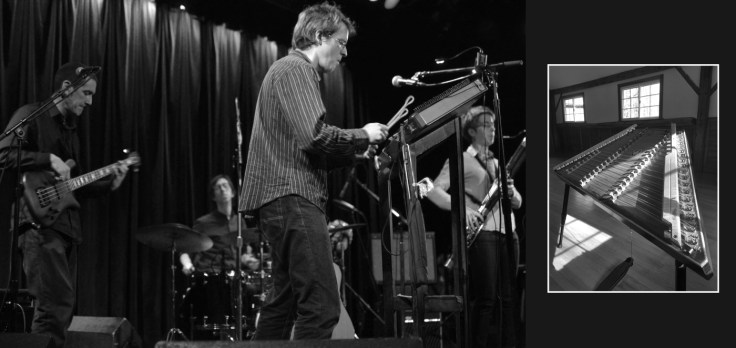
The hammer dulcimer I was entranced by when I heard the recordings of Malcolm Dalglish when I was about 10, and around the same time encountered one in a store. I picked up a used dulcimer around 1995, but only started really working hard at the instrument when I started Jack O’ the Clock. I don’t know why it drew me, but there is an interesting elegance to this trio of instruments in that the hammer dulcimer does sort of split the difference between the piano and the acoustic guitar, just as I split the difference between my parents. So maybe this one is “me.”
Mills College played a major role in the birth of Jack O’ The Clock so let’s talk about your old school for a moment.
How did you end up studying at Mills College and what were your ambitions for music when you started? Could you also tell us a little bit about what kind of school Mills College is?
My ambitions at first, at least consciously, were to compose instrumental music more or less traditionally on paper, although the score for me was only ever a means to an end. I also did a lot more free improvising back then, and that was alive and well at Mills. I was drawn there initially because of Fred Frith.
Someone once said Mills’ music department had more of an art school ethos than anything else, and I think that was a good characterization. It didn’t have a conservatory vibe in the sense of being a mill that turned out canonically-erudite players for orchestras, nor did it quite fit into the research-institution mold of university music departments. The premium was on creativity and original thinking, not so much on technical facility (though there were certainly some good players there). The work coming out of there could get very conceptual, but it could also be very heartfelt. But maybe more than anything else, it seems to have internalized the Cagean ethos that every sound is potentially musical, and also something of Pauline Oliveros’ deep listening discipline. These things were in the water there. We can’t really go back, nor is there any reason to.
You mentioned Fred Frith. He was one of your teachers at Mills College. Frith is also one of the most important musicians to me personally so I just have to ask you a few questions about him. What was he like as a teacher and can you highlight anything in particular that you learned from him. And what does Frith’s own music mean to you?
As this moves further into the past, it gets harder to remember a lot of specifics. I never got to take private lessons with him while I was there, though I took a few classes; he became quite supportive of me and JOTC after I finished.
I recall him as being very open-minded, broad-listening, encouraging, no-bullshit to an extent, emphasizing the experiential and practical as opposed to the abstract. He encouraged clarity with language and musical gesture, and also brought a certain amount of pragmatism to the classes. We crafted terse, functional artist’s statements. I remember one class in which he simply played us music from all over the world for a few hours, without regard to genre or cultural purpose. He characterized it as an “ear-cleaning,” and it was fantastic.
I just revisited Clearing (2001), one of my all-time favorite of Fred’s albums, the other day, and it still is as affecting as it was when I first heard it. It’s like a journey through the wilderness, with just the right balance of order and chaos. It’s a solo acoustic guitar album which incorporates all manner of extended techniques and electronics—a lot of looping and pitch-shifting in particular—to create an almost symphonic experience. He’s doing it all in real time, which is amazing. “Not With Love But With Fear” is positively elevating.
Let’s move on to Jack O’ The Clock and the birth of the band. You formed the band with fellow student Nicci Reisnour in 2007. Tell us a bit about the genesis of the band. Did you have a clear vision from the beginning of what kind of music you wanted the band to make?
Nicci Reisnour and I wanted to form a composer’s band that operated as a “benign dictatorship.” We wrote fairly delicate, carefully-constructed acoustic music with vocals at the center and unique orchestrations. It all started when I was messing around with a slide on the hammer dulcimer and wrote ”New American Gothic”, which opens Rare Weather, and Nicci answered that with the harp solo at the middle. She also played melodica and liked to futz with wine glasses, and Emily Packard was filling in a lot of the low-end with baritone violin, Jordan Glenn playing a bunch of overturned metal bowls with chopsticks or brushes. That’s where it started, very quietly. It all changed and became much more of a “band” when Jason Hoopes and Kate McLoughlin joined a year later, Nicci went to Bali, and Jordan moved over to drum set.
I also have to ask; what on earth does the name ”Jack O’ The Clock” mean? The name doesn’t make sense to this Finn.
It’s a moving statue on some medieval churches that strikes a bell on the hour. Never actually seen one myself. It’s more of a European phenomenon—not much going on in the U.S. with churches in the middle ages.
I have described Jack O’ The Clock’s music to friends as a combination of dark Americana (especially Appalachian music) and avant-garde progressive rock. Do you think I’m on the right track at all? How would you describe the band’s music to someone who hasn’t heard it at all?
Oh man, I can never get this right. Every category is freighted in some way and misleading. Usually I just go with something along the lines of what you’ve said and try not to worry about it.
Let’s talk a little bit about your compositional process. How does your academic background influence the music you compose for Jack O’ The Clock? How do the compositions come about? Are some of the songs composed for sheet music? As I understand it, all the music in the band is composed by you. In what way do the band members have an influence on the compositions? Does free improvisation play any role in the studio or live when it comes to the music of Jack O’ The Clock?
I don’t think my academic experiences really influence my creative projects on the level of inspiration or idea, which is to say that I don’t rely heavily on methods. The higher-level academic study mostly provides a vocabulary, a shorthand to use with others, and at times it can suggest something new to try. Most of my work is intuitive and probably most of the suggestions that influence it come through my ears or eyes through immersion in other music, writing, film, visual art, and observation of nature, rather than through active study. Obviously I did it and don’t regret it. Formal study as an adult helped to concretize where my ears were going, make its methods conscious, and knock the rough edges off the work, to be sure.
Study of classical piano as a child however undoubtedly had an influence. I had my parents’ psychedelic records in my ears, but I also had Bach and Debussy in my ears and at my fingers, experiencing these from the inside out. Something happens when you find yourself suddenly able to maintain multiple, distinct voices at the same time between the hands, which is not something all musicians get to cultivate on their instruments. It wasn’t easy for me and I was mediocre at best by the time I gots to “Prelude and Fugue” level, but the influence on how I heard as well as engaged bodily with musical content was indelible.
The compositional process: usually there is a feeling, often rooted in an image—I’m very visually-oriented, I think—that suggests a story or an impressionistic play of words. Very often there is a concrete narrative I end up telling, but songs don’t always get that far: sometimes there’s something compelling or haunting about a certain street corner at a certain time of day, the cant of a tree, a person walking, some constellation of meaning that words can begin to address and that music can then support or work in generative tension with, and it needs only be illustrated—a tableau, a single moment, no narrative. It’s all about emotion and often indivisible from place, setting. Fear, pathos, humor: it all gets in there eventually. There’s a music for any human experience, if you want to find it. Well, as Robin Holcolm says, “You will never tell all that you know.” But you try to get the important parts out. It’s just a process of trying to deepen your honesty with each attempt at making something.
To answer your other questions: Yes, I use sheet music—frequently, but not always, and rarely do I notate 100% of a song. Band members always have influence on their own parts—they know their own instruments and abilities best. Drums get the most leeway. Bass will be notated for the more through-composed sections, often less in more traditional singer-songwriterly sections. Once in a while someone else will come up with an idea on their instrument or on paper that I will then subsume into a song if it strikes me as compatible with a mood that haunts me too, or I will take a recording of an improvisation between a few of us and extract the parts I like, which we will then relearn as a composition. I’m not married to any instrumental role myself—I’ve had other guitarists, other singers. I’m even, with Victor Reynolds, in danger of having another hammer dulcimer player (maybe we can get two going together some day). But I do shape the compositions and write the lyrics—that’s what JOTC is, and my role in it. I used to feel a little guilty about this, but it’s not a judgment on the creative work of the others. It’s just damn near impossible, maybe because so many of my songs come from dreams or dreamlike states with very specific mood and context to them, or involve very specific narratives, to collaborate on many of the broad strokes.
You asked about improvisation too. We’ve used it to generate raw material, as when Jason, Jordan and I set up a bunch of mics around a gutted piano Jason had and a bunch of odd percussion and spent a few hours recording spontaneous ideas (most of that stuff hasn’t been released yet). Those guys are master improvisors, as was Ivor, albeit in a somewhat more traditional jazz context. We’ve worked a little free or vaguely-structured improv into our shows most of the time—there’s always some indeterminacy, at the very least some violin and bassoon solos—but it’s the exception rather than the rule, minute-for-minute. A solo or loose transition here or there. Yet if there was no improv in a live set I think I’d feel like the group couldn’t breathe. JOTC seems to need some to feel right.
Let’s move on to instrumentation. For me, one of the most interesting aspects of Jack O’ The Clock is its very rich and even eclectic instrumentation. In addition to the usual rock instruments, your own dulcimer often takes centre stage, but violin, bassoon, flute and other wind instruments also play a key role in the band’s sound. This is quite unusual in rock music. For me, avant-prog bands such as Univers Zero, Art Zoyd and Henry Cow come to mind. Do you feel any affinity with these bands or where did the inspiration for the unusual instrumentation come from?
Violin has always been in my ear, ever since I first started writing songs in high school. My first band recruited a violinist, ostensibly in place of a lead guitarist—seemed more interesting to me—so I got used to it in my writing early on. She was actually a friend of Emily’s from youth orchestra and was the one who introduced us.
Lindsay Cooper definitely was the reason I even thought to have bassoon in the band, much later, and Henry Cow in general broke new ground for me in terms of suggesting what could be done with a hybrid ensemble splitting the difference between chamber music, DIY rock, and free improv without seeming to lose anything or to peddle gimmicky eclecticism, though by this time I was also listening to a lot of chamber and orchestral music, some jazz, so there was interest in all sorts of sounds that extended beyond the traditional rock ensemble. Univers Zero and Art Zoyd have never grabbed me, for whatever reason, even though I can hear the effort and skill that goes into what they’re doing.
I’m not sure why I gravitate towards generalism and diversity rather than focusing on one instrument or refining one sound. Both are valid, satisfying approaches to music, and art in general, but I like to work in a richly-colored world. It’s amazing to pick up a new instrument and see what comes out of it—voila, a new personality! How does it jive with the other sounds? What does it evoke? What do this and that evoke together? That wasn’t there before, now it is! Amazing. I can’t resist that process.
Jack O’ The Clock seems to operate on the margins of the fringe and completely outside the music business. How do you see the band’s place in the wider music world? The previous album Leaving California was released by Cuneiform, but the new album is again independently released. Why and what did you learn from your collaboration with Cuneiform?
If I had an idea of how to fit JOTC into the musical world without having to change the music in order to better fit into a niche, I’d be pursuing it.
I’d rather not go into the details of our departure from Cuneiform, but suffice to say it was our choice, and we continue to maintain a good relationship with them. Their sister company, Wayside Music, continues to carry our physical catalog, including The Warm, Dark Circus.
One thing that resonated with me that Cuneiform encouraged was making a beautiful physical product. I came of age buying CDs in the 90s. There was a whole ritual around it: getting on the bus and making the rounds to like five or six record stores, picking up a few used, a few new, immersing myself in the art and the lyrics at the same time as the music, making a seasonal mixtape from the new haul, etc. There’s some buy-in when you invest in a physical product, a basic level of commitment. Even stuff I didn’t respond to would draw me back from time to time, and often it’d be the art that would open the imagination, suggest a way to enter otherwise opaque musical content. The Warm, Dark Circus, with its artwork by Chester Hawkins, a project that started under the auspices of Cuneiform, is the best-looking CD we’ve produced. We took Albrecht Dürer’s Rhinoceros and put it through all sorts of permutations using artificial intelligence. It’s amazing to look at, cohesive, relevant to the album’s themes, and only deepens the experience as you leaf through it. I’ve been involved in the concepts and some of the execution of all the JOTC album art, and it’s important to me, but I can’t say I’m 100% satisfied with the results across the board. One of the pitfalls of being completely DIY: eventually you run up against the limits of your experience, abilities, or financial resources.

Jack O’ The Clock has now released eight regular studio albums, one cover album and one live album. What are your thoughts on the band’s development and what do you think are the band’s most significant albums?
The live band became somewhat more efficient and simpler over the years. We stopped bringing quite as many odd instruments out with us in favor of more reliable sound. And we learned how to work together, what to expect from one another, and even began to influence one another in terms of the style of ideas we’d come up with. So: a move towards less trial-and-error, more efficiency in the compositional/orchestrational process.
There was also an interpersonal efficiency that developed, a de facto determination of roles in the original quintet that evolved. I was the musical leader and primary composer, for example, but it often fell to Kate, who is trained as a conductor, to finalize decisions on how to use our time in any given rehearsal. We noticed this big time when she left for a few years—it’s not that we couldn’t function, it’s just that we (I, at least) felt the drag. Jason was a workhorse. He’d do the things that really needed to be done to make something possible. The van-tetris guru. He built me a pedal board and a wooden road case for my hammer dulcimer, even stained it. I would have banged together a Homer Simpson job that would have fallen apart at the luggage check. This is all a bit of a caricature perhaps, but true enough.
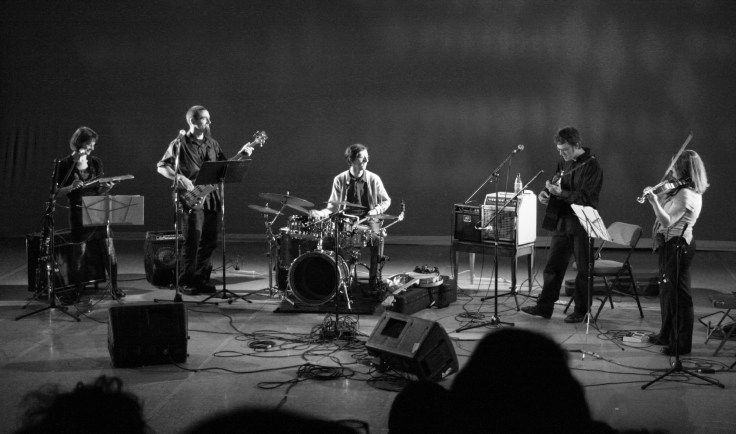
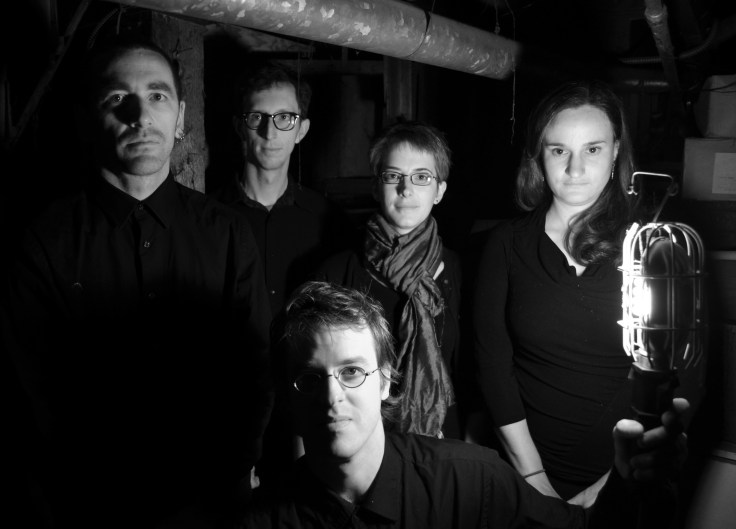
Something of this interpersonal chemistry was off during our last few years in California, while Ivor Holloway (reeds) and Thea Kelly (vocals) stepped in to fill Kate’s shoes. It’s absolutely an alchemical thing, nothing personal (or musical) with them that was lacking, just a sort of imbalance in the group as a whole that is hard to articulate. Fortunately, the energy has been really good, bouncing us forward like we’re doing the right thing once again, since we’ve reconstituted the group in Vermont. Jason and Jordan are sorely missed, but Kate is back, and we have a new influx of energy and enthusiasm from Victor Reynolds (bass and a million other things) and Ben James (drums). Once again, I don’t know what it is exactly, but the thing has an effortlessness and lightness again.
Instead of being a steady progression towards one thing and away from another, the band’s development from a recording perspective has been cyclical. I tend to vacillate between wanting to hear relatively tight-sounding albums that represent the live band and more production-heavy, wide-ranging experiments. From this perspective, the band has gone through three eras. (I’m not counting the first album, Rare Weather, which predates JOTC as a functioning band.) The early period includes How Are We Doing…, All My Friends and Night Loops, the main-sequence period would include the Repetitions albums, and now we’re into the post-move albums, Leaving California, The Warm, Dark Circus, and one more I have sitting in draft form on a hard drive, to be fleshed out later.
Another difference that I should mention that distinguishes the last three (“post-move”) Jason/Jordan albums from the earlier ones is that the earlier ones, particularly the Repetitions albums and to some extent the first two, were made up of heavily-rehearsed and performed material. Jason and Jordan spent months and even years working out and refining their parts for those middle albums as we played that stuff out, whereas many of the songs on the post-California albums I threw at them the day of the recording session. Can’t necessarily tell the difference? They’re brilliant improvisers and fast-learners. But when Jordan finally heard The Warm, Dark Circus, he said he couldn’t even remember his own contributions, let alone the rest of the music, and that he felt like he was listening to a different drummer, albeit in a good way. I actually have no problem with working in both of these ways, but I would not want to only do the latter.
Night Loops (2014) fascinates me. It somehow feels like its own special album in the Jack O’ The Clock catalogue, but I can’t quite get a grip on why I think that. How do you perceive the album? Do you think there’s anything exceptional about it?
Oh thanks, Janne—it’s secretly my favorite. I’m a lover of nocturnes, and night was a simple, versatile, but very clear theme to work around. I’d been building up nocturnal material for years, and having exhausted most of the live band material in the first two band albums, was really free to go rogue with this one. It was our first “production” album, so it was the first time I tried out all sorts of orchestrations and production techniques that wouldn’t have been practical live. Even though we later worked up Ten Fingers, Come Back Tomorrow, and Rehearsing the Long Walk Home live, only Salt Moon and Down Below were in our sets at the time of Night Loops’ release.
The production-first ethos made it both more fun and harder to pull off—because when a live song is orchestrated right, all you have to do is render the live band well, maybe lay down a few overdubs, and it will probably work. But songs like ”Ten Fingers”, ”Fixture”, and ”As Long As the Earth Lasts”took a long time to get right because there was no tried-and-true basic band sound to build on top of. Just taking ”As Long As The Earth Lasts” as an example: you can’t just replace a guitar with a rubber band, I discovered, and expect it to have the same propulsive force. So Jordan overdubbed some experimental percussion, and he put a cymbal between his kick pedal and the drum head—sounded interesting—and then we had to decide if we wanted to stop there and let the orchestration sit in a deliberately unbalanced place or if the compromised low end really would need to be replaced by something else in order for the song to heave forward convincingly. We decided to bring Jason in, but with his bass detuned to an almost pitches flabbiness, rumbling along below the horns like a train car. Now it seemed to work. It’s still an unconventional sound, but it hits enough of the tried-and-true combinations of frequency and envelope to be legible as a band, to be satisfying. There’s always a subjective tension between “convincing” or “satisfying,” which bears a relation to some convention, and “interesting, off-kilter, experimental,” whatever you want to call it. Always a judgment call. I got in the habit of hoarding useful things to hit to fill in the gaps in these production songs. Our neighbour found this shitty bass drum in the trash and I insisted against Emily’s regular complaints that it take up space in our apartment, and sure enough I always found one or two places on an album where I needed to haul it out and hit it. Same thing with oven racks with toaster trays rattling on top of them.
There were also some interesting moments in the recording process that I remember fondly. ”Furnace” was about as conceptual as JOTC has ever gone: I had a recording of the furnace in the house I grew up in roaring away, and asked each of the band members to whisper his or her deepest fears over it. I don’t know what any of them said because I reversed them in order to sit them at an audible but unintelligible level in the mix. I don’t know that that was cathartic for anyone but me, but I’m proud that there’s a cleansing crucible right in the middle of the album, a minute of pure combustion.
”Bethlehem Watcher” was a unique moment too. I’d done several late night improvisations in various churches around the East Bay with my friend Marty (the songwriter Art Elliot) and sometimes bass clarinetist Jon Russell, and one of them led to a texture I wanted to recreate with good recording equipment. Marty worked as an organist. We drew sleepy priests out of their beds more than once, but for the most part they tolerated our “rehearsals.” The night we did the organ for ”Bethlehem Watcher”, though, we were a bit creeped out. We found out later that one of the parish priests was on his deathbed upstairs, with another priest—the one who eventually came down to shut us up—sitting vigil. At the end of the track, you can hear Marty stopping abruptly and saying “did you hear something?”
The cover album Outsider Songs was really interesting by the way (the Duran Duran cover was especially great!). Could you imagine doing a follow-up to that one day?
The Duran Duran cover was particularly fruitful because Jason was at the helm and the two of us were both coming up with a lot of different, sometimes generatively conflicting ideas for the orchestration. Because the song was not one I knew or had a particular interest in, though I liked it well enough, I had no loyalty to the original. And Jason did have passion to bring to the vocals and a feel for the original. Somewhere between us, something interesting happened.
Night Loops had sort of exhausted me, and it seemed like a good moment to just have fun and not have to worry about composition for a while. My other project, Ventifacts, also recently released a cover of R.E.M.’s entire Chronic Town EP incidentally. That’s probably enough R.E.M. for me. There are people like Kate Bush and David Bowie who were big old influences on me in a similar way to those other heavy hitters but whose voices were so distinctive I couldn’t see a way in to covering them without sounding sub-par, but if I did some day, there could be more Outsider Songs. Or I could take a totally different tack and cover unknown artists. That’s something which would be cool to do if we were in any sort of position to help with exposure, but we have no real exposure to lend. Another cover EP is not a priority, but not out of the question as an eventuality.
Let’s talk a little about your brand new album The Warm, Dark Circus. This is the band’s ninth studio album. How would you describe the album in relation to the band’s previous output?
Well, my four-year-old daughter Sage has been listening to it. Her response is either “Oh my God! Yes! Halloween music!” or “bedtime songs!” That about sums it up. Some of it, like “How Are We Doing…” is for doing a crazy jumping dance around the studio with spooky lights on, and some of it, like “This Is Just What It Seems” and “Sage’s Song,” have been mainstays in the bedtime folk circuit around here for a while. (That’s been about the extent of my live performance since she’s been on the scene, incidentally, but that’s about to change.)
The Warm, Dark Circus is probably the least personal album we’ve done, in contrast to Leaving California, though only on a surface level in that it’s rarely me, Damon, singing about my own life directly. Instead, it is a character-driven album, turned outward towards the world. Without being deliberately topical or trying to advance a distillable message, it’s shot through with an anxious awareness of the radical cultural, technological, and environmental shifts we’re undergoing right now, along with concomitant shifts in consciousness, right down to uncertainties about consciousness itself.
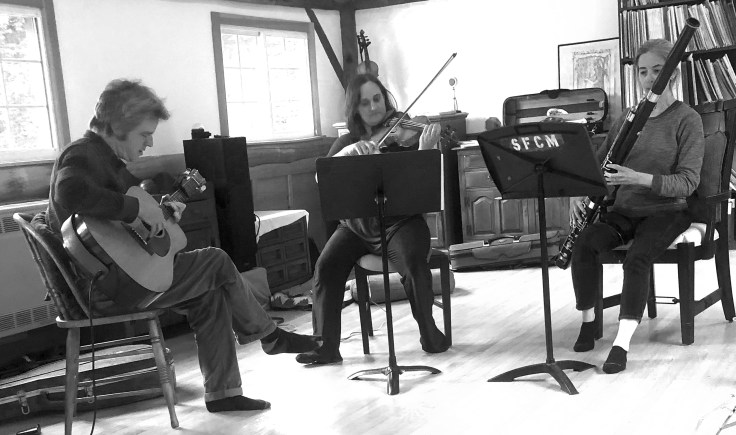
Musically, it is another “production” album, vacillating away from Leaving California’s live-band emphasis. It goes further off the deep end musically than any of our previous efforts, and that actually has to do more with the age of some of its pieces than some sort of trend in our interests.
One day around 2005, while I was still at Mills, I started messing around with prepared guitar, bass, and bronze bells, not even bothering with a click track (good plan, Damon). I had Ivor Holloway and Jon Russell over soon afterwards to record some horn parts I’d notated and blow over the prepared guitar intro, and then composed a gentle, contrasting all-horns chamber piece for them to arrive at later. It became a 30-minute long instrumental called “All Souls” which was to be the centrepiece of a second sort of electro-chamber album to follow up on the album I’d completed around my Mills thesis piece “Anxiety,” but it never felt like it fully made it to where it wanted to be. Over the years, I kept refining and expanding on the opening section, which eventually became ”How Are We Doing…”, and broke up the quieter last section to create the instrumental interludes called “Familiar” that are on the Night Loops album.
Other songs like “Durer’s Rhinoceros,” something I always meant to bring to the live band but never did, are nearly as old. By contrast, “The Ladder Slipped,” “Sage’s Song,” and “Division Blues” are all new creations. The central contrapuntal part of “The Ladder Slipped” was a fragment of music we’d rehearsed and recorded as a band, but never used, but the song originated when I had a heart-to-heart with the somewhat neglected banjo right after we moved.
“Division Blues” had a funny provenance. I actually dreamed I was listening to an outtake from Bowie’s Low, and when I woke up I realized both that it was microtonal and that it wasn’t really a Bowie outtake, in fact sounded nothing like Bowie, which meant I was free to go and create it. I had some lyrics I’d been saving for just this sort of musical context since about 2011, so I dug them up, repurposed some unused drum takes from Jordan, got out the 22-edo guitar I’d used with Ventifacts, and threw the basic song together that day.
Other songs like “..And Who Will Tell Us?” and “Elvis” are middle-aged. Jason and I did an “immersion” day in 2014 in which we independently tried to come up with 20 completely new pieces of music in one unbroken 12-hour period, more an exercise in plowing past the inner critic than a realistic goal. I wrote “Errol at 23” and “This Is Just What It Seems,” among a couple other things, that day, and Jason came up with the opening section of “…And Who Will Tell Us?” with its acoustic guitars and high active bass idea. He gave it to me and I fleshed it out into the full song.
The open-hearted, warmer tone of Leaving California is closer to where I am today than The Warm, Dark Circus, particularly the epics with all their chaotic, centripetal energy.
Partway through working on “Leaving California” early on in the pandemic, I got sick of the music I was immersing myself in and thought maybe I’d finish “Warm, Dark Circus” instead. But at that particular moment, during lockdown, How Are We Doing…gave me the howling fantods, so I went back to “Leaving California.” I doubt I would initiate something as blustery and episodic as that piece again today, but I am immensely proud of it and glad to have finally gotten to the finish line with it without losing my shit.
After Leaving California, I figured it would be the last album with the great rhythm section of Jason Hoopes (bass guitar) and Jordan Glenn (drums) because you moved with your partner Emily Packard (violin) to the east coast of Vermont and Hoopes and Glenn stayed in California. However, I was pleasantly surprised when both were featured on The Warm, Dark Circus. Based on the About section of your official website, however, it appears that this will be the last album Hoopes and Glenn play on. So did this happen? Was The Warm, Dark Circus recorded before the Leaving California album?
No, there’ll be one more eventually, as I suggested earlier. Somehow, I managed to get three albums worth of raw tracks out of Jason and Jordan before we left California. However, the third is going to go on hold for a while, because I’m much more eager to complete a couple other recordings, including one which represents the new material the band is currently working on, which we haven’t even started to lay down. In part, this is another manifestation of the JOTC cycle: I just burnt myself out on another “production” album in WDC; now I want to put my energy into the live band and rendering recordings of it, and the last of the Hoopes/Glenn albums is looking like it wants to be another “production” one.
I also love working with Jason and Jordan. They are irreplaceable, one of the world’s great rhythm sections as far as I’m concerned. I remember thinking to myself before we left that I could work with this guys fruitfully for the rest of my life, and yet at the same time there was a feeling of curiosity about what other musicians would bring, respond to, evoke. Towards the end of our time in California, despite what I just said, we did run out of energy. Meanwhile, I’m loving the way the group is currently going, the energy is back, and the ideas Victor Reynolds (bass) and Ben James (drums) are bringing are perfect for the new material and refreshing. So it’s a big, impractical Both-And in my mind. Jason and Jordan may be currently-inactive members, but nobody ever drew a line on either side and said the collaboration is over, kind of like when Kate left for a few years. Let the change be generative, the limitations provoke new ideas. Everyone seems to be easy going about this.
For now, I’m happy to continue exploring the possibilities of the new group. At some time in the future, I’d probably like to reconnect musically with Jason and Jordan as well. There are several ways this could work, but it’s not front and center on my mind for now.
Read also:
- Levyarvio: Jimmy Page – Outrider (1988)
- Review: Brian Eno + David Byrne – My Life in the Bush of Ghosts (1981)
- Levyarvio: Gong – Zero To Infinity (2000)
- Review: Michael Oldfield – Heaven’s Open (1991)
- Review: Talk Talk – The Colour Of Spring (1986)
- Levyarvio: Jeff Wayne – Jeff Wayne’s Musical Version Of The War Of The Worlds (1978)
- Review: Gong – Shamal (1976)
- Review: Genesis – A Trick Of The Tail (1976)
- Review: Rush – Moving Pictures (1981)
- Review: Pavlov’s Dog – At The Sound Of The Bell (1976)
The music of Jack O’ The Clock is quite complex. Leaving California seemed to me to be heading in the direction of slightly more stripped down and simpler music, but The Warm, Dark Circus again contains some of the band’s most complex songs. What does complexity mean to you as a composer?
Music exists that reflects all aspects of nature and culture—from their highly ordered systems to their simple, broad gestures—and as far as I’m concerned, there’s a time and place for everything. Complexity is an aspect of nature which emerges at certain resolutions. At other resolutions, you become more aware of elegant simplicity. The busy surface of the ocean viewed from a boat creates a different impression than a huge swath of open sea with maybe a few cloud-shadows moving across it viewed from a thousand-foot headland.
My visual analog for complexity in music, (which often triggers a desire for counterpoint, one of my favorite manifestations of complexity) has been a gaze up into a canopy, where strong lines of branches crisscross each other, ramifying out into branchless, twigs, leaf-veins. It’s chaotic up to a point, but it’s not “anything goes”—there’s a pretty strong limit to the set of possibilities (the color-set, for example), boldly delineated rules to the game, and clear patterns like self-similarity. There is a lot of order in this kind of complexity, which makes it interesting to me. But you have to balance that order with chaos, places where the rules get broken or simply can’t be discerned—what I’ve usually thought of as “wilderness” in music—or it gets stultifying, dogmatic. Chaos, for its part, is de-centering, and that breathes life into art up to a point, but too much of it I find nihilistic.
You’ve said that a significant part of the music of The Warm, Dark Circus was composed years ago. Is this a ”clear the cupboards” album and is there something completely different to follow with a new line-up? What can you currently tell us about the future of Jack O’ The Clock?
There always seems to be something else in the cupboard. One of the things that I’m working on now is a still-older project dating from around 2003. I was most invested at that time in building up a portfolio of “serious” instrumental compositions and getting them played, and looked down my nose at my own love of straightforward songwriting. Even then though I didn’t have the discipline not to write songs, and songwriting was something I did when I wanted to relax and simply enjoy music—imagine that. As a result, they came out as a pure, unfiltered pleasure, largely upbeat and full of catchy hooks. I remember working on them on the front porch of the house Emily and I lived in in Boulder, Colorado, right after I left Massachusetts to move in with her. The song “Jubilation” is actually a celebration of that moment of my life. We lived with other musicians and in a community of extremely adept bluegrass players, and there were always jams going on. I’d try to hole up in our bedroom composing “serious” music, but I’d always be drawn out by sounds from the other room. Emily took a lesson or two with one of our heroes, Darol Anger, who was passing through on tour with a friend of hers from music school, and he got her going on the baritone violin (a regular violin strung with chubby strings tuned an octave lower) and developing some rhythmic comping techniques. The baritone violin is all over those songs from the Boulder era and early JOTC, and has great expressivity—it’s since fallen into disrepair, but I’d love to revive it.
Emily and I recorded the Boulder songs in short order over the summer of 2003, borrowing the drummer from the band she was playing in at the time, and even played some of them live a couple times, and then I basically forgot about them until last year when a friend returned to me the original ADATs they were recorded on. I had those converted to DAW-ready files, and was really taken in by how catchy and pleasurable many of those songs were. The original album was a group of portraits of individuals, and almost none of the lyrics worked anymore, but I like the “portraits” idea and basic tone of the songs quite a bit, which is mostly comic, so over the past six months or so I’ve rewritten most of the words and re-sung all the vocals, in addition to adding a bunch of overdubs. Victor has helped me quite a bit with this as well, contributing guitars, bass, vocals, piano, recorders, and percussion. I think I’ll probably bring Kate in in places too, so, what the hell, might as well call it JOTC. We’re cooking with gas now, so I imagine we’ll have it out in 2024. It’ll be interesting to see how it goes over. For those fans of JOTC that are in it for the “avant” or “experimental” stuff, this won’t scratch that itch very much. On the other hand, there are probably a few listeners out there who would love to hear what it sounds like if JOTC made a whole album of folk-pop songs, and this is it.
“Cupboard” projects aside, I’m really jazzed about the way the live group is developing right now, and this is all new stuff, a clean break. When the pandemic hit right after we moved to Vermont we got in touch with Kate and she expressed interest in working together again, having recently moved back to her home state of Vermont herself, so I started writing new music for the three of us plus an imagined bass player. It was really satisfying to work on fully notated, contrapuntal music again, and I amassed a good half hour of it before we were able to actually get together in person and try any of it out. Meanwhile, Victor, who’d been a fan of the band, had contacted me for remote lessons and learned all of my solo guitar pieces and a bunch of JOTC songs astonishingly quickly. He played everything, and eventually the lessons stopped being lessons and Victor started taking on the bass parts for the new music. Then he was flying out from the Bay Area several times a year and rehearsing with us. He’s a very melodic and open-minded musical presence raised on XTC, Captain Beefheart, and Gentle Giant, and stepped right into contrapuntal thinking, which is essential from the bass in this project. But what is also exciting to me about Victor’s presence is that we’re able, for the first time really, to get multiple fingerpicked guitars going—one of my favorite things to do in recordings but something I’ve never before had a chance to experiment with live—and it just sounds so good.
Meanwhile, we’ve recruited a local drummer, Ben, who I met soon after moving East. We discovered we had many common reference points and shared broad musical interests, and when he invited me to check out some free-improv events he was participating in, I felt like I was back at Mills. He’s been drumming with the Julian Gerstin sextet, an original jazz outfit influenced by Caribbean and Eastern European folk music, for years, and has brought a great sensitivity, erudition, and holistic musicality to our project.
Even with Victor traveling out for a week or two three or four times a year, it’s been a slow process rehearsing the new material, but we’ve now got a 50-minute set of all-new songs that we’re finally able to perform live. I’d describe the new music as somewhat sunnier, more fully-composed, and folkier than the wild electric forays of The Warm, Dark Circus. More personal, probing, and reflective, different from both WDC and the “Portraits” project. If anything, it’s a bit like Repetitions I, but only on the surface, in terms of its instrumentation and compositional approach, featuring a lot of bassoon/violin/bass interplay. I’m eager to show this stuff off before real live humans again, which we haven’t really done since 2019. By the time this interview goes live we will have had our first performance and album-release party in our own studio here in Brattleboro, and there should be more to come in 2024. It’s sort of classic JOTC to be doing an album release show and playing absolutely nothing off the album…
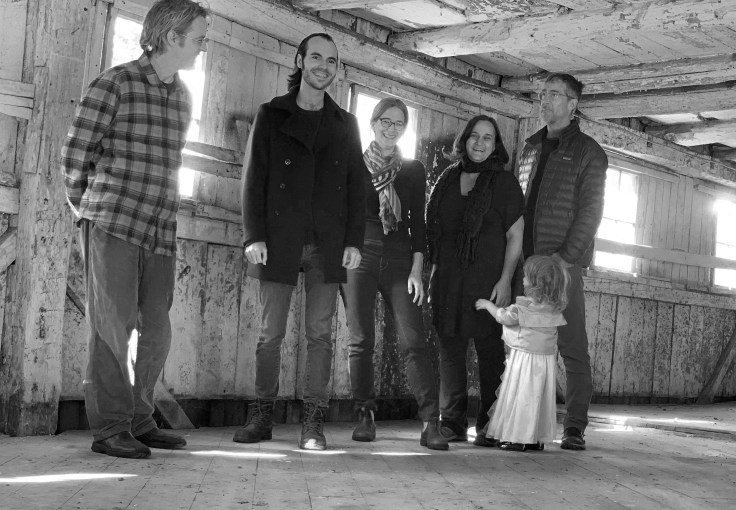
Your side project Ventifacts explores microtonality in a pop context. Microtonality is probably quite an exotic concept for many listeners. Could you describe microtonality a bit? What interests you about it and what do you think it can bring to music?
It’s the use of pitches which fall in between the 12-tone, equal-tempered set that dominates Western music. The band The Mercury Tree, an extraordinarily tight and inventive trio from Oregon with whom we’ve shared several bills, went whole-hog down this road, mostly exploiting other equal divisions of the octave (like 17, which they’ve worked a lot within), and I suggested a collaboration with the band’s leader, Ben Spees, soon after moving east. I didn’t necessarily intend to go as microtonal as we did, but there was no going back for Ben, and I was game for the exploration. I’m glad I did, though. It expanded my ears, and continues to do so.
The novel intervals that microtonality offers have less predictable perceptual effects on people in the Western world, which is to say less culturally-preordained symbolic baggage within Western music, than the familiar compromised 12-equal-divisions-of-the-octave sounds, so associations take private routes when you hear them, often along unexpected pathways. I thought initially, for example, that I’d hear most “new” intervals as dissonances, and that I’d thus experience them as dark and murky and pair them with appropriately shadowy words, but it’s turned out to be far more complex than that. There’s a giddy quality to super-major thirds that I didn’t expect, almost an ecstatic quality, as there is to flat minor sevenths. These are some of my favorite private associations.
And there is another dimension to this that can’t be ignored: some of the intervals you gain access to are more perfect, closer to the chord of nature or overtone series, than 12-edo affords. 12-edo evolved in order to allow player to play a keyboard instrument in any key and sound reasonably in tune, but as a result, intervals like major thirds had to be pretty severely compromised from their natural state. String players naturally take advantage of their fretlessness to compensate for this, incidentally, letting their pitches approach natural thirds when they don’t have to tune to a piano, because they simply sound more in tune with each other. So it’s not all cultural or semantic associations: our bodies pick up on the “rightness” of closer-to-perfect intervals. Microtones offer both deeper dissonances and deeper consonances.
Ben and co. go way farther than I do with the mechanics and study of microtonality. I’m happy with the casual, playful way I’ve been able to engage microtones without completely divorcing myself from familiar methods of composition, and for the most part am just doing what I’ve always been doing in this project, but with an expanded vertical palette. And the microtones have started creeping into JOTC a bit too—they were always there in a “random” way to an extent, in certain instrumental preparations and abnormalities (like staples on the guitar, playing rubber bands, etc.), but the 17-and 22-edo guitars actually make cameos on newer recordings like WDC, although hardly to the extent that they do in Ventifacts.
Is Ventifacts still an active project?
Just as I’ve turned back towards JOTC recently, The Mercury Tree has been working hard at their own material post-pandemic and has just released an impressive new album Self-Similar, which I had the privilege of guesting on. They came through and stayed with me and Emily a few days last month on tour and we had the pleasure of doing some microtonal jams together and witnessing their stunning live show.
Ventifacts will likely do some more recording at some point. I think we’d all like to, it’s just hard to say how soon that will be, lives being as busy as they are right now.
Read also:
- A Conversation With Bill Bruford
- Thinking Plague: Beyond the Frontier of Rock Music: Interview of Mike Johnson
You have also composed instrumental art music. Tell us about it. Is any of this material available on record? Has the music been performed live?
I focused on writing instrumental music roughly from 2000 to 2006, and that is when I learned a good deal of the craft of composition—how to orchestrate effectively, notate efficiently (or in a way that doesn’t annoy the players), etc. A lot of chamber music for small ensembles, string quartet, wind ensemble, a bit for orchestra. It was hard because my music, tending towards syncopation and groove, was rehearsal-intensive, so satisfying performances were hard to come by. It’s a lot of effort for a messy reading or 3-rehearsal concert, and then the piece disappears into a drawer. I can see why composers end up fetishizing the score after a while. The process, unless you’re at like John Adams’ level of prominence, selects for simpler, almost sight-readable music, which wasn’t of interest to me.
I’ve written some non-JOTC music since starting the group, but only when asked. It’s just a matter of finding the time, and of wanting JOTC to be as rich and diverse as possible. So if I’m in the mood for winds, say, or ensemble strings, I’m more likely to work them into a JOTC piece than start a separate project. It’s a whole other avenue of promotion as well. I just don’t have the energy to keep that part of it up. I’ve thought about doing it again, but as my life has only gotten busier, it seems unlikely at the time being.
In any case, yes, there have been some recordings, some wonderful people who have really put in the time with it, for which I’m grateful—largely folks we knew when Emily was at San Francisco Conservatory, when I was still focusing on developing and selling myself as a free-floating composer. The bass clarinet duo Sqwonk played the hell out of my piece ”Valediction”, which they recorded for their first album and then subsequently got even better at live. Electric guitar/drums duo The Living Earth Show did phenomenal work with my piece ”The North Pacific Garbage Patch”, which they finally released as a single a couple years ago. Quartet San Francisco gave a movement of my string quartet a good thrashing at a Dave Brubeck tribute concert at Mills towards the end of his life. Brubeck seemed pleased with it, though maybe he was just being polite—said he was glad to see such “fiery” music coming out of a young composer. I’d almost forgotten about that.
There are various other live performances scattered around YouTube and recordings compiled on bandcamp, which are uneven. And then there is my first foray into using a DAW, the 2006 experimental album “Anxiety,” which contains my Mills thesis piece of that name as well as a few other “tape” and chamber pieces. Somehow it ended up on Spotify without my approval, I’m noticing. I’ve got mixed feelings about this—proud of it on some level, but it’s also crude, part of a learning process.
Which artists or composers inspire you the most right now? Do you listen to a lot of music?
I listen to music all the time, also podcasts and recorded books. During the day I’ll often listen to more complex, upbeat, stimulating music as I go running—we live in a beautiful spot for this, and I’ve become addicted to this little ritual between morning and evening work—and at night, more meditative music like Jon Hassell or Morton Feldman.
A big find in recent years is the varied catalog of Robin Holcomb. She might be the greatest living songwriter as far as I’m concerned. Her lyrics stand alone as poetry, first of all, but she has a bafflingly broad musical interest and capability on top of that which make her work so varied it could get lost in the cultural cracks. It’s coherent, however: there is a Robin Holcolm style (or constellation of styles) and identity that threads it all together.
She made a few band-oriented rock albums in the early 90s, drawing from the New York scene which included Bill Frisell and her partner Wayne Horvits, also a formidable keyboardist, put out two solo piano albums (one with Horvits, and it’s fun to try to figure out who is playing what), did a jazz album in the early oughts, and has written a good deal for traditional “classical” settings and instrumentations. Her piano playing is stately, elegant, harmonically surprising. She has an Ivesean sensibility at times—and I’ve never heard anyone else even approach this competently, particularly within songwriting—that will lull you into complacency with delicate IV-V-I cadences and then go completely off the map—it is organic, never forced, although if you don’t have a taste for Ives it might not make sense at first. ”Iowa Lands” is an amazing piece about the homesteading era that demonstrates this capacity. ”The Point of It All”, from the album of that title is just about the perfect song: a devastatingly naked and vulnerable deathbed monologue that breaks its own delicate, lullingly repetitive phrase with low piano chords jarringly descending by 5ths, which seems to underscore the simultaneity of grace and acceptance on one hand and the painful dissolution of body and individual ego on the other that—I can only imagine—one goes through at the time of death. Then there’s an elegant, gently swung solo in the middle. Gives me chills straight through. “The saint perseveres with sudden ordinary tears.” Phenomenal. More perfection, her early songs “Waltz,” a portrait of a moment in a small town, the creepy nocturne “So Straight and Slow,” just about the entire Little Three piano album, I could go on…I don’t always understand her work completely, but that’s part of the allure—she convinces me. It’s coming from a deep, wise, heartfelt place.
What else?
A newer discovery is Y-Otis II, by Otis Sandsjö, a Berlin-based sax player whose arrangements are wildly original and whose compositions have an ecstatic quality both weird and danceable. It’s a mix of live and (I think) sampled elements. I haven’t yet had a chance to explore interviews and whatnot and discover how he puts his textures together, but I like that—I like being bowled over by the end result and am in no rush to demystify it. Fabulous drummer, metric modulations that make you smile. And there seems something really good-natured about the whole thing, which might be a weird characterization, but I appreciate it.
I’ve also been introduced to the work of Susheela Raman by a listener to the band, and she’s had an outsize influence on my ears in recent years. She’s a British singer of Tamil extraction who creates a hybrid music which is all over the map, but once again in a way that strikes me as authentically integrated, drawing from the music of India and Pakistan as well as rock, soul. I have no knowledge of the Carnatic tradition she came up through, so I come to her music somewhat naively, for what it’s worth. Her vocal command is astounding, totally prepossessing. The Queen Between is a phenomenal album. She also did a fascinating album of songs built up using Gamelan instruments called “Ghost Gamelan,” and is I believe currently working on an album of songs with Western orchestral instruments, which I can’t wait to hear.
Thank you very much for this interview! Is there anything else you’d like to share or send greetings to the readers of Pienemmät purot?
Greetings, yes! And thanks for indulging me, Janne, as well as readers. God help you if you’ve made it this far!
Author: JANNE YLIRUUSI *
* Well Damon did all the heavy lifting really
You can listen to and buy the new Jack O’ The Clock album The Warm, Dark Circus here.
 Pienemmät Purot
Jätä kommentti