
Mirror To The Sky is Yes’ 22nd studio album.
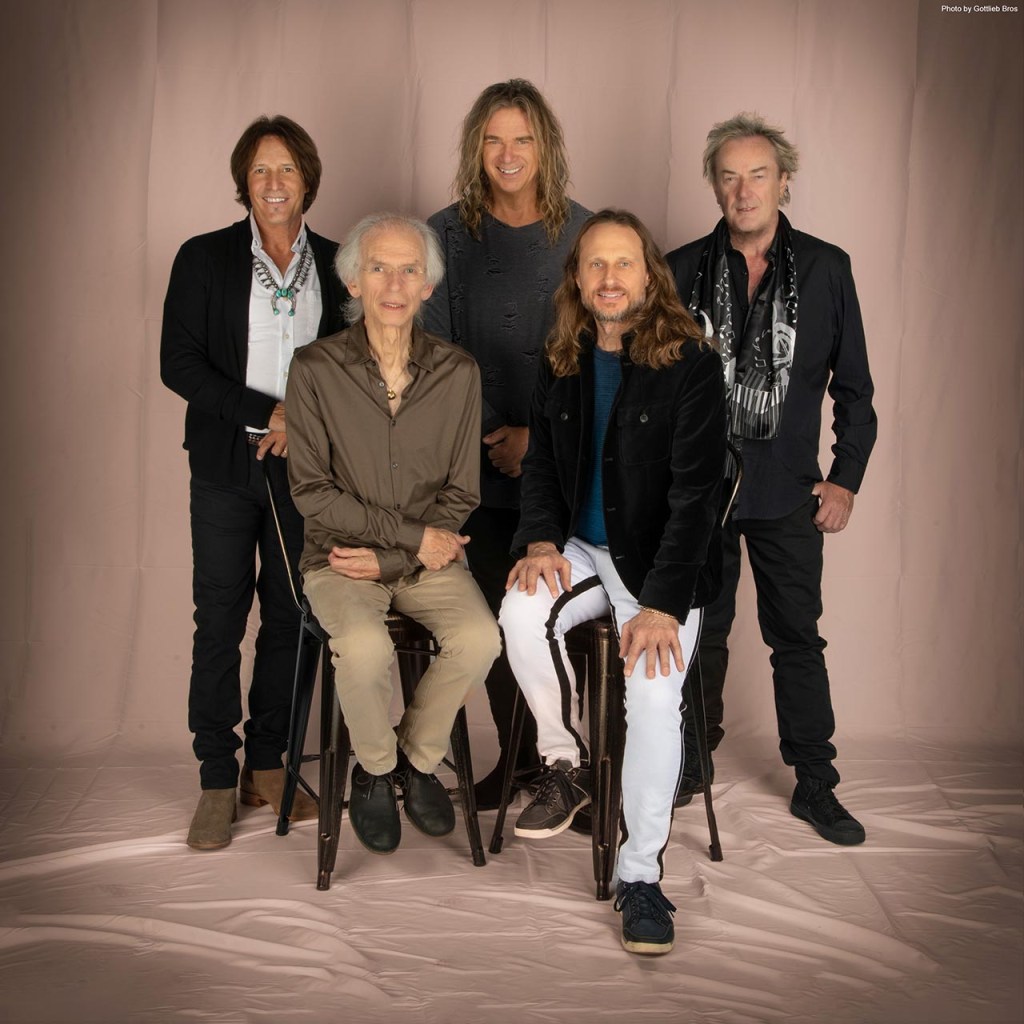
It’s ironic that Yes, a band that takes the most positive word possible for its name and often sings about universal love and or the search for inner peace, has over the years almost constantly been a real war zone. In particular, founding members bassist Chris Squire and vocalist Jon Anderson have been at loggerheads with each other. Since then, Squire and guitarist Steve Howe, who joined Yes in 1971, or Howe and Anderson, have also crossed swords. The multi-talented Trevor Rabin added his own contribution to the mix when he joined in 1983. He ended up fighting for power with Anderson and, on the other hand, relations with Howe were also frosty. With many twists and turns, in 2023 Yes is now a Howe-led band.
How Yes came to be fronted by guitarist Howe. What’s essential here is that the other powerhouses of the band have gradually moved, or been moved, to the sidelines. Rabin left Yes back in the mid-90s and has since concentrated mainly on composing film music. Anderson, meanwhile, was excluded from the band in 2008 after a near-fatal asthma attack. After that, the band was mainly led by Squire, but after his death in 2015, a power vacuum was created, with Steve Howe as the only natural replacement. Neither the easy-going veteran members drummer Alan White and keyboardist Geoff Downes nor the junior members bassist Bill Sherwood and vocalist Jon Davison were any challenge to the guitar maestro. Apparently, life in Yes is now more harmonious than ever under Howe’s leadership. But does a harmonious working environment necessarily produce great art?
The first Yes album produced under Howe’s direction was The Quest, released in 2021. Mirror To The Sky was released in May 2023, just a year and a half after its predecessor. At least Yes hasn’t been as prolific as it has been under Howe’s leadership for a long, long time. Yes will also continue with The Quest line-up with one exception; long-time drummer Alan White died in the summer of 2022 and his place was taken by Jay Schellen, who had long supported the ailing veteran at the band’s gigs.
White was once a potent drummer who was at home with the irregular rhythms typical of Yes, even making them groove. White and Squire formed, at their best, one of the most powerful rhythm sections in progressive rock. Sadly, White’s playing was not what it was in recent years as he fell ill for a long time before his death. In retrospect, he had even become a hindrance to the band.
In The Quest’s credits, the drums are credited to White alone and Schellen is credited with percussion. However, I strongly suspect that Schellen played a significant part of the drums on The Quest so the drumming on Mirror To The Sky sounds similar. Schellen’s style is something between White and Yes’ first drummer Bill Bruford. Schellen plays relatively straightforwardly like White often does, but with a lighter touch and a more orchestral feel that reminds me of Bruford. On the other hand, Schellen’s playing has none of the unexpectedness of Bruford. Whereas Bruford tended to accentuate the strokes in a strange way and to terrorise the music a little, Schellen seems to play only what is needed. As if he were a little timid. He also doesn’t seem to really drive the music with his playing, as I think the best drummers do, but plays as if with the rest of the band. Schellen is a competent drummer, but unfortunately he is not a particularly interesting musician.
Mirror To The Sky consists of six songs and three bonus tracks. This time there are also quite long pieces. Two of the compositions narrowly exceed the nine-minute mark and the title track lasts a whopping 14 minutes. As on the previous album, most of the songs are accompanied by a small symphony orchestra. The orchestrations are again by Paul Joyce. The overall style is also very much along the lines of The Quest, with Mirror To The Sky offering a relatively light prog sound. Overall, however, the atmosphere is a bit more energetic and proggy this time.
Read also: Mike Oldfield: Tubular Bells (1973)
Opening with a short string intro, the five and a half minute ”Cut From The Stars” is the most upbeat track on the album. After the strings, it becomes upbeat, bouncy and downright uplifting feel-good music. Stylistically, ”Cut From The Star”, composed by Jon Davison and Billy Sherwood, is a clear counterpart to ”The Ice Bridge”, which opened the previous album. Both successfully position themselves somewhere between prog, pop and AOR.
Apart from the general swagger of ”Cut From The Star”, its most pleasing aspect is Sherwood’s nimble bass guitar playing. Sherwood’s bass guitar is constantly circling around Davison’s vocal melody, playing a kind of countermelody. Chris Squire’s melodic bass patterns have always been one of Yes’ trademarks so ”Cut From The Star” fills at least one of Yes’ checkmarks in that regard. At times Sherwood’s buzzing bass effect also brings to mind Squire’s Mu-Tron pedal experiments. Indeed, Sherwood as an instrumentalist is in the strongest shape of the current Yes members. It’s a pity he didn’t get a more powerful rhythm partner than Schellen.
Davison, now singing on his third Yes album, handles the vocals on ”Cut From The Stars” fine with his high and slightly thin voice, but his one-note lyrics about the stars are disappointing. They clearly aspire to Jon Anderson’s supremely commanding cosmic style, but the lyrics are completely devoid of the surprises and strange poetry Anderson offers.
Steve Howe’s guitars feature prominently on much of Mirror To The Sky, but on ”Cut From The Stars” they are overshadowed by Sherwood. Keyboardist Downes is generally relegated to the role of extra on the whole album, but on this song at least he gets to play a very short Mini-Moog-sounding solo. I would have liked to have heard more of him.
”Cut From The Stars” is a successful start to the album and stylistically it would have suited The Ladder or even Drama if the execution had been a bit more energetic and intense.
”Cut From The Star” is followed by two nine-minute mini epics. The first is ”All Connected”, signed by Davison, Howe and Sherwood. Featuring plenty of Howe’s steel guitar, the track is again propelled by Sherwood’s handsome bass line. There’s plenty of harmony vocals which have traditionally been one of Yes’ trademarks. The vocal harmonies, however, remain too weak with the current line-up, if only because of Davison’s rather thin voice. Davison sings high like Anderson, but there is no similar depth to his voice. It lacks all of the roughness and edge. Amusingly, Davison makes Anderson, who is usually dismissed as a pixie, sound like a real rock god!
The second mini epic ”Luminosity” is by the same trio as ”All Connected”. It contains quiet passages in which Davison’s voice is almost single-handedly brought to the fore. In these passages his voice is really at its best because they are so far away from rock music that a complete lack of distortion is not a problem. As a whole, ”Luminosity” remains a somewhat uninteresting song that just sort of floats through its duration without any major highlights.
The fourth song ”Living Out Their Dream” is the only song on the album for which Downes gets the composition credit (shared with Howe). ”Living Out Their Dream” is probably intended to be the album’s ”rock song”, but it’s a pretty weak affair as such. Howe’s guitar playing on the album is otherwise pleasantly varied, but the raw side of his sound is still completely missing. After all, when he joined The Yes Album, Howe was one of progressive rock’s raunchiest guitarists! That’s the sort of touch this song could have done with.
”Living Out Their Dream” is also cramped by dull drumming. Mirror To The Sky is generally quite well produced. Its sound is light and airy and distinctive and nicely balanced. For one reason or another, however, Schellen’s drums are rather poorly recorded throughout the album and sound particularly muffled on ”Living Out Their Dream”.
Howe and Davison sing together the silly lyrics written by Howe and I have to say that the solution doesn’t work: this may well be the worst vocal performance in Yes history.
”Living Out Their Dream” is the weakest track on the album, but despite all the barking, there’s still something elusively charming about it. At least Howe’s fast guitar scales are entertaining to listen to. ”Living Out Their Dream” serves nicely as a leisurely snack between more serious music, but it would have served its purpose better in a more condensed form. Almost five minutes is way too long.
”Mirror To The Sky” is the longest track on the album at 14 minutes. It is also the longest Yes composition since 1997’s ”Mind Driven” (from Keys To Ascension 2). The tune, which is credited to Davison and Howe, features some of the most fiery guitar work on the album. Indeed, Howe is the absolute star of the track as his guitars, both acoustic and electric, dominate the song almost constantly. The amount of guitar tracks is quite impressive. And when the vocals finally start after a three minute intro, the first words are sung by the guitar maestro himself. But the vocal responsibility is mercifully soon passed on to Davison.
Howe and Davison duet more in the song, but unlike in ”Living Out Their Dream”, this time the solution works much better. Davison’s bright, clear vocals contrast successfully with Howe’s huskier voice.
”Mirror To The Sky’s” light semi-symphonic music reminds me of the Renaissance productions of the mid-70s. Towards the end, the orchestra plays alone for a while without the band, but the effect is not particularly interesting. Fortunately, the finale that follows is more successful.
As with a couple of long songs from the early part of the album, ”Mirror To The Sky” lacks a proper dramatic arc. It feels more like a collection of, in itself largely interesting, discrete sections than a true emotional journey with its moments of elation and highs like the best Yes epics have been.
Yes has ended the album with an often light and simple song that acts as a kind of gentle code for the whole album. Such songs have included Big Generator’s ”Holy Lamb”, The Ladder’s ”Nine Voices”, Magnification’s ”Time Is Time” and now Mirror To The Sky’s closing ”Circles Of Time”. Davison’s voice is better suited to songs like this where he is allowed to sing in a slightly lower register and in softer tone. In a song composed and written by Davison alone, his vocals are mainly accompanied by strings and acoustic guitar. ”Circles Of Time” is a simple and beautiful end to the album.
Most editions of Mirror To The Sky include three bonus songs composed by Howe alone. Lasting around 16 minutes in total, the tracks are roughly on a par with the rest of the material, for better or worse. Although ”Living Out Their Dream” could have been replaced by any of the three bonus tracks, ”Unknown Placella”, which highlights Downes’ organ in particular, would have been a good substitute. In general, as a devotee of compact albums, I am nevertheless pleased that not all the material was squeezed into the actual album. It will be nice to come back to the less played bonus tracks when the real Yes hunger comes back and there is no more new material available.
Read also: Rick Wakeman: The Six Wives of Henry VIII (1973)
Mirror To The Sky has been received quite favourably by the music press and fans (if we forget the most die-hard ”No Jon Anderson, no Yes” school of thought). The most enthusiastic have even hailed the album as Yes’s best since the 70s and a return to the band’s golden days. Such talk is a gross exaggeration, but for a band with a name more than half a century old, Mirror To The Sky is undeniably a creditable achievement. In my book, the album is more or less on a par with its predecessor The Quest, sharing much of that album’s strengths and weaknesses.
Usually, when veteran bands like Yes release new music, speculation about whether it’s a swan song starts very quickly. In Yes’ case, there seems to be no fear of this as they are apparently already working on their next album. I welcome the new productivity of Howe and company, but hopefully the next album will bring a slightly more radical departure from its predecessors.
Best songs: ’Cut From The Star’, ’Mirror To The Sky’, ’Circles Of Time’
Author: JANNE YLIRUUSI
Tracks
- ”Cut from the Stars” Davison, Sherwood 5:25
- ”All Connected” Davison, Howe, Sherwood 9:02
- ”Luminosity” Davison, Howe, Sherwood 9:04
- ”Living Out Their Dream” Howe, Downes 4:45
- ”Mirror to the Sky” Davison, Howe 13:53
- ”Circles of Time” Davison 4:59
- ”Unknown Place” Howe 8:15
- ”One Second Is Enough” Howe 4:04
- ”Magic Potion” Howe 4:08
Yes:
Jon Davison: lead vocals (1-3, 5-6), duet vocals (4, 7-9), acoustic guitar (5-6) Steve Howe: electric guitars, acoustic and pedal steel guitars, autoharp (track 3), duet vocals (4, 7-9), lead vocals (5) Geoff Downes: piano (3, 5, 8-9), organ (1-2, 4, 6-7), synthesizers (1, 3, 5, 9), keyboards (2, 4, 7), minimoog (3), celeste (3) Billy Sherwood: bass guitars, backing vocals (1-3, 5-7) Jay Schellen: drums, percussion
Other musicians:
FAMES Studio Orchestra: orchestra (1–3, 5-6) Paul K. Joyce: orchestral arrangements Oleg Kondratenko: conductor
Producer: Steve Howe
Label: InsideOut Music / Sony Music

 Pienemmät Purot
I hope you will review “Magnification,” a wonderful album. At first I avoided it, fearing that I wouldn’t like the orchestration, but now it’s a top-10 Yes favorite.
TykkääLiked by 1 henkilö
I will definitely write about Magnification eventually. I really like it. 🙂
TykkääTykkää