
Lucky Golden Stripes And Starpose is the sixth studio album by Wigwam, which was formed in 1968.
Wigwam’s previous album, Nuclear Nightclub, had taken the band’s musical direction in a more stripped-down and simpler direction. The album was a huge success in Finland, but it did little to advance the band’s dream of conquering the world, even though Richard Branson’s newly launched Virgin record label—focused on progressive rock—promoted the album in the UK.
Virgin, however, didn’t give up on Wigwam; instead, they flew the band to their own mansion-studio, Manor, to record the follow-up to Nuclear Nightclub. This was the same place where the label’s massive hit, Mike Oldfield’s Tubular Bells, had been recorded a few years earlier. Wigwam’s Finnish record label, Love Records, did not, however, give up on its flagship band but retained the Scandinavian rights to the album, meaning that Lucky Golden Stripes And Starpose became a joint production between Virgin and Love.
The lineup working on the album at Manor was almost the same as Wigwam’s lineup on Nuclear Nightclub. From the original lineup, drummer Ronnie Österberg and singer/keyboardist Jim Pembroke were still with the band. Pekka “Rekku” Rechardt and Måns Groundstroem, who joined the band for Nuclear Nightclub, continued in their roles as guitarist and bassist. There is also one new member in the band. Heikki “Pedro” Hietanen, who had previously mainly accompanied pop musicians, was hired to handle the keyboards.
Born out of a somewhat stressful atmosphere, Lucky Golden Stripes And Starpose continues in the “deep pop” vein of Nuclear Nightclub, offering a blend of melodic and quite distinct pop and progressive rock. Lucky Golden Stripes And Starpose is an album that sounds slightly rougher and rockier than its predecessor. Perhaps even a bit more complex in places. In keeping with the spirit of the times, the music has also taken on slightly funky tones at times. The overall mood is darker. Even somewhat resigned. As if the band somehow knew that this endeavor wouldn’t end in world domination. On the contrary. Pembroke’s lyrics, however, seem to foretell the global collapse of society as a whole, but in hindsight, it’s easy to interpret them as reflecting the decline of Wigwam—and, in fact, of progressive rock as a whole. Imagined or real. It depends on your perspective.
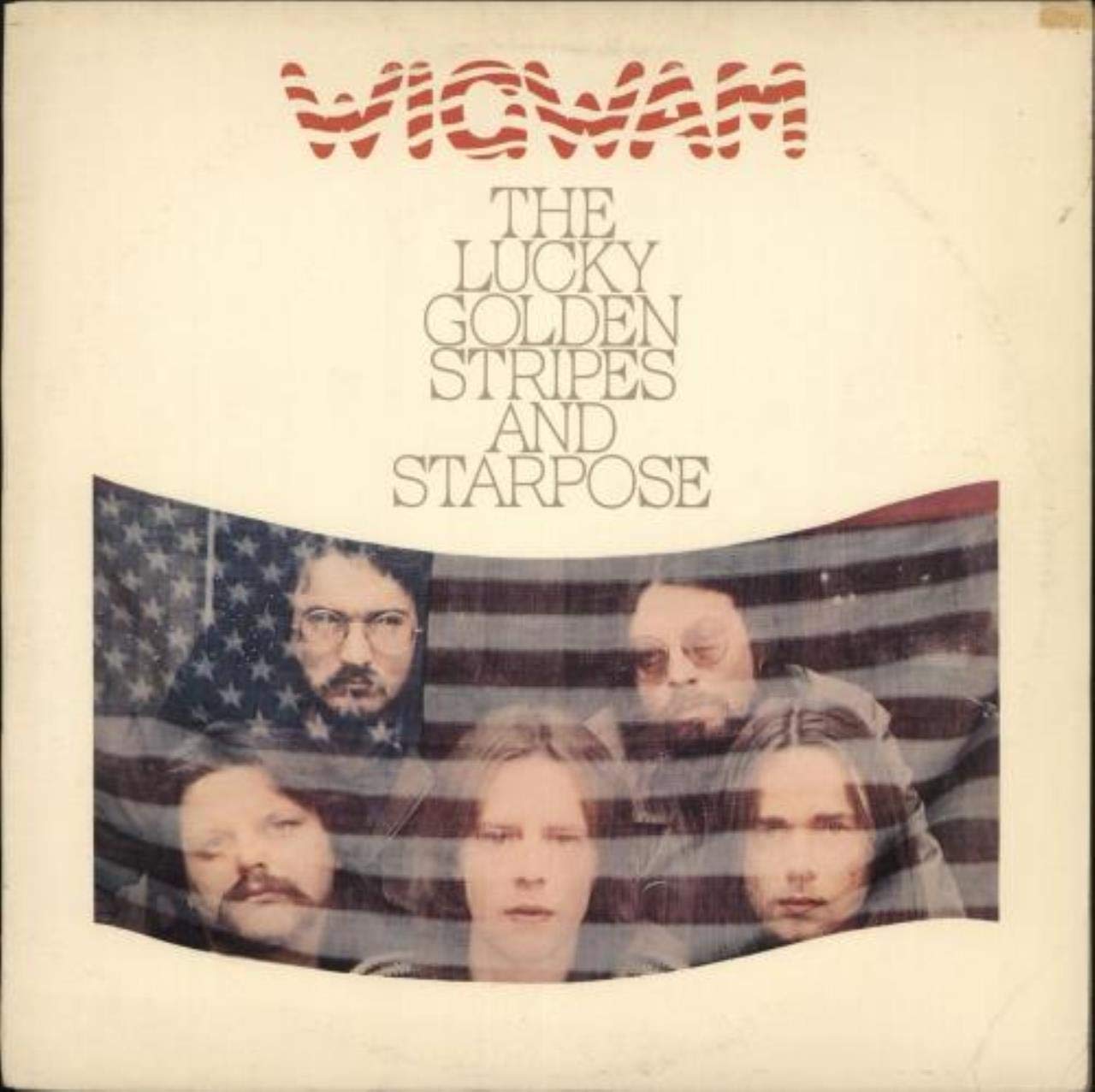
Although the mood on Lucky Golden Stripes And Starposella is somber, especially in terms of the lyrics, this isn’t always true of the music. In several places, the music’s upbeat tone contrasts with the lyrics in an interesting way. A prime example of this is the cheerfully sounding “International Disaster,” whose pessimistic lyrics, however, effectively mirror the song’s title. It’s a downright delightful track. One of Wigwam’s best. A somewhat similar effect is found in the album’s closing track, “In A Nutshell,” which surrealistically appears to address mental health issues, yet features music that pulses quite briskly and is occasionally accompanied by Österberg’s cheerful marimba playing.
Alongside “International Disaster,” one of the album’s highlights is the almost 7-minute-long “Colossus,” which sounds mysterious and somewhat menacing and clearly represents the album’s progressive side. All in all, however, Lucky Golden Stripes And Starpose is a very strong album as a whole, from which it’s difficult to single out individual tracks. The one-minute funk track “Time Dance,” however, is a rather pointless interlude. On the other hand, this consistency also lends the album a certain monotony. The songs blend together stylistically to some extent. Perhaps part of the reason for this is the scarcity of solos. Whereas, for example, Rekku played endlessly long guitar solos on almost every track on Nuclear Nightclub, there’s hardly any such exuberance to be heard on Lucky Golden. And that’s fine, because too much is too much, but a few decent solo flashes could have livened up the album. Rekku’s fine solo on the title track does deserve a mention, though. New keyboardist Pedro also settles for—or is forced to settle for—the role of accompanist throughout the album. He could have been given at least one good opportunity to shine.
Read also:
- Review: Wigwam – Lucky Golden Stripes And Starpose (1976)
- Review: Rain Tree Crow – s/t (1991)
- Review: John G. Perry – Sunset Wading (1976)
- Levyarvio: Black Sabbath – Master Of Reality (1971)
- Review: Henry Cow – Concerts (1976)
- Levyarvio: Spock’s Beard – V (2000)
- Review: Cos – Viva Boma (1976)
- Levyarvio: King Crimson – The ConstruKction Of Light (2000)
- Review: Camel – Moonmadness (1976)
Upon its release, Lucky Golden Stripes And Starpose received a somewhat mixed reception and sold significantly fewer copies than its predecessor, Nuclear Nightclub. The band’s situation began to look precarious, especially as the changing musical climate led Virgin to seriously consider jumping ship from progressive rock. Shortly after the release of Lucky Golden Stripes And Starpose, most of Virgin’s prog-leaning artists and bands were let go, and Wigwam’s next album, Dark Album, was no longer considered acceptable by the label.
Although Lucky Golden Stripes And Starpose marked a dip in Wigwam’s popularity, in terms of musical quality, it has been completely and unjustifiably overshadowed by its predecessor. In my opinion, it is clearly a more nuanced and interesting album. Lucky Golden Stripes And Starpose is an excellent rock album with a touch of prog.
Unfortunately, Lucky Golden Stripes And Starpose also turned out to be the last truly great Wigwam album. The following year’s Dark Album was already a clearly duller affair, and the albums released after their comeback in the ’90s were, unfortunately, mostly mediocre or truly terrible. One would have hoped for more glorious later years for Finland’s most notable prog band. Fortunately, the band still had energy on stage.
(The 2005 CD release includes the single “Tramdriver” and its B-side “Wardance.” Virgin had high hopes for “Tramdriver,” but it didn’t achieve much success. “Tramdriver” is, however, a really good song. It’s pop, yet with a sufficiently distinctive Wigwam touch, without the bitter aftertaste of compromise. Both songs are a great addition to the album’s original tracks.)
Best tracks: ”International Disaster”, ”Colossus”, ”Lucky Golden Stripes And Starpose”, ”Never Turn Me In”
Author: JANNE YLIRUUSI
Read also: Review: Wigwam – Being (1974)
Tracks:
Side A
Sane Again – 3.37
International Disaster – 2.41
Timedance – 1.07
Colossus – 6.40
Eddie and the Boys – 4.03
Side B
Lucky Golden Stripes and Starpose – 6.36
June May Be Too Late – 3.35
Never Turn You in – 5.03
In a Nutshell – 3.47
Wigwam:
Jim Pembroke: vocals, electric piano, acoustic piano, backing vocals Pekka “Rekku” Rechardt: guitars Måns Groundstroem: bass Ronnie Österberg: drums, marimba Pedro Hietanen: keyboards Pave Maijanen: backing vocals
Producer: Ronnie Leahy
Label: Love Records / Virgin Records
 Pienemmät Purot
Jätä kommentti