Viva Boma is the second studio album by the Belgian band Cos.
Cos was founded by guitarist/flutist Daniel Schell in 1974, and the band released its excellent debut album, Postaeolian Train Robbery, that same year. Postaeolian Train Robbery drew inspiration from, among others, Magma and Hatfield And The North, as well as jazz-rock in general.
Their debut album, Postaeolian Train Robbery, was already an excellent record, but Viva Boma marks a clear step forward for the band. The music on Viva Boma is more sophisticated and complex, and I particularly enjoy the increased prominence of the keyboards as well as the expanded role of vocalist Pascale Son (Schell’s wife). Somewhat paradoxically, Viva Boma sounds both more pop-oriented and more progressive than its predecessor.
Viva Boma also feels, more so than before, like an album that fits specifically into the Canterbury scene, even though the band’s geographical location doesn’t quite match. From the very beginning, there have been Canterbury-style bands outside of England as well. The first pioneer of the genre abroad was perhaps the Dutch band Supersister.
What matters more than geographical location is the right attitude and the right musical influences. In terms of attitude, what matters is a certain friendliness in the music and a light, usually slightly offbeat, sense of humor. Musically, what matters is a skillful blend of pop, jazz, and rock influences, along with complex rhythms and sophisticated harmonies. Musically, Cos clearly meets the required criteria, and the attitude is spot on as well. Despite its occasional complexity, Cos’s music is accessible and delightfully “pleasant.”
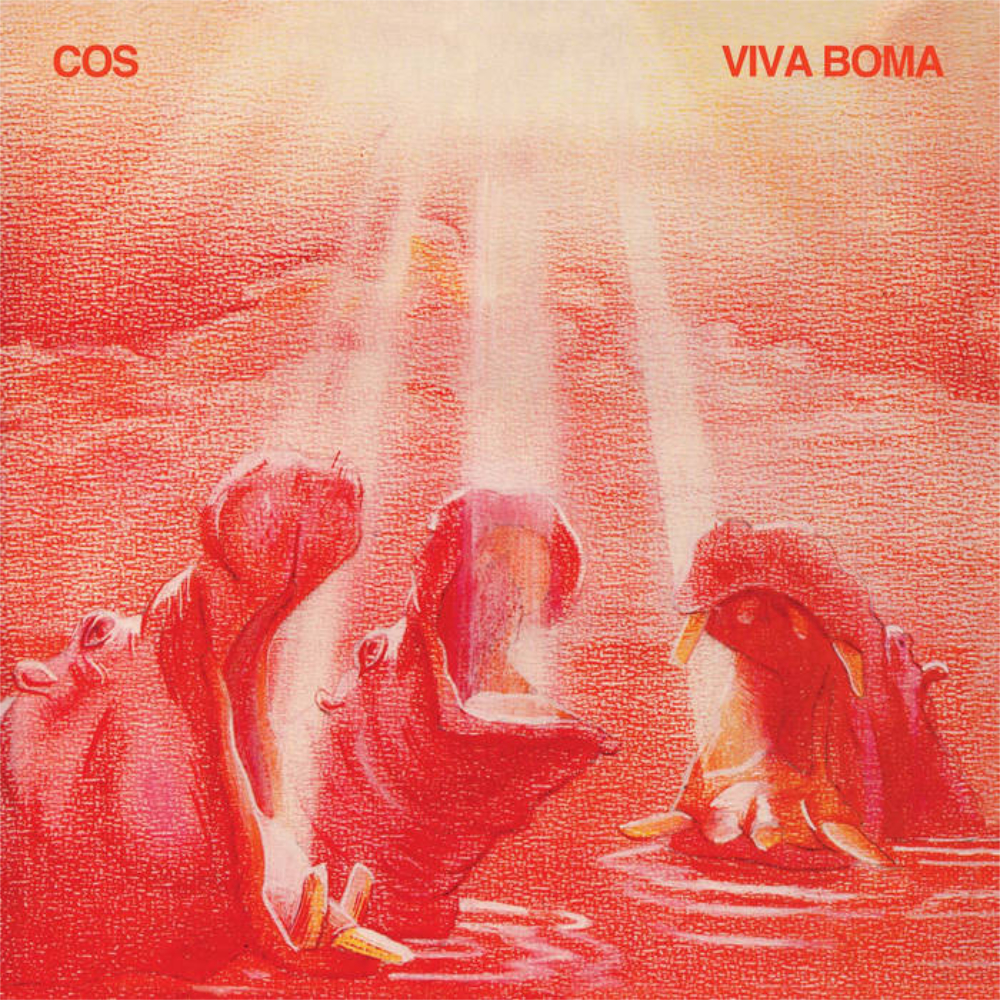
Since Cos doesn’t use straightforward, plain-language lyrics, the humor isn’t conveyed directly through them but is instead brought out through musical means: the album is dedicated to “Mick Mahler” and “Gustav Jagger.” The album title is a play on the Belgian word for “grandmother” and, on the other hand, a city located in the African Congo (which belonged to Belgium during the colonial era). On the album cover, there are apparently Congolese hippos frolicking, and on the back cover, a grandmother sits with the band and a motley crew of others. This kind of cheerful, slightly odd behavior and “silly” puns are very typical of Canterbury bands.
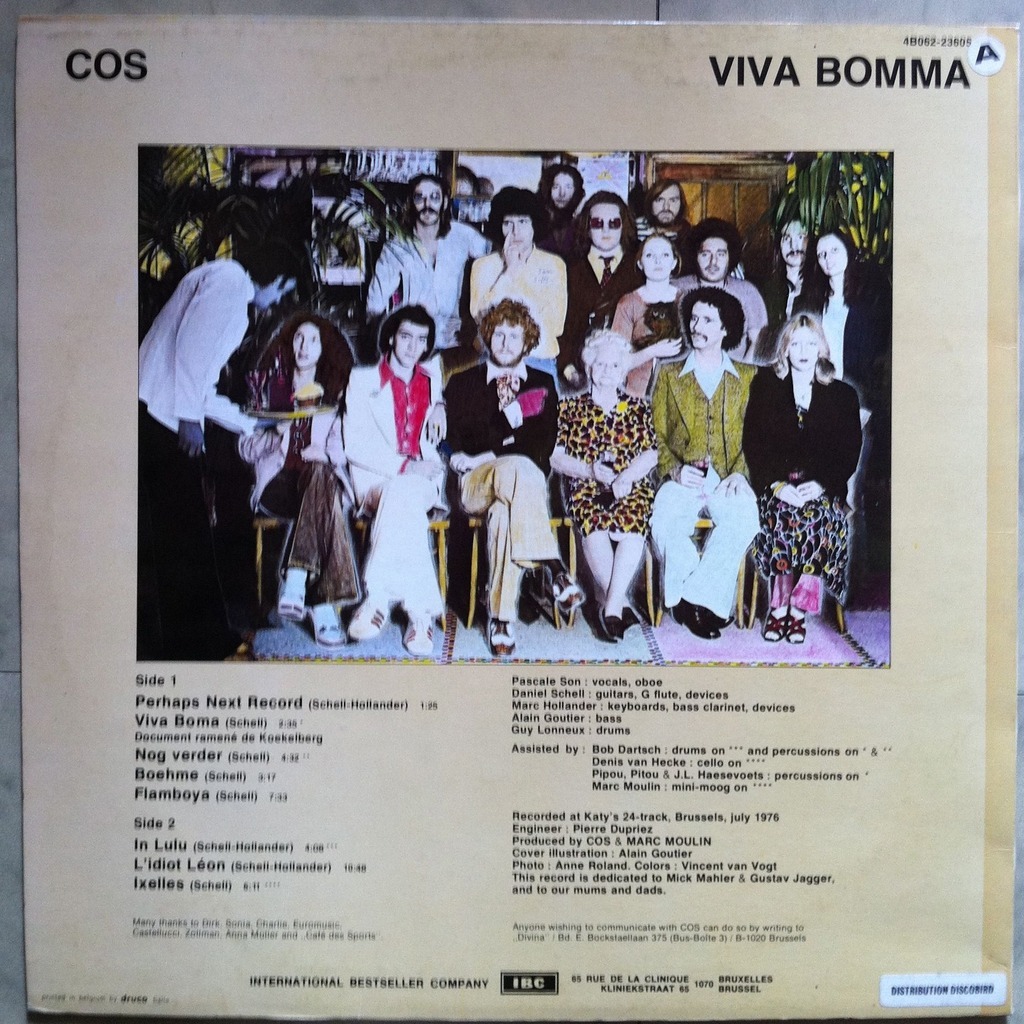
Viva Boma saw a few personnel changes. The band welcomed enthusiastic King Crimson fan Guy Lonneux as their new drummer, but the more significant new addition was keyboardist/clarinetist Marc Hollander.
Like Schell, the band’s undisputed leader, Hollander was also particularly interested in the more eccentric and challenging strands of progressive rock; he was especially fond of Henry Cow and Magma, but also of early 20th-century classical composers such as Béla Bartók. Hollander and Schell got along very well thanks to their shared musical interests, and although the music on Viva Boma is still almost entirely composed by Schell, Hollander brought his own eccentric flavor to the album’s tracks. Hollander was also a skilled and original keyboardist, and the role of keyboards in the band grew significantly with his arrival.
However, the first thing many listeners notice on Viva Boma is Pascele Son’s vocals. Her beautiful and skillful wordless vocalizations bring to mind, on the one hand, Magma’s more serene vocals, but also the vocal trio The Northettes, who sang as part of Hatfield And The North. Some have also compared Son to Flora Purim of Return To Forever. The talented Son, however, has not contented herself with just singing; she also plays the oboe throughout the album.
Viva Boma opens with a striking and ahead-of-its-time instrumental intro track, “Perhaps Next Record,” which runs just under two minutes. The track, which contains some Indian-inspired elements, features keyboards and drum machines bubbling away in a way that brings to mind the 1980s—or even Stereolab of the nineties—more than the 1970s. This ahead-of-its-time track is clearly a vision of Hollander’s, as his own, as-yet-unformed band Aksak Maboul went on to create very similar, strange music a few years later. “Perhaps Next Record” is also somewhat reminiscent of Brian Eno’s tracks on the album Another Green World. Stylistically, the track has little to do with the rest of the album’s content, which is perhaps also reflected in the title “Perhaps Next Record.” One might guess from the title that Schell was interested in this direction for future Cos albums, but apparently the song and its style were actually conceived for a Schell and Hollander duo that ultimately never materialized.
The next track, the title song “Viva Boma,” is also just over two minutes long and features ethnic influences. I can’t quite pinpoint exactly where they come from, but the prominent hand drums evoke for me, at least, the atmosphere not only of South America but also of Africa. Son sings rhythmically in a made-up language. Apparently, Son improvised some of the “lyrics,” while Schell wrote others for him quite precisely. So Son’s vocals aren’t mostly just wordless sighs; he’s actually singing words. They just aren’t words from any real language. That said, Cos didn’t attempt to create a language of his own like Magma’s Kobaian; the words were completely meaningless and were used only once per song, with new ones invented for the next one.
The album’s third track, “Nog Verder,” is one of its best. Starting off with a seductively laid-back, almost languid sound, “Nog Verder” picks up the pace nicely toward the end and features tight drumming from Lonneaux and truly delicious electric piano work from Hollander. Unfortunately, Hollander’s solo is cut short as the song fades out.
The seven-minute “Flamboya,” with its restrained, understated sound and slight echoes of Magma, is also a mesmerizing track. Hollander taps out a stylish, laid-back groove on the electric piano over a grooving bass line (bassist Alan Goutier plays with magnificent imagination throughout the album), while Son sighs and whispers the vocals in a clear voice, evoking the calmer and more beautiful side of Magma.
“In Lulu” features a wildly meandering guitar solo from Schell that clearly owes a debt to the style of Canterbury scene guitar master Phil Miller (e.g., Hatfield And The North, National Health). Schell’s playing on the album is largely inspired by Miller anyway, but this is most evident in “In Lulu” and the album’s longest track, the ten-minute “L’Idiot Leon,” which is the album’s rockiest, but also likely the most complex offering and the track on Viva Boma that comes closest to the music of Hatfield And The North. At times, the song is almost confusingly close to the Hatfields’ style, yet it retains enough of its own character to prevent the music from feeling like mere imitation. Son’s more intense and rhythmic vocals than usual are one clear distinguishing factor, as are Goutier’s bass playing—more aggressive than Richard Sinclair’s—and Hollander’s distinctive electric piano sounds. Admittedly, however, Hollander’s organ sounds do at times very clearly fall into the territory of the Hatfields’ Dave Stewart. Schell’s intricate guitar solo around the seven-minute mark is magnificent. The guitar solo transitions smoothly into a slightly medieval-sounding trio of wind instruments, where the oboe, flute, and bass clarinet weave around one another. “L’Idiot Léon” is a magnificent track and certainly one of the best examples of Canterbury prog made outside of England.
Cos released three more albums after Viva Boma, but Viva Boma remained the band’s crowning achievement. Viva Boma is undoubtedly among the elite of the non-British Canterbury prog scene, alongside the best albums by the Dutch band Supersister and the Italian band Picchio dal Pozzo. If you like Hatfield And The North, don’t miss out on Viva Boma under any circumstances.
Best tracks: ”Nog Verder”, ”Flamboya”, ”L’ Idiot Léon”
Author: JANNE YLIRUUSI
Tracks
1. Perhaps Next Record (1:25)
2. Viva Boma (2:35)
3. Nog Verder (4:32)
4. Boehme (3:17)
5. Flamboya (7:33)
6. In Lulu (4:08)
7. L’idiot Léon (10:48)
8. Ixelles (5:02)
Cos
Pascale Son: vocals, oboe Daniel Schell: acoustic guitar, electric guitar, alto flute Marc Hollander: keyboards, bass clarinet, alto saxophone Alain Goutier: bass Guy Lonneux: drums
Guests:
Marc Moulin: Mini-Moog (5.8) Denis Van Hecke: cello (8) Bob Dartsch: drums (6.8), percussion (2.3) Pipou (Yves Lacomblez): percussion (2) Jean-Louis Haesevoets: percussion (2)
Producer: Cos
Label: IBC
 Pienemmät Purot
Jätä kommentti