
A Trick Of The Tail is Genesis’ seventh studio album and the first without Peter Gabriel.
When vocalist Peter Gabriel left Genesis in the summer of 1975, the British music press predicted the band’s demise. Journalists did not believe that the band could survive without its charismatic frontman. The remaining four members, Tony Banks (keyboards), Mike Rutherford (bass), Phil Collins (drums), and Steve Hackett (guitar), were also somewhat concerned, but as insiders, they understood something that the music press and even many of their fans had failed to grasp: Genesis had never been just a backing band for the visionary Gabriel.
On the contrary. Genesis operated quite democratically, and although Gabriel certainly played a significant role as one of the composers and lyricists of Genesis’ music, Rutherford and Banks also made important contributions from the very beginning. In fact, when it comes to giving credit for Genesis’ compositions, Tony Banks probably did the most significant work. Previously, Genesis had credited the entire band for the compositions, regardless of who had actually composed them, leading many to mistakenly assume that Gabriel was primarily responsible for the band’s music and lyrics. Starting with A Trick Of The Tail, the credits were changed to reflect reality. With a few talented composers in their ranks and more than enough instrumental firepower to back them up, Genesis believed they could continue without Gabriel.
But where will the band find a new vocalist?
Before searching for a vocalist, Genesis even considered becoming an instrumental band. However, they soon abandoned the idea, as the four members also craved the huge popularity that is almost impossible to achieve with instrumental music.
Genesis received over 400 responses to its anonymously worded newspaper advertisement from hopeful vocalists. As the band’s extrovert and the only member with actual background as a vocalist, Collins was left with the main responsibility of conducting the auditions. He directed the auditionees to sing material that had already been composed for the new album. However, it soon became clear that none of them could do the job as competently as Collins himself. The rest of the band eventually persuaded the somewhat reluctant Collins to take on the role of vocalist.
Gabriel took Genesis’ music and lyrics in a slightly more streetwise direction on the previous album, The Lamb Lies Down On Broadway, but now that he is out of the picture, the band is returning to the mood that preceded that album to some extent. Genesis did not return to Rutherford’s idea of making a concept album based on The Little Prince (which was a competing concept to Gabriel’s Rael story on The Lamb Lies Down On Broadway), but there is something fairy-tale-like about the mood of A Trick Of The Tail. Much of the album’s lyrics are like short stories, and their themes are usually fantastical or taken from old fairy tales. The songs feature dancing on volcanoes, space creatures, beings from ancient myths, and robbers and police officers racing each other like in the Benny Hill Show. Genesis thus returns to the era preceding The Lamb Lies Down On Broadway, albeit largely without the dark and even macabre tones often found in the lyrics of those albums. Everyday realism has never been Genesis’s thing, and the emerging punk rock zeitgeist clearly failed to scare the band into changing their style.
The fairy-tale atmosphere is also emphasized by the cover art, which features detailed drawings of archetypal characters adventuring on the album. The music on A Trick Of The Tail is a majestic mix of beautiful melodies and intense performances. The atmosphere is light, but not entirely without edge. A Trick Of The Tail is an accessible album, but musically it is no simpler than its predecessor. Perhaps even the opposite. Some of the music is quite complex. Lyrically, however, the album is a bit bland. Banks and Rutherford’s stories lack the strangeness and even occasional sexual tension that Gabriel managed to weave into them.
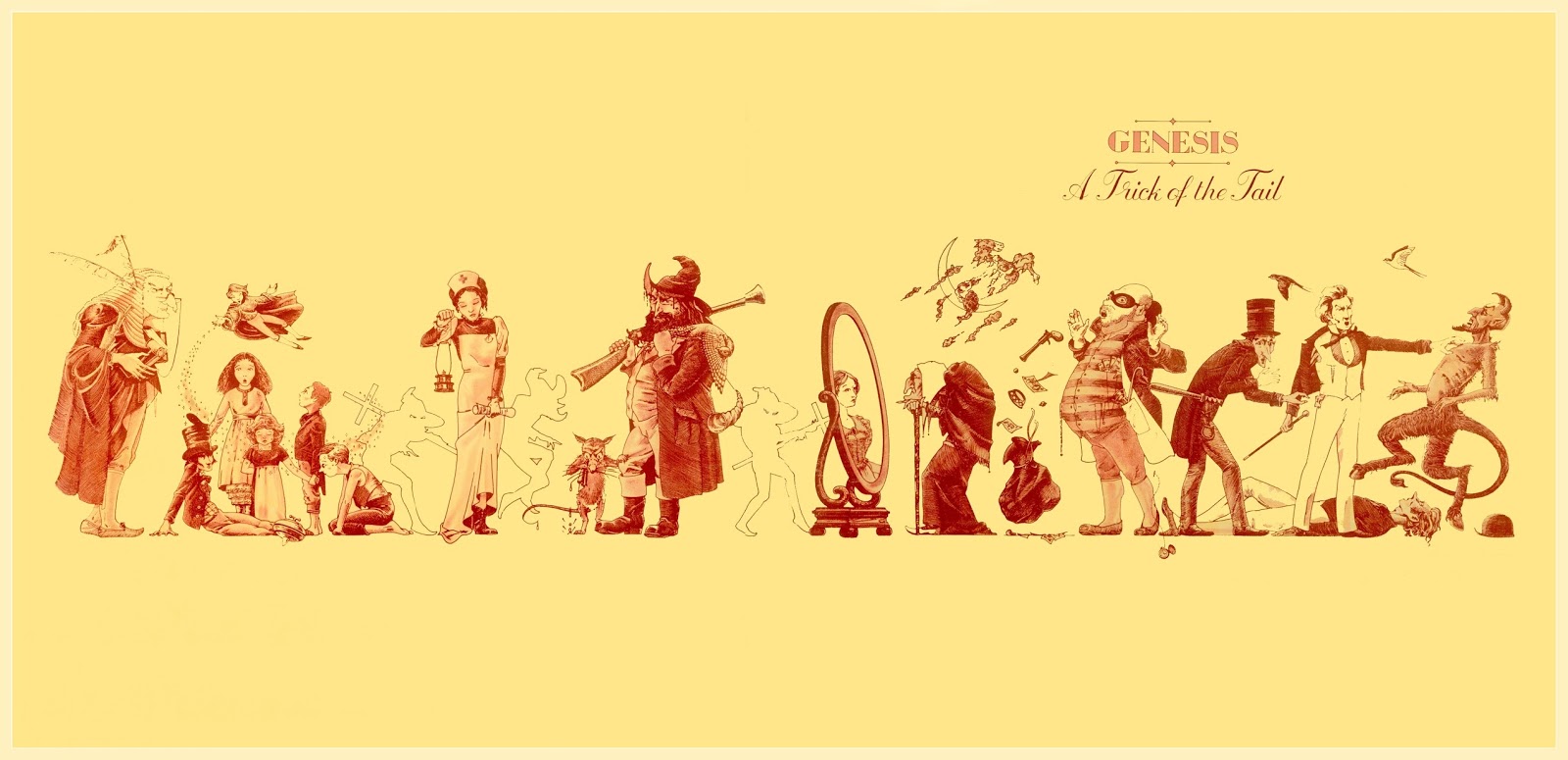
A Trick Of The Tail begins with ”Dance On A Volcano,” which, as its name suggests, is a rather fiery song. The band is on fire in this song, roaring ahead with volcanic power. With its numerous tempo and time signature changes, ”Dance On A Volcano” is probably one of Genesis’ most rhythmically energetic songs. The remaining four members of Genesis sound super confident right from the first song on the album. It’s as if the band absentmindedly says ”Who’s Peter?” and gets down to business. Genesis sounds more muscular than ever instrumentally on ”Dance On A Volcano,” and the six-minute song is both powerful and technically detailed. The song also immediately shows that Collins is more than capable of handling the vocals. His voice is actually surprisingly similar to Gabriel’s, even though it lacks Gabriel’s charismatic hoarseness. Collins’ voice is clearer and… again we return to this term, somehow more approachable.
”Into the fire and into the fight
Well, that’s the way the heroes go, ho, ho, ho”
After the energetic ”Dance On A Volcano,” the mood calms down and the jangling 12-string guitars of ”Entangled” transport the listener to the pastoral landscapes of Genesis’s early albums. The hypnotic strumming of the guitars in ”Entangled,” curving around each other, and Banks’s haunting organ create a magical and slightly eerie atmosphere. ”Entangled” is one of Genesis’s most beautiful songs.
After “Entangled,” we hear “Squonk,” the simplest track on the album, with its almost Led Zeppelin-esque heavy drum groove. The song tells the story of a mythical creature named Squonk, who is ugly as sin and, when distressed, can turn into a puddle of tears. Clearly you can write rock songs about anything. And that’s a good thing! ”Squank” is not one of the most interesting tracks on the album, even though it is quite pleasant to listen to.
From ”Squank’s” rock, we move on to more ethereal moods with Tony Banks’ solo composition ”Mad Man Moon”. Featuring piano and Mellotron, ”Mad Man Moon” has a truly beautiful melody that is heart-wrenchingly melancholic, yet strangely uplifting. Typical of Genesis, the seven-minute song is a dynamic combination of calm and more upbeat sections. Like ”Entangled,” ”Mad Man Moon” can easily be counted among Genesis’s most beautiful compositions. Collins does a good job on vocals, and his performance on ”Mad Man Moon” is perhaps his most successful singing to date.
The B-side opener, ”Robbery, Assault, and Battery,” raises the energy level once again. This fast-paced and humorous tale of robbers and cops races along pleasantly and, at times, quite bizarrely. The time signature shifts to 13/8 in the song’s ”chase scene.” The instrumental section of ”Robbery, Assault, and Battery” is one of the best parts of the album and, for some reason, reminds me a little of Jethro Tull.
After ”Robbery, Assault, and Battery,” the album shifts back to a more atmospheric style with ”Ripples,” composed jointly by Rutherford and Banks. Starting as an acoustic ballad, the song gradually grows in grandeur, yet remains refreshingly understated. The drums don’t really kick in until around the three-minute mark. Towards the end of ”Ripples,” we hear a quiet but interesting electric guitar solo from Hackett, whose role on the album is generally quite small. However, there is no time to miss him, as Banks, Rutherford, and Collins confidently handle their own parts. Hackett’s minor role can be explained by the fact that he joined the sessions a little late because he was busy finishing his first solo album, A Voyage Of The Acolyte. Incidentally, ”Rippless” was written from the outset to be sung by Collins, even before it was decided that he would become the band’s permanent vocalist.
Read also:
- Levyarvio: Jimmy Page – Outrider (1988)
- Review: Brian Eno + David Byrne – My Life in the Bush of Ghosts (1981)
- Levyarvio: Gong – Zero To Infinity (2000)
- Review: Michael Oldfield – Heaven’s Open (1991)
- Review: Talk Talk – The Colour Of Spring (1986)
- Levyarvio: Jeff Wayne – Jeff Wayne’s Musical Version Of The War Of The Worlds (1978)
- Review: Gong – Shamal (1976)
- Review: Genesis – A Trick Of The Tail (1976)
- Review: Rush – Moving Pictures (1981)
Side B is not quite as brilliant as the first half. The last two tracks on the album, ”A Trick Of The Tail” and ”Los Endos,” are not entirely convincing. The title track, also released as a single, swings nicely and is charming in its lightheartedness (the percussion effect describing the sound of the creature’s hooves in the song’s story is fun!), but it never really takes off and remains somewhat bland. The album’s closing track, ”Los Endos,” is an effective and energetic instrumental in which Genesis, exceptionally, flirts a little with jazz-rock, but I’m not particularly excited about how the song mixes snippets from songs heard earlier on the album. Live, the song was certainly an effective romp and an opportunity for the band to let loose a little.
With a total length of 51 minutes (quite long for a 70s album!), A Trick Of The Tail is nevertheless a truly high-quality work. Perhaps even the highest quality of all Genesis albums, as there is not a single real dud among its tracks. On the other hand, the brightest highlights of A Trick Of The Tail do not quite reach the level of the band’s previous albums.
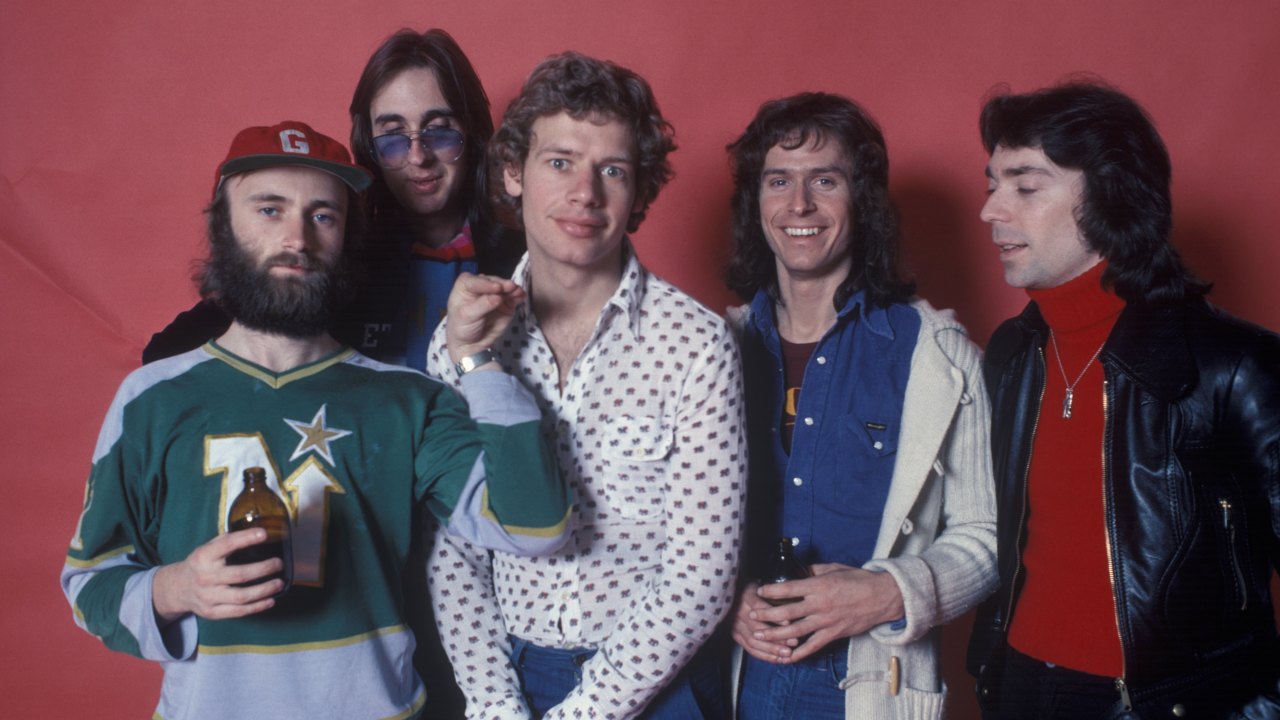
The album is crowned by an excellent, downright luxurious and inviting soundscape. All instruments sound balanced. Powerful but not overbearing. The sounds on A Trick Of The Tail were the best Genesis had achieved so far, and the band never really managed to surpass them in this regard. Producer/recording engineer David Hentschel, who had previously worked with Genesis, surpassed himself on this album. (Note: the 2007 remastering/remixing should be avoided like the plague. It is badly compressed.)
A Trick Of The Tail was a major success. In fact, it did better than any previous Genesis album. The change of vocalist exceeded expectations, and Genesis no longer had to look back, but continued steadily forward, lightening their music and eventually ending up as a plastic and soulless arena pop monster of the 1980s. A Trick Of The Tail is not only by far the best Genesis album without Peter Gabriel, but also the band’s last truly successful album from start to finish.
Author: JANNE YLIRUUSI
Tracks:
Side A
1. ”Dance on a Volcano” Rutherford, Banks, Hackett, Collins 5:55
2. ”Entangled” Hackett, Banks 6:27
3. ”Squonk” Rutherford, Banks 6:29
4. ”Mad Man Moon” Banks 7:36
Side B
1. ”Robbery, Assault and Battery” Banks, Collins 6:16
2. ”Ripples…” Rutherford, Banks 8:06
3. ”A Trick of the Tail” Banks 4:35
4. ”Los Endos” Rutherford, Banks, Hackett, Collins 5:46
Bändi:
Mike Rutherford: 12-string guitar, bass, bass pedals Tony Banks: piano, synthesizers, organ, Mellotron, 2-string guitar, backing vocals Phil Collins: drums, percussion, vocals Steve Hackett: electric guitar, 12-string guitar
Producer: David Hentchel and Genesis
Label: Charisma
 Pienemmät Purot
Jätä kommentti