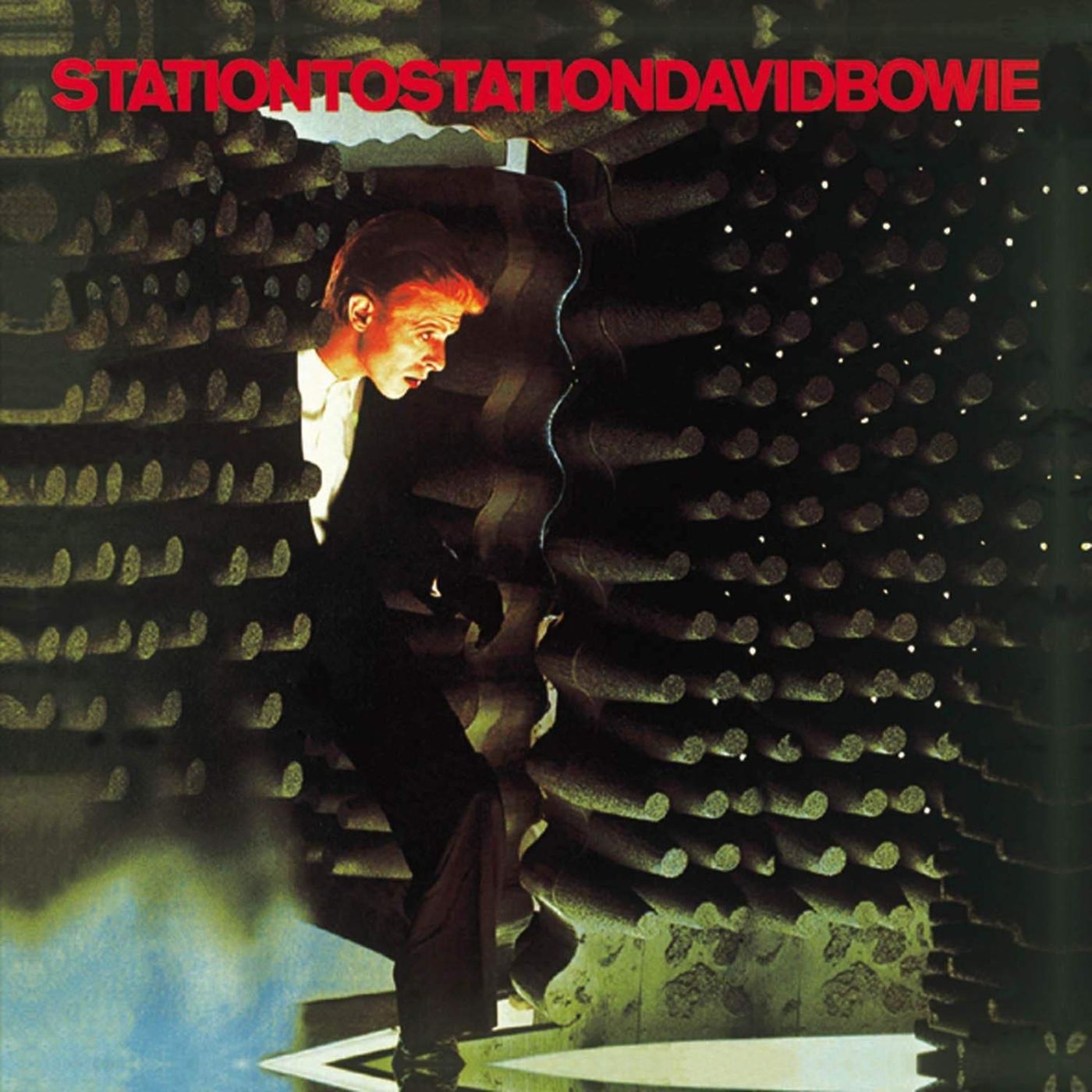
Station To Station is the tenth studio album by David Bowie, who released his first album in 1967.
Bowie’s previous album, Young Americans (1975), was a pure soul album. Or as pure as one could expect from a white British vocalist. Bowie himself called his experiment, which was only partially successful, ”plastic soul.” Station To Station is a counter-reaction to the polished soul pop of Young Americans and, on the other hand, a clear transitional album that gives a taste of Bowie’s future.
Station To Station was recorded in the US, but it also marked the beginning of Bowie’s transition to a more European rock style. Soul and funk are still present in many of the songs on the album, but at the same time, influences from krautrock, prog, and even Western art music are creeping into the music. Station To Station is a collision point between American and European influences, and on subsequent albums, the balance shifted increasingly towards Europe.
The overall mood of Station To Station is dark and brooding. Even the most cheerful song on the album, the rocking ”TVC 15,” was based on Bowie’s hallucinations in which a wall of televisions sucks in Iggy Pop’s girlfriend. The soundscape is rougher and harder-edged than before. The single adjective that comes to mind most strongly is ”chilling.”
At the time of Station To Station, Bowie was living on a diet consisting mainly of milk, green and red peppers, and cocaine, and was in many ways very much out of his mind. Bowie himself has said that he remembers practically nothing about making the album. Considering this, the end result is surprisingly coherent and accessible. Of course, Station To Station is a dark-toned and, by mainstream rock standards, experimental album, but it also contains many addictive pop moments. A good example of this is ”Golden Years,” which, according to Bowie, was originally written for Elvis and released as the first single, and is an absolutely magnificent pop song. In a way, it is a model of its genre, but still suitably strange and spiced with a dark undertone so that the song does not become bland or too obvious.
Read also:
- Review: Gong – Gazeuse! (1976)
- Review: Mike Johnson – The Gardens Of Loss (2026)
- Levyarvio: Mike Johnson – The Gardens Of Loss (2026)
- Levyarvio: Led Zeppelin – Presence (1976)
- Vuosi vuodelta : Parhaat levyt 2000 – Sijat 11-20
- Review: Univers Zero – Ceux Du Dehors (1981)
- Levyarvio: Steve Walsh – Glossolalia (2000)
- Year by Year : Best Albums of 1976 – 21-29
- Levyarvio: Jimmy Page – Outrider (1988)
The instrumentation on Station To Station is based on a relatively simple rock lineup, which Bowie colors with occasional saxophone flourishes and synthesizer effects. The backbone of the band is formed by the simple but effective rhythm section of George Murray (bass) and Dennis Davis, who also play an important role on Bowie’s subsequent albums. There are hardly any actual guitar solos on the album, but Earl Slick’s and Carlos Alomar’s buzzing guitars, which play a slightly smaller role, are still an essential part of the album’s sound. Also playing a central role is the rock ’n’ roll-inspired piano playing of Roy Bittan, borrowed from Bruce Springsteen’s band. It is somewhat surprising how traditional the rock instrumentation on the album ultimately is, even though the end result sounds relatively unfamiliar and experimental.
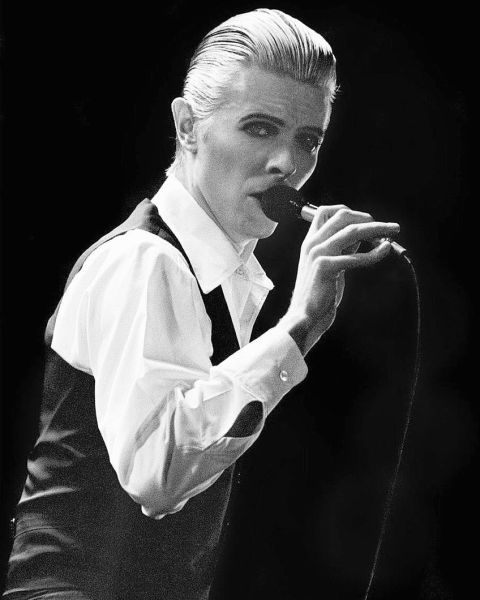
The album begins with a ten-minute title track (Bowie’s longest song), which starts with train-like sounds created by guitars, after which the music begins to chug forward, not entirely steadily, but jerking like a steam train that is not quite in working order. The first three minutes of the song are a kind of dark instrumental march. A prelude that prepares the listener for Bowie’s eerie vocals, announcing the return of the Thin White Duke, Bowie’s new alter ego. The lyrics of the song are both cryptic and very clearly reveal Bowie’s paranoid state, with references to black occultism, Kabbalah, and, of course… cocaine.
Musically, Station To Station is a good example of Bowie’s new musical style, which balances between America and Europe. It feels like funk and krautrock are shaking hands evenly. Bowie is moving from station to station, and ”Station To Station” is somewhere in the middle of those relatively distant destinations. Bowie’s detached and theatrical singing style in the song creates a unique atmosphere. Taking on the role of the aristocratic and mystical Thin White Duke (in Bowie’s own words, ”a romantic without feelings”), Bowie sings ”Station To Station” autobiographically and at the same time consciously untruthfully:
”It’s not the side-effects of the cocaine
I’m thinking that it must be love
It’s too late to be grateful
It’s too late to be late again
It’s too late to be hateful
The European canon is here”
There were probably not many things in Bowie’s life at that time that were not side effects of cocaine, but Bowie’s musical train was definitely chugging towards Europe.
Bowie is often praised as a chameleon who constantly changes his style, but on the other hand, he is also criticized for being nothing more than a magpie who builds his changes on ideas stolen from others. However, the song ”Station To Station” is a good example of how skillfully Bowie can naturally blend previously unfamiliar influences into styles he has already adopted, while at the same time creating a completely new synthesis. On ”Station To Station”, Bowie brilliantly combines krautrock, soul, and funk with his own rock/pop heritage, and the result is something quite unique that could be called, for example, occult prog disco.
Review: David Bowie – ★ [Blackstar] (2016)
“Station To Station” is a breathtakingly magnificent start to the album, and there are five more great songs to come. The delicious ”Golden Years” serves up a delicious dose of pop. ”Word On A Wing” looks back to some extent to the soul of Young Americans, but this time there is nothing plastic about the music; the desperation in Bowie’s quivering voice is palpable. The slightly overlong ”TVC 15” is the brightest moment on the album (although, as we noted earlier, this song also has its dark side) and the most straightforward rock song. ”Stay” is a dark, funky song (with impressive bass playing from Murray), and the album’s closing cover song, ”Wild Is The Wind” (composed by Dimitri Tiomkin and Ned Washington for the 1957 film of the same name) is a strange, almost pop-like ballad that is at the same time a desperate prayer. I would be very surprised if the later dark romantic Nick Cave did not worship this powerful song. Bowie’s vocal performance on this beautiful and moving song is one of the finest of his career.
Despite his confused state of mind, Bowie somehow managed, against all odds, to conjure up an album containing many different genres, which is one of the most coherent works of his fascinating career.
Station To Station is a consistently strong art rock album that kicked off David Bowie’s true artistic golden age, which lasted until the early 1980s. In my personal opinion, Station To Station is easily one of Bowie’s five best albums.
Best tracks: ”Station To Station”, ”Golden Years”, ”Word On A Wing”, ”Wild Is The Wind”
Author: JANNE YLIRUUSI
Review: Scott Walker – Tilt (1995)
Tracks
- ”Station to Station” 10:11
- ”Golden Years” 4:03
- ”Word on a Wing” 6:00
- ”TVC 15” 5:31
- ”Stay” 6:13
- ”Wild Is the Wind” 6:01
Musicians:
David Bowie: vocals, guitar, tenor and alto saxophone, Minimoog, Mellotron Carlos Alomar: guitar Roy Bittan: piano, organ Dennis Davis: drums George Murray: bass Warren Peace: backing vocals Earl Slick: guitar Harry Maslin: melodica, synthesizer, vibraphone
Producer: David Bowie, Harry Maslin
Label: RCA
 Pienemmät Purot
Jätä kommentti