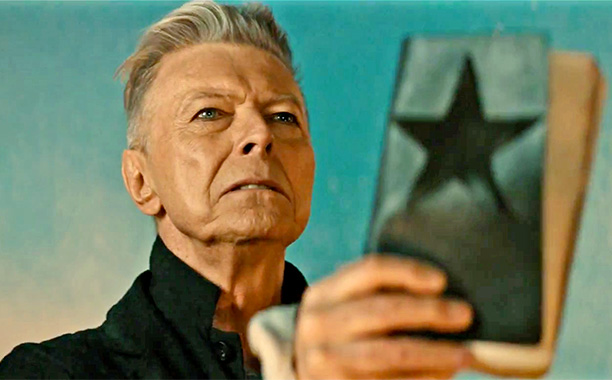
★ (Hereafter referred to as Blackstar) is one of those albums that is inevitably linked to death. David Bowie (1947-2016) passed away just two days after the album’s release from liver cancer at the age of 69. Bowie’s illness had been kept out of the public eye, so his death came as a great shock to his fans. The tragedy so closely linked to the album’s release naturally colors not only my experience of the album, but also that of millions of other people.
Although Bowie’s death is closely linked to the album, it does not define the music on Blackstar. Blackstar does not sound like the last breath of a fragile musician, but rather a work of art created by a man who probably knows he is dying soon, but nevertheless – or precisely because of this – works harder and with more inspiration than ever before. And in fact, as we will see, Bowie was not content to simply make the best album he could, but even at the age of almost 70 and seriously ill, he strove to do something completely new.
Bowie’s previous album, The Next Day, released three years earlier, was a surprisingly conventional rock album. It was definitely a good rock album, but I have to admit that its conventionality was a slight disappointment to me.
With Blackstar, Bowie once again took a more experimental direction and, more than ever before, made use of jazz musicians in his band. Bowie had flirted with jazz here and there before, but his excursions into jazz had usually been assisted by rock musicians (avant-jazz pianist Mike Garson being perhaps the clearest exception).
However, Bowie was not interested in making yesterday’s jazz, but was also inspired by experimental electronica, rap, and hip-hop. Bowie has said that artists such as Kendrick Lamar, Death Grips, and Boards of Canada were sources of inspiration for him. I believe that Bowie’s vision for Blackstar was roughly: ”What would happen if I combined my own style with so-called urban modern pop and everything was played by jazz musicians?”
Jazz was, of course, in Bowie’s blood. His first instrument as a teenager was the saxophone, which he used to imitate his heroes John Coltrane and Eric Dolphy. Bowie’s path ultimately took him in a different direction, and he never had time to develop into a brilliant saxophonist, but over the years he has returned to the instrument from time to time. However, Bowie’s own saxophone skills were not sufficient for the music he now had in mind. The next album would have to be made with real jazz musicians.
Bowie had, of course, long been in a position where he could have hired just about any musician from any genre to play on his album. Herbie Hancock,Chick Corea, and Wayne Shorter (the latter two have since moved on to the orchestra across the border and may now be playing with Bowie!) would certainly have jumped at the chance if invited. However, Bowie wanted young, hungry musicians who were at home with modern music. Whether it was jazz or urban music.
Bowie’s friend, composer/musician Maria Schneider, ultimately proved to be a vital catalyst in putting together the Blackstar band.
In 2014, Bowie began a new musical phase by recording the furious-sounding song ”Sue (in the Season of Crime)” with Maria Schneider’s own jazz orchestra. One of the instrumental soloists on the track was the virtuoso tenor saxophonist Donny McCaslin, who would go on to play a significant role in Bowie’s final recordings. ”Sue (in the Season of Crime)” was eventually released as a digital single, with another new song, ”Tis a Pity She Was a Whore,” as the B-side. These experimental jazz-influenced songs served as a guide for Bowie as he began planning his next full-length album, Blackstar.
Bowie originally wanted to make the album with Schneider and his orchestra, but Schneider had other commitments and obligations. Schneider recommended that Bowie check out McCaslin’s own band. So one evening, Bowie walked into a tiny jazz club called 55 Bar in New York’s Greenwich Village, where McCaslin’s band was performing. McCaslin was completely surprised by Bowie’s appearance. The band gave their best performance in front of their superstar guest. And not for nothing. Bowie was impressed by what he heard and soon after that evening contacted McCaslin and told him he wanted the whole band to be the backing band for his new album.
Born in 1966 and raised on jazz and classical music, McCaslin was not particularly familiar with Bowie’s music, but he was naturally interested in collaborating. Especially since the sessions for ”Sue (in the Season of Crime)” had been such an inspiring experience. McCaslin was the perfect collaborator for Bowie, as the saxophonist, who admired John Coltrane, Sonny Rollins, Igor Stravinsky, and Béla Bartók, was also interested in modern electronic dance music and had sought inspiration for his own jazz from artists such as Squarepusher and Skrillex. Bowie needed just such a versatile and contemporary musician to lead the musicians on Blackstar.
McCaslin thus became Bowie’s new band leader. This position had previously been held by Mick Ronson, Carlos Alomar, Adrian Belew, and Reeves Gabrels, among others. The core lineup of Blackstar consists of musicians from McCaslin’s band: keyboardist Jason Lindner, who started playing piano at the age of two, bassist Tim Lefebvre, and drummer Mark Guiliana. All of them were experienced musicians in their 30s and 40s, each of whom had also led their own bands. McCaslin’s quartet was reinforced by avant-garde jazz guitarist Ben Monder. In addition, James Murphy, known from LCD Soundsystem, plays a small role in two songs, and Eric Tonkin sings backing vocals on one track.
Of Bowie’s old collaborators, only producer Tony Visconti is involved. Visconti, who also produced the previous album, The Next Day, as well as many of Bowie’s greatest classics, such as the entire ”Berlin Trilogy” and Scary Monsters (and Super Creeps), brings a touch of continuity to the project.
The album kicks off with a title track lasting just under ten minutes, which is the second longest song of David Bowie’s career. The longest is the title track of Station To Station (1976), which just barely exceeds the ten-minute mark. In fact, in its original form, ”Blackstar” would have easily surpassed ”Station To Station,” as the composition was originally 12 minutes long. However, in 2016, Apple’s iTunes service, which was still in a prominent position, had a 10-minute limit for singles, so Bowie edited the song to make it shorter because he didn’t want to confuse fans by releasing two different versions of it. So let’s blame Apple for not letting us hear Bowie’s original vision! Fortunately, when listening to ”Blackstar,” you would never guess that you are listening to an edited version.
In addition to their length, ”Blackstar” and ”Station To Station” have other similarities. Both are quite experimental, dark-toned, and downright mystical compositions that seem to have an occult theme at their core. Musically, however, ”Blackstar” takes a big step away from the krautrock of ”Station To Station” and toward jazz and electronica.
The lyrics of the song seem to deal with Bowie’s own mortality and his conflicting attitude towards stardom. The term ”black star” itself is probably a reference to Elvis Presley’s song ”Black Star,” which includes the line ”When a man sees his black star, he knows his time…has come.” Bowie was indeed a man who had seen his own black star in the form of a cancer diagnosis (apparently, some cell changes caused by cancer are also referred to as ”black star”). On the other hand, the black star, combined with references in the lyrics to fallen angels, also seems like some kind of occult detail, especially since the song repeatedly features the phrase ”at the center of it all,” which comes from a book by the well-known occultist Aleister Crowley.
Something happened on the day he died Spirit rose a metre then stepped aside Somebody else took his place, and bravely cried (I’m a blackstar, I’m a star star, I’m a blackstar)
After a brief, harmonically unstable intro, the music of ”Blackstar” builds on a drum ’n’ bass-style rhythm that sometimes seems to veer into irregular time signatures. Or perhaps it’s just Giuliana’s clever syncopation. Bowie sings with an eerie, thin voice full of skillfully measured despair. Lindner conjures up sci-fi-like bubbles from his synthesizers here and there, slightly alleviating the overall gloominess, but at the same time emphasizing the otherworldly atmosphere of the music. McCaslin’s few short solos on the tenor saxophone are stylishly controlled. McCaslin also adds small saxophone riffs or longer dark chord patterns here and there. Towards the end, the rhythm becomes more subdued and dark-sounding strings join in, which I’m not sure are real or synthesized. At the end, the music breaks down into an atonal flutter of flute, saxophone, and keyboards.
In addition to its similarity to ”Station To Station”, Blackstar also reminds me a little of the late work of Scott Walker (1943-2019), whom Bowie greatly admired. Bowie doesn’t venture quite as deeply into the avant-garde as Walker, but Blackstar could have been the first step toward something truly strange.
”Blackstar” is a magnificent and quite unique journey into the heart of darkness and back, and finally I would like to add that although I have never particularly wanted the song to be longer, I still hope that the original version will be released at some point.
After the gloomy ”Blackstar,” ”Tis a Pity She Was a Whore” is a more upbeat and playful song. However, this intensely forward-driving song also has a dark undertone that extends to the lyrics. The song’s title refers to John Ford’s 1633 story ”Tis Pitty Shee’s a Who[o]re,” in which a man has an incestuous relationship with his sister. The relationship ends in tragedy when the man stabs his pregnant sister in the heart while kissing her. Quite joyful. However, Bowie’s lyrics do not seem to deal with the story very directly. An amusing detail is the first line, ”Man, she punched me like a dude,” which is delightfully free of gender norms.
The original version of ”Tis a Pity She Was a Whore” was released in 2014 as the B-side to ”Sue (Or in a Season of Crime)” and is one of the few songs in Bowie’s catalog where the maestro plays all the instruments himself. Bowie’s original version is really good too, but the ”Blackstar” version improves on it considerably. Bowie sought inspiration for the new version from his new band leader’s album Casting For Gravity (2012). The result is a powerful, intensely driving electronic soundscape, highlighted by McCaslin’s saxophone, which alternates between jerky and lyrical, and Bowie’s strong vocal performance.
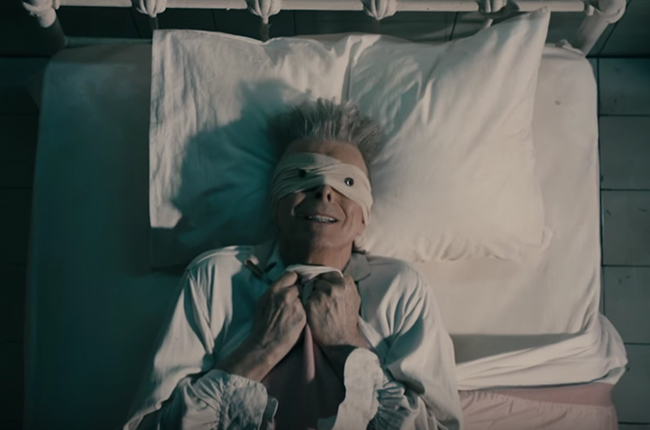
The third track, “Lazarus,” finally brings us into the realm of pop music. With its stylish and modern rhythm track, this pulsating song is the most melodic offering on the album so far. McCaslin repeatedly plays a melancholic theme on the saxophone, which is echoed by the electric guitar somewhere in the distance. With a different arrangement, ”Lazarus” could have been an excellent ballad, but the hectic work of the rhythm section takes the song in a different direction. Guiliana’s drums sound tight and delightfully lively. Lefebvre’s thick-sounding bass sounds like a double bass, but I may be wrong. Monder’s distorted electric guitar adds just the right amount of edge to the melodic whole here and there. The band plays magnificently and seems to vary the tempo naturally. Towards the end, we hear a stylish saxophone solo full of emotion. At the very end, the individual electric guitar chords that cut through the rest of the music are full of fateful inevitability. Bowie’s vocals are also full of emotion, once again seeming to deal with approaching death. This time, he celebrates a life well lived, while at the same time curiously pondering that death for a star like him is only a path to even greater fame.
Look up here, I’m in heaven I’ve got scars that can’t be seen I’ve got drama, can’t be stolen Everybody knows me now
I remember how excited I was when I heard the original version of ”Sue (Or in a Season of Crime)” in 2014. At that point, I had only explored Bowie’s catalog selectively. I loved some of the albums, others didn’t make much of an impression on me, and there were many I hadn’t heard at all. ”Sue” hit the spot perfectly. At the time, I was becoming more and more interested in avant-garde jazz, and ”Sue” seemed like the perfect way to combine the unpredictability of experimental jazz with Bowie’s irresistible, yet slightly twisted pop sensibility. In a strange way, the song also reminded me of one of my all-time favorite bands, King Crimson. ”Sue” was like a modernized version of the music on Crimson’s Islands album (1971). This was exactly the kind of music I wanted Bowie to make in the 2010s!
I have to admit that my initial reaction to Blackstar’s version of ”Sue” was disappointment. The roar of the big jazz orchestra had been reduced to the more conventional sound of a small ensemble, and some of the ferocity of the original version had been lost. However, after listening to it several times, I realized I was wrong. I still think the original ”Sue” sounds great, but ultimately it leaves the impression that Bowie is just visiting jazz circles. He’s in town, but not quite at home. Although the composition is Bowie’s, the end result doesn’t really sound like Bowie’s music. The version on Blackstar, meticulously produced by Visconti, on the other hand, molds the original material into a magnificent Bowie song without losing any of the song’s progressiveness.
Blackstar’s version sounds heavier and more intense. The rhythm section again has a hint of drum ’n’ bass. The rhythm feels excitingly jerky, constantly pulling the rug out from under the listener’s feet while simultaneously kicking the songs forward intensely. The humming sub-bass, which really resonates deep in the stomach, adds to the feeling of disorientation. If the original ”Sue” was avant-garde jazz, then Blackstar’s version could undoubtedly be called modern progressive rock.
The fifth track, ”Girl Loves Me,” is again dark, but also mischievously playful music. Bowie uses the fictional slang created by Anthony Burgess that the violent gang members in the book Clockwork Orange spoke. The song is highlighted by Bowie’s skillful vocals, which Visconti effectively and naturally enhances with effects, as well as Giuliana’s unpredictably striking drums.
You viddy at the Cheena Choodesny with the red rot Libbilubbing litso-fitso Devotchka watch her garbles Spatchko at the rozz-shop Split a ded from his deng deng Viddy viddy at the cheena
”Dollar Days” is a song that I don’t usually remember anything about, which makes me think it’s a relatively insignificant track, but in fact it’s a very captivating and emotionally powerful art rock ballad. ”Dollar Days” was created spontaneously in the studio. Bowie played the song once on acoustic guitar, and the band quickly put together an arrangement and recorded it in an hour.
The album’s closing track, I Can’t Give Everything Away, also brings Bowie’s entire career to an impressive conclusion. The song’s minimalist lyrics, which seem to be yet another reflection on the ”Bowie myth,” contain only a few actual verses. The chorus ”I can’t give everything” takes center stage, repeated and varied by Bowie with increasing emphasis as the song progresses, accompanied by McCaslin’s nimble saxophone riffs. The song is crowned by the album’s only guitar solo, which is all the more magnificent for it. Bowie’s albums over the decades have featured many great guitar solos, and Monder’s softly rising, wailing solo is definitely one of the best.
Seeing more and feeling less Saying no but meaning yes This is all I ever meant That’s the message that I sent
Blackstar is a compact 41-minute album with no weak tracks. Apparently, there were five more or less finished songs left over from the Blackstar sessions. It may be that the album was short due to scheduling pressures, but whatever the reason, Blackstar feels like a complete work just as it is. It seems inconceivable that Bowie was able to do this while terminally ill.
I know that for many people, Blackstar is difficult to listen to precisely because it is so strongly associated with the death of an artist they loved. Listening to it is distressing for them, and they only return to the album occasionally, with a heavy heart. I don’t feel quite the same way. I admit that I have a rather superficial attitude toward the deaths of artists I am familiar with. I don’t know them. We are not friends. I appreciate them through their work. Work whose best days are often long gone by the time of their death. Still, I have to admit that David Bowie’s death was one of those that hit me hard. Partly for selfish reasons; Blackstar shows with such staggering certainty that Bowie’s creativity was still in full swing, and it is devastating that I and all his millions of other fans were robbed of the opportunity to hear more of his new music. Despite this, Blackstar is not sad music to me; on the contrary, it celebrates and even crowns Bowie’s long and illustrious career.
In popular music, it is difficult to think of artists who, after decades-long careers, have released albums that rival the most inspired works of their youth. Bowie did just that. Blackstar is David Bowie’s best album.
Best tracks: ”Blackstar”, ”Lazarus”, ”Sue (Or in a Season of Crime)”, ”I Can’t Give Everything Away”
⭐⭐⭐⭐⭐
Rating: 5 out of 5.
Author: JANNE YLIRUUSI
Tracks:
”Blackstar” 9:57
”’Tis a Pity She Was a Whore” 4:52
”Lazarus” 6:22
”Sue (Or in a Season of Crime)” 4:40
”Girl Loves Me” 4:52
”Dollar Days” 4:44
”I Can’t Give Everything Away” 5:47
Musicians:
David Bowie: vocals, acoustic guitar, electric guitar (3), harmonica (7) Donny McCaslin: tenor saxophone, flute. Jason Lindner: piano, Wurlitzer organ, keyboards Tim Lefebvre: bass Mark Guiliana: drums, percussion Ben Monder: guitar Tony Visconti: strings (1) James Murphy: percussion (4,5) Erin Tonkon: backing vocals (2)


 Pienemmät Purot
Jätä kommentti