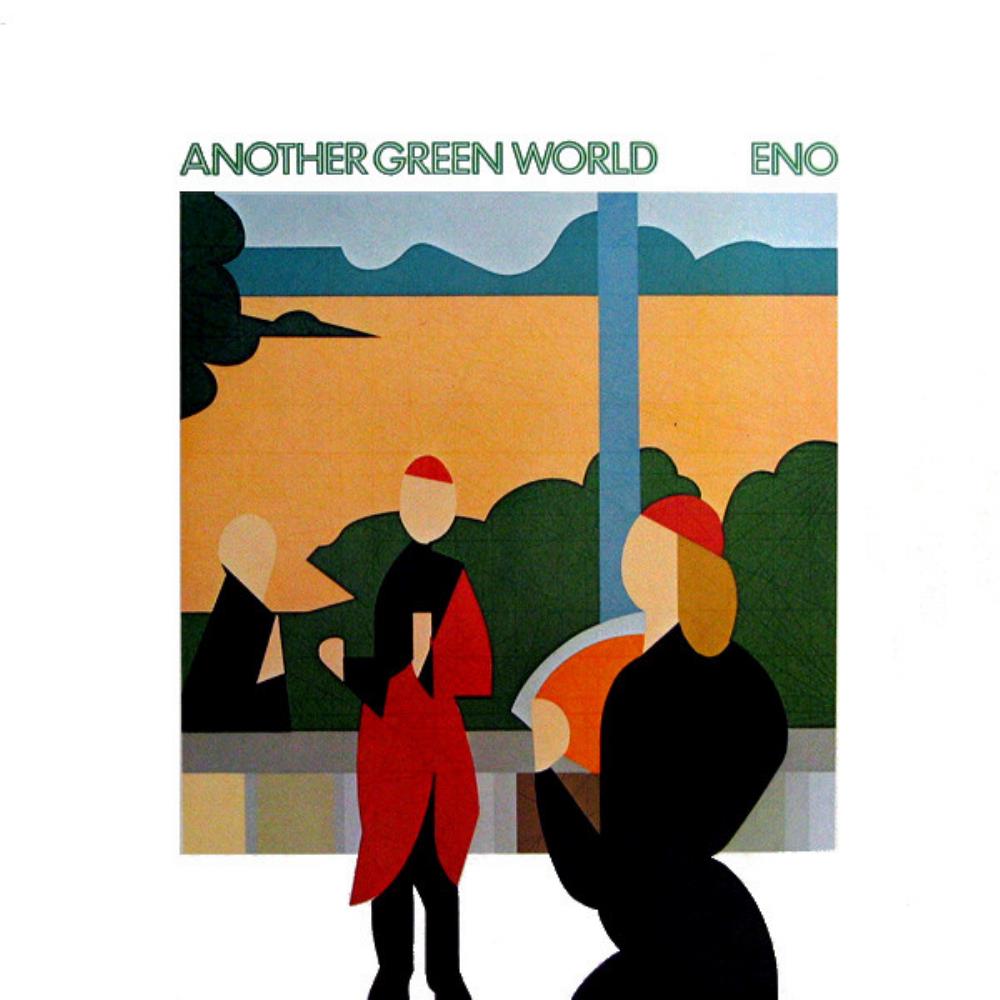
Another Green World is Brian Eno’s third solo album.
In July 1975, Brian Eno, who had previously played with Roxy Music and subsequently embarked on a solo career, calling himself a non-musician, walked into Basing Street Studios (now Sarm West, owned by Trevor Horn) without any demos or preliminary plans.
Well, he did have a vague plan: Eno’s goal was to build something from scratch in the studio and thus create something more surprising than what could be achieved with old, tried-and-tested methods. Eno had booked expensive studio time for two months, which was risky without any pre-prepared song drafts. The first few days were desperate, and nothing sensible was accomplished.
Nowadays, it is already a cliché to say that this or that artist used the studio as a compositional tool, but this definition fits Brian Eno perfectly. Eno seemed to sculpt his songs through trial and error, adding sound fragments and reacting to the additions by either removing or modifying old sections. He used many esoteric methods to aid in the process, such as relying on chance.
The randomness of the process was introduced, for example, by a deck of cards called Oblique Strategies, designed by Eno in collaboration with Peter Schmidt. The Oblique Strategies card deck contained various aphorisms and direct instructions, and the idea was that when stuck, a random card would be drawn from the deck and the instructions it gave would be followed as closely as possible to suit the situation. The instructions on the cards could be literal, such as ”Tape your mouth,” philosophical, such as ”Don’t be afraid of clichés,” or downright cryptic, such as ”Trust in the you of now.”
The instructions were followed literally in the studio, sometimes so radically that parts that had just been recorded were completely erased when the card instructed us to do so. Sometimes the instructions were downright disastrous, but sometimes they led to completely new and surprising insights, which then triggered a chain reaction of new ideas. Just as intended. In addition to the Oblique Strategies cards, Eno used many other methods to get the musicians out of their comfort zones and entice them to do something completely unexpected. After a difficult first few days, things started to work and something magical was created.
Eno was smart enough to balance his vague vision and randomness with a highly skilled group of musicians. The musicians on Another Green World were not only highly skilled technically, but each had also developed their own unique style at this point. These musicians, most of whom came from the progressive rock and art rock scene, were not just any competent studio musicians, but all visionaries in their own right.

The musicians featured on Another Green World include Genesis drummer Phil Collins, the highly skilled bassist Percy Jones (who also formed the rhythm section of the jazz-rock band Brand X with Collins), Velvet Underground’s classically trained violinist John Cale, and Eno’s frequent collaborator, King Crimson guitar virtuoso Robert Fripp. Fripp’s guitar playing on the album is particularly invaluable, but each of the other musicians also brings not only technical skill but, above all, an original vision that Eno managed to harness with his strange methods into a unique blend.
The album kicks off with the sensational ”Sky Sawn,” featuring Percy Jones’s incredible bass playing. Jones’s rubbery sound on his fretless bass provides a solid foundation for the song, over which Eno weaves atonal, saw-like guitar sounds and eventually sings a couple of cryptic verses. Phil Collins accentuates the song stylishly, leaving Jones to take care of the groove. The song is crowned by John Cale’s piercing violin.
The songs on Another Green World alternate with instrumental pieces. In fact, the ratio is 3:1 in favor of instrumental tracks. For every vocal track, there are three instrumentals. That’s why it’s a little funny that Another Green World is often referred to as ”one of Eno’s vocal albums.” Of course, this can be explained by the fact that the songs on the album are generally a little longer than the instrumentals and are more reminiscent of normal pop songs in their structure, and of course they are easier for the listener to remember. The lyrics of the songs are charmingly Dadaist. They are haunting fragments that don’t seem to say anything about anything, but work perfectly as part of the music. Together with the music, they paint truly powerful images at their best.
The instrumental tracks on the album are quite abstract and often harmonically static. As listeners, we hear only a fragment of them. A taste of something larger. The instrumental tracks on the album don’t usually have a real beginning or end (this also applies to some extent to the vocal tracks), but rather seem to appear out of nowhere and then disappear, creating the illusion of a longer continuum of which we only get to hear a small part. It’s like listening to the radio (the radio of a better, greener world) and constantly switching from one channel to another. Sounds a bit annoying, doesn’t it? Surprisingly, this concept works on Another Green World. Even for me, who usually hates fade-out endings.
Read also:
- Levyarvio: King Crimson – The ConstruKction Of Light (2000)
- Review: Camel – Moonmadness (1976)
- Review: Gong – Gazeuse! (1976)
- Review: Mike Johnson – The Gardens Of Loss (2026)
- Levyarvio: Mike Johnson – The Gardens Of Loss (2026)
- Levyarvio: Led Zeppelin – Presence (1976)
- Vuosi vuodelta : Parhaat levyt 2000 – Sijat 11-20
- Review: Univers Zero – Ceux Du Dehors (1981)
- Levyarvio: Steve Walsh – Glossolalia (2000)
There is something unfamiliar about the music on Another Green World. Even alien. The combination of primitive drum machines and real drums was still brand new in 1975, and Another Green World’s use of this combination still doesn’t sound outdated. The sound is exceptionally timeless for a 70s album. Another Green World combines the organic with the synthetic, and ambient music blends with pop and progressive rock in a fascinating way. The sound of the album is inviting and envelops the listener. Producer Rhett Davis did a brilliant job helping Eno realize his vision.
I don’t really want to single out individual tracks from Another Green World because it’s such a cohesive whole, rather than a collection of individual hits, but I’ll do it anyway.
Alongside “Sky Sawn,” I definitely want to highlight the catchy and lively “St. Elmo’s Fire.” This absolutely magnificent song is dominated by Fripp’s sharp guitar solo, which plays throughout almost the entire song. Fripp’s guitar playing is downright magical and fits the song perfectly. In fact, it fits so perfectly that it is impossible to even imagine ”St. Elmo’s Fire” without that solo. That’s how essential it is. Fripp’s guitar is credited on the album as the ”Wimhurst guitar.” This unusual name comes from Eno asking Fripp to imitate Wimhurst’s influence machine, an electrostatic generator developed by James Wimhurst in the 1880s. Fripp’s fast-paced guitar playing perfectly captures the sudden surges of electric current. I don’t have a clear picture of how Wimshurst’s influence machine behaves, but I think Fripp’s solo would also be a good description of Van de Graaff’s generator, which literally shoots spark-like electric currents around.
The closest the album comes to actual pop music is the wonderful and fun “I’ll Come Running,” which has a pleasantly gentle and naive atmosphere. Fripp’s guitar solo, which makes tasteful use of sustain, also adds a nice edge to the song. “I’ll Come Running” would have deserved to be a hit.
I want to be the wandering sailor
We’re silhouettes by the light of the moon
I sit playing solitaire by the window
Just waiting seasons change, ah, ah
You’ll see, one day, these dreams will pull you through my door
And I’ll come running to tie your shoe
And I’ll come running to tie your shoe.Ote ”I’ll Come Runningin” sanoituksista (Sanat: Brian Eno)
My favorite instrumental track on Another Green World is perhaps the cinematic and fateful-sounding ”The Big Ship.” It would be easy to imagine this song playing during the melancholic climax of a Michael Mann film. This is perhaps partly because Mann later used Eno’s later music in his films. The song, played solo by Eno (a non-musician, supposedly!), is entirely electronic, but he has managed to make the synthetic and artificial material sound strangely organic and human.
A similar contradiction applies to the entire album. Another Green World is a strange and somewhat peculiar album, but at the same time also a very human one.
Another Green World is a tremendously original album. Its combination of slightly offbeat pop and cinematic ambient music is completely unique, even by Eno’s standards. Eno’s next album, Before And After Science, attempted something similar, but in my opinion, Another Green World is definitely the most brilliant masterpiece of Brian Eno’s entire career.
Best tracks: “Sky Saw”, St. Elmo’s Fire, “The Big Ship“, “I’ll Come Running”, Sombre Reptiles”
Author: JANNE YLIRUUSI
Tracks:
1. Sky Saw (3:25)
2. Over Fire Island (1:49)
3. St. Elmo’s Fire (2:56)
4. In Dark Trees (2:29)
5. The Big Ship (3:01)
6. I’ll Come Running (3:48)
7. Another Green World (1:28)
8. Sombre Reptiles (2:26)
9. Little Fishes (1:30)
10. Golden Hours (4:01)
11. Becalmed (3:56)
12. Zawinul / Lava (3:00)
13. Everything Merges with the Night (3:59)
14. Spirits Drifting (2:36)
Producer: Brian Eno, Rhett Davis
Label: Islands
 Pienemmät Purot
Jätä kommentti