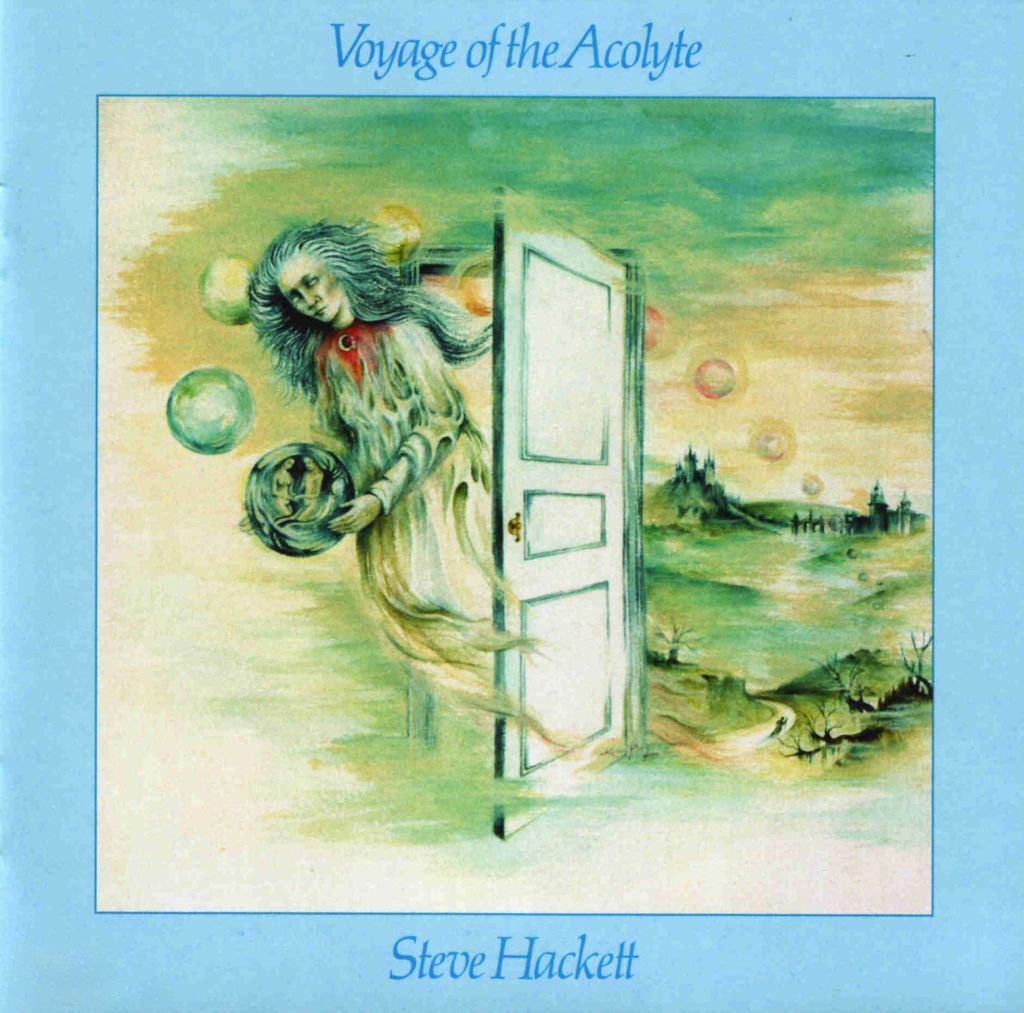
Voyage Of The Acolyte is the first solo album by Genesis guitarist Steve Hackett.
Steve Hackett was somewhat frustrated with his role in Genesis, as he felt that his compositions were not really getting through the band’s filter. Instead of Hackett’s songs, it was especially keyboardist Tony Banks’ compositions that got more space on Genesis’ albums.
However, Hackett was not yet ready to leave the band, so the logical solution to the problem was, of course, to make a solo album. In fact, Voyage Of The Acolyte is not only Hackett’s first solo album, but also the first solo album ever made by a Genesis musician. Even Peter Gabriel, who had just left the band, would have to wait a few more years before making his solo debut.
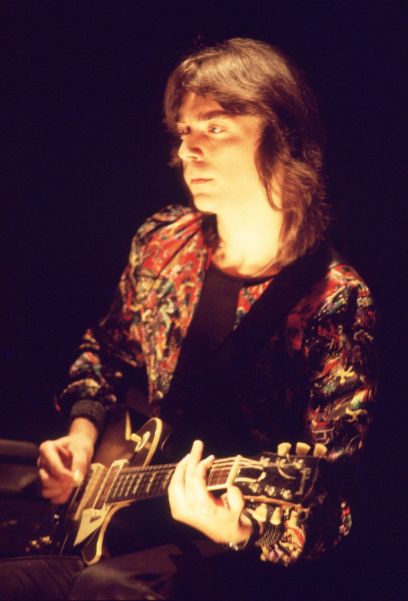
However, Hackett did not have to embark on his project entirely without the support of the Genesis organization, as he was able to recruit his old battle companions, drummer Phil Collins and bassist Mike Rutherford, to form the rhythm section for the album.
Voyage Of The Acolyte sounds very similar to Genesis’ albums from 1971 to 1974. Hackett’s guitar naturally gets more space than in Genesis, at the expense of the keyboards. On the other hand, the flutes often played by Steven’s brother John Hackett on the album create a slight difference from Genesis. The flute also had its own role in Genesis, but John Hackett plays the flute with a much more confident touch than Gabriel did in Genesis.
However, it wasn’t necessary to assemble the album solely with relatives and Genesis members. On bass, Rutherford is joined on a couple of tracks by Roxy Music’s Johnny Gustavson and fretless bass expert Percy Jones. Robin Miller, who has played on King Crimson albums, plays wind instruments (oboe and English horn) on two tracks. Nigel Warren-Green’s cello can be heard on The Hermit, and Sally ”Mike’s sister” Oldfield sings on the album’s closing track, Shadow Of The Hierophant. Alongside the Hackett brothers, keyboards on the album are played by the album’s producer/recording engineer John Acock.
Voyage Of The Acolyte is built around a loose tarot card theme, and each of the eight tracks on the album depicts (or purports to depict…) one tarot card.
Read also:
- Vuosi vuodelta : Parhaat levyt 2000 – Sijat 11-20
- Review: Univers Zero – Ceux Du Dehors (1981)
- Levyarvio: Steve Walsh – Glossolalia (2000)
- Year by Year : Best Albums of 1976 – 21-29
- Levyarvio: Jimmy Page – Outrider (1988)
- Review: Brian Eno + David Byrne – My Life in the Bush of Ghosts (1981)
- Levyarvio: Gong – Zero To Infinity (2000)
- Review: Michael Oldfield – Heaven’s Open (1991)
- Review: Talk Talk – The Colour Of Spring (1986)
The album kicks off energetically with the instrumental opening track ”Ace Of Wands.” The song is mostly fast-paced, but its most captivating moments are the quieter passages, which make successful use of tubular bells and Mellotron. The song is marred by a few jarring transitions, the worst of which occurs around the three-and-a-half-minute mark, when the slow section transitions back to a faster tempo with a strange jolt. With Hackett’s fast guitar runs, ”Ace Of Wands” is a very entertaining song, but it cannot be praised as a particularly skillful composition.
The mood calms down with the next track, the short, pastoral-sounding ”Hand Of The Priestess (Part 1),” which is very Genesis-esque with its mellotron and flute.
The strangely roaring and thumbing ”Tower Struck Down” is an interesting song and the most original music Voyage Of The Acolyte has to offer. The song is carried by Rutherford’s fuzz bass and, apparently, Percy Jones’ bass, which is also part of the mix. I do have trouble distinguishing Jones from the whole, but the end result is nevertheless successful and provides a thick foundation for the song. The song, which repetitively and aggressively thunders along, is something completely different from Genesis’s often harmonically complex songs.
Honoring prog traditions, Hackett effectively plays with contrasts on the album. Fast-paced and intense songs are usually followed by light and airy melodic tunes. After the heavy ”Tower,” we return to the beautiful and serene ”Hand Of The Priestess” theme in part two. Hackett plays a tasty guitar solo in the song, but the song itself ends unsatisfactorily, fading out.
The acoustic ”The Hermit” brings to mind Hackett’s own guitar piece ”Horizon” (from the album Foxtrot), but also the gentle songs from King Crimson’s early years. I would have liked to hear more of Nigel Warren-Green’s cello, but John’s flute gets more space, and it sounds nice too. Hackett sings the song himself. The performance is rather dull but not awful, and fortunately the vocals play a fairly minor role in the song. In fact, they are so minor that they could have been left out entirely without any concern.
On this mostly instrumental album, vocals can be heard on ”The Hermit” as well as a couple of other tracks. Phil Collins sings somewhat lethargically on ”Star Of Sirius,” the track following ”The Hermit.” After a loose acoustic intro, ”Star Of Sirius” has some powerful moments (the music in the background of the chorus works well), but overall it’s a somewhat vague performance that jumps around a bit.
Before the album finale, we hear the less than two-minute-long ”The Lover,” which begins as an acoustic solo guitar piece but fizzles out in the second half into a dull synth mood piece. All in all, a rather pointless song.
Fortunately, there is still perhaps the best song on the album, the 11-minute ”Shadow Of The Hierophant.” Sally Oldfield performs better than Collins as a vocalist on this song. Oldfield sings beautifully and high, almost operatically. Her voice manages to be both delicately fragile and majestically magical at the same time. It would have been nice to hear more of Oldfield on the album.
The arrangement of ”Shadow Of The Hierophant” is, as is typical for Hackett, quite choppy, but the alternation between delicate acoustic moments and stronger Mellotron-filled crescendos works quite well. However, “Shadow Of The Hierophant” suffers from a problem typical of Hackett: he has a lot of good ideas, but he often has difficulty building them into coherent songs. Too often, Hackett’s compositions are a bit like Frankenstein’s monsters, cobbled together haphazardly.
Hackett had originally offered ”Shadow Of The Hierophant” for Genesis’s Foxtrot album, but at the time, the song did not make it through the band’s screening process, which was essentially a pseudo-democratic vote. In a way, I understand this, because for me, Oldfield’s vocals save the song, and it’s hard to imagine that Gabriel’s voice would have made the song stand out among Genesis’s best songs.
Voyage of the Acolyte is an entertaining debut from Hacket, but it’s not a particularly innovative album, nor is it a clear departure from the mothership, Genesis. It would have been interesting if Hackett had boldly made the album without Phil Collins and Mike Rutherford, as the end result sometimes sounds a little too much like Genesis. On the other hand, even fifty years later, I still consider Voyage Of The Acolyte to be the best solo album by the prolific Steve Hackett, so perhaps the Genesis guys should have been enlisted more often…
Voyage of the Acolyte was moderately successful upon its release, reaching number 26 on the UK album chart at its peak. The album gave Hackett a huge boost of confidence, which ultimately led to his departure from Genesis a few years later. Hackett’s solo career has been prolific and quite diverse, but the quality of his albums has not always been outstanding. As a guitarist, however, Hackett has continued to develop, and now, at over 70 years of age, he plays perhaps better than ever. In recent years, Hackett has given his career a fresh boost with his Genesis-themed concerts, which have made him a popular live performer around the world.
Best tracks: ”Ace Of Wands”, ”Tower Struck Down”, ”Shadow Of The Hierophant”
Author: JANNE YLIRUUSI
Lisää Genesis-aiheisia kirjoituksia löydät täältä >
Kappaleet:
- ”Ace of Wands” 5:23
- ”Hands of the Priestess, Part I” 3:28
- ”A Tower Struck Down” S. Hackett, John Hackett 4:53
- ”Hands of the Priestess, Part II” 1:31
- ”The Hermit” 4:49
- ”Star of Sirius” 7:08
- ”The Lovers” 1:50
- ”Shadow of the Hierophant” 11:44
Muusikot:
Steve Hackett: kitarat, Mellotron, urkuharmooni, kellot, autoharp, vokaalit (”The Hermit), efektit John Hackett: huilu, ARP syntetisaattori, kellot Mike Rutherford: basso, 12-kielinen fuzz-basso, basso-pedaalit Phil Collins: rummut, vibrafoni, perkussiot, vokaalit (”Star of Sirius) John Acock: Elka syntetisaattori, Mellotron, urkuharmooni, piano
Vierailijat:
Sally Oldfield: vokaalit (”Shadow of the Hierophant”) Robin Miller: oboe (”Star of Sirius”), Englannintorvi (”The Hermit”) Nigel Warren-Green: sello (”The Hermit”)
Percy Jones: bassokitara (”A Tower Struck Down”) Johnny Gustafson: bassokitaara on (”Star of Sirius”)
Tuotanto: Steve Hackett & John Acock
Levy-yhtiö: Charisma
 Pienemmät Purot
Jätä kommentti