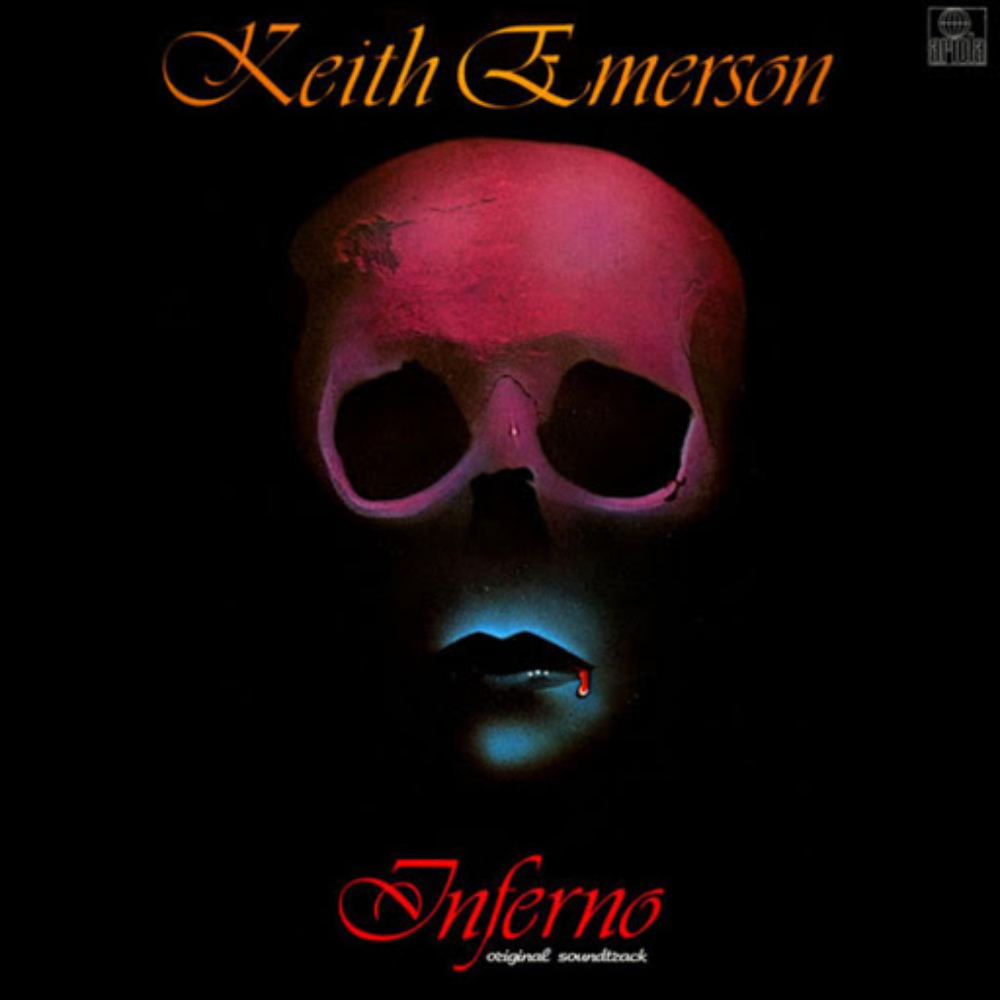
Inferno is Keith Emerson’s first solo album.
Keith Emerson was facing something new at the end of the 1970s. Emerson had risen to the ranks of England’s rock aristocracy in the late 1960s as the leader of The Nice and a colorful keyboard virtuoso. Throughout the 1970s, he had reaped gold and glory, sometimes dubiously, as the main composer for Emerson Lake & Palmer. However, ELP ran to a halt dramatically with their 1978 album Love Beach.
Love Beach was not only a financial failure but also a complete artistic disaster, which led to the band calling it quits. Emerson had been interested in composing film music for some time, and in fact, the composition that eventually became one of the central tracks on Works Volume 1, ”Pirates,” had been offered for the film The Dogs Of War (a film about mercenary musicians, which was ultimately made by Geoffrey Burgon). That project never came to fruition, but after ELP broke up, Emerson had his manager spread the word that he was once again available to compose film music.
Orchestral film music experienced a new boom in the late 1970s thanks to John Williams’s grandiose orchestral music, which he had composed for George Lucas’s space epic Star Wars. Emerson was better positioned than many other rockers of his generation to compose similar music, because even though he had no formal classical training, he could still read and write music fluently and had a deep understanding of the structures of art music.
Soon after, a film director who was interested in Emerson appeared. In 1979, Emerson received an offer to compose film music from Italian horror film auteur Dario Argento. Dario Argento specialized in dramatic and visually extravagant horror films that were hollow in content. Argento already had experience working with prog musicians, as the Italian band Goblin had successfully composed the music for his two previous films, Profondo Rosso (ELP had been Argento’s original choice at the time, but the budget did not allow for it) and Suspiria.
In Inferno, which premiered in February 1980, ancient evil lurks in urban New York. Argento’s gory film is ridiculously bad, but Emerson’s music supports it reasonably well and, more importantly for music lovers, works surprisingly well as a standalone piece.
In his compositions for Inferno, Emerson effectively combines almost pathetic romanticism with frenzied drama. His tools include not only the piano and synthesizer, which he plays himself, but also an entire symphony orchestra and choir. Emerson uses a rock band-like sound in only three songs. In these, his rhythm section consists of Kendall Stubbs (bass) and Frank Scully (drums). This Bahamian duo also played on Emerson’s next solo album, Honky (1981).
In terms of instrumentation, Inferno is more reminiscent of Emerson’s first piano concerto (”Piano Concerto No. 1,” from the album Works Volume 1) than ELP’s prog rock compositions. On the other hand, while the piano concerto drew inspiration from 19th-century classical music, Emerson returned to more modern, angular art music for inspiration in Inferno. Like many of Emerson’s best ELP compositions, Inferno also owes a debt to modernists such as Alberto Ginastera and Béla Bartók.
Inferno benefits greatly from Godfrey Salmon’s colorful orchestrations, which seem to be a perfect match for Emerson’s compositions. Emerson was certainly capable of orchestrating himself, as ”Piano Concerto No. 1” (although John Meyer assisted him in the task) demonstrated, but at least in that work, the result was too cautious, and Salmon’s orchestrations are considerably wilder. In Hollywood, it is actually common practice, if only for scheduling reasons, for even experienced composers to use external orchestrators. Salmon and Emerson clearly worked well together, having already collaborated on Works Volume 1 and the subsequent tour. Salmon orchestrated ”Pirates” and many other songs performed at the concerts, as well as conducting the symphony orchestra that accompanied the band.
Emerson uses synthesizers sparingly and discreetly on Inferno, relying more on the piano. The piano plays a significant role throughout the album, and Emerson skillfully uses his instrument to reflect different moods, sometimes depicting the innocence of the film’s main character, Rose, and sometimes throwing himself into discordant riffs, such as in ”A Cat Attic Attack.” Emerson has always been the most expressive pianist in progressive rock, and he does not disappoint in this regard on this album either.
Inferno begins with a delicate and beautiful, almost lyrical piano theme (which is also the main theme of the entire score), accompanied by lingering strings. The drama is soon heightened by the orchestra, especially the brass instruments. The three-minute ”Inferno (Main Titles Theme)” serves as an effective opening and introduces the album’s three main themes, which Emerson skillfully varies throughout the album.
The highlight of the album is ”Taxi Ride (Rome)”. At once menacing and seductive, the slightly funky, delicious 5/4 (Emerson’s favorite time signature?) groove carries ”Taxi Ride” forward with the same inexorable force that characterizes many of ELP’s best songs. Emerson’s solo synthesizer sounds distorted, almost like an electric guitar, reminiscent of Jan Hammer’s style from the Mahavishnu Orchestra. With a virtuosic and menacing piano ostinato in the background, ”Taxi Ride” also contains a reference to Giuseppe Verdi’s composition ”Va pensiero” (from the opera ”Nabucco”), which was added at Argento’s request, as this piece also plays as diegetic music in the film (i.e., music that the characters in the film also hear). At just over two minutes long, I would have liked the song to last much longer. On the other hand, perhaps the short length of the song is part of what makes it so effective. ”Taxi Ride” could have also been a really great ELP song. It’s a shame that the trio never performed a version of it live on their reunion tours.
Another song featuring drums and bass is ”Mater Tenebrarum,” where the atmosphere becomes downright satanic. With the help of a choir and orchestra, Emerson unleashes a grandiose, unholy mass that is somewhat reminiscent of Jerry Goldsmith’s composition ”Ave Satani” from the film The Omen (1976). ”Mater Tenebrarum” is so grandiose that it is in danger of becoming kitsch, but like ”Taxi Ride,” it has an inspiringly aggressive vibe that, in my opinion, clearly tips the scales in its favor.
In ”Inferno Finale,” the tension builds and Emerson impressively draws power from the orchestra. The album ends with the magnificent orchestra-colored prog piece ”Cigarettes, Ices, Etc.,” which echoes the themes of the album. Emerson’s flute-like synthesizer also seems to refer to ELP’s song ”Pirates.”
Read also: Review: Emerson Lake & Palmer –Brain Salad Surgery (1973)
As is often the case with film music, some of the tracks on Inferno are just short snippets whose main purpose is to directly support the events on screen, but fortunately the album also offers plenty of music that is enjoyable to listen to on its own. Argento’s film is rubbish, but Emerson’s album manages to stand on its own two feet and, apart from a few minor dips, carries nicely from start to finish.
Inferno contains some of Emerson’s best compositions since ELP’s golden age and, as a whole, is one of the most impressive achievements of his illustrious career. It is a pity that Inferno has received so little attention, partly because Argento’s film was not very successful and partly because rock musicians’ film music is not usually taken very seriously. Not even when there is good reason to!
It’s kind of a shame that Emerson didn’t develop Inferno into a real solo album that wasn’t weighed down by the demands of film music. The style of Inferno would have provided an excellent direction for Emerson’s solo albums, but unfortunately, in the early 1980s, there was little demand for orchestral albums by keyboard virtuosos. Emerson was no longer particularly hot property in the eyes of record companies anyway.
After Inferno, Emerson made a few more soundtrack albums (the most famous of which was Nighthawks, 1981, starring Sylvester Stallone), but none of them could match his first attempt. The first ELP reunion (although Carl Palmer was replaced by Cozy Powell at this stage) followed in 1986, after which Emerson made a few uneven solo albums while ELP returned from time to time to tour and record. Unfortunately, Emerson’s music never again reached the dizzying heights it had achieved in the 1970s. Emerson, who hid his sensitivity beneath his showmanship, took his own life in 2016.
Author: JANNE YLIRUUSI
- Review: Cos – Viva Boma (1976)
- Levyarvio: King Crimson – The ConstruKction Of Light (2000)
- Review: Camel – Moonmadness (1976)
- Review: Gong – Gazeuse! (1976)
- Review: Mike Johnson – The Gardens Of Loss (2026)
- Levyarvio: Mike Johnson – The Gardens Of Loss (2026)
- Levyarvio: Led Zeppelin – Presence (1976)
- Vuosi vuodelta : Parhaat levyt 2000 – Sijat 11-20
- Review: Univers Zero – Ceux Du Dehors (1981)
Tracks
- ”Inferno (Main Titles Theme)” – 2:56
- ”Rose’s Descent into the Cellar” – 4:58
- ”Taxi Ride (Rome)” – 2:15
- ”The Library” – 0:57
- ”Sarah in the Library Vaults” – 1:17
- ”Bookbinder’s Delight” – 1:11
- ”Rose Leaves the Apartment” – 3:30
- ”Rose Gets It” – 2:04
- ”Elisa’s Story” – 1:10
- ”A Cat Attic Attack” – 3:13
- ”Kazanian’s Tarantella” – 3:34
- ”Mark’s Discovery” – 1:23
- ”Mater Tenebrarum” – 2:38
- ”Inferno Finale” – 2:26
- ”Cigarettes, Ices, Etc.” – 2:50
Musicians
Keith Emerson: keyboards, orchestral conducting Kendall Stubbs: bass guitar (3,15) Frank Scully: drums (3,15) Rossana Barbieri: vocals (13) Godfrey Salmon: arrangements, orchestration, and orchestral conducting (13)
 Pienemmät Purot
Jätä kommentti