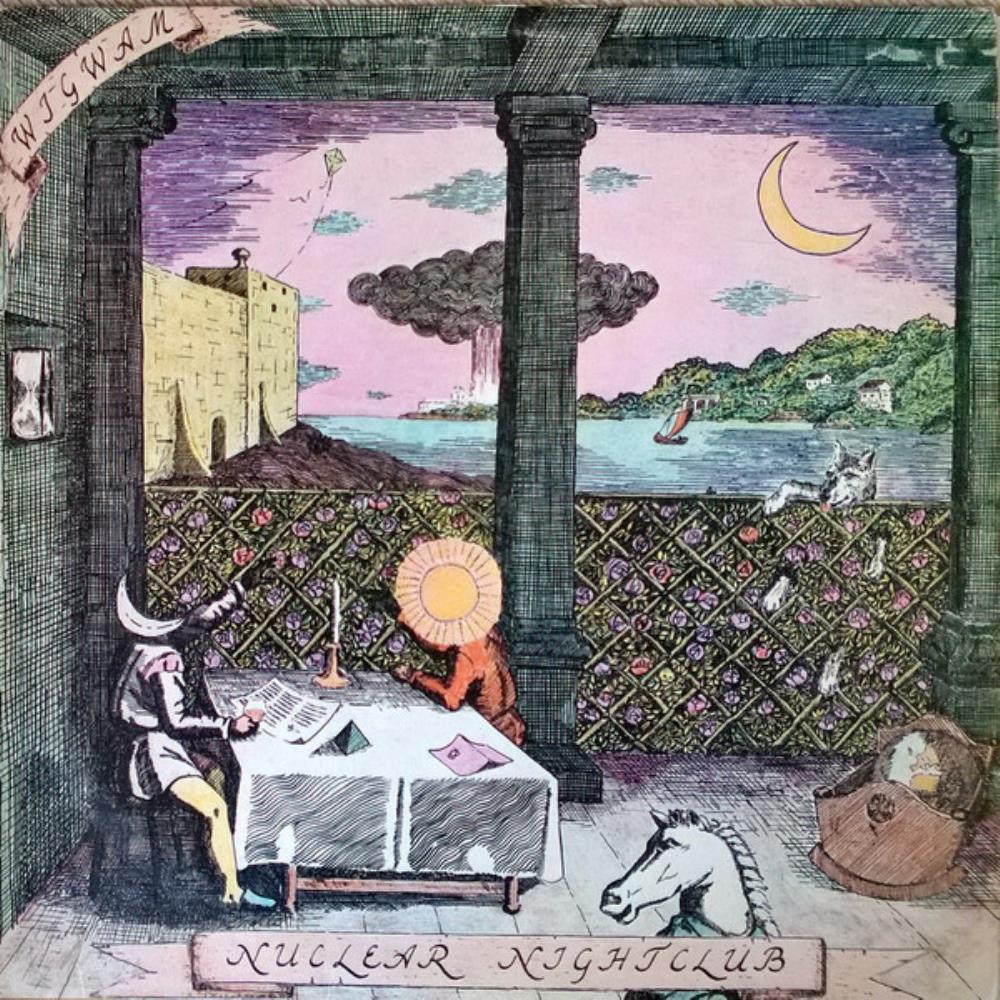
Nuclear Nightclub is the fifth studio album by Finnish band Wigwam, formed in 1968.
If Wigwam was Finland’s Henry Cow for a while on their previous album, Being, then on Nuclear Nightclub, the band’s new lineup makes a 180-degree turn toward the mainstream, sounding more like a cross between Steely Dan and Wishbone Ash than avant-garde prog. In my opinion, Nuclear Nightclub is also quite reminiscent of some of Manfred Mann’s Earth Band’s albums from the same era. Wigwam themselves named this new era ”deep pop.”
The driving force behind the change was, of course, significant changes in the band’s lineup. Being’s challenging birth process sowed seeds of discord within the band, the most significant of which, but not the only one, was a difference of opinion about the band’s musical direction. Virtuoso musicians keyboardist/vocalist Jukka Gustavson and bassist Pekka Pohjola no longer believed that they could make the kind of complex progressive rock they wanted in Wigwam, so they decided to leave the band to pursue their own solo careers.
The more pop-oriented Jim Pembroke (vocals/keyboards) and Ronnie Österberg (drums) remained in the band. They were tasked with rebuilding the band, and, not surprisingly, their record label, Love Records, strongly encouraged them.
Guitarist Pekka “Rekku” Rechardt had joined the band shortly before Gustavson and Pohjola left, and he was originally supposed to play the cello in addition to the guitar (which greatly appealed to Gustavson, who had an orchestral mindset). The cello was quickly abandoned (due to problems with amplification, among other things), but Wigwam gained a stylish guitarist in Rekku, who played melodically and with a slight blues influence. Stylistically, Rekku was roughly in the vein of Camel’s Andy Latimer or Pink Floyd’s David Gilmour. Rekku also made a strong contribution to the band as a composer, taking on a significant role in this area on Wigwam’s first album, even though Pembroke still dominated the credits.
The bass was provided by Blues Section and Tasavallan Presidentti, experienced musician Måns “Måsse” Groundstroem. Måsse was a talented bassist, but his style was considerably more “grounded” and conventional than Pohjola’s. Måsse’s more traditional role as a rock bassist is one of the key factors that defines the sound of Nuclear Nightclub.
The keyboards on the album were played by Esa Kotilainen, who had previously played mainly in dance bands and enjoyed a reputation as a pioneer and expert on synthesizers, owning, among other things, the first Minimoog brought to Finland. For some reason, however, Kotilainen was not taken on as a full member of Wigwam, but instead plays on the album as a guest musician. Kotilainen’s style as a player was considerably simpler and more subdued than Gustavson’s, as he focused more on accompanying the rest of the band in a restrained manner and building atmosphere with his synthesizers rather than playing virtuoso solos. Kotilainen rarely takes or is given a solo role on the album.

The sound of the new Wigwam album Nuclear Nightclub is fresh and crystal clear. Minimalistic. Downright simple. The songs are friendly and relatively straightforward, yet still quite sophisticated. The melodies are catchy, but fortunately, despite their straightforwardness, the songs usually have enough depth to withstand repeated listening.
On the instrumental side, there isn’t much of the soloist fireworks heard on the old Wigwam albums, but Rekku Rechardt does get to play some stylish guitar solos on the album, which, although often drawing on the blues, don’t get too bogged down in the clichés of the genre.
The most complex track on the album is “Simple Human Kindness,” which, with its numerous key changes, provides a refreshing change of pace among the otherwise fairly straightforward material. Jim Pembroke has said that he consciously sought to capture the more intricate feel of earlier Wigwam songs with this track. He succeeds so well that one would have hoped for a little more of this ambition on Nuclear Nightclub.
Otherwise, the songs on the album balance somewhere between art rock and progressive rock, offering catchy pop hooks coated with skillful but relatively restrained and controlled rock performances. So, to return to the band’s own definition, this is indeed deep pop.
Read also:
- Review: Cos – Viva Boma (1976)
- Levyarvio: King Crimson – The ConstruKction Of Light (2000)
- Review: Camel – Moonmadness (1976)
- Review: Gong – Gazeuse! (1976)
- Review: Mike Johnson – The Gardens Of Loss (2026)
- Levyarvio: Mike Johnson – The Gardens Of Loss (2026)
- Levyarvio: Led Zeppelin – Presence (1976)
- Vuosi vuodelta : Parhaat levyt 2000 – Sijat 11-20
- Review: Univers Zero – Ceux Du Dehors (1981)
Personally, I consider Nuclear Nightclub a slight disappointment after the masterful and challenging Being, and I can’t help but imagine what heights Wigwam could have reached with Gustavson and Pohjola at the helm. But if you forget the comparisons and approach Nuclear Nightclub without the baggage of history, it’s quite fresh-sounding and high-quality music. And undoubtedly an album that came naturally from this particular lineup. It would be unfair to ask for more.
Besides, the general consensus may even still be that Nuclear Nightclub is Wigwam’s best album, although I don’t agree with that myself. Recorded at Marcus Music Studios in Stockholm under the direction of producer Pave Maijanen, Nuclear Nightclub received an enthusiastic reception in Finland upon its release, rising straight to number one on the album charts and quickly selling enough copies to earn a gold record.
Nuclear Nightclub was the first Wigwam album released in the UK by Virgin, Richard Branson’s record label, which at that stage was still focused on progressive rock. Despite Virgin’s fairly extensive promotion of the album, it sold only (?) 8,000 copies in its first month and failed to make it onto the best-selling album charts. So Wigwam didn’t achieve a spectacular international breakthrough with Nuclear Nightclub, but it’s still an excellent rock album.
Best tracks: ”Do Or Die”, ”Bless Your Lucky Stars”, ”Simple Human Kindness”
Author: JANNE YLIRUUSI
More articles on Finnish music here >
Tracks:
Side A
- Nuclear Nightclub – 2.45
- Freddie Are You Ready – 5.37
- Bless Your Lucky Stars – 6.03
- Kite – 4.17
Side B
- Do or Die – 5.06
- Simple Human Kindness – 4.05
- Save My Money & Name – 4.10
- Pig Storm – 4.51
Wigwam:
Jim Pembroke: vocals, electric piano, acoustic piano, backing vocals Pekka “Rekku” Rechardt: guitars Måns Groundstroem: bass Ronnie Österberg: drums, marimba
Guests:
Esa Kotilainen: keyboards Pave Maijanen: backing vocals
Producer: Pave Maijanen, Måns Groundstroem, Ronnie Österberg
Label: Love Records
 Pienemmät Purot
Jätä kommentti