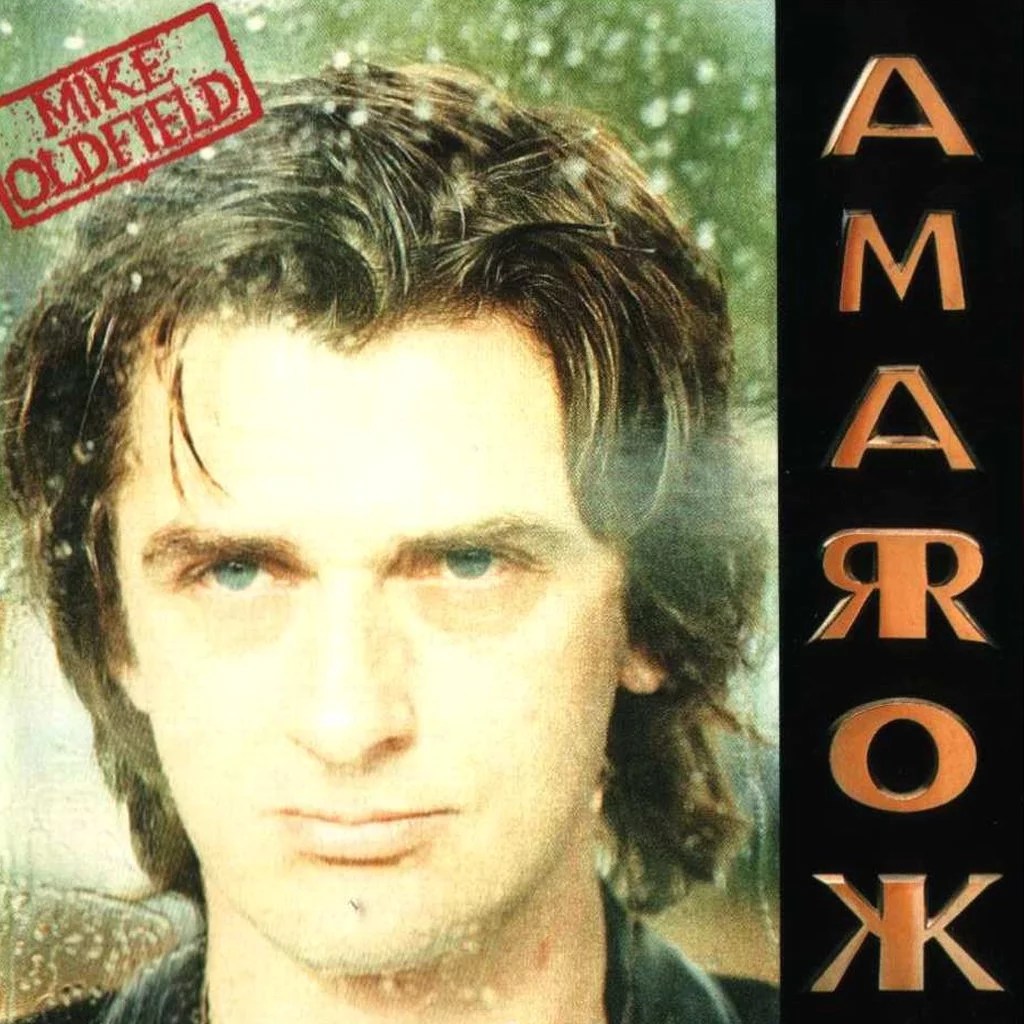
Amarok is Mike Oldfield’s 13th studio album.
At the dawn of the 1990s, Mike Oldfield’s (born 1953) career had hit rock bottom. Commercially, Oldfield’s career had also been in a lull in the early 1980s, but his luck changed in 1983 with the massive hit ‘Moonlight Shadow,’ which made the album Crises a success.
Originally known for his long and complex instrumental compositions, the multi-instrumentalist became a musician who more or less enthusiastically churned out pop songs. Little by little, all personality was stripped away from these pop songs, and by the time Earth Moving was released in 1989, they could have been written by any pop songwriter cranking out hits behind the scenes.
Oldfield has attempted to blame the blandness of Earth Moving on his record company, Virgin. According to Oldfield, he obediently followed Virgin’s demands on that album. It is somewhat tragicomic that the most calculated album of Oldfield’s career to date was such a dismal failure. Despite its desperate attempt to be a hit, Earth Moving sold worse than its predecessors, which further diminished Virgin’s interest in Oldfield. Oldfield, on whose success with Tubular Bells the entire record company had been built, began to look like a spent force in Virgin’s eyes. Oldfield, for his part, was fed up with dancing to Virgin’s tune and frustrated by what he felt was the lack of promotion he was receiving from the company. However, Oldfield was still tied to Virgin for two more albums. In the 1980s, Oldfield negotiated a higher royalty percentage than his original meagre deal, but in return, his original 10-album contract was extended by three albums.
”It doesn’t have a real meaning but it’s similar to many Gaelic words, like those for morning or happy. And if you split the letters up, you get Am-a-rok… it could mean: am a rock. Maybe that implies I don’t want to change anything by following trends.”
Mike Oldfield about the name Amarok
Inspiration for Oldfield’s next move came from a session he did for BBC Radio 1. At the BBC’s request, Oldfield quickly put together a seven-minute excerpt from Tubular Bells in the radio studio, and he realised that he was enjoying making music again using his old method, without sequencers and computers. The modern technology that had come to dominate Earth Moving would now take a back seat, and Oldfield would return to the good old one-man band format, where everything would be played live and by hand. The music on the next album would be instrumental, with songs as long and complex as felt natural. Oldfield decided to make the album, which he named Amarok, without compromise. To hell with the record company’s opinions! From then on, he would only listen to his own inner voice, and in fact, Oldfield has described Amarok as his personal revenge on Virgin.
Oldfield called on his old producer friend Tom Newman for help. Newman’s task was to make sure that Amarok sounded as good as possible. The album was recorded in Buckinghamshire in Oldfield’s state-of-the-art home studio, which had just been upgraded to 48 tracks. Oldfield and Newman worked ten-hour days for three months with the goal of completing two minutes of music per day. The result was a 60-minute-and-2-second epic full of surprising twists and turns.
Oldfield purchased a new grand piano and old analogue organs (Hammond, Lowrey, Farfisa) for the making of Amarok. All instruments were played by hand in real time, and computers and sequencers were only used to build quick demos, on top of which the final recordings were built. Synthesizers were not completely abandoned, but they are mainly used as background glue or here and there as shock effects. Numerous different guitars, both acoustic and electric, take centre stage, and the album features some of the finest and most virtuosic guitar work of Oldfield’s career.
In addition to traditional instruments, Oldfield also uses strong elements of musique concrète, which is quite atypical for him. Amarok is full of strange sound effects, such as footsteps, the clinking of spoons, the whirring of a vacuum cleaner, teeth being brushed, breaking glass, fist punches, wind-up toys and all sorts of other exciting and strange things. The music is mainly instrumental, but it is interwoven with various strange cries, wordless singing and, on the other hand, African Xhosa singing performed by a whole choir. Towards the end, there is even a strange imitation of Margaret Thatcher!
However, the album was not entirely the work of Oldfield and Newman; a few guest artists were invited to participate. With the exception of Janet Brown, who impersonated Thatcher, most of them had been involved in the 1975 album Ommadawn. Clodagh Simonds and Bridget St John, who sang on that album, also sing on Amarok, and Paddy Moloney, the legendary member of The Chieftains who played the bagpipes so impressively on the same album, makes a guest appearance this time playing the tin whistle. The percussion group Jabula, led by Julian Bahula, who played African drums memorably on Ommadawn, plays an important role on Amarok. Bahula also arranged the choir singing in the Xhosa language mentioned above.
Review: Review: Mike Oldfield – The Songs Of Distant Earth (1994)
Repetition and slowly changing themes played a central role in Oldfield’s long compositions of the 1970s. Of course, they also contained occasional surprising transitions (whether planned or not), but on Amarok, Oldfield turns rapid changes into an art form. I recently wrote about John Zorn’s album Naked City, released in the same year, and although it is a very different album from Amarok, what they have in common is an endless musical imagination, as if leaping from one idea to another through jump cuts. Admittedly, Amarok can sometimes feel a little frustrating to listen to, when a great passage that you wish would continue or be developed further is suddenly replaced by something else. However, the pain is greatly eased by the fact that the next part is almost without exception just as magnificent!
However, Amarok is not as chaotic as it may seem on first listen. In fact, the album consists of eight different themes, which are revisited throughout the album with variations in instrumentation, key or tempo. Most of the themes are introduced quickly in the first ten minutes, but the last theme is not heard until halfway through the album.
- ”Fast Riff Intro” (0:00)
- ”Intro” (2:32)
- ”Climax I” – 12 Strings (5:46)
- ”Soft Bodhran” (6:18)
- ”Rachmaninov 1” (7:20)
- ”Soft Bodhran 2” (8:35)
- ”Rachmaninov 2” (9:29)
- ”Roses” (9:56)
- ”Reprise 1 – Intro” (10:42)
- ”Scot” (12:45)
- ”Didlybom” (13:16)
- ”Mad Bit” (15:00)
- ”Run In” (15:56)
- ”Hoover” (16:11)
- ”Fast Riff” (18:00)
- ”Lion” (19:57)
- ”Fast Waltz” (21:57)
- ”Stop” (23:42)
- ”Mad Bit 2” (24:33)
- ”Fast Waltz 2” (24:46)
- ”Mandolin” (25:06)
- ”Intermission” (26:07)
- ”Boat” (26:23)
- ”Intro Reprise 2” (29:27)
- ”Big Roses” (32:07)
- ”Green Green” (33:13)
- ”Slow Waltz” (34:24)
- ”Lion Reprise” (36:04)
- ”Mandolin Reprise” (37:05)
- ”TV am/Hoover/Scot” (37:47)
- ”Fast Riff Reprise” (39:50)
- ”Boat Reprise” (42:22)
- ”12 Rep / Intro Waltz” (43:32)
- ”Green Reprise” (44:12)
- ”Africa I: Far Build” (44:46)
- ”Africa I: Far Dip” (48:00)
- ”Africa I: Pre Climax” (48:46)
- ”Africa I: 12 Climax” (49:32)
- ”Africa I: Climax 1” (50:24)
- ”Africa II: Bridge” (51:00)
- ”Africa II: Riff” (51:17)
- ”Africa II: Boats” (51:34)
- ”Africa II: Bridge 2” (51:52)
- ”Africa II: Climax 2” (52:10)
- ”Africa III: Baker” (54:22)”
(Unofficial Amarok division into 45 sections. The division apparently originates from Oldfield’s original working files.)
One of the recurring key elements of the album is the complex and fast guitar pattern that opens the album, which is both confusing and intriguing in its rhythmic and harmonic instability. The section, which constantly shifts between 3/4, 4/4 and 5/4 time signatures at a very fast tempo, is one of Oldfield’s most interesting moments as a guitarist. Oldfield himself, however, stated that the section has no time signature. This so-called ‘Fast Riff’ section also features exciting robot-like vocoder vocals, and at the half-minute mark, there are some VERY loud synthesizer blasts, which were part of Oldfield’s revenge on Virgin. Oldfield relished the idea of Virgin’s A&R boss Simon Draper driving his Lamborghini as usual, listening to loud music, when the shock effects of Amarok would scare him off the road. Amarok does indeed contain many moments that clearly seek to provoke the listener. Oldfield seems to be testing his audience, asking, ‘How far are you willing to go?’ The tense, disjointed and robotic voice also asks ‘happy?’ several times throughout the album.
Extreme dynamics are one of the defining characteristics of the superbly recorded Amarok. Amarok moves in an impressive (or irritating, depending on the listener!) way from very quiet moments to downright explosive sound levels. The quiet moments are also effectively punctuated by louder shock effects, which remind the listener even during the more serene sections that this is not toothless new age music.
However, the album’s sonic excellence is not limited to raw dynamics. The stereo image is wide and deep. The sense of space is consistently strong. The sound is very distinct, but at the same time the mix stays elegantly together and the instruments don’t feel too detached from each other. In many places, I am delighted by how the mixing makes use of distance and proximity. Some of the instruments seem to be playing their parts somewhere far away, while others caress the listener’s ears from close range. This impression is accentuated when listening with headphones. Amarok is one of the few reference albums I use to test new components for my hi-fi equipment.
However, Amarok is not just a celebration of virtuoso performances or cold technology, but is also full of truly powerful emotional moments. The music is at times angry and furious, as befits its rebellious spirit, but there is also joy, melancholic longing and heart-wrenching moments of elation. Usually, Oldfield’s extremely expressive electric guitar takes centre stage at these points, but not always. For example, in the contemplative section at the 9-minute mark, the magnificent atmosphere is created mainly by tin whistles, acoustic guitar and organ.
One of the strangest elements of this strange album is Janet Brown’s Margaret Thatcher impersonation, which I mentioned earlier. The former British Prime Minister, known as the legendary ‘Iron Lady’, steps onto the stage at one of the album’s more serene moments, around the 50-minute mark. ‘Thatcher’ mumbles something about endings and new beginnings. African singing, shouting and commotion rise in the background. The use of stereo imaging in this rather sparse section is once again first-rate and helps to maintain interest. Finally, having had her day, “Thatcher” exits the stage laughing and literally tap-dancing across the stereo image to the beat of Moloney’s whistle. And finally, the glass shatters. A political statement? The point of the Thatcher episode remains unclear. It doesn’t really hurt the album, but it would have been even better if something more musical had been come up with to replace it.
However, the Thatcher section works quite well as a bridge to the album’s truly massive finale. Jabula’s African drums echo here and there during the last 20 minutes of the album, but at the very end their intensity grows to a staggering level. When they are joined by a full-voiced African choir (I don’t know how big the choir is, but it sounds MASSIVE) and Oldfield’s passionately screeching electric guitar, the effect is truly explosive. Especially when everything is recorded so dynamically and vividly. Oldfield has always been able to build magnificent climaxes, and the climax of Amarok is one of his greatest, if not the greatest, achievements in this field. When the 60-minute and two-second rollercoaster ride of Amarok finally comes to an end after the last rush, at least this listener is left completely drained. After Amarok, you don’t feel like playing any other music. The experience must be cleansed with silence.
” Sondela / uSomandla / sukuma / wena / obengezela. ”
Excerpt from lyrics sung in Xhosa
Come closer / the Almighty / arise / you / shining one.
(Come closer to us, o Almighty: arise, you who shines.)
Read also:
- Levyarvio: King Crimson – The ConstruKction Of Light (2000)
- Review: Camel – Moonmadness (1976)
- Review: Gong – Gazeuse! (1976)
- Review: Mike Johnson – The Gardens Of Loss (2026)
- Levyarvio: Mike Johnson – The Gardens Of Loss (2026)
- Levyarvio: Led Zeppelin – Presence (1976)
Virgin was not happy to get their hands on Oldfield’s 60-minute mammoth. Virgin had been pestering Oldfield for a sequel to Tubular Bells for a long time, so they seized this opportunity and demanded that Oldfield release the album under the name ‘Tubular Bells II’. Oldfield refused outright and stated that instead of Tubular Bells, the album was more akin to Ommadawn. This is true, at least on the surface; the style of the cover art references Ommadawn, and the same musicians appear on both albums. However, the only slightly greater musical connection, in my opinion, is that African drums play a central role in the finale of both albums, and both albums have a somewhat Celtic feel to them.
It is also worth noting that, in addition to his musical integrity, Oldfield had purely selfish reasons for holding back the coveted sequel to Tubular Bells. Oldfield’s contract with Virgin was finally coming to an end after his next album, and he knew full well that Tubular Bells II would be his carrot to dangle in front of greedy record company executives in order to secure a new lucrative contract. Oldfield played this card, and Tubular Bells II, made with Trevor Horn, was his first album under Warner Music in 1992.
Virgin ultimately refused to promote Amarok in any way, but Oldfield was apparently not particularly cooperative either. For example, he refused to release a suitable excerpt from the album as a single. And there was no such excerpt to be found on Amarok – that was the whole point of the exercise! Oldfield had deliberately constructed the music to be constantly changing, so that extracting a single from it would have been an impossible exercise. Oldfield was not interested in going on tour either. In the end, the only promotion for Amarok was a competition organised by Oldfield himself, in which he offered a £1,000 prize to the first listener who could find a secret message hidden on the album. The prize was never claimed, but it later emerged that the message was Morse code hidden at around the 48-minute mark, which bluntly stated ‘FUCK OFF RB’. RB is, of course, Virgin founder Richard Branson. Childish? Yes, but also quite funny!
As expected, Amarok did not exactly set the sales charts alight, but the reported sales figure of 200,000 copies cannot be considered a poor result when you consider that this is a 60-minute set of highly complex instrumental music. In fact, it seems that Amarok did not sell much worse than its predecessor, Earth Moving, which was in every way tailor-made to top the charts. At least Oldfield was now making exactly the kind of music he wanted, completely on his own terms. Today, Amarok is widely considered one of Oldfield’s best albums, and the maestro himself often cites it as one of the highlights of his career.
Did Amarok start a new creative renaissance in Oldfield’s career? Not really. Oldfield still had one more album to fulfil his contract with Virgin. The last album of the contract, Heaven’s Open, released in 1991, is a somewhat forced mix of conventional rock songs and Amarok-style exuberant musical revelry. It wasn’t until 1992’s Tubular Bells II that a new era in Oldfield’s career truly began, and even that was full of ups and downs.
Amarok is a constantly surprising, playful and passionate musical journey of discovery that I never seem to tire of listening to. However, the experience is so intense that it is not an album I would listen to repeatedly. Amarok is one of those rare albums where you can honestly say that with focused listening, each time you listen to it, you discover some new little detail that you hadn’t noticed before. Amarok is endless joy. For me, the masterful Amarok is not only Oldfield’s best music alongside Ommadawn, but one of the greatest albums of all time.
Author: JANNE YLIRUUSI
Read also: Review: Mike Oldfield – Hergest Ridge (1974)
Tracks
- ”Amarok” 60:02
Musicians
Mike Oldfield: acoustic bass guitar, acoustic guitar, banjo, bass guitar, bass flutes, bouzouki, bell tree, bodhran, bowed guitar, cabasa, classical guitar, electric guitars, keyboards, effects, Farfisa organ, Lowrey organ, Vox organ, flamenco guitar, glockenspiel, high-string guitar, munniharp, kalimba, mandolin, marimba, melodica, Northumbrian bagpipes, tin whistles, percussion, piano, psaltery, rototom, sitar guitar (Coral electric sitar), spinet, timpani, tubular bells (in the booklet: ‘long thin metallic hanging tubes’), 12-string guitar, ukulele, violin, vocals, wonga box Janet Brown: voice of Margaret Thatcher Jabula: African choir and percussion Paddy Moloney: tin whistle Clodagh Simonds: vocals Bridget St John: vocals
 Pienemmät Purot
Jätä kommentti