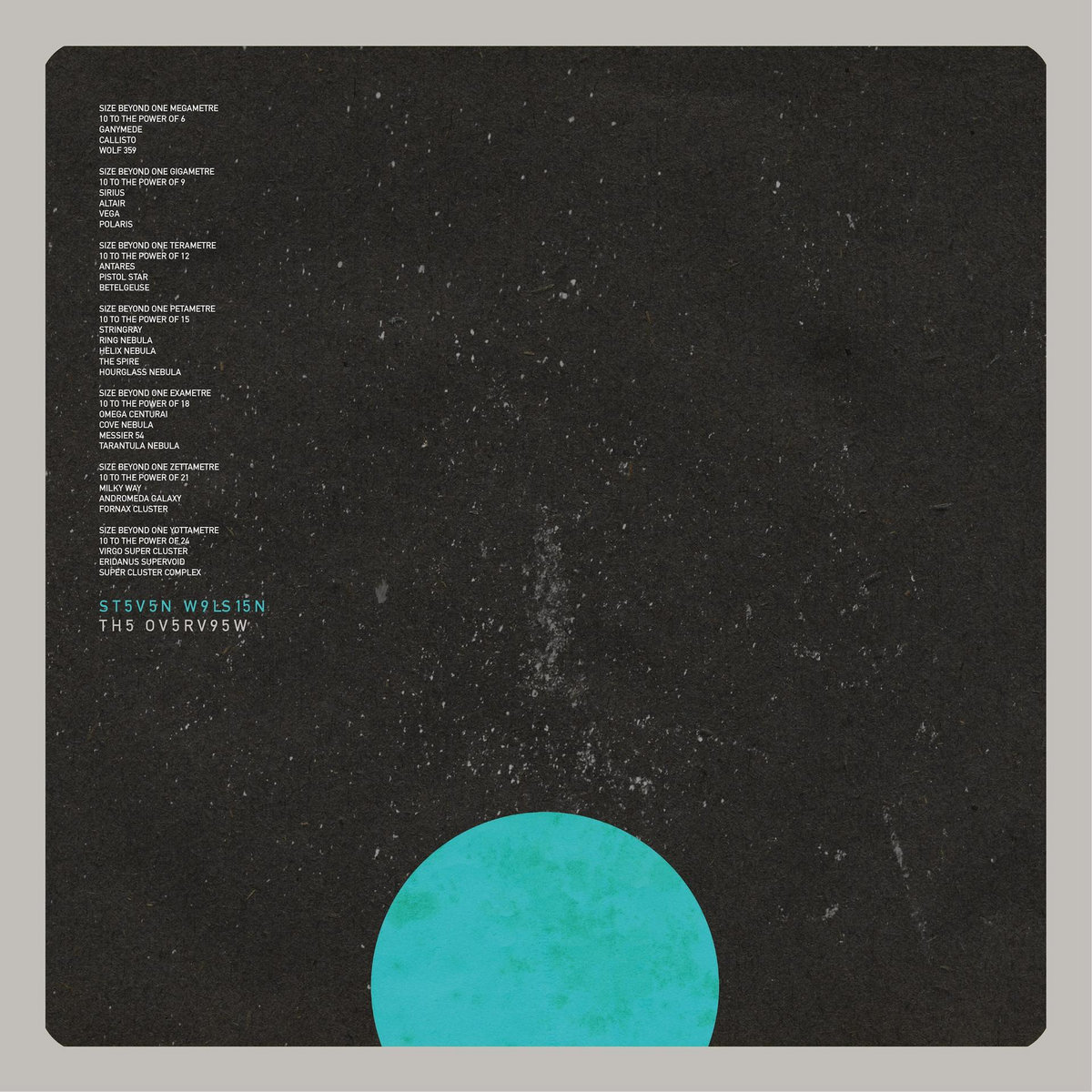
The Overview is Steven Wilson’s eighth solo album.
In 2015, After the release of Hand. Cannot. Erase, Wilson loudly announced in the media that he was no longer interested in progressive rock. A short time later, he also declared the electric guitar to be a dead instrument, as I recall. Well prog (or electric guitars) never completely disappeared from Wilson’s music although To The Bone (2017) was a heavily pop-inclined art rock and the subsequent The Future Bites (2021) focused on sterile synthpop. Progressive rock began to make a return to Wilson’s music with The Harmony Codex (2023), a stylistically multi-directional album.
Shortly after The Harmony Codex, Wilson announced that the next step would be a real return to prog. The more cynical might think, of course, that such a backtrack would be about the fact that Wilson’s recent pop experiments had not expanded his fan base, but the opposite, and now this worrying erosion would be halted by a return to his core expertise. However, Wilson himself has said that it was simply that the album’s theme provided an opportunity to return to more progressive atmospheres.
So what is the theme of the album? Space. The final frontier. However, it’s not a straight sci-fi concept (although there are elements of that on the album), but rather a record that deals with space through known facts. The actual overarching theme of the album is the so-called overview effect”, which refers to the cognitive shift in consciousness that astronauts, or at least some of them, have experienced during spaceflight when looking at planet Earth from space. Seeing the Earth from space has changed the perspective of many astronauts as they come to understand the fragility of their home planet in the midst of a vast emptiness. Wilson’s album explores this theme from a slightly different perspective within the framework of two half-album-length compositions.

Read also: Review: Porcupine Tree – Closure / Continuation (2022)
Objects Outlive Us
The first work on the album is the 23-minute long ”Objects Outlive Us”, which is divided into eight parts. Its first part, ”No Monkey’s Paw”, begins with Wilson’s beloved falsetto vocals. In a lightly floating mystical section accompanied by synthesizers, we meet an alien from outer space on the moors.
From the misty moors we move to the rhythmically chanted section ”The Buddha of the Modern Age” which effectively builds tension. The build-up doesn’t really go anywhere, though, as after a short piano break the song jumps into a completely different style again.
”Objects: Meanwhile” is a typical Wilson pop song interspersed in the middle of this epic with a somewhat indiscriminate feel. However, the somewhat familiar pop-song format supports the message of the song as XTC ’s Andy Partridge ’s lyrics juxtapose everyday things with events on a cosmic scale (”Her shopping bag broke sending eggs and flour crashing / Down to the ground, just like star clusters smashing”). Lasting more than six minutes, ”Objects: Meanwhile” is no ordinary pop track as it also contains a tasty instrumental section with a crunching bass riff that recalls the atmosphere of the latest Porcupine Tree album (Wilson himself plays bass guitars this time too).
The Cicerones”, which starts very quietly, plays for a while on acoustic guitar, and Mellotron also quickly enters the soundstage, bringing a hint of Genesis vibes. The music continues seamlessly in the ”Ark” section with more of the rhythmic vocals that remind us of the beginning. This time, though, with a lighter touch. Towards the end, the intensity grows as Russell Holzman’s drums beat faster and faster alongside a screeching electric guitar and bubbling synths in the background.
In the sixth part, ”Cosmic Sons of Toil”, modern synthesizers take the mood deeper into space. The rhythm becomes more complex and Randy McStine ’ s very interestingly swooping electric guitar joins in the fun . At times McStine’s guitar rattles in an almost flamenco-like way. I’m not a huge fan of guitar solos, but McStine’s solo is excellent and really the highlight of the whole album. At times the synthesizer takes a solo turn and soon a dialogue of instruments follows, where it is sometimes hard to tell which one is playing. The synthesizer or the electric guitar. ”Cosmic Sons Of Toil” is basically a very typical prog showcase that we have heard on Wilson’s albums since at least ”Ancestral”, but it is a very entertaining listen this time as well.
The ethereal ”No Ghost On The Moor” returns to the mood of the floating intro on the misty moor and for a while Wilson manages to keep the music really quiet and low-key. A sneakily tasty stretching electric guitar creeps in, a modern version of David Gilmour’s elegant playing. The solo lasts for a few minutes, continuing into the final section of the album, ”Heat Death Of The Universe”, where the music finally fades away with the noise of atonal synthesizers.
”Objects Outlive Us” is very clearly a series of songs in different sections, but the transition from one section to another is relatively agile, which makes the listening experience if not seamless, at least satisfyingly smooth.
The Overview
The album’s second track ”The Overview” lasts 18 minutes and is divided into six parts. If ”Objects Outlive Us” was largely a return to Wilson’s prog roots, ”The Overview” feels like a continuation of the experimental electronica of The Harmony Codex’s last track ”Staircase”. ”Objects Outlive Us” offered strong evocations of the early days of Porcupine Tree (e.g. Voyage 64) and recalled Wilson’s old romance with Wish You Were Here-era Pink Floyd and 70s Tangerine Dream. ”The Overview” is more clearly something new in Wilson’s catalogue, a combination of electronica and ambient with familiar Wilsonisms.
Opening with bubbling synthesizers, the first part ”Perspective” soon adds programmed rhythms and facts about space spoken in Rotem Wilson’s passionless and deliberately machine-like voice. A lone synthesizer wafts through the soundscape like a solar wind. Eh, if there were sounds in space…. The music is airy and extremely simple. Then the programmed rhythms become more complex and Rotem gets on with his mind-numbing patter. The beginning of ”The Overview” is not very promising, to be honest.
The second part ”A Beautiful Infinity I” takes the mood in a whole new direction. Musically it has nothing to do with the first part, but is another very typical Wilson pop song with acoustic guitars and piano. Of course, the music is also enriched by a healthy dose of synthesizers. Niko Tsonev’s electric guitar playing also brings some life to the whole, but otherwise this stagnant pop track locks the music in a boring way in the ground. It’s as basic Wilson as it gets.
”Borrowed Atoms” continues the previous one smoothly and is mainly based on Adam Holzman’s light piano and Wilson’s vocals, with McStine’s voice here and there. Then it’s back to the previous part with ”A Beautiful Infinity II”, which is now a bit more intense and features a bit of McStine’s Moog.
Then a full stop and the music returns for a moment to the ethereal atmosphere of the beginning. Unfortunately, Rotem also returns to repeat his random space facts. However, the music becomes delightfully more lively and this penultimate movement, ”Infinity Measured in Moments”, is by far the most powerful of the whole. Graig Blundell’s drums kick the music along effectively, McStine plays a futuristically effected electric guitar solo and Holzman also gets to belt out a great Moog solo, proving once again that he is one of the tastiest synth soloists of our time. At the end of the section, we hear the ukulele playing gracefully (a positively delightful twist on a space-themed album!) until the music dies down and all that remains is Rotem’s speaking voice, still repeating her monotonous message. ”Size beyond one yottametre / 10 to the power of 24 / Virgo super cluster / Eridanus supervoid / Super cluster complex”. Rotem Wilson, Steven’s wife, also had a major speaking role on The Harmony Codex. I really hope that this will not become a tradition for Wilson’s records…
At the very end, we hear a completely disconnected light-jazz tune ”Permanence” which, with its electric piano and gentle soprano saxophones, brings to mind the retro-futuristic moods of Blade Runner score by Vangelis
Read also
- Levyarvio: Mike Johnson – The Gardens Of Loss (2026)
- Levyarvio: Led Zeppelin – Presence (1976)
- Vuosi vuodelta : Parhaat levyt 2000 – Sijat 11-20
- Review: Univers Zero – Ceux Du Dehors (1981)
- Levyarvio: Steve Walsh – Glossolalia (2000)
- Year by Year : Best Albums of 1976 – 21-29
- Levyarvio: Jimmy Page – Outrider (1988)
- Review: Brian Eno + David Byrne – My Life in the Bush of Ghosts (1981)
- Levyarvio: Gong – Zero To Infinity (2000)
So what does The Overview ultimately manage to draw from its lofty concept? Surprisingly little. Wilson’s message seems to be that space is vast and we are very small and insignificant in its midst. No shit Sherlock! Unfortunately, the album also fails to create a particularly strong sense of wonder, musically speaking, that is appropriate to science fiction, or to portray the immensity of space in a convincingly desolate way. Not to mention that it succeeds in creating a ’cosmic vertigo’ for the listener, as Wilson himself has described his aim. Nor, on the other hand, can it be said that it falls into any of the most obvious musical clichés on the subject.
So the music doesn’t meet the concept’s requirements in a particularly strong way (even if it sounds like the background music of a planetarium at times…), but despite that the album is mostly very pleasant to listen to. At the time of writing, I listened to it several times and always came back to it with great pleasure. One thing that particularly pleases me is that Wilson has the courage in many places to drop the music at times very quiet and simple, which brings a pleasant airiness and dynamism. On the other hand, the climaxes of the album don’t really reach the stratosphere, let alone the exosphere. The more complex parts of the music are also not quite as intense and energetic as one would hope. It’s also a little worrying that the best moments on the album are the performances of the guest soloists. The absolute star of the album is McStine with his slick guitar solos.
SoThe Overview offers the familiar Wilson music with a slightly new twist. The album is full of familiar Wilsonisms, but executed with enough freshness that the music never sounds too much like a recycling of the old. At no point doesThe Overview reach the dimensions of its epic theme, but it’s still at its best a very captivating easy-listening prog. Welcome back to space Wilson. Next time reach for even higher altitudes?
Key track: ”Objects Outlive Us”
Author: JANNE YLIRUUSI
Read also: Steven Wilson – Grace For Drowning (2011)
Tracks
- ”Objects Outlive Us”
- ”No Monkey’s Paw”
- ”The Buddha of the Modern Age”
- ”Objects: Meanwhile”
- ”The Cicerones”
- ”Ark”
- ”Cosmic Sons of Toil”
- ”No Ghost on the Moor”
- ”Heat Death of the Universe”
- ”The Overview”
- ”Perspective”
- ”A Beautiful Infinity I”
- ”Borrowed Atoms”
- ”A Beautiful Infinity II”
- ”Infinity Measured in Moments”
- ”Permanence”
Musicians:
”Objects Outlive Us”
Steven Wilson: vocals, guitar, bass, keyboards, percussion, piano, pump organ Adam Holzman: Hammond organ, Mellotron, piano, Rhodes, synthesizer Randy McStine: background vocals, guitar, sound effects, vocals Theo Travis: flute, saxophone Russell Holzman: drums Willow Beggs: vocals
”The Overview”
Steven Wilson: vocals, guitar, bass, drum programming, keyboards, percussion, piano, pump organ Adam Holzman: background vocals, piano, Rhodes, synthesizer Randy McStine: background vocals, guitar, keyboards, sound effects, ukulele, vocals Niko Tsonev: guitar Craig Blundell: drums Theo Travis: saxophone Rotem Wilson: voice
 Pienemmät Purot
Jätä kommentti