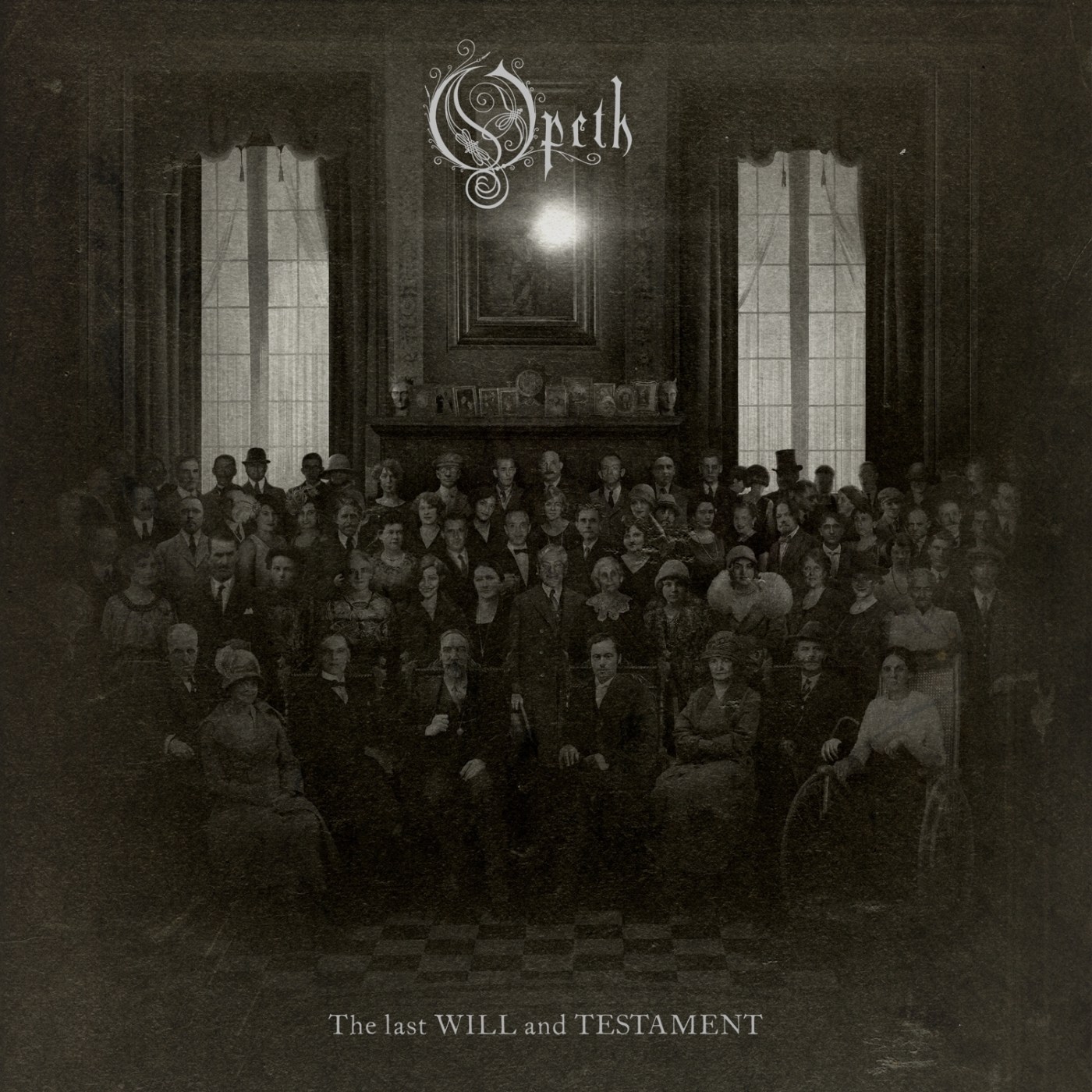
The Last Will And Testament is Opeth’s 14th studio album.
Founded in 1990, Sweden’s Opeth is one of the most important prog-metal bands of all time. Guitarist/vocalist Mikael Åkerfeldt’s groundbreaking insight was to combine elements of extreme metal, especially death metal, with progressive rock. Åkerfeldt’s influences came equally from prog bands like Genesis, Jethro Tull and Camel, but also from heavy metal bands like Iron Maiden, Black Sabbath and Slayer, and eventually from the mid-80s death metal scene.
One of the key characteristics of progressive rock is the dynamics between the soft/quiet and the harsh/loud sections. Opeth took this to extremes as the band could go from frenetic double bass rumbling and brutal growling vocal sections to feather-light passages carried by acoustic guitars and vocals sung in a pure, clear voice in an instant. This gimmick was potentially surprising and very effective, although it was slowly becoming a cliché in Opeth’s hands. However, albums such as Blackwater Park and Ghost Reveries, for the most part, made effective use of this trick and Opeth’s extreme use of the old method was undoubtedly a progressive move.

After 2008’s Watershed, Åkerfeldt declared that he was fed up with metal and said the band would next change direction in a radical way. It was a bit of a surprise when Heritage finally came out that Opeth’s new line-up offered a relatively stale retro rock. Released in 2011, Heritage, followed by Pale Communion and Sorceress, sounded more like a mix of old-fashioned progressive rock and 70s heroic 70s hard rock with a touch of folk music. Personally, this kind of toothless fusion of old heavy rock and prog didn’t really excite me, although I have to admit that the quality of Opeth’s music never really collapsed completely. It just became uninteresting. The culmination of this development was In Cauda Venenum (2019), which had the ”innovation” of releasing the same music in English and Swedish. Unfortunately, the music on this album was exhaustingly boring regardless of the language of the songs. At this point I had already jumped off the bandwagon myself; I had bought the previous albums out of habit, but In Cauda Venenum remained on the store shelf. My relationship with Opeth was coming to an end.
I think Åkerfeldt had similar ideas. The break between In Cauda Venenum and The Last Will And Testament stretched over five years. This is the longest gap between two Opeth albums in the band’s history. It’s anyone’s guess, but I think Åkerfeldt himself realised that it was time to recharge the batteries and think about a new direction for the band.
Read also
- Review: Cos – Viva Boma (1976)
- Levyarvio: King Crimson – The ConstruKction Of Light (2000)
- Review: Camel – Moonmadness (1976)
- Review: Gong – Gazeuse! (1976)
- Review: Mike Johnson – The Gardens Of Loss (2026)
- Levyarvio: Mike Johnson – The Gardens Of Loss (2026)
- Levyarvio: Led Zeppelin – Presence (1976)
- Vuosi vuodelta : Parhaat levyt 2000 – Sijat 11-20
- Review: Univers Zero – Ceux Du Dehors (1981)
When Åkerfeldt finally told me that a new album was in the works and that the cookie monster vocals would be making a comeback, my first reaction was amusement. I’m not a big fan of growled vocals and they sound mostly comical to me. The most amusing thing about Åkerfeldt’s announcement, however, was that it seemed, at least on the surface, that he was finally giving in to a vocal sector of the band’s metal fans who had been quite hostile to the new style (unlike me… my own reaction was merely apathetic!). So my expectations were not very high for The Last Will And Testament.
So I am happy to say that I was wrong. Very wrong. The Last Will And Testament is a very strong album and showcases a re-energised Opeth.
So the growling is back and the overall feel of the music is also a little more metal than Opeth fans have become accustomed to over the last decade or so. However,The Last Will And Testament is not a direct return to the ”golden age” of Blackwater Park, but more a case of Opeth bringing back some of the stylistic elements of those days, while retaining the folk, jazz, hard rock and of course classic progressive rock influences that came with Heritage and subsequent albums. Indeed, The Last Will And Testament is Opeth’s most eclectic album to date, so freely does it make use of different genres. And what is essential is that it all happens with a relaxed naturalness. The growling vocals are back, but more importantly, the band is once again able to exploit extreme contrasts to their full potential, moving from brutal metallic episodes to a more laid-back and traditional prog sound in an instant. These transitions also happen more naturally than before and seem to be backed up by stronger arguments in terms of the narrative of the story.
Speaking of narrative. The Last Will And Testament is Opeth’s first concept album since Still Life (1999). At the time of writing, I’m not very familiar with the lyrics, but the theme of the album is set in the period of the First World War and deals with the malevolent will of the patriarch of a wealthy industrial family. Indeed, all the songs on the album, with the exception of one, are named simply by a number and a paragraph mark, i.e. ’§1’, ’§2’, ’§2’, etc. The songs on the album are therefore like different parts of the will. The concept makes Åkerfeldt’s approach to singing more theatrical than before, at times clearly inhabiting the style of the various characters in the story. I’m no expert on growling, but on this album Åkerfeldt’s growls blend in with the clear vocals more naturally than ever before, and although they still amuse me in a way, they appear to function as an operatic element on the album. Alongside the operatic growling bass and Åkerfeldt’s natural tenor, one also hears the background vocals of Joey Tempest , familiar from Europe, in one song, but more significantly Ian Anderson’s narrative voice here and there throughout the album. In three songs, the Jethro Tull legend, who also plays the flute delightfully, gets the honour of channeling the demonic patriarch’s dlalogue directly. Usually such speech roles get boring after several listens, but Anderson’s babbling has been mixed deep enough into the middle of the music that remains active enough in those parts anyway.
And the music is indeed active! The relatively short songs, 5-7 minutes long, are really packed with stuff. The music is fast paced, intense and constantly changing shape. One key difference from the old stuff is that the compositions this time around lack a certain stoner feel that has usually been a key part of Opeth’s DNA. Now, instead of getting stuck on one theme or riff for a long time, new ones are served up at a constant, frenetic pace. The solution works perfectly. And although the songs are short, it’s more or less a coherent long whole with the next song often picking up seamlessly where the previous one left off. Again, along with the enthusiastic Opeth, other musical elements can also be heard. I’ve already mentioned Ian Anderson’s flute, but a piquant addition is Mia Westlund’s harp, which plays beautifully in a few of the album’s rare slow moments. Also playing an important role are the excellent string arrangements by Canterbury legend Dave Stewart, which blend in perfectly with the rest of the instrumentation, sometimes even taking on a more prominent role.
Read also: Sleepytime Gorilla Museum – Of The Last Human Being (2024)
Opeth’s line-up has remained unchanged since Heritage, but now with a new drummer. Waltteri Väyrynen , the Finnish drummer who previously played in Paradise Lost ( 🇫🇮), makes his debut as Opeth’s drummer on the album, replacing Martin Axenrot, who left the band in 2021. Väyrynen, who is much younger than the other Opeth members, does an excellent job bringing a new energy to the band’s playing. Väyrynen plays his technically challenging parts with a natural feel and doesn’t have the mechanical approach often typical of metal drummers, but despite the complexity of his playing he even makes it groovy to a certain extent. And even though the growled vocals are back and the music has a slightly more metallic sound again, Väyrynen has not been made to play fancy, mechanical-sounding double bass lines that would drown out Martín Méndez’s tasty bass lines. Väyrynen’s drum sounds are also excellent. Part of the credit for this must also go to the album’s excellent production. The sounds are massively brassy, but not too heavy and there is no concern for over-compression either. Opeth have never before had such good sounds as on The Last Will And Testament. This is a particular relief after the rather muffled sounds of Sorceress and In Cauda Venenum.
I don’t know if this is just initial excitement, but at the moment The Last Will And Testament seems to be Opeth’s strongest album. The song material is strong throughout (I’m not particularly keen on the album-closing ballad ”A Story Never Told”, though) and what’s most pleasing is that Opeth, who usually make albums that are almost invariably overlong, have had the courage to keep the duration relatively tight at 51 minutes this time.
The Last Will And Testament is an extremely natural combination of metal and prog. It feels as if it is the culmination of an entire career to date, drawing on the band’s entire history with a confident grasp. And at the same time still managing to sound fresh. Not an obvious feat for a band over 30 years old.
Opeth’s decade-long dabbling in stale retro is over. Welcome back.
Best tracks: ”§1”, ”§2”, ”§4”, ”§6”
Author: JANNE YLIRUUSI
Tracks
- ”§1” 5:56
- ”§2” 5:33
- ”§3” 5:10
- ”§4” 7:00
- ”§5” 7:29
- ”§6” 6:03
- ”§7” 6:30
- ”A Story Never Told” 7:11
Opeth
Mikael Åkerfeldt: guitars, solo and backing vocals, cittra, Mellotrons, percussion and FX Martín Méndez: bass, backing vocals Fredrik Åkesson: guitars, backing vocals Joakim Svalberg: piano, Hammond organ, Mellotrons, Fender Rhodes & Moogs, backing vocals and FX Waltteri Väyrynen: drums, percussion
Guests
Ian Anderson: flute (§4, §7, A Story Never Told), spoken word (§1, §2, §4 and §7) Joey Tempest: backing vocals (§2) Mia Westlund: harp Mirjam Åkerfeldt: spoken word (§1) London Session Orchestra: strings Dave Stewart: string arrangements.
 Pienemmät Purot
Jätä kommentti