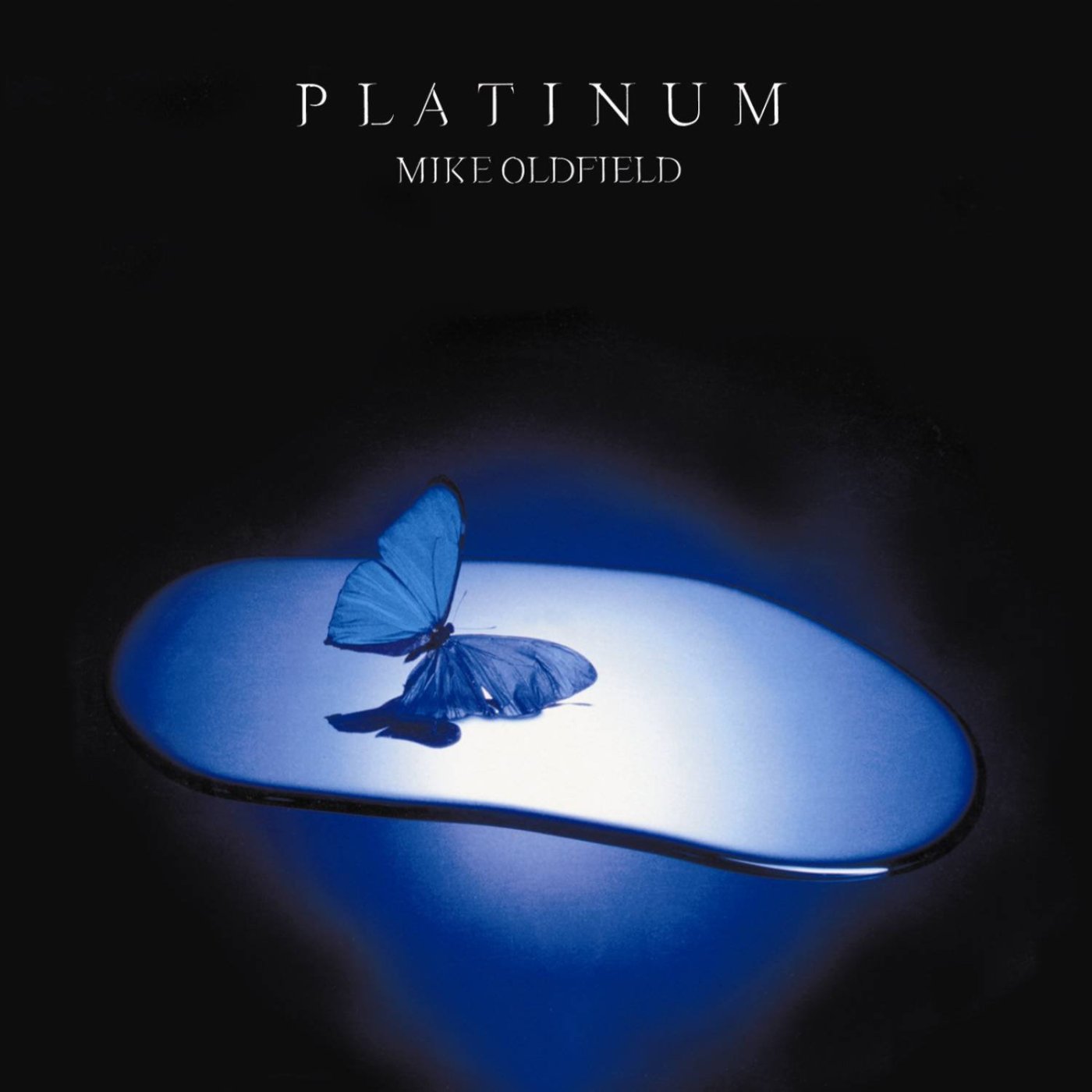
Platinum is Mike Oldfield’s fifth studio album.
Multi-instrumentalist Mike Oldfield, who shot to world fame six years earlier with Tubular Bells in 1979, was a man reborn. And this is not just a figure of speech on my part, Oldfield really felt reborn during the Exegesis seminar in the middle of recording Incantations. Exegesis, defined as an aggressive shock therapy, changed Oldfield’s personality in a significant way. From an angst-ridden introvert, he became an outgoing raconteur who could give interviews all day long and was finally ready to perform live on concert stages.
After Incantations, Oldfield went on tour in grand style. The 50 person strong tour resulted in the excellent live album Exposed and a debt of half a million pounds. In the middle of the tour, Oldfield also travelled to New York to Electric Ladyland Studios and recorded the single ”Guilty” with local studio musicians. Like Incantations, ”Guilty” was based on the use of circle of fifths, but this time with a strong disco twist. Oldfield used the song, which became a minor single hit, as a production exercise, and part of the exercise included working with actual studio musicians for the first time. ”Guilty” became a minor hit and the production exercise proved a success and Oldfield returned to Electric Ladyland to make a Platinum album. In his own words, Oldfield amazed the studio staff by his skill in operating all the studio equipment. The years of home study and the do-it-yourself attitude had paid off. However, Oldfield was supported in his US sessions by top sound engineer Kurt Munkacsi , who had worked extensively with composer Philip Glass.
Platinum is a kind of transition album for Oldfield. It is a clear departure from his previous albums. The music is more playful, lighter and much less serious. The angst that characterised Hergest Ridge and Ommadawn particular is completely absent. And after the artistic Incantations, Platinum is a downright entertaining album. On the other hand, despite the constant experiments with new genres, it sounds like Oldfield music.
Platinum is Oldfield’s first album to abandon the song-per-album format and include shorter songs. The A-side, however, consists to some extent of the familiar 20-minute title track. This time, however, the long whole is divided into four parts and is really more of a suite of four separate songs than a fully coherent epic. The ”Platinum” suite has some family resemblance to Incantations, but with much more pop/rock influences with a touch of jazz and even disco mixed in for good measure. It all works astonishingly well.
Read also: Mike Oldfield – Discovery (1984)
Platinum Part One: Airborne
The ”Platinum” suite gets off to an efficient start. Opening with a pumping synthesizer ostinato and an electric guitar snaking around it, ”Airborne” is the closest thing to jazz-rock Oldfield had done so far in his career (if you forget Oldfield’s appearance on Gong’s Downwind album that year). The song also showcases Platinum’s new airy and snappy sound. The soundscape is simpler and brighter than on Oldfield’s previous albums. The instrumentation relies mainly on synthesizer (playing a larger role than ever before on Oldfield’s albums), bass, drums and guitars. Throughout the album, however, there are also various wind instruments and percussion here and there. ”Towards the end of ’Airborne’, vibraphones played by Pierre Moerlen come in to play a cyclical repetitive pattern, bringing with them clear Incantations allusions.
Platinum Part Two: Platinum
The title track of the ”Platinum” suite continues quite naturally in ”Airborne”. ”Airborne’s” more flighty feel, however, gives way to a pounding 6/8 rhythm, but it’s counterbalanced by some supple guitar work from Oldfield with his tense trademark sound. The first half of the six-minute section is mostly just a backing track for Oldfield’s tasty guitar soloing. Halfway through, the music becomes a little more varied, the bass patterns come to life, with horn section hits and fun duu-daa-dam-dubbi-daa vocalizations that sound particularly successful when listening to the album on headphones (”Platinum is recorded beautifully!). The section is brought to a close with a nice guitar solo and horn blasts.
The 2012 deluxe edition features an alternate studio live version of the song which is a much more raucous and funkier jam than the one that ended up on the album, featuring some really great fretless bass playing from the studio ace Neil Jason.
Platinum Part Three: Charleston
”Charleston” starts with a tightly sounding and heavily compressed horn section with a joyfully bouncing synthetic bass in the background. The piano plays a hypnotic and spiralling arpeggio and Oldfield’s acoustic guitar joins in the fun. Ghostly female vocals and close-miked duddi-dabbi vocalizations create a peculiar and slightly contradictory atmosphere. ”Charleston” refers to a popular 1920s dance of the same name in which syncopation plays a significant role. Syncopated rhythms are a completely new element in Oldfield’s music and radically change the atmosphere. From the misty and serene moors to the clubs and dance floors of a bustling metropolis. The powerful horn sections of ”Platinum” are arranged by Michael Riesmann, who has had a long career as arranger and musical director of the Philip Glass Ensemble. Another Glass connection! Oldfield also met Glass around this time in New York when the maestro of minimalism came to check out an Oldfield concert. What did Glass think of Oldfield’s concert? That, unfortunately, I have never found out.

Philip Glass, Peter Baumann (Tangerine Dream) and Mike Oldfield having fun after the concert. Happy chaps!
Platinum Part Four: North Star/Platinum Finale
The last part of ”Platinum” contains a heart-wrenchingly beautiful melody which he plays first on acoustic guitar and then switches to electric guitar. A simple but tight and downright minimalist groove pulsates in the background. At the three-minute mark, a choir joins in, vocalising wordlessly on a theme borrowed from Philip Glass’s ”North Star”. Oldfield’s guitar solo increases in intensity and the song is brought to a stirring finale as the music suddenly dies down, leaving the choir alone to sigh for a moment. A very handsome end to the ”Platinum” suite.
The ”Platinum” suite is a really interesting reinterpretation of the instrumental style of Oldfield’s earlier albums. It’s a much brighter and happier piece of music with a more rocking edge, and the pastoral touch of Oldfield’s earlier albums is replaced by a metropolitan pulse with hints of jazz-rock and even disco. Platinum may not be a musical masterpiece, but it’s still a really fascinating experiment by Oldfield and a testament to the courage and skill with which he tried new things.
It’s interesting that after Incantations Oldfield could well have turned in the direction of serious minimalist art music, but he eventually turned in a much lighter direction for Platinum, still flirting with that trend.
The A-side of Platinum is quite high quality thanks to a successful suite, but unfortunately the second half of the album is more uneven.
Woodhenge
The B-side, however, starts very interestingly with the four-minute instrumental ”Woodhenge”, which is a completely different story from the snappy rhythm of the ”Platinum” suite. ”Woodhenge” is an earlier composition and dates from 1976, I believe. It may even have been recorded then. The elastically surging ”Woodhenge” is a kind of very quiet and curious avant-garde pagan ambience. The song makes extensive use of various buzzing and rumbling percussions and the overall sound is very peculiar. The only clear reference point that comes to mind is some of Jade Warrior’s songs. A very interesting experiment and a possible direction that Oldfield never really delved deeper into. Perhaps the most avant-garde tracks on the The Killing Fields (1984) soundtrack are somewhat related to ”Woodhenge”, but the execution is very different in all its electronics.
Into Wonderland (Sally)
The next track onPlatinum is a bit of an oddity because, depending on the edition of the album, it features two completely different tracks. Originally, Oldfield planned a humorous ode to his then girlfriend Sally Cooper and the song was called ”Sally”, of course. However, Virgin boss Richard Branson disliked the song and blocked it from being included on the album. The 30 000 copies with ”Sally” somehow made it to the shops somehow anyway. And strangely enough, even though the song was replaced by a new song ”Into Wonderland” for the next vinyl edition, the name ”Sally” still haunted CD covers. This was only replaced on the cover of the 2012 deluxe edition.
The original ”Sally” is a strange, slightly new-wave whimsy with monotone effected vocals and the omission of the song was no great loss to Platinum. ”Sally” also had the same musical ingredients as the next song ”Punkadiddle” and in fact the outro of ”Sally” was eventually cut into the intro of ”Punkadiddle”. So if something positive should be said about ”Sally” it may be that with it the flow of the B-side of the album would have been a bit more natural.
”Into Wonderland”, which eventually replaced ”Sally” on the album, is a playful song in which the dubbadubba vocalizations of the ”Platinum” suite make a comeback, although Wendy Robertson’ s soulful vocal performance takes the lead. The song also features an upbeat synthesizer solo with slightly comical sounds. It’s a little odd that Oldfield uses synthesizers throughout Platinum to bring an explicitly humorous mood. Sometimes this works, often it doesn’t. ”Into Wonderland” beats ”Sally” (the label was right for once?), but it’s still not much of a song.
Punkadiddle
Punkadiddle’s upbeat intro (which was originally part of the song ”Sally”) lasts just under a minute and is great, but then the song starts to stagnate with a simple rhythm and the synthesizers playing a slightly childish-sounding comic (again!) melody. ”Punkadiddle” has been called Oldfield’s punk parody, but I’ve never quite figured out what this is based on. There is a simple and repetitive rhythmic pedal, but it still doesn’t sound punk at all. At least ”Punkadiddle” worked a little better live, but this studio version is easily Platinum’s weakest offering.
I Got Rhythm
Platinum ends with a cover version of George and Ira Gershwin’s classic ”I Got Rhythm”. Oldfield slows this 1930s jazz standard into a languid ballad. The song begins with a low key. Roberts’ vocals are accompanied only by a subdued and simplistic electric piano until the drums and synthesizer come in after a minute or two and Oldfield’s beautiful acoustic guitar brings the song to its midpoint. Roberts sings an emphatic chorus and Oldfield’s electric guitar plays an octave rising pattern at the end of which his then-girlfriend Cooper gets the honour of bringing the song to its final climax by ringing tubular bells. ”I Got Rhythm” is a great song and a successful version of Gerswin’s original composition and something quite unexpected from Oldfield at this stage.
Read also: Mike Oldfield – The Songs Of Distant Earth (1994)
As I mentioned a few times in the text, Platinum was released in 2012 as a double-disc extended edition with a few interesting bonus tracks, but most pleasantly, over 70 minutes of excellent live material from May 1980. Included is the complete ”Platinum” suite.
Platinum is a rather strange entity. If it can even be called a whole, as it moves in so many different directions. On the other hand, all the songs (with the possible exception of ”Woodhenge”) have certain stylistic similarities that pull the somewhat fragile whole together. Where Oldfield’s previous albums were clearly reaching somewhere high and at their best manage to be, in all their intimacy, a truly shattering art form, Platinum’s goal is a little lower. The feeling is that Oldfield’s aim on Platinum was to try new things, to develop himself as a musician and above all to have fun and hopefully entertain his listeners in the process. And yes, Platinum succeeds in that, at least for me. Platinum is not a great work of art or an important album in the progressive music canon or even in Oldfield’s own catalogue, but it is a damn entertaining and well-executed experiment.
Best tracks: ”Platinum”, ”Woodhenge”, I Got Rhythm”
Author: JANNE YLIRUUSI
Tracks
Side A
- ”Platinum Part One: Airborne” – 4:59
- ”Platinum Part Two: Platinum” – 4:36
- ”Platinum Part Three: Charleston” – 3:11
- ”Platinum Part Four: North Star/Platinum Finale” – 4:36
Side B
- ”Woodhenge” – 4:05
- ”Into Wonderland” – 3:36
- ”Punkadiddle” – 5:39
- ”I Got Rhythm” – 4:35
Musicians:
Mike Oldfield: acoustic guitars, electric guitars, marimba, piano, synthesizers, vibraphone, vocals Francisco Centeno: bass guitar Hansford Rowe: bass guitar Neil Jason: bass guitar Nico Ramsden: keyboards Peter Lemer: keyboards Sally Cooper: Demelza: congas Pierre Moerlen: drums, vibraphone Morris Pert: drums Allan Schwartzberg: drums Wendy Roberts: vocals David Bedford: vocal arrangements Peter Gordon: brass arrangements Michael Riesman: brass arrangements
Producer: Tom Newman
Label: Virgin

 Pienemmät Purot
Jätä kommentti