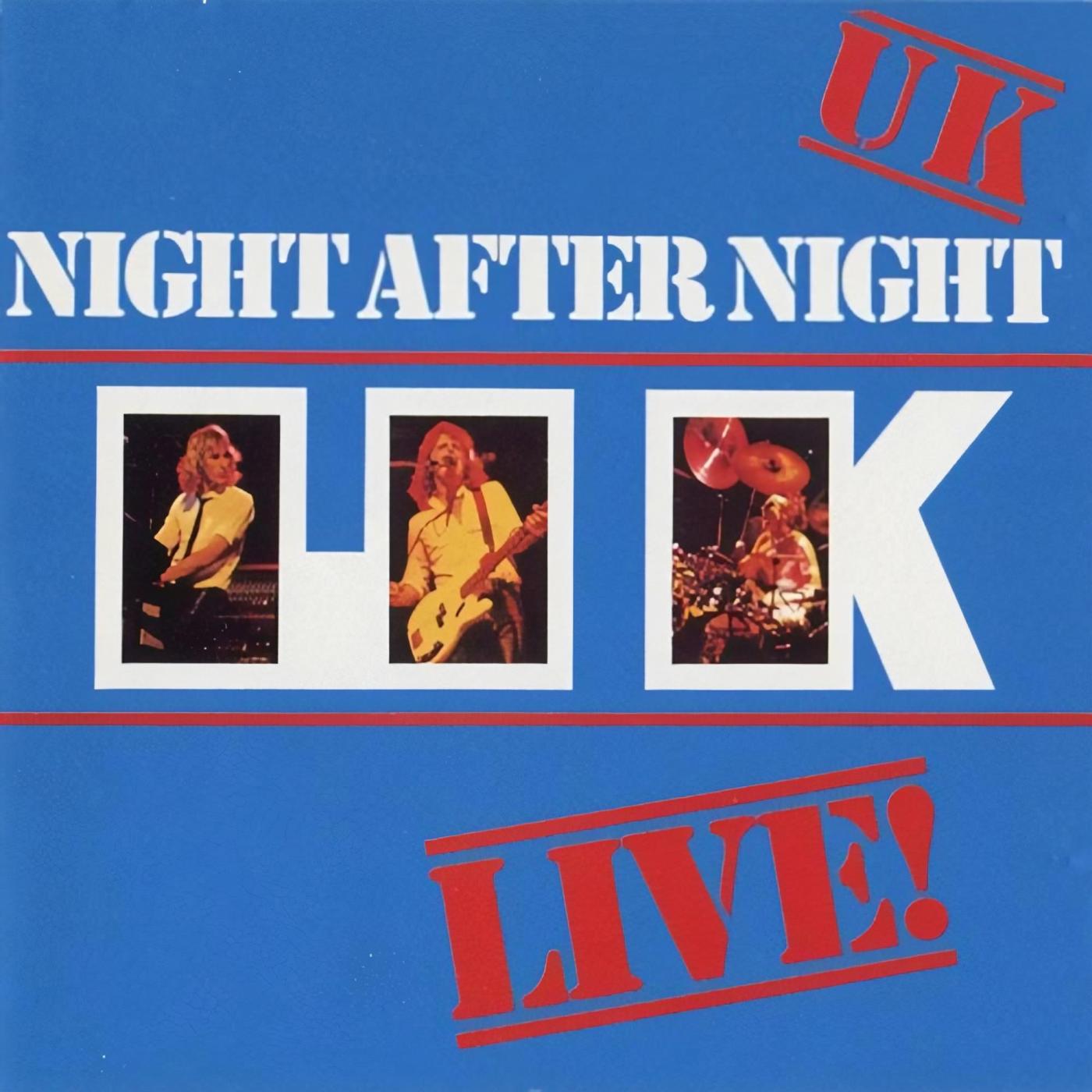
Night After Night is the first live album by U.K., formed in 1977.
U.K. became a trio after a tour celebrating the band’s debut album when drummer Bill Bruford and guitarist Allan Holdsworth left the band due to artistic differences. This slowed U.K.’s momentum surprisingly little as bassist/vocalist John Wetton and keyboardist/violinist Eddie Jobson with new drummer Terry Bozzio succeeded beyond expectations with their studio album Danger Money, released in March 1979. Danger Money abandoned much of the jazz-rock influences of the first album in favour of more ELP-inspired symphonic prog. In a way, Danger Money moved the band in a safer and more traditional direction, but on its own terms it is an excellent album.
Soon after Danger Money, the new trio U.K. headed out on tour. Night After Night was recorded in the summer of 1979 in Japan midway through the tour. Live recordings were very popular in Japan at the time and the idea for a concert album came directly from U.K.’s Japanese label. The original plan was to release it only in Japan, but in the end the album was so good that it got a global release. Night After Night was finally released in September 1979, just six months after Danger Money.
What makes Night After Night particularly interesting as a live album, apart from its general quality, is that it contains two brand new U.K. compositions that were never recorded for studio albums. These new tracks, ”Night After Night” and ”As Long As You Want Me Here”, take U.K. music in a decidedly more straightforward direction. Although Night After Night is definitely mostly progressive rock, there are exciting side flavours of AOR and even new wave creeping into the arrangements of the new songs and to some extent the old ones. U.K.’s energetic combination of old-school prog and these new influences was pretty much in the same vein as Yes’s Drama album the following year. It would have been extremely interesting to hear the third U.K. studio album, directed by Trevor Horn, who was in Yes at the time and just starting his career as a producer.
Night After Night is a strong display of Jobson, Wetton and Bozzio’s 70s live performance. The band had lost two highly distinctive virtuosos in Bruford and Holdsworth, but they will not be missed when listening to Night After Night. What is particularly striking is how well Jobson manages to fill the gap left by Holdsworth with his keyboards and violin. Jobson’s synthesizers sound thunderously lush throughout the album and the coldness that plagued his sounds on the first album is completely gone. Jobson was one of the most accomplished musicians of the original progressive rock and Night After Night is, if anything, one of the most significant testaments to this claim.
Wetton is also on a roll. He is probably at the peak of his bass skills by this time and his bass guitar takes on a much bigger role than on the debut album in Holdsworth’s absence. It also growls in places with almost as much power as it did in King Crimson. Wetton sings powerfully throughout the album and his development as a vocalist over the years is well illustrated by the fact that he sings better on this live album than on the first U.K. studio album.
Bozzio does his job confidently, playing the songs with a more robust approach than Bruford, but not really slacking on the details. Later in his career Bozzio became quite an innovative drummer with his massive drum kit, but on Night After Night he still seems to be ”just” a damn good musician who gets the job done and that’s that.
Night After Night is crowned with excellent sounds. They are tight, yet distinctive. Rumour has it that Night After Night underwent quite a lot of post-production work in the studio, as had become the norm for live albums in the late 70s. The listening experience is not affected by this, at least in my case, because the sound is intensely energetic all the time and it’s only in some vocal parts that I wonder if this could really sound this good.
Read also: Review: Emerson Lake & Palmer – Trilogy (1972)
Night After Night
Night After Night kicks off with the staccato title track, the first of two new songs on the album. ”Night After Night” features a great organ solo from Jobson and although it’s quite simple for a U.K. song it contains enough progressive elements to remain an interesting power trio remix until the end. ”Night After Night” is yet another good example that a prog song can also rock.
I’ve seen claims that ”Night After Night” was recorded entirely in the studio and perhaps intended as a single for the band’s next album, but I can’t confirm this because it blends so well with the rest of the material on the album.
Rendezvous 6:02
”Night After Night” is followed by a strong and very faithful interpretation of one of Danger Money’s best songs, the melancholic ”Rendezvous 6:02:02”. Wetton’s vocals are perhaps at their best on this emotional highlight of the album and Jobson’s electric piano licks and stinging synthesizer blasts are great to hear.
Nothing To Lose
The next track ”Nothing To Lose”, on the other hand, takes a bit more liberties compared to the studio version. With ”Nothing To Lose” U.K. turned for the first time to more straightforward music, and prog fans often scorn it as a foreshadowing of Wetton’s AOR band Asia already on the horizon, but I think it’s a really effective song and oh how the Jobson synths are so brilliantly thick in the (admittedly too short) intro! The instrumental interlude that first brings Wetton’s bass to centre stage and then moves into Jobson’s snappy violin solo is also effective.
As Long As You Want Me Here
”Nothing To Lose” continues in a more upbeat direction. ”As Long As You Want Me Here” was Wetton’s new composition that takes U.K.’s music too close to the AOR-softness of the Asian AOR of the future. The song was a clear sign that Wetton and Jobson’s views on the band’s style no longer really coincided. Jobson wanted to play progressive rock and Wetton’s preferences were increasingly moving towards simpler vocal-driven pop-rock. ”As Long As You Want Me Here” is in itself a decent AOR rally, even if the grinding chorus gets boring quickly, and would have been right at home on Asia’s first couple of albums. It doesn’t really feel like U.K. music, though. The backing vocal harmonies of the song also make you wonder if they really sounded as good in concert or if they were reworked in the studio afterwards.
Alaska/Time To Kill
Fortunately, the next ”Alaska/Time To Kill” pairing raises the level considerably. The instrumental ”Alaska” is the first song from U.K.’s debut album to be heard on Night After Night. ”Alaska” begins with Jobson’s jangly synth intro before the rhythm section kicks in and the rest of the song is pushed through at a furious, much faster than the studio version, tempo that is quite impressive to listen to. Curiously, on the CD, part of ”Alaska” is indexed as belonging to ”Time To Kill”. ”Time To Kill” plays effectively including Jobson’s violin solo and a delightfully gruff sounding synthesizer torture. I’d argue that this energetic and faster tempo ”Alaska/Time To Kill” combination beats the studio version hands down.
Presto Vivace / In The Dead Of Night
The rhythmically super-complex and fast ”Presto Vivace” is also confidently rolled through, before moving on to the band’s trademark song ”In The Dead Of Night”. The highlight of the song is Jobson’s futuristic-sounding synth solo which shows how much his sound had improved in the last couple of years.
It’s interesting to note that at no point on the album do you miss Holdsworth’s guitar. So virtuosic is Jobson with his violin and synthesizers, filling in the gaps left by Holdsworth. Jobson’s violently effected violin solo towards the end of the song is particularly spectacular. Wetton also makes his contribution to the situation with his bass guitar playing much more aggressively and with more surface than on the studio version. Of course, Jobson and Wetton have cleverly chosen the music on the album to be mostly where Holdsworth’s role was at its lowest.
Caesar’s Palace Blues
The album closes with a furiously fast-paced rendition of ”Caesar’s Palace Blues” which was one of the highlights of Danger Money. Bozzio’s sizzling, jerky drumming is powerful, but Jobson’s back-and-forth transitions from violin (sometimes strumming like a pizzicato, sometimes whirring with a bow) to keyboards and the skill with which he handles both is even more impressive. The man’s virtuosity is head-spinning! Jobson was definitely on the same level as Keith Emerson, Rick Wakeman or Patrick Moraz. And as a violinist, the aforementioned three would hardly be a match for Jobson… A truly remarkable and unique musician. I myself had the pleasure of seeing U.K. live in Holland in 2012 and Jobson, even in his old age, hadn’t lost an ounce of his skills.
Read also: Review: King Crimson – Starless and Bible Black (1974)
Night After Night was expanded into an Extended Edition with the Ultimate Collector’s Edition U.K. box set originally released in 2016, and in 2019 it was also released in its own different packaging. The Extended Edition more than doubles (from 42 minutes to 96 minutes) the amount of music, restoring the tracks to their correct concert order. The Extended Edition’s additional material includes relatively entertaining solos from each band member, but most importantly excellent versions of songs such as ”Carrying No Cross”, ”Danger Money”, ”Thirty Years” and ”The Only Thing She Needs”. Night After Night definitely deserved at least a double vinyl release in due course, but better late than never.
Night After Night shows that U.K. was in incredible live form in 1979, but unfortunately the album remained the band’s swan song as Jobson and Wetton’s musical differences could not be resolved. Both men headed for solo careers, although Jobson was briefly lured into visiting Jethro Tull before that. In the 80s Jobson turned his attention to composing prolifically for TV series and commercials, while Wetton formed the AOR supergroup Asia, which briefly became very popular. Immediately after the break-up of U.K., Bozzio founded the new wave band Missing Persons. It’s a shame that none of the trio made any more notable progressive rock recordings after Night After Night. In the 2000s, U.K. returned with a slightly varied line-up for a few tours, but no new studio album from the band.
U.K. would have had the potential to make loads of great prog albums in the 80’s, but the band’s career was ultimately limited to two great studio albums and this Night After Night live album which is definitely among the elite of 70’s live albums.
Best tracks: ”Night After Night”, ”Rendezvous 6:02”, ”Alaska”
Author: JANNE YLIRUUSI
Tracks
Side A
- ”Night After Night” 5:21
- ”Rendezvous 6:02” 5:17
- ”Nothing to Lose” 5:25
- ”As Long As You Want Me Here” 5:00
Side B
- ”Alaska” 2:25
- ”Time to Kill” 4:17
- ”Presto Vivace” 1:12
- ”In the Dead of Night” 6:22
- ”Caesar’s Palace Blues” 4:58
U.K.:
Eddie Jobson: keyboards, electric violin, electronics John Wetton: bass guitar, vocals Terry Bozzio: drums
 Pienemmät Purot
Jätä kommentti