Trilogy is Emerson, Lake & Palmer’s third studio album and follows the previous year’s live album Pictures At An Exhibition, which contained only new material (partly based on compositions by Modest Mussorgsky). ELP’s career up to that point had been a success, both artistically and commercially, and Trilogy did not cause a dip in the band’s upward trajectory.
Trilogy is a slightly more serene and romantic (I’m referring mainly to the classical music era) album than its predecessors. The album does not contain quite as many high peaks as the previous albums, but on the other hand, in all its evenness, Trilogy also avoids the real ups and downs that the band had occasionally fallen into in the past.
Almost all the music in Trilogy is composed by Keith Emerson. The exceptions are ”Living Sin”, co-written by the trio, Greg Lake’s ”From The Beginning” and an interpretation of Aaron Copland’s ”Hoedown”.
”Living Sin” is a darkly-tinged rock song with elements of classical music and blues. The song has an absolutely gorgeous dirty Hammond sound! ”
Lake’s own light and easy-going ”From The Beginning” is perhaps the finest ”folk ballad” he has composed for ELP. Slightly reminiscent of ”Lucky Man” (but surpassing it!), the song has a pleasantly swaying rhythm that suggests something along the lines of bossa nova. If any song can be described simply as ”pleasant”, this is it. ”From The Beginning” was a minor hit in America, peaking at #39 on the charts, which is ELP’s best ranking on the singles charts overseas.
The material on Trilogy is strong throughout and even the obligatory joke track on the album, ”The Sheriff”, a humorous tune with barroom piano, is probably ELP’s best song in this series. ”After ’The Sheriff’, ELP linger on the western atmosphere for another track, arranging a piece from the ballet ”Rodeo” by the American composer Copland (1900-1991). ELP’s version of ”Hoedown” is a very successful interpretation. The original Copland song (which is itself an arrangement of American folk music) is recognisable, but ELP’s typically frenetic forward thrusting version is still very much its own. You could call it a very idiosyncratic take on electronic bluegrass music. The overlaid synth swirls at the end of the song are a stunning listen and Emerson’s partly otherworldly, but not too over-the-top sounds are really creatively constructed. At this point, Emerson had not only a giant modular Moog, but also a Mini-Moog, and Emerson created more impressive and exotic sounds from his Moogs on ’Trilogy’ than on previous albums.

However, Emerson did not limit himself to using only synthesizers on the album, but in addition to Hammond organs, the grand piano plays a central role on the album. Perhaps even more than ever before on an ELP album. Throughout the album you can hear some truly virtuosic piano playing from Emerson. The best example is the title track ”Trilogy” with its truly expressive playing that effortlessly jumps from subtle atmospherics to intense percussive rhythms. ”Trilogy” also features the most impressive collaborative playing from the whole band on the album and the massive sounding instrumental section at around three and four minutes is really impressive with Palmer and Lake’s playing intensely in the background as Emerson wails furiously on his Moog. Emerson perhaps indulges in a bit too long a solo, but it’s still a damn entertaining listen!
Along with ”Trilogy”, the opening three-part suite ”The Endless Enigma”, lasting just over 10 minutes, is also one of the album’s highlights. After an atmospheric and slightly cinematic tension building piano intro (the music is easily imaginable in a Alfred Hitchcock film), we move into a toccata-like section led by Emerson’s Hammond growls and Greg Lake takes the lead, singing with a familiar majesty. Lake’s voice sounds interestingly emotionally distant and more than a little arrogant. The effect is excellent and works perfectly with the lyrics where some kind of god-like figure seems to frantically beckon his followers. In between we hear a clever instrumental fugue section (”Fugue”) with counterpoints that starts the delicate piano playing and returns to the actual theme (”The Endless Enigma Part 2”) which this time plays triumphantly and more elaborately than before with numerous changes of time signature. In the last part we also hear for the first time Emerson’s legendary Moog ”trumpet” sound which would later play an important role on Brain Salad Surgery. ”The Endless Enigma” suite is a stunning piece of work that manages to combine sensitivity and grandeur with seamless skill.
One of the production and arrangement differences between Trilogy and ELP’s previous albums is that it contains considerably more overdubbing than on previous albums, which is why the more complex songs on the album were not played very often live because the hands of the three musicians were simply not enough.

Of course, the most obvious example of overdubbing is heard in the album-closing ”Abbaddon’s Bolero”. The 8-minute composition repeats a complex long melody which is then gradually built up in the spirit of Maurice Ravel’s (1875-1937) Bolero (1928), adding new instruments while increasing the volume and tempo. In the background, Palmer’s insistent march-like bolero rhythm (albeit in 4/4 time signature rather than 3/4 as is usual for boleros) beats insistently in the background. The piece builds skilfully and by the end the intensity is immense.
”Abbaddon’s Bolero” is a very unusual ELP song and often divides the band’s fans. Personally, I’m a bit torn. In the right mood, the song’s restrained, patient build-up of intensity is very satisfying to listen to, but at times when you just want to hear more typical ELP racket, the song feels a bit dull. However, ”Abbaddon’s Bolero” is a respectable departure. ELP tried to perform it live a few times with the help of backing tapes and the Mellotron (an instrument Emerson hated) played by Lake, but with rather unsatisfactory results. The song did not return to the band’s live set until a infamous tour with a symphony orchestra in the 70s. Somewhat paradoxically, however, when played with the symphony orchestra, the song lost its charm, which was largely based on the sound colours created by Emerson on the Moogs. Played by the symphony orchestra, the piece sounded somehow more conventional and boring.
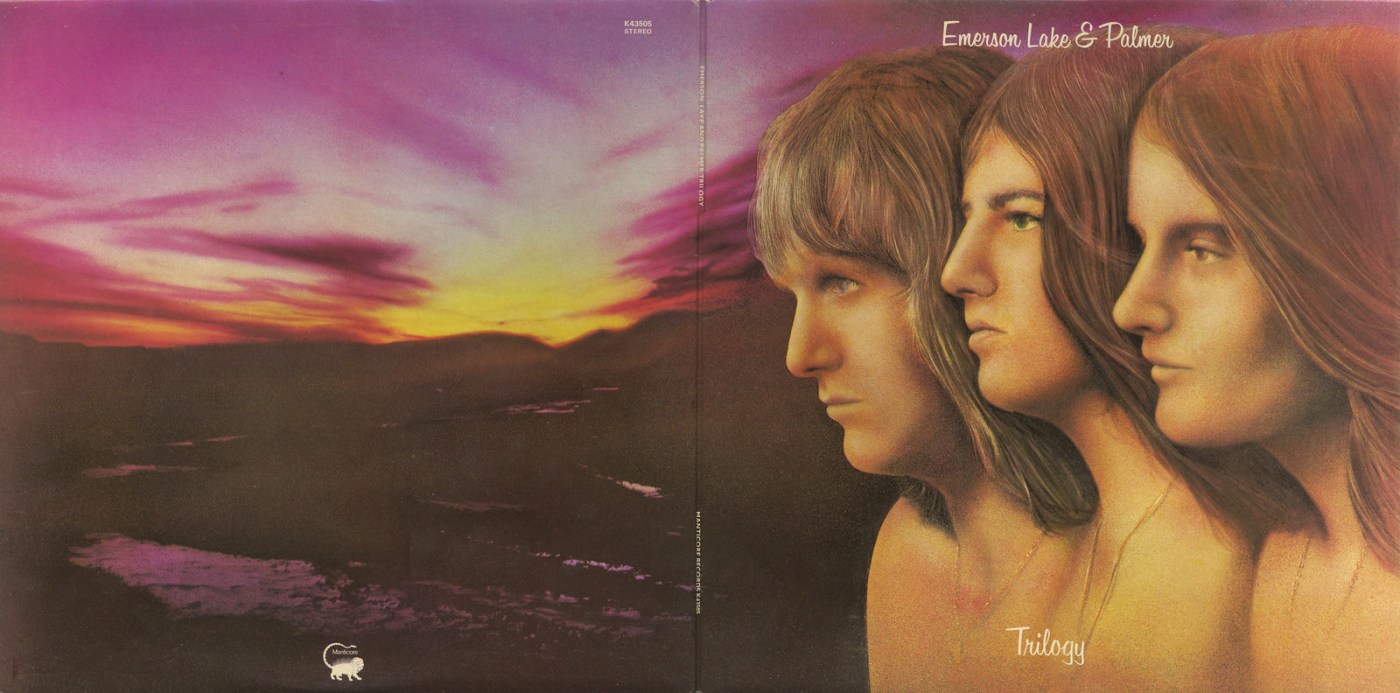
ELP would have liked to hire Salvador Dali as their cover artist, but Dali’s demand for $50,000 (about $350,000 in today’s money) was unfortunately too high for the trio, and the final, rather clumsy painting, which features the side profiles of the band members as if fused into one body, was done by the design firm Hipgnosis. The cover is certainly not one of the firm’s most spectacular achievements.
Trilogy was the last ELP album recorded by Eddie Offord. Offord again did a great job and the album sounds great even though the soundscape has become more complex due to more overdubs than before. After Trilogy, Offord defected completely to the Yes camp, taking over the band’s live sound alongside the recordings.
Read also: Emerson Lake & Palmer – Tarkus (1971)
Trilogy is not a visionary album in the same way as its predecessors, but rather builds on the innovations they have already created. However, progress was made, especially in the form of Emerson’s more sophisticated synth sounds and orchestrations.
Palmer and Lake had also honed their skills. The former plays throughout the album with real elegance and increased orchestral quality. Lake, on the other hand, has matured even more as a vocalist and his phrasing is in places a stunningly precise piece of work. Even at its best, Trilogy doesn’t quite reach the level of ELP’s finest moments, but it is a very fine performance thanks to its consistency.
Trilogy was also another commercial success, reaching number five on the US album charts and number two in the UK. As a touring support act, Trilogy also became one of the biggest bands in the world. In 1972, ELP seemed like an unstoppable force.
Best tracks: ”The Endless Enigma Suite”, ”Trilogy” ja ”Living Sin”
Author: JANNE YLIRUUSI
Tracks:
- The Endless Enigma (Part One) (6:42)
- Fugue (1:57)
- The Endless Enigma (Part Two) (2:05)
- From the Beginning (4:17)
- The Sheriff (3:23)
- Hoedown (Taken from Rodeo) {Aaron Copland, arranged by E, L & P} (3:47)
- Trilogy (8:54)
- Living Sin (3:14)
- Abaddon’s Bolero (8:08)
Total time: 38:55
Bändi:
Keith Emerson: Hammond C3 organ, Steinway piano, zurna, Moog synthesizer III-C, Mini-Moog model D synthesizer Greg Lake: vocals, bass guitar, acoustic guitar, electric guitar Carl Palmer: drums, percussion
Producer: Greg Lake
Label: Island / Atlantic
 Pienemmät Purot
Jätä kommentti