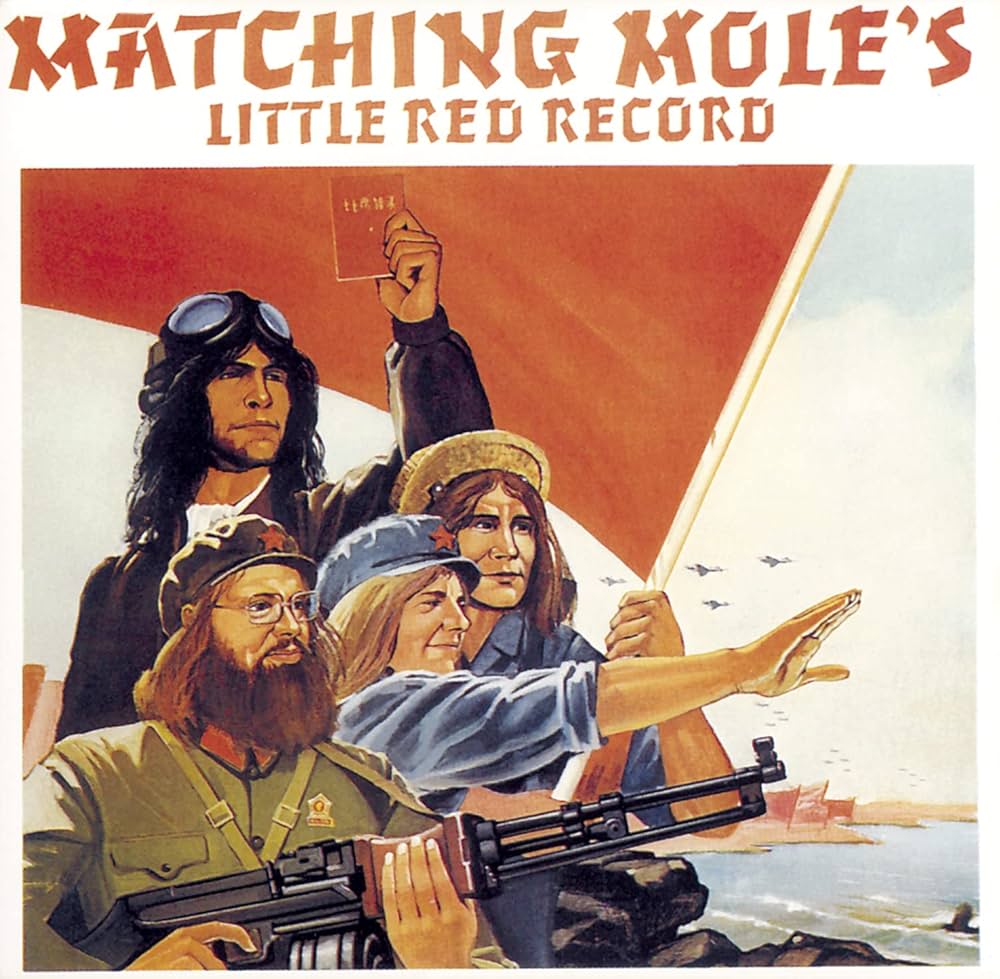
The debut album by Robert Wyatt’s Matching Mole was released in April 1972 and in July of the same year the band returned to the studio to record their sophomore album, Little Red Record.
Dave Sinclair left the band after the release of their debut album and was replaced by keyboardist Dave MacRae. Otherwise the line-up remained the same, with Phil Miller on guitar, Bill MacCormick on bass and Robert Wyatt on drums and vocals. In 1972, the still relatively unknown Brian Eno played keyboards on one track ”Gloria Gloom” that starts in a slightly ambient way.

Robert Fripp of King Crimson was chosen as producer. The idea was bassist MacCormick’s, but Wyatt and Fripp had also crossed paths the previous year during the recording of Keith Tippett’s Centipede album, which Fripp produced and on which Wyatt drummed as part of the big band.
The authoritarian and super-systematic Fripp seems an odd choice to steer a chaotic and somewhat rambling Canterbury band like Matching Mole. On the other hand, that was probably the point. To bring order to the chaos. However, bassist MacCormick has said that not everything went smoothly in the studio with Fripp. Miller thought Fripp was more or less a demigod as a guitarist and, as an insecure man, was downright terrified of playing his guitar parts under him. This was not helped by Fripp’s dictatorial approach, insisting on having the last word on every issue while making the record.
However, I don’t think Fripp’s presence radically affected the style of the album. The end result is certainly a little more polished and controlled and although the songs are more composed and structured the music is still clearly recognisable as the Canterbury experimental jazz-rock that the band’s debut was.
A big credit for the most coherent songs than before must go to keyboardist MacRae who gets many compositional credits on the album. Indeed, the 8-minute, intricate jazz-rock revue ”Marchides” is one of the album’s absolute highlights. MacRae’s intricate electric piano tinkling throughout the album is also an excellent listen and it seems that he also performs the more free-form material on the album much better than his predecessor Dave Sinclair who is not a great improviser.
Wyatt’s original ambitions of a ” vocal band ” were not realised on Little Red Record any more than on his debut. The band’s music is again very experimental and although vocals are used to great effect in many of the songs, there are only a few real ”songs” on the album, the most important of which is the fine and understated ”God Song”, composed by Miller, to which Wyatt wrote very sarcastic, yet sincere, lyrics in which he directly addresses God.
Little Red Record as a whole is a slightly stronger album than the band’s debut and one of the best examples of the Canterbury scene’s original vision of what happens when jazz-rock meets progressive rock.
Best tracks: ”Marchides”, ”God Song”, ”Floria Fidgit”
Author: JANNE YLIRUUSI
Tracks
- ”Starting in the Middle of the Day We Can Drink Our Politics Away” (MacRae, Wyatt) – 2:31
- ”Marchides” (MacRae) – 8:25
- ”Nan True’s Hole” (Miller, Wyatt) – 3:37
- ”Righteous Rhumba” (aka ”Lything and Gracing”) (Miller, Wyatt) – 2:50
- ”Brandy as in Benj” (MacRae) – 4:24
- ”Gloria Gloom” (MacCormick, Wyatt) – 8:05
- ”God Song” (Miller, Wyatt) – 2:59
- ”Flora Fidgit” (MacCormick) – 3:27
- ”Smoke Signal” (MacRae) – 6:38
Bändi:
Phil Miller: guitars Dave MacRae: Fender Rhodes electric piano, piano, organ, synthesizer Bill MacCormick: bass Robert Wyatt: drums, vocals
Guests:
Brian Eno: synthesizer (”Gloria Gloom”) Ruby Crystal (pseudonym of Julie Christie): vocals (”Nan True’s Hole”)
Producer: Robert Fripp
Labels: CBS
More reviews can be found here.
 Pienemmät Purot
Jätä kommentti