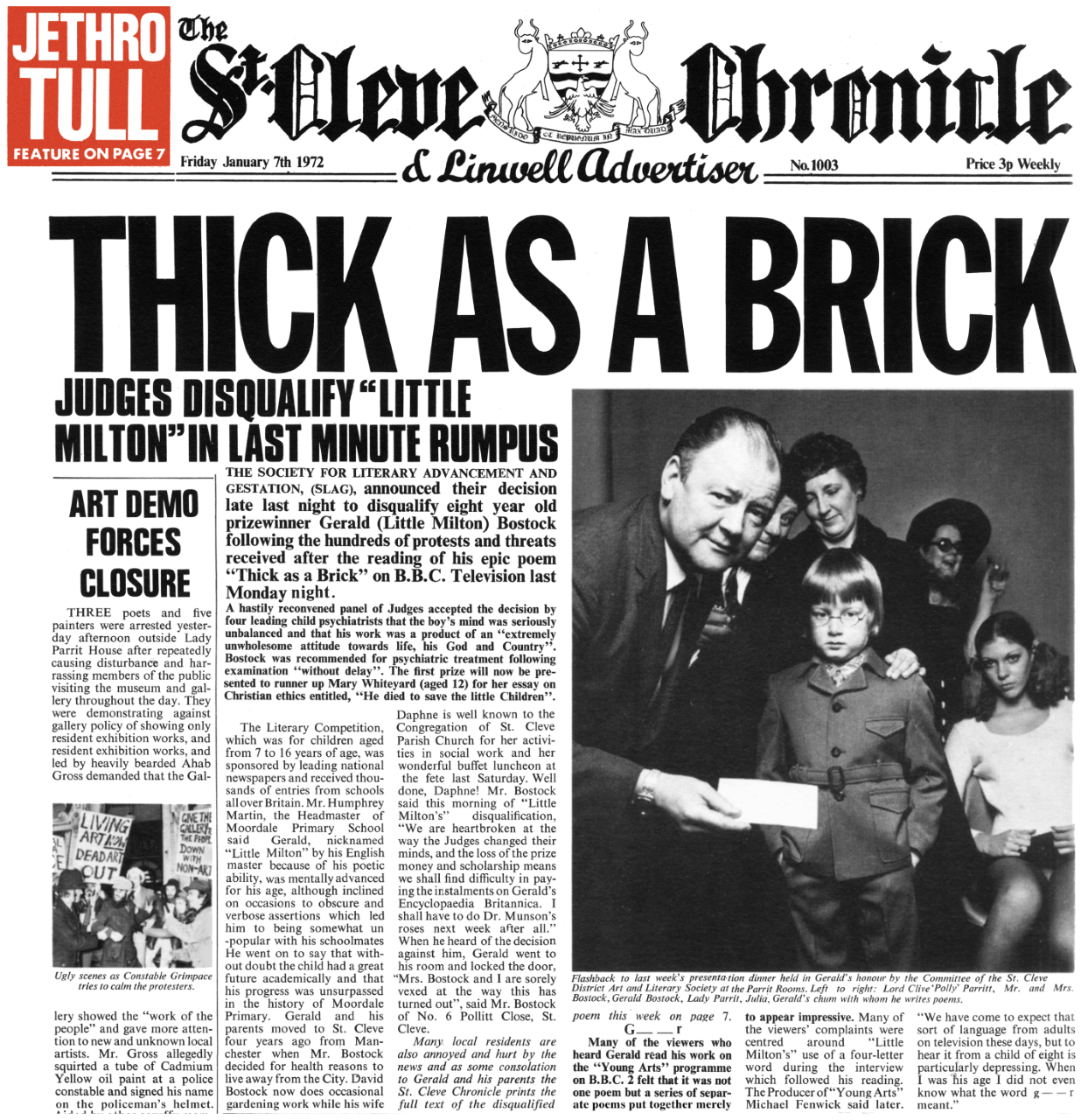
Released in March 1972, Thick As Brick is the fifth studio album by Jethro Tull.
Jethro Tull’s frontman Ian Anderson was annoyed by the band’s previous album being ”labelled” as a concept album by the music press because he felt it was just a collection of separate songs (actually, also I think Aqualung IS a semi-concept album). Incensed or at least inspired by this, Ian Anderson decided to give music critics a real concept album.
Later Ian Anderson has also tried to claim that TAAB is a parody of the concept albums of prog bands, but that’s a bit hard to believe, first of all because similar massive concept albums had hardly been made before TAAB to the extent that parody would have made much sense.
One way or another, in December 1971 Jethro Tull returned to the studio with Ian Anderson’s rather unfinished song sketches. The original intention was to make a bunch of songs of ’normal’ proportions, but eventually the band decided to splice the pieces together and the result was a massive forty-plus minute composition (although split into two parts due to vinyl limitations) built around an epic poem by child genius Gerald Bostock that had caused some outrage. Well, Gerald Bostock didn’t really exist, and the lyrics are, as always, by Ian Anderson.
However, the band did their best to give the impression that the lyrics were indeed the scribblings of a school-leaving little genius, and this impression was further enhanced by wrapping the album in cover art consisting of newspaper articles. Some of the articles in ’The St. Cleve Chronicle and Linwell Advertiser’ were of course about the drama surrounding Bostock, but some of the articles were quite serious looking news and some were more humorous bits. All of them, of course, written by members of the band. Ian Anderson has said that it took more time to do the covers than to make the album itself. Apparently the effort paid off and at least some of the audience really believed that Bostock existed and that the lyrics of the new album by Tull were indeed the work of this eccentric child genius.
The lyrics put in Bostock’s name are great stuff. The stream-of-consciousness lyrics are full of montypythonic, very British humour, but also biting and apt social criticism. Bostock’s… I mean Anderson’s barbs are also aimed at British class society.
Musically, TAAB is even stronger than the lyrics. Unlike Yes’ Close To The Edge from the same year, TAAB is definitely not a coherent symphonic work in structure, but more a collection of separate tracks cleverly glued together. There are, of course, a few recurring themes that bring at least a superficial coherence to the piece. The main thing is that throughout the 43-minute whole its various pieces are full of stunning music and at no point does the stitching together of the pieces feel forced, so skilfully have Ian Anderson and his players arranged the music.

Thick As A Brick’s music is full of speed and dangerous incidents, and the song makes effective use of dynamics. The use of staccato rhythms and unexpected breaks is impressive. The band’s new drummer Barriemore Barlow does a great job on the album. His playing of complex rhythmic patterns has a similar effortlessness and lightness to Phil Collins at his best. Barlow, along with bassist Jeffrey Hammond, who joined the band on the previous album, formed what is by far Jethro Tull’s strongest rhythm section. The duo play with dynamic and agile style throughout the album. They play softly and precisely in the calmer sections and with a correspondingly furious force when the music calls for it.
The maestro himself, Ian Anderson, is also in outrageous form on the album, singing more convincingly than ever before, and his acoustic guitar playing (Martin Barre again handles the electric guitars in his own sure-fire style) is also impressive to listen to. The music is also spiced up with a collection of slightly more exotic instruments for rock music such as harpsichord, xylophone, timpani and lute. A small string section is also used in a few passages. David (now Dee) Palmer, who later became a member of the band, helped with the orchestral arrangements.
Thick As A Brick was a huge success when it was released, selling platinum in the huge US market, which says a lot about the musical climate of that era and how open-minded even large audiences were about complex music that went well beyond the normal pop boundaries.
Read also: Emerson Lake & Palmer: Tarkus (1971)
Thick As Brick is, for me at least, by far the best album by Jethro Tull. The same opinion is usually shared by at least those fans of the band who are clearly oriented towards progressive rock. Over the decades, Thick As Brick has achieved legendary status as one of the most iconic (parody or not!) complete works of art in the genre. The father of the idea, Ian Anderson, realised this and forty years later made a regrettably weak sequel to the album under his own name, dealing with Bostock’s life as an adult. However, this does not diminish the power of the original album, which will forever shine as one of the brightest gems of progressive rock’s golden age.
Author: JANNE YLIRUUSI
Tracks:
Side A
1. ”Thick as a Brick, Part I” 22:40
Side B
1. ”Thick as a Brick, Part II” 21:06
Duration: 43:46
Band:
Ian Anderson: vocals, acoustic guitar, flute, violin, trumpet, saxophone Martin Barre: electric guitar, lute John Evan: piano, organ, harpsichord Jeffrey Hammond: bass guitar Barriemore Barlow: drums, timpani, percussion
Producer: Ian Anderson
Label: Chrysalis
 Pienemmät Purot
Jätä kommentti