
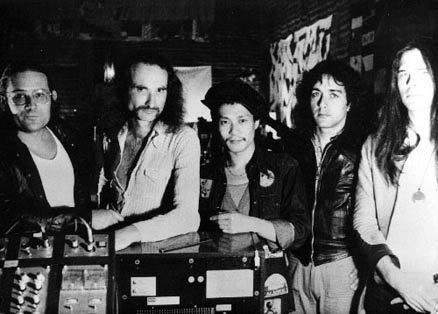
Tago Mago is the third studio album by the German band Can and the first one the band made with the wild Japanese-born vocalist Damo Suzuki (b.1950).
Can is often regarded as the definitive krautrock band. But what exactly is krautrock? Some people think broadly that all German experimental rock is krautrock and some even more open-minded individuals may even think of all German rock as krautrock. In my opinion, krautrock is a kind of German version, or rather the next step, of psychedelic rock. Apart from the psychedelic haze, an essential part of the krautrock sound is a certain kind of insistent rhythmic repetitiveness. Many krautrock bands have taken advantage of a thumping steady (so-called motorik beat) rhythm that the most skilled German drummers like Can’s Jaki Liebezeit (1938-2017) can still somehow magically make groove.
Although krautrock is closely related to progressive rock (and can be considered its subgenre), it lacks the symphonic element typical of prog, and virtuosic individual performances are not given as much space. Like symphonic prog, krautrock also draws heavily on Western art music, but more from the experimental avant-garde than from the symphonic masters of the 1800s and 1900s. The experimentation in the spirit of musique concrète associated with the avant-garde is often one of the means of krautrock.
In Can’s case, the band even had an academic background from the more experimental side of art music. Both bassist Holger Czukay (1939-2017) and keyboardist Irmin Schmidt (b.1937) had studied music under Karlheinz Stockhausen himself.
Alongside Can, other notable krautrock bands included Neu!, Faust, Embryo and the more electronic Tangerine Dream and Kraftwerk, especially later in their careers.
Tago Mago was recorded in Cologne for no less than three months and the music was largely built from a huge number of improvisations from which Chukay then edited the final tracks. So it was largely the same method used by producer Teo Macero on Miles Davis’ albums of the turn of the 60s and 70s. The best example being of course the legendary Bitches Brew (1969).
Originally released as a double vinyl, but which fits on a single CD, the 73-minute Tago Mago begins with a dreamy, gently swaying spacerock with the track ”Paperhouse”. After a couple of minutes of atmospherics, the mood changes radically as the song takes on an upbeat motorik kraut groove over which guitarist Michael Karoli (b.1948-2001) sits, alternating between shimmering guitar patterns and sawing sharp jagged riffs. A great start to the album, but the next track is even better.
The second track, the wonderfully hypnotic ”Mushroom”, floats and swooshes along in a softly psychedelic way as vocalist Damo Suzuki chants an autistically insane (and insanely catchy!) verse:
When I saw a mushroom head I was born and I was dead
Suzuki wakes up the hypnotised listener, sometimes with a brutal roar: ”I’m gonna give my despair, I’m gonna give my despair I’m gonna give my despair, I’m gonna give my despair!”
”Mushroom” is like the soundtrack to a nervous breakdown. And one of Can’s finest songs.
Tago Mago’s grip doesn’t let up a bit on the third track ”Oh Yeah” which is also mechanically manic but again drummer Liebezeit manages to keep the minimalist beat groovy. The vocalisation, which grows from Suzuki’s whispers to unexpectedly wild roars, and Michael Karoli’s original buzzing electric guitar are also a delight.
The 18-minute ”Halleluhwah” is the album’s centrepiece. It is characterised by an extremely strong rhythmic quality. Liebezeit’s insistent yet magically propulsive drumming is nothing short of brilliant. The sound of the song is truly massive and somehow still sounds very modern almost fifty years after its release. I have to admit though that the song probably would have worked even better a few minutes shorter. Live, the band played the song in a longer version for half an hour or so…
After ”Halleluwah”, the album is halfway through, meaning the first LP of the original release has been played through, and as it goes, it’s been mostly masterful, but the second half of the album is a bit more problematic.
Sure, the music on the first album is steamy and far from mainstream, but the second half of Tago Mago turns the experimentalism up a notch or two. The more experimental and avant-garde and pre-ambient experiments don’t always work as satisfactorily as the songs on the first album. And some sections feel downright boring, with their endless humming and clattering.
On the other hand, the second half of Tago Mago also has many great moments, such as the long drum sequence of the 17-minute ”Aumgni”, where the whole band plays various rhythm instruments to create a fiendish but fascinating noise. I wonder if this section inspired Yes a few years later on Tales From Topographic Oceans (1973) in ”Ritual” which contains a somewhat similar percussive section?
The 11 minute song ”Peking O” also has a really interesting early drum machine driven section.
All in all, however, the second album could have used a bit of trimming. Perhaps in the CD era, the whole would have been more compact as there would have been no need to produce enough material for four halves of the album, but could have settled for ”only” 60 minutes.
Can, and perhaps especially Tago Mago, has played a huge role in the development of modern rock music. The entire post-rock genre is indebted to the album, and an endless number of notable musicians and bands from other genres have said they were influenced by it. This includes bands as diverse as the Sex Pistols, Talk Talk, The Flaming Lips, Swans and Radiohead.
Considering how influential Tago Mago has been, it’s a little surprising that it has also retained its freshness and freshness so well. The imitators have not managed to dilute the power of the album.
Can later made a few albums that I personally like a bit more than Tago Mago because of their more balanced nature, but somehow this is the album where the band’s unique energy blossoms in the most primal and powerful way.
Best tracks: ”Paperhouse”, ”Mushroom”, ”Oh Yeah” ”Halleluhwah”
Rating: ****
Author: JANNE YLIRUUSI
Tracks:
- ”Paperhouse” 7:28
- ”Mushroom” 4:03
- ”Oh Yeah” 7:23
- ”Halleluhwah” 18:32
- ”Aumgn” 17:37
- ”Peking O” 11:37
- ”Bring Me Coffee or Tea” 6:47
Duration: 73:27
Band:
Damo Suzuki: vocals Holger Chukay: bass guitar, engineering, tape manipulations Michael Karoli: guitars, violin Jaki Liebezeit: drums, upright bass, piano Irmin Schmidt: organ, electric piani, synthesizer
Producer: Can
Label: United Artist
More album reviews can be found here
 Pienemmät Purot
Jätä kommentti