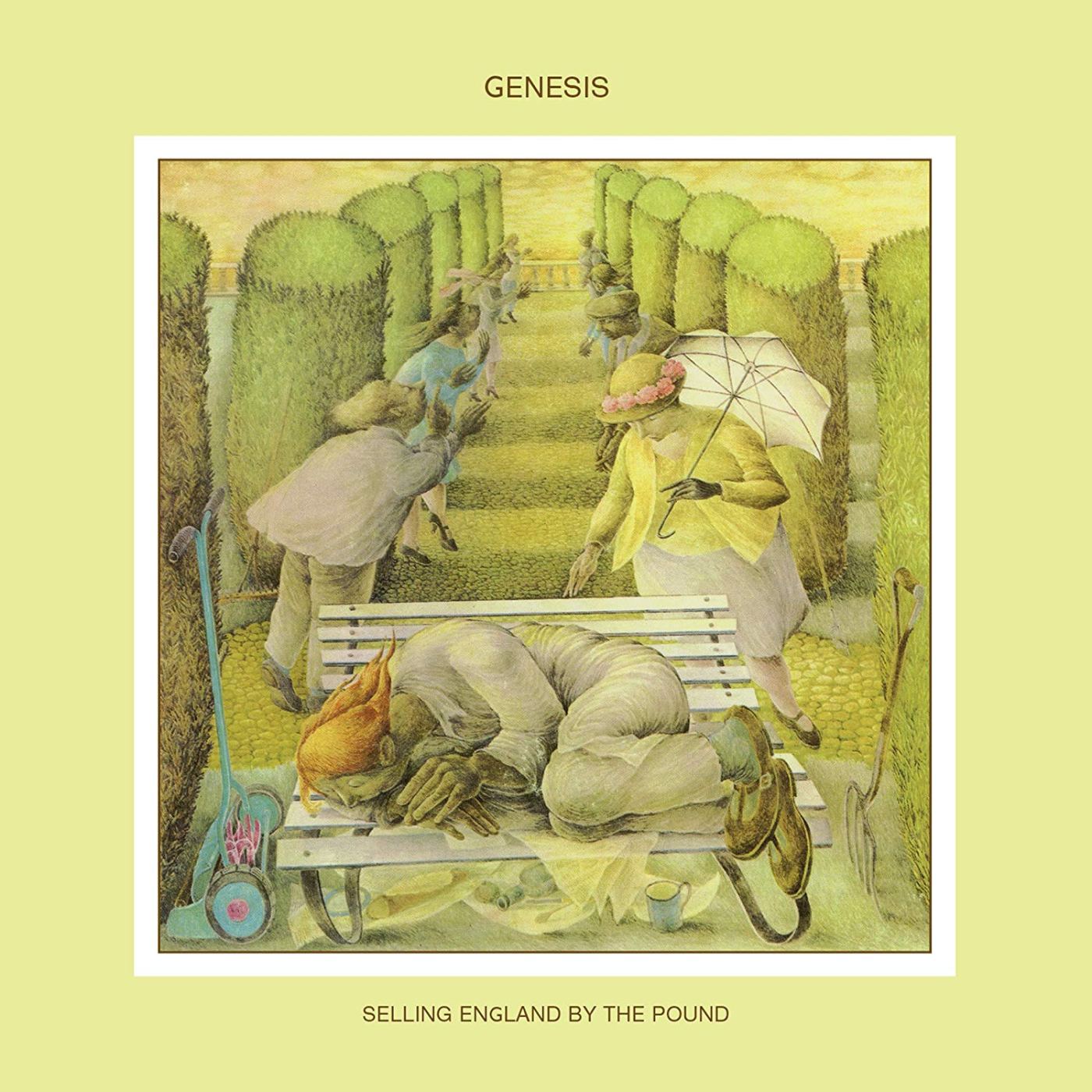
Selling England By The Pound is Genesis’ fifth studio album.
Assembled on Nursery Cryme in 1971, Peter Gabriel (vocals), Tony Banks (keyboards), Mike Rutherford (bass), Steve Hackett (guitar) and Phil Collins (drums) have become a skilfully cohesive group by the time of Selling England By The Pound.

Selling England By The Pound sounds much more muscular than its predecessors. Tony Banks uses a synthesizer alongside organ, piano and Mellotron for the first time on the album and Hackett’s soloing skills have improved dramatically. Some of the pastoralism of the earlier albums has been abandoned and much of their harshness has also been honed away by more skilful recording and improved playing.
At the same time, however, some of the band’s original charm and mystique has been lost. Sure, Genesis still sounds very original, but at the same time they have moved somewhat closer to a ”generic prog sound”. Part of this, though, may also be due to a distorted perspective: many later prog bands have tried to imitate Selling England The Pound’s Genesis. This can be heard especially in the sound of the so-called neo-prog bands that started in the 80s.
The backbone of Selling England By The Pound is four long pieces (8-12 min) with four shorter pieces sandwiched between them. These shorter pieces are unfortunately inferior not only in length but also in quality. Instead of providing rhythm, they mainly succeed in making the album a little too long. At 54 minutes, Selling England By The Pound is therefore an unusually long single vinyl release for the era, with most 70s albums lasting much closer to 40 minutes than 50.
Dancing With the Moonlit Knight
The album opens dramatically with Gabriel’s acapella singing:
”Can you tell me where my country lies?”
Said the unifaun to his true love’s eyes
”It lies with me!” cried the Queen of Maybe
For her merchandise, he traded in his prize!
That first verse sums up a lot of the general ethos of the album. There seems to be a certain nostalgia for the past in many of the songs, and the songs seem to be set in some kind of imaginary or fairytale-like past. However, many of the lyrics on the album are hard to get a grip on and ”Dancing With The Moonlit Knight” is a good example of how the lyrics on Selling England are much more vague than on a couple of previous Genesis albums. They lack the easygoing craziness and macabre nature that characterised many of Genesis’ earlier songs. The lyrics on Selling England are more serious and thoughtful, but the attempt at profundity often feels a little forced. Apparently the reason lies with Tony Banks, who this time was given more space for his lyrics at the expense of Gabriel.
The song contains a nice rocking instrumental part that Finnish listeners can listen to with amusement as Pelle Miljoona’s keyboard player Ari Taskinen stole the riff from this song to the band’s punk anthem ”Moottoritie on kuuma”. The song has had enough influences in other, less surprising, directions. Fish, the vocalist of the neo-prog band Marillion, is often accused of imitating Gabriel, and it seems that Gabriel’s aggressive vocals on ’Moonlit Knight’ in particular have been a clear influence.
The eight-minute ”Dancing With the Moonlit Knight” is a great song, but unfortunately the ending is a bit weak. It’s as if the song just fades away instead of a proper ending.
I Know What I Like (In Your Wardrobe)
”I Know What I Like” is a sympathetic attempt to make a slightly more approachable (pop?) song without losing the band’s characteristics to mediocrity. Despite its annoying chorus, the song works quite nicely. Collins plays the percussion creatively and his lively playing adds a nice extra dimension to the song. ”I Know What I Like” even managed to get a little spark in the singles charts, reaching number 21 in the UK charts. Not a huge hit, but it helped to make the band more recognisable.
Firth Of Fifth
Next up, at just over nine minutes, ”Firth Of Fifth” is the absolute highlight of Selling England By The Pound. The track opens with a stunning and rhythmically complex grand piano intro by Tony Banks. Apparently, this section, with several alternating time signatures, was so challenging that Banks, a little unsure of himself live, didn’t want to play it in concert. Although he also blamed the fact that the electric piano he was using had no touch-strength detection which made playing the subtle part satisfactorily very challenging if not impossible. It was apparently not financially feasible to charter the piano to gigs. That was how small Genesis was at the time. Anyway, on the album Banks’ intro is not only great to listen to instrumentally, but especially compositionally.
From the piano intro we move into a majestic section where Gabriel sings with a noble and very charismatic sound (this song would also have been also perfect for Greg Lake to sing). Then the extremely skilfully composed (Tony Banks deserves most of the credit) track progresses to its stately finale with a very sweet harmonic development.
Alongside Banks, guitarist Steve Hackett is the star of the song. Hackett gets to play an epic guitar solo on ”Firth Of Fifth” with a strong emotional charge. The solo that soars over the song is not only one of the most elegant in progressive rock, but also by far the best that has ever left Hackett’s fingers.
As in ”Dancing With Moonlit Knight”, the lyrics of ”Firth Of Fifth” do not reach the level of the music itself. The lyrics, written by Banks in collaboration with Rutherford and containing vague references to Greek and Roman mythology, seem to go nowhere. Despite the somewhat unsatisfactory lyrics, ’Firth Of Fifth’ is probably the best single ten-minute slice of Genesis music. It is an absolute masterpiece of progressive rock.
More Fool Me
After the majestic ”Firth Of The Fifth” comes the acoustic and light interlude ”More Fool Me”. ”More Fool Me”, sung by Phil Collins, remains a rather anaemic song. The song about relationships is probably Genesis’ most straightforward and simple song since their debut album.
The Battle Of Epping Forest
The longest track on the album, the 12-minute ”The Battle Of Epping Forest” is musical theatre that, with a very montypythonesque sense of humour, tells a roguish story of a gangster war in a park.
The problem with the song is that Gabriel fills almost every moment with his lyrics which often don’t seem to quite match the music. Gabriel does indulge in colourful characters and sings their parts in different voices in a fun way, but too much is too much.
”Epping Forest” contains some very complex and intense music (Rutherford is on fire on bass!), but it often tends to be totally overshadowed by Gabriel’s wordplay. Tony Banks in particular detracted from the final result, but I think some of ”Epping Forest” works very nicely.
However, it is overlong and the music itself should have been given much more room to breathe. I know this is controversial to say about an album that I consider overlong, but in a way ”Epping Forest” could have benefited from a longer duration. This would have allowed for a better balance between the music and Gabriel’s lyrics.
After The Ordeal
”After The Ordeal”, composed by Steve Hackett, is a nice melodic instrumental, but doesn’t really justify its existence on such a long album. Banks and Rutherford objected to its inclusion, but for once Hackett stood his ground and even threatened to quit the band if the song was not included. In such a situation, Genesis’ democracy becomes a bit self-defeating; having to please everyone in the band doesn’t necessarily make for a coherent and optimal result. However, there is nothing particularly wrong with ”After The Ordeal” (apart from a rather lame fade-out ending) and it does contain some nice guitar work, but perhaps it could have been saved for Hackett’s solo album.
The Cinema Show
Opening with an acoustic guitar strum, the modern Romeo and Juliet story ”The Cinema Show” fools the listener for a moment into thinking that the band has returned to the pastoral atmosphere of the early days, but the song gradually grows more energetic and its instrumental section is one of the highlights of the album.
In a great section of several minutes, mostly in 7/8 time, Gabriel and Hackett are left out and the band suddenly becomes a power trio with Banks, Rutherford and Collins riffing in a tasty jazz-rock atmosphere. Banks solos very elegantly on the track, although at times with a slightly too thin synthesizer sound. Rutherford and Collins do a stunning job in the background as a rhythm section, especially as Collins achieves perhaps the best performance of his career so far.
The instrumental section of ”The Cinema Shown” gives an interesting glimpse into an alternative future where the trio of Banks, Rutherford and Collins ignored the call of the singles charts and focused instead on instrumental prog…
Aisle Of Plenty
The album-closing, less than a couple of minutes long, light and beautiful ”Aisle Of Plenty” serves as a kind of outro to ”Cinema Show”. Gabriel’s delicate vocals take centre stage, while Banks plays Mellotron strings in the background with an elegantly understated sound. A nice end to the album even though it ends in a fade-out again. This time, however, it works quite well.
The trio of ”Dancing With The Moonlit Knight”, ”Firth Of The Fifth” and ”The Cinema Show” are definitely among Genesis’ best songs, and on their strength alone, Selling England By The Pound is a classic. Unfortunately, the rest of the material does not reach the same level and makes the whole uneven and overlong, even though there are no real disasters in it.
Selling England By The Pound received mixed reviews when it was released, and not all members of the band were very happy with the album. Tony Banks, in particular, was surprisingly vocal in his criticism of the album in interviews with the band.
Since then, the album has grown in popularity and is now considered one of the best prog albums of all time. Selling England By The Pound is a regular contender for the title of best prog album in various polls, alongside Yes’s Close To The Edge (1972). In my opinion, the uneven Selling England is no match for the seamless perfection of Close To The Edge and is not even Genesis’ best album. That honour belongs either to the edgier Foxtrot (1972) or the epic urban odyssey Lamb Lies Down On Broadway (1974).
Despite its incompleteness, Selling England By The Pound is still a great record and a truly significant and influential part of the progressive rock story.
Parhaat biisit: ”Dancing With The Moonlit Knight”, ”Firth Of The Fifth”, ”The Cinema Show”
Author: JANNE YLIRUUSI
Tracks:
Side A
- ”Dancing with the Moonlit Knight” 8:02
- ”I Know What I Like (In Your Wardrobe)” 4:03
- ”Firth of Fifth” 9:36
- ”More Fool Me” 3:10
Side B
- ”The Battle of Epping Forest” 11:43
- ”After the Ordeal” (instrumental) 4:07
- ”The Cinema Show” 11:10
- ”Aisle of Plenty”
Genesis:
Peter Gabriel: vocals, flute, percussion, oboe Steve Hackett: guitar, backing vocals on ”I Know What I Like” Tony Banks: piano, keyboards, backing vocals, acoustic guitar on ”The Cinema Show” Mike Rutherford: bass, bass pedal, acoustic guitar, sitar on ”I Know What I Like”, double bass on ”The Cinema Show” Phil Collins: drums, backing vocals, percussion, vocals on ”More Fool Me”
Producer: Genesis ja John Burns
Label: Charisma
 Pienemmät Purot
Jätä kommentti