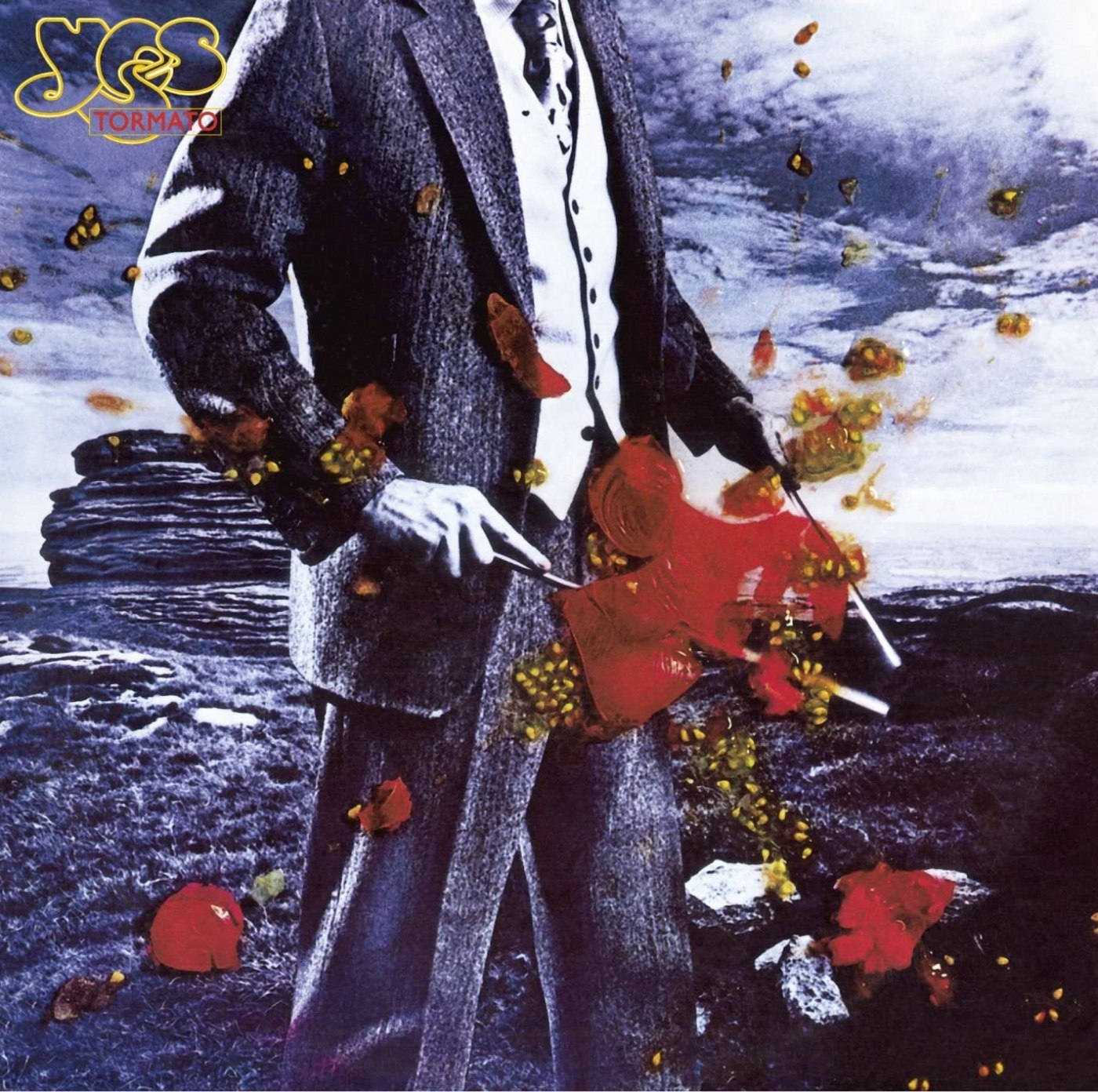
Tormato is the ninth studio album by Yes, founded in 1968.
Yes’ previous album Going For The One (1977) was born in a harmonious and enthusiastic atmosphere after the return of prodigal son Rick Wakeman. The album was also very successful and even produced the band’s biggest single hit to date in the form of ”Wondrous Stories”.
The next album, Tormato, was built on the Going For The One line-up, with Wakeman joined by founding members Jon Anderson (vocals), Chris Squire (bass guitar), guitarist Steve Howe and drummer Alan White.
Although Going For The One was a long and painstaking process, the whole band was pulling together throughout the process. The band clearly seemed to have a common goal to work towards. Tormato seemed to have lost the vision from the start.
The first bitter battles within the band were already taking place over where to record the album. Some of the band wanted to continue in Switzerland where Going For The One had been successfully assembled, some wanted to return to their hometown of London and some wanted to travel somewhere far away in the warm. In the end, London won out as a sort of compromise.
However, no agreement was reached on the studio either and the album was then recorded at two different studios, the familiar Advision (where Close To The Edge was born) and the new RAK studio, founded in 1976. There was also some wrangling over the producer. The good old stalwart producer Eddie Offord initially returned behind the mixing desk, but the collaboration with him didn’t work out. The actual reason is unclear, but it is rumoured that Offord’s substance abuse problems had escalated to a very severe level in the late 70s and that he had become unpredictable and unreliable.
Eventually Yes decided to produce the album himself. It had worked for Going For The One. This was a mistake as we shall see.
For the first time on Tormato, several of the songs support the feeling that this is not bad music, but on the other hand it doesn’t really feel like Yes music either. Apart from the lack of a common vision, there were at least two practical factors that contributed to this. The record company pressured the band to write shorter and easier songs. Yes responded to this with Tormato, jumping around a bit uncertainly and half-heartedly experimenting with different styles. The band’s strength for several years had been long epics. You don’t hear that on Tormato. Even the longest song is only less than eight minutes long, and otherwise the eight songs range from 2 to 7 minutes.
The most significant practical problem, however, was that the songwriting duo of Jon Anderson and Steve Howe was broken. From Close To The Edge onwards, much of Yes’ best music was written by Anderson and Howe, but the duo didn’t really get on with each other any more, and Tormato has only one composition by Anderson and Howe (with Wakeman) and one song is credited to the whole band.
”Future Times”/”Rejoice”
The tumultuous first track ”Future Times”/”Rejoice” opens with Wakeman’s Polymoog fanfare, on top of which Howe begins to strum his waspishly buzzing guitar, swirling a little aimlessly among the synthesizer. Who’s carrying the song? I don’t know and I don’t think Yes did either. Chris Squire’s bass hums and echoes strangely. The Yes members had a lot of new toys at their disposal at Tormato, the most notable being the Mu-Tron pedal that turned Squire’s bass sound into an ethereal whirr (which apparently worked a bit like the Harmonizer?) and Rick Wakeman’s almost perpetual Polymoog.
The first polyphonic synthesizer on the market, the Polymoog, cost more than the average car and was of course state of the art, but it doesn’t sound very good. Wakeman seemed to love the thing, though, and he fills almost every corner of the album with his Polymoog tinkling. This changes the sound of the band significantly as usually Howe’s electric guitar had been the main solo instrument in Yes.
Although Wakeman has a reputation as an extravagant player, in fact, in the Yes ranks he had mostly shown a relatively good taste and was a decent team player. On the torrent this changes and Howe and Wakeman seem to be almost constantly fighting for space and playing off each other. At times the duo’s noodling seems to cancel each other out and everything just becomes a vague mass of sound. On the other hand, their rivalry is at times also very exciting to listen to. Despite its strange soundscape and the Howe vs. Wakeman confusion, ”Future Times”/”Rejoice” is ultimately a rather interesting song that varies its basically rather simple themes quite interestingly.
”Don’t Kill the Whale”
Some of the best Howe and Wakeman moments on the album can be heard on the second track ”Don’t Kill The Whale”. They mostly manage to stay out of each other’s way, alternating energetic and at times hilariously florid solos. Also noteworthy on the track is Squire’s funky and bubbling bass sound which is really weird. Weird but charming.
Anderson and Squire’s joint composition ”Don’t Kill The Whale” is a great catchy rock song that always makes you feel good. It’s a bit silly, but oh so entertaining! And not even Anderson’s well-meaning but rather corny, anti-whaling lyrics manage to sink it. Dig it! Dig it!
On a personal level, a funny detail about ”Don’t Kill The Whale” is that I first heard it in high school English class. The song and a short interview with Steve Howe were part of the audio tapes we used for the book series. Yes was a band I was familiar with at this point, but I hadn’t heard Tormato yet. I rectified the situation soon after this legendary English lesson. Other new fans of Howe and ”Don’t Kill The Whale” at that time at Haukilahti High School were probably not won over.
”Madrigal”
By the third track, the atmosphere calms down. Anderson and Wakeman’s ”Madrigal”, just over two minutes long, is a beautiful acoustic interlude. Wakeman’s vibrantly ringing harpsichord and Anderson’s brightly reverberating vocals take the lead. Howe’s Spanish guitar provides support in style. A rare trio arrangement for Yes offers a rest for the ears after two noisy tracks. But while listening to the song, the question creeps into your mind: is it really Yes music? Perhaps it would have fit more naturally on a Jon Anderson solo album. Nevertheless, ”Madrigal” is very pleasant music.
”Release, Release”
After a relaxing harpsichord flourish, Yes turns the taps to the south-east for an outright hard-rock blast in the form of the less than six-minute ”Release Release” by Anderson, White and Squire.
”Release, Release” is a surprisingly brash rock song, and perhaps even more surprisingly, a very successful one. Jon Anderson’s voice isn’t always at its best on the rockiest material, but on ”Release, Release” his breathy screaming vocals work.
It’s breathtaking in other ways too. Squire and White are especially on fire (as they are for most of the album), as the band furiously churns out a song, kicked forward by their stunning rhythm section. ”Release, Release” is so intense that Alan White has said that the song drained the band’s juices so much at gigs that it had to be left out of the repertoire.
”Release, Release” features a short and apparently deliberately rather cheesy drum solo with the roar of the crowd playing in the background. Obviously this was intended as a commentary on the stadium rock culture that was on the rise. I’m not sure why, but it doesn’t matter. From the drum solo, the spotlight shifts to Howe’s boisterous solo, which in turn returns to the tasty basic groove after the song. Yes have some really great rocking songs under their belt and ”Release, Release” is definitely one of them.
”Arriving UFO”
The mood doesn’t really calm down after ”Release Release” as the following Anderson, Howe and Wakeman composition ”Arriving UFO” grows into a really furious song after a relatively calm beginning.
”Arriving UFO” is Tormato’s wildest and most proggiest song and in its ferocity and outright chaos it brings to mind Relayer’s ”Sound Chaser”. Not that ”Arriving UFO” is on a par with that masterpiece, but it is an interesting song in all its mayhem. Wakeman and Howe again battle it out throughout the track, with Squire’s phased bass taking a powerful part in the battle at times. Who will be the winner this time? Hard to say. Many will think that the loser is the poor person listening to the song and their sensitive ears, but I’m attracted by the insanity of ”Arriving UFO”.
Unfortunately, Anderson’s UFO-themed lyrics are rather tiresome and would have required more of his characteristic abstraction.
”Circus of Heaven”
If the lyrics of ”Arriving UFO” cause painful face-palm reactions in the listener, the same is offered to the power of ten by Anderson’s strange fairy-tale spectacle ”Circus Of Heaven”.
Anderson’s complex lyrics, which he hasn’t quite managed to match the music of the song, tell a strange and frankly rather silly tale of a magical circus full of wonders. As a ”final climax” we hear Jon Anderson’s young son Damien’s view of the miracle circus described by his father: ”Oh! it was OK!!! But there were no clowns, or lions, or tigers, no bears, no candy-floss, toffee apples, no clowns.” Aargh. The music that tinkles in the background flirts lightly with reggae at times and even contains some interesting moments, but in the end everything is too subordinate to Anderson’s vocals and the whole thing doesn’t really take off at any point. This song should have been saved for Anderson’s solo album. Or maybe better not to do it at all.
”Onward”
Anderson’s circus moves on to more dignified atmospheres with ”Onward”, composed by Squire. Outgoing and quite subdued, ”Onward” is a beautifully simple ballad lifted by Andrew Pryce Jackman’s fine orchestration. Jackman also did an excellent job in a similar role on Chris Squire’s solo album Fish Out Of Water.
”Onward” is a pretty song, but a bit like ”Madrigal” it doesn’t really feel like Yes music at all and would have been more at home on Squire’s second solo album. If he had ever bothered to make one.
”On the Silent Wings of Freedom”
The final track ”On The Silent Wings Of Freedom” by Tormato sounds in a way like the most familiar and safe Yes music. On the other hand, it also sounds a bit inspired by Led Zeppelin’s more progressive songs like ”Kashmir” and Achille’s Last Stand” which is kind of funny because I’ve always thought that the aforementioned Zeppelin classics probably owed something to the Yes style. Around we go, together we come. Art imitates art… or whatever.
Squire and White shine again in ”On The Silent Wings Of Freedom” and sometimes they seem to take the lead role. At times the song feels a bit too much like a stretched bass-drum jam with the guitar and keyboard parts being thin and casually thrown together. As a result, ”On The Silent Wings Of Freedom” doesn’t really seem to carry its eight-minute duration. Listening to the song, you always get the feeling that it is somehow unfinished. It’s like listening to a demo version where the music is just taking shape.
Read also: Yes – Mirror To The Sky (2023)
Tormato was not as successful as its predecessor, but still sold gold in the UK and platinum in the US. Not bad for a ten year old band that, like other progressive dinosaurs, was allegedly doomed by the rise of punk the previous year. Yes did even better in concert arenas than in record shops, and the In The Round tour celebrating the band’s Tormato, which stretched to 101 shows, was one of the most successful in the band’s history.
For all its success, things were not going particularly well at Yes. Money was coming in, but it was also being burned at a rapid rate as the band members’ lifestyles changed over the years to become quite lavish. None of the members were particularly happy with Tormato either, and tensions between the various musicians only grew, both financially and artistically.
The stormless quintet met again in October 1979 in Paris to record the next album, but no common ground could be found and eventually the sessions were interrupted when Jon Anderson and Rick Wakeman went their separate ways. The output of the Paris sessions is heard as bonus tracks on the 2004 reissue of Tormato and is not a very flattering listen.
However, the remaining trio of Howe, Squire and White didn’t give up and enlisted the help of The Buggles duo Trevor Horn and Geoff Downes, and the 1980 album Drama introduced a rather radically reformed Yes.
Tormato is probably the weakest Yes album since their 1969 debut. Objectively speaking, it’s full of problems, but for one reason or another, most of the songs still grab me, if nothing else, with their wild energy. Even with its flaws, Tormato is for the most part a very entertaining listen.
Best tracks: ”Don’t Kill The Whale, ”Release, Release”, ”Arriving UFO”
Author: JANNE YLIRUUSI
Tracks
- ”Future Times”/”Rejoice” Jon Anderson, Chris Squire, Steve Howe, Rick Wakeman, Alan White / Anderson 6:40
- ”Don’t Kill the Whale” Anderson, Squire 3:53
- ”Madrigal” Anderson, Wakeman 2:23
- ”Release, Release” Anderson, White, Squire 5:42
- ”Arriving UFO” Anderson, Howe, Wakeman 5:59
- ”Circus of Heaven” Anderson 4:28
- ”Onward” Squire 3:57
- ”On the Silent Wings of Freedom” Anderson, Squire 7:45
Yes:
Jon Anderson: vocals, percussion, guitar, cuatro Steve Howe: electric guitars, acoustic guitars, mandolin, Spanish guitar, vocals Chris Squire: bass guitars, bass pedals, piano, vocals Rick Wakeman: Birotron, Hammond organ, Polymoog synth, piano, harpsichord, RMI electric piano Alan White: drums, percussion, drum synth, vibraphone, vocals
Producer: Yes
Label: Atlantic

 Pienemmät Purot
Jätä kommentti