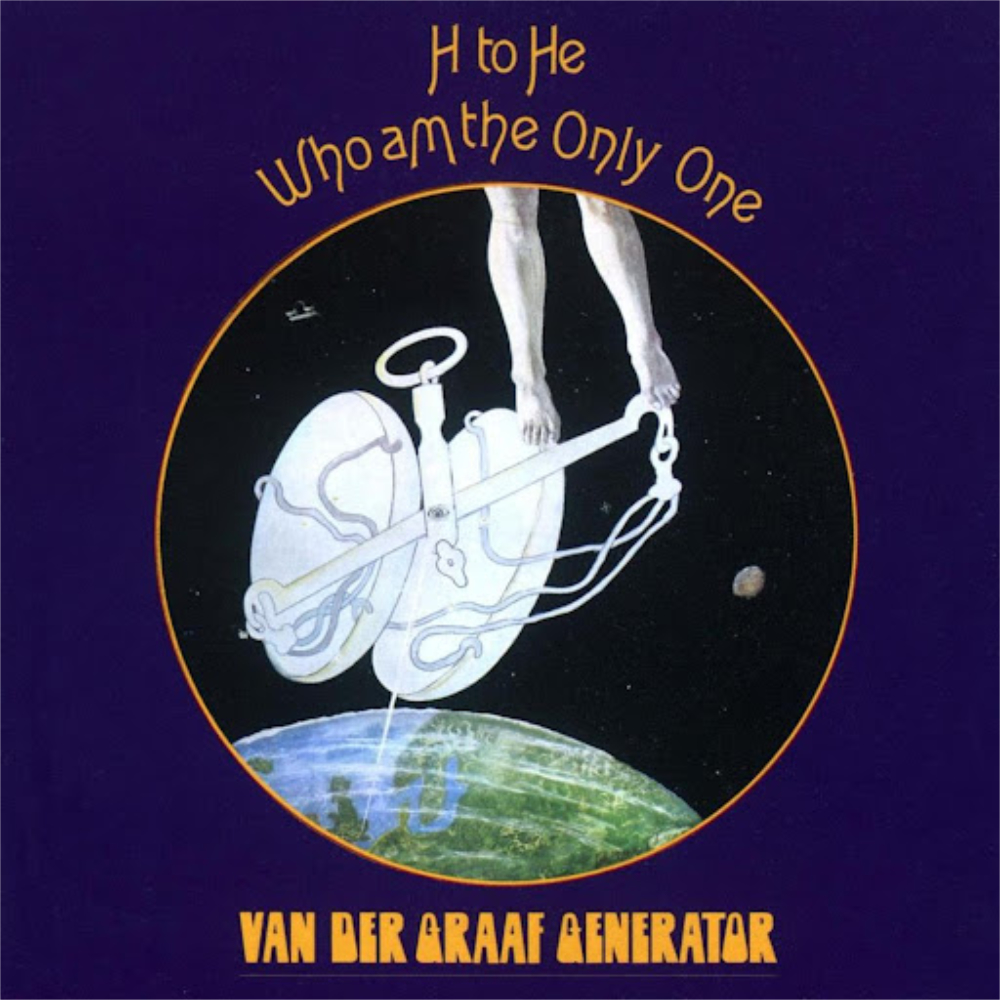
Van Der Graaf Generator’s third album H to He Who Am the Only One was released in December 1970, just 10 months after its predecessor The Least We Can Do Is Wave to Each Other.
H to He Who Am the Only One continues in the vein of its predecessor. The band’s line-up remained the same and even in the studio the same duo of producer John Anthony and engineer Robin Cable were still in the fold, this time backed up by assistant engineer David Hentschel who later went on to a relatively distinguished career as a producer himself (Genesis, Renaissance, Mike Oldfield, etc.).
Sound-wise, H to He has improved a lot compared to The Least We Can Do, but on the other hand, with a crisper and clearer sound, some of the strange mystique of the previous album is gone. H to He is the most restrained and ”ordinary” sounding of the 70s VdGG albums. In terms of sound, H to He could almost be a Genesis album. Which is not surprising, as producer John Anthony also worked on the early Genesis albums. On this album, VdGG also shared the cover artist with Genesis. The album’s somewhat clunky cover was designed by the same Paul Whitehead who illustrated the covers of Nursery Cryme and Foxtrot for Genesis.
Along with the production, the music itself is also a little more restrained than on the previous release. Peter Hammill doesn’t unleash his ferocious vocal style in quite as extreme a way, and David Jackson’s saxophone doesn’t sound quite as violent. Perhaps the band (or the producer?) was trying to make the music a little more commercial.
Of course, VdGG’s music on H to He is far from mainstream and is still full of dark atmospheres and progressive intricacies. The lengths of the songs don’t particularly bow at the altar of commercialism either: of the five songs on the album, two are over ten minutes long and even the shortest, ’House With No Door’, lasts six minutes.
The album opens with ”Killer”, whose slightly goofy lyrics are about a shark that kills everything around him in the ocean (including his mother), eventually becoming lonely and suffering for it. Existential anguish and nihilism metaphorically depicted through fish? Yes! Only prog bands can do that! ”Killer” is known for its catchy organ riff and the song rocks pretty hard. David Jackson’s saxophone parts are also great. The band has later admitted that ”Killer” is the only song they ever made while calculating and thinking about what kind of elements their listeners would like. It wasn’t a big hit, but it became one of the band’s most beloved songs.
Read also: King Crimson: Lizard (1970)
”The Emperor In His War Room” features King Crimson’s Robert Fripp on guitar. It was Fripp’s first session as a hired studio musician and he managed to squeeze in his contribution in two attempts without ever having heard the music playing in the background before. He used the same method, almost ten years later, for the sessions on David Bowie’s ”Heroes” album. Fripp’s acoustic guitar parts, however, do not make a particularly big impression on the song and are somewhat overshadowed by the overall raucousness of the song. Stylistically, Fripp’s electric guitar parts are very similar to those heard on Crimson’s In The Wake Of Poseidon (1970), but not nearly as well recorded this time. Still, it’s a fine piece of music. The song successfully juxtaposes quiet and loud sections.
At 11 minutes, ”Lost” is perhaps the finest and wildest track on the album. It features not only some stunning, wistfully catchy vocal performances, but also a punchy interplay that foreshadows the maniacal energy of the band’s next album, Pawn Hearts. Lyrically, ”Lost” is a somewhat unusual VdGG song in that it’s a relatively straightforward love song. Well, a song about lost love and of course the protagonist of the song is very deeply tormented by this loss. The drama builds up quite a bit at the end:
Looking out through the tears that bind me
My heart bleeds that you may find me .. or at least that I can
Forget and be numb, but I can’t stop, the words still come:
I love you
Hammill cries out the last I love youuuuuuuuuu very convincingly.
The final track, over 12 minutes long, ”Pioneers Over c”, returns to more typical proge vibes as the sci-fi inspired song is about astronauts who fly over the speed of light (hence the letter ”c” in the song’s name) and end up trapped in a time warp, living a kind of anti-life while going mad. Or something.
Bassist Nic Potter decided to leave the band in the middle of recording the album. After that, a dedicated bass guitarist was never heard from again under the Van Der Graaf Generator name, and the job was left to Hugh Banton’s organ pedals.
H to He Who Am the Only One an excellent album although I don’t think it’s quite as magical as The Least We Can Do Is To Wave Each Other. Being a bit more commercial and punchier, one would have thought that it would have been more successful than its predecessor, but surprisingly this was not the case. The album did not chart in the UK at all which was disappointing for a band that was on a high. The following year, however, the band hit back with Pawn Hearts. An album that many consider to be the band’s supreme masterpiece.
Best songs: ”The Emperor In His War In Rome”, ”Lost”
Author: JANNE YLIRUUSI
Tracks
- ”Killer” Hammill, Chris Judge Smith, Hugh Banton 8:24
- ”House with No Door” 6:37
- ”The Emperor in His War Room” 8:15
- ”Lost” 11:17
- ”Pioneers Over c” 12:42
Van der Graaf Generator:
Peter Hammill: vocals, guitar, piano David Jackson: tenor and soprano saxophones, flute
Hugh Banton: Hammond organ, bass, Mellotron, piano Guy Evans: drums, percussion Nic Potter: bass guitar (”Killer”, ”The Emperor in His War Room”, ”Lost”).
Guest:
Robert Fripp: electric guitar, acoustic guitar (”The Emperor in His War Room”)
 Pienemmät Purot
Jätä kommentti