
Oscillospira is the first collaborative album by JG Thirlwell and Simon Steensland.

Australian composer/producer JG Thirlwell (b.1960) is a man of many projects and pseudonyms. The man who emerged from the post-punk scene combines a kind of elusive cinematic style with heavy industrial overtones. Foetus is probably the best known of his own projects and he has also worked with the Melvins, Nine Inch Nails, Swans, Nick Cave and The Kronos Quartet. Thirwell has also composed music for the TV series The Venture Bros. and Archer.
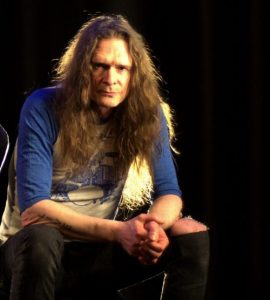
Swedish composer and multi-instrumentalist Simon Steensland (b.1961) is one of the most prolific composers of theatre music in his home country. Theatre music is Steensland’s bread and butter, but in the spirit of pure art for art’s sake he has also made numerous solo albums, usually in the dark avant-prog vein. Steensland’s best known solo albums are Led Circus (1999) and Fat Again (2009).
Thirlwell and Steensland met in Stockholm in 2017 at a workshop organised by The Great Learning Orchestra. The Great Learning Orchestra is an experimental orchestra that aims to bring musicians of different genres or skill levels together. For Thirlwell and Steensland, this was fruitful. Not only did they get on well as people, but they also found that despite their different backgrounds, they also had many common interests in music. In particular, they shared a love of the more challenging extremes of progressive rock. After the workshop, Steensland performed a cover version of one of the songs Thirlwell wrote for The Great Learning Orchestra. Steensland sent his version to Thirlwell, wondering what on earth the song could be used for. Thirlwell was enthusiastic about Steensland’s version and suggested that they make a whole album together.
”I had been a fan of Steensland’s work for some years through his albums like Led Circus and Fat Again. I admired the dark power in his work and it seemed adjacent to a lot of music that I love and inspires me – groups in the Rock in Opposition and Zeuhl worlds such as Magma, Univers Zero and Present, as well as 70’s era King Crimson and Bartok.” – JG Thirlwell
Oscillospira is made remotely, in the now typical way of musicians sending files back and forth to each other, slowly adding parts. This often leads to rather sterile results, and Oscillospira doesn’t sound like a spontaneous band, but then again, it doesn’t aim to be. Oscillospira is aiming for a kind of fusion of modern orchestral music and rock. This basic combination is spiced up with industrial tones and influences from film music. If Béla Bartók were to be dug out of his grave to make music with Univers Zero’s Daniel Denis, Nine Inch Nails’ Trent Treznor and film composer Hans Zimmer, the result could be something more or less like Oscillospira. At times, Oscillospira also brings to mind the grandiose, percussion-intensive orchestral works of the master composer Sebastian Fagerlund.
Interestingly, the eight tracks of Oscillospira (four of which are ten minutes long) are credited to Thirlwell and Steenland, so that every second track is credited to Thirlwell and every second to Steenland. Listening to the album, I for one have not yet learned to distinguish by ear which song is by which composer. So the men’s styles blend together perfectly on this album. Apparently, during the realisation phase, both of them made a strong contribution to each other’s compositions and the arrangements were written in collaboration.
Oscillospira (oscillospira is the name of a bacterium) paints appropriately post-apocalyptic pictures of huge crowds of people fleeing in terror from some inevitable doom. In Oscilliospira’s world, icebergs are collapsing, raising tidal waves that engulf cities, rainforests are burning, drifting clouds of smoke that darken continents, while pandemics mow down the population like scythe hay. Hordes of people flee in terror with no direction, vaguely aware that there is nowhere left to run. The lead grey attack helicopters of governments turned semi-fascist buzz around everything in a vain attempt to bring order to a world where there is no longer any place for it. The Oscilliospira is doomsday music and I could imagine it as a soundtrack to something a little more artistic, and very dark, for a disaster film.
As you can tell from the mood above, Oscillospira’s music is dark and austere. However, it is not as complex, intense and ever-changing as the music of Univers Zero or Henry Cow in particular. Oscillospira contains more repetition than artists at the more challenging end of the avant-prog spectrum, and its insistent ostinatos are at times reminiscent of Magma, one of whose trademarks is repetition and its built-in subtle changes. Thirlwell and Steensland are not capable of the same subtle thematic development as Magma’s Christian Vander. In principle, Oscillospira’s compositions are relatively simple. They are largely built on a foundation of repetitive sequences that build tension and then release it.
However, there is enough complexity in the details of the album to keep you busy for many listens. And the rich arrangements are the real heart of the album. The rich instrumentation often makes it difficult to distinguish between what has been produced with real instruments and what are orchestral simulations created by Thirwell’s skill with a computer (I understand that this is mainly Thirlwell’s responsibility). Even the credits on the recordings do not give full clarity as to which sounds were produced by which means, since Thirwell and Steensland are credited only with the vague ”plays the instruments”. However, the list of guest players includes an oboist, bass clarinetist, cellist, trombonist, violinist, saxophonist and a couple of electric guitarists. Drums throughout the album are played by Swedish virtuoso Morgan Ågren. The album also features spoken vocals by two female singers on several tracks.
Oscillospira begins with over 11 minutes of ”Catholic Deceit” which serves as a good introduction to the general style of Oscillospira. The song starts with a melancholic chamber music-like section with violins, but explodes into orchestral proportions with brass and brashly aggressive percussion and marching drums. The female vocalists, singing in a choir-like, wordless manner, create an eerie atmosphere. ’Catholic Deceit’ also makes effective use of the dynamics created by volume variation. From slow sections, the song gradually moves to moments of power and majesty, then the rhythm is lowered for a while and, after a brief cooling-off period, a new ascent is built up. The finale of ”Catholic Deceit” is stunning. In it, the slightly too controlled music gives way to a bit of chaos and drummer Ågren is let loose. His frantic drumming is a stunning listen.
The album’s greatest contribution is the hilariously over-the-top ”Heresy Flank”. The truly massive ”Heresy Flank” is a perfect cross between Zimmer’s film music at its wildest and the complexity of avant-prog. The strings buzz and whirr, alternately menacing and keyed pizzicato, building tension, percussion thumps frantically, increasing the intensity of the nightmarish atmosphere, and the female choir wails and moans in the midst of this manic mass of the soul. ”Heresy Flank” is the most orchestral of the album’s tracks and, admittedly, its midi-oriented execution dims its power at times and it’s easy to imagine that with a real orchestra it would have sounded even more stunning. But it’s understandable that an album that sells only a few thousand copies at best doesn’t have the money for a symphony orchestra of 100. And the song sounds really impressive in its current form.
Oscillospira, released by Mike Patton’s Ipecac label, has a really punchy, downright massive sound, but still pleasantly airy and dynamic enough. Everything sounds meticulously thought out and polished. A little bit of roughness and a hint more spontaneity could have done the result some good, though. Now the music is dark and menacing, but there’s something missing in the real sense of danger.
Oscillospira is a long album. It carries its massive 69 minute duration surprisingly well considering the music is very heavy, but a little condensation or trimming wouldn’t necessarily have hurt, especially as the songs are a bit too similar. The atmosphere is also too monotonous. In the midst of all the menace and hopelessness, at least a few rays of light would have been welcome.
Despite its weaknesses, Oscillospira is a fascinating and rewarding album. It clearly builds on the sturdy shoulders of many giants, but the end result is original enough. JG Thirlwell and Simon Steensland’s turbocharged and cinematic widescreen vision of avant-prog is potentially the start of something new.
It’s too early to say whether Oscillospira is truly a modern avant-prog classic, but at the very least it’s definitely one of the strongest albums of 2020 and a recommended listen, especially for all fans of dark chamber prog bands of the Belgian school like Univers Zero and Present.
Best songs: ”Catholic Deceit”, ”Heron”, ”Night Shift”, ”Heresy Flank”
Author: JANNE YLIRUUSI
Tracks
- Catholic Deceit 11:22
- Heron 07:16
- Night Shift 10:06
- Papal Stain 09:58
- Heresy Flank 08:22
- Mare 07:36
- Crystal Night 03:57
- Redbug 11:16
Musicians
Simon Steensland: Instruments JG Thirwell: Instruments Morgan Ågren: drums
Scott Bartucca: oboe Lisa Grotherus: bass clarinet Pelle Halvarsson: cello Simon Hanes: guitar Ellekari Sander: vocals Joanna Mattrey: violin Chris McIntyre: trombone Eva Rexed: vocals Sami Stevens: vocals Ossian Willen: guitar Fredric Thurfjell: contrabass saxophone, baritone saxophone.
 Pienemmät Purot
Jätä kommentti