
Permanent Waves is Rush’s seventh studio album.
Rush was formed in Canada in 1968, although the band initially operated under names such as The Projection and Hadrien before settling on a final name. Rush made their first studio album in 1974 with Alex Lifeson (guitars), Geddy Lee, (vocals, bass guitar) and John Rutsey (drums). The trio’s untitled debut was essentially a Led Zeppelin copycat, and was not a huge success and received very little attention in general. Lifeson and Lee were interested in making more complex music and the more rock-minded Rutsey was flushed out of the band and the much more accomplished drummer Neil Peart was recruited. The result was a trio that would last until 2015, when Peart decided to retire. Neil Peart eventually died of brain cancer in 2020.
With Peart, Rush headed for more progressive waters, starting with 1974’s Fly By Night. The prog icon for Rush seems to have been Yes. Rush’s music became something of a hybrid of progressive rock and heavy rock, combining elements of both genres. Often in a slightly uncomfortable way that seemed to emphasise the weaknesses of both genres rather than their strengths.
From heavy metal, you got the stratospheric screaming vocals that poor Geddy Lee had to sing outside his natural vocal range and songs built on riffs that had been bred to prog epic proportions by lengthening those riffs or simply pasting them clumsily together. Geddy Lee has described Rush’s compositional process thus: ”We recorded 14 parts or sections that were in different time signatures and glued them all together to create a concept piece”. And that’s what it often sounded like. It was all crowned with drummer Neail Peart’s akward sci-fi-themed lyrics that were completely detached from real life. Melodically, the music of 70s Rush also often left something to be desired, but the band made up for this with precisely played catchy riffs and often inventive rhythms. Lee and Peart formed an effective rhythm section and the band made extensive use of irregular time signatures. Sometimes a little forced, but frequently very entertaining.
The above paints perhaps too bleak a picture of Rush’s 70s albums, as in fact the trio’s music steadily improved from album to album and 2112 (1976), A Farewell to Kings (1977) and especially Hemispheres (1978) are already relatively accomplished albums for the most part. At least if you like hard rock flavoured prog. For me, the combination just doesn’t happen to be very attractive. For a large number of often fanatical Rush fans, however, it was like a siren call and the band grew in popularity at a fairly steady pace towards the end of the 70s.
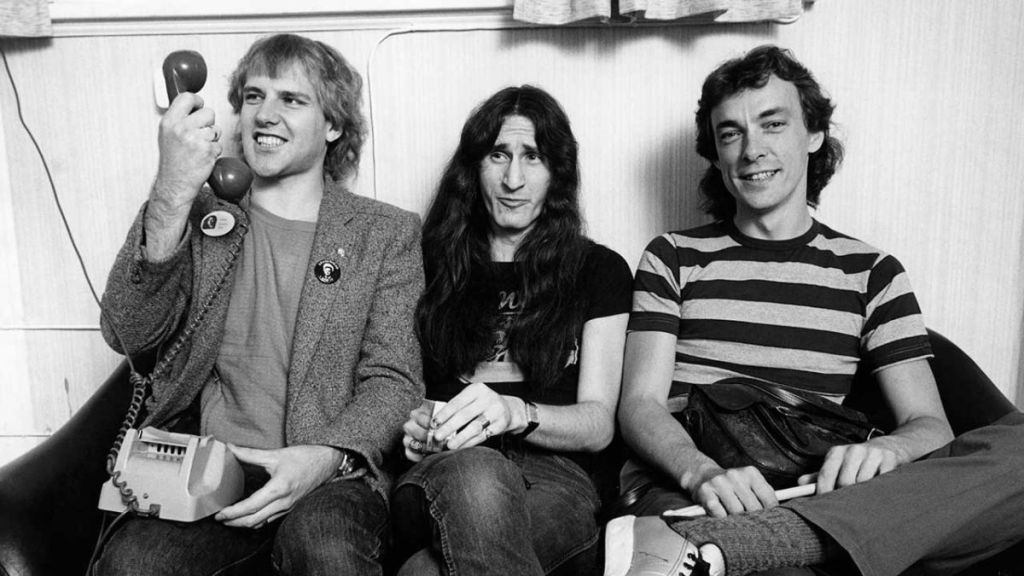
The end of the 70s was not an easy time for prog bands and many groups found themselves in trouble after becoming instantly unfashionable as punk and new wave hit the music press. Rush, on the other hand, had never really enjoyed the acclaim of the music press before, but on the contrary, its ”prog-heavy crap” had been mercilessly mocked by music critics. And since the band’s popularity was steadily growing, there was no real external pressure for Rush to change direction. The fact that the band decided to take a step towards something new with Permanent Waves speaks well for the trio as musicians. They saw the change in the musical environment and realised that it would be good to adapt in time in some way. Preferably, of course, while maintaining the integrity of their own music.
With Permanent Waves, Rush consciously condensed his expression, dropping the 20-minute epics and moving towards more conventional song structures. At the same time, the bass-guitar-drums instrumentation began to expand more and more with synthesizers. The most childish fantasy-themed lyrics were cut out (the song ”Sir Gawain And The Green Night” was completely abandoned from the album…) and, perhaps most importantly, Lee was finally allowed to sing in his own vocal range without any crazy screaming. Sure, Lee’s voice is naturally a high counter-tenor, but the absence of the highest tones from his palette brought a new, natural musicality to Rush’s music. One sometimes hears claims that Rush’s music has somehow been simplified by Permanent Waves, but I don’t think that’s true. The band just learned to integrate their complex rhythms more naturally into the compositions.
Read also: Porcupine Tree: Closure/Continuation (2022)
The Spirit of Radio
The album starts with less than five minutes long ”The Spirit Of Radio” which is perhaps the most pop-oriented music Rush had made so far. With the possible exception of ”Closer To The Heart” (A Farewell To Kings, 1977). The song successfully introduces a new more streamlined Rush. The song is simple and the chorus catchy, but of course the music is embellished with a few proggy moments. And while ”The Spirit Of Radion” is quite pop, it still lacks the pop sheen of future Rush albums and still has a hard rock edge to its sound. In other words, ”The Spirit Of Radio” is a clever and natural leap towards the new. ”The Spirit Of Radio” appeals to a new audience, but it’s not too radical a revamp to alienate old Rush fans. However, some old fans may have had their throats choked by the reggae-inspired moments towards the end of the song. The reggae influences add a little eclectic overtone to the music which I find purely refreshing. Reggae influences could be heard later in Rush’s music on several tracks (including ”Vital Signs” and ”Digital Man”).
Pleasingly, ”The Spirit Of Radio” abandons the sci-fi/fantasy themes that have dominated Rush’s lyrics in the past, and Peart’s lyrics deal with the music industry, where it is the industrial part that is getting the upper hand. The lyrics of ”The Spirit Of Radio” take a particular look at the strictly formatted radio playlists and the pressures this puts on music makers. Ironically, the song, which criticises radio overplay, became Rush’s most radio-played song to date and also performed reasonably well on the singles charts.
Freewill
The next song, ”Freewill”, sums up even better the style Rush came to take their music to in the following years. Rush’s new music was more compact, more upbeat, but still progressive. A prog where the punchiness of rock at its best blended seamlessly with the catchiness of pop and a compact format.
”Freewill” is just over five minutes long, but it packs into its concise duration the same number of ideas that the band would have milked for 10 or even 20 minutes before. ”Freewill” successfully combines a catchy chorus with a prog-like sound. The time signature is changed several times, but it is also done in a more natural way than the band used to do before. A particularly great moment can be heard in the instrumental section in the middle of the song, where Lee’s bass riff turns delightfully serpentine. Lifeson unleashes a sharply sounding, shrill guitar solo over Lee’s bass riff.
In the final minute, Lee briefly returns to his ”bad old ways” of screaming over his natural range, but carefully dosed, the man’s hyena-like cackling serves as a successful final shot.
The lyrics of ”Freewill”, praising free will, still seem to reflect Peart’s enthusiasm for the right-wing fanatic Ayn Rand’s clunky writings glorifying extreme individual freedom and rationalised selfishness. Fortunately, these influences gradually diminished in Peart’s lyrics. It must be admitted, however, that if one were not aware of Peart’s Rand-interest, one might interpret the lyrics more leniently as nothing more than an innocent cry for free will.
”Freewill is the best song Rush had made so far in their career and considering the whole discography, it’s fighting for its place at the top.
Jacob’s Ladder
The third track ”Jacob’s Ladder” is the heaviest and most complex track on the album. It supports the interpretation that Rush was a kind of prototype for the prog metal that was slowly gaining ground in the second half of the 80s.
”Jacob’s Ladder” begins with understated ambiguity, with Lee’s bell-like bass, Lifeson’s guitar chords and Peart’s marching drumming. Peart’s fine snare drumming carries the song into its main theme. The plodding but constantly changing main guitar riff of ”Jacob’s Ladder” is a tasty listen, and Lee’s simple synth parts provide a successful contrast. The lamenting tone of Lifeson’s electric guitar also creates a nice ambience. An ethereal interlude halts the jamming for a few minutes until Peart’s tubular bells give the signal to pick up the pace again. The instrumental section before Lee’s vocals return at the very end is probably the most technically challenging music on Permanent Waves and features some very impressive drumming from Peart.
One of the most interesting aspects of ”Jacob’s Ladder”, especially for the future, is how effectively it makes use of Lee’s tasteful use of simple synthesizer patterns. The synthesizers gradually began to take up more and more space in Rush’s music and up to a certain point their effect was nothing but exhilarating.
As a whole, ”Jacob’s Ladder” isn’t quite as effective as the previous two tracks and even feels a little overlong, but overall it takes Permanent Waves’ first half of the album to the finish line with flying colours.
Unfortunately, the b-side of the album is much more uneven.
Read also: Black Midi – Hellfire (2022)
Entre Nous ja Different Strings
”Entre Nous”, which kicks off the second half of the album, begins with some sharp synthesizer lines but then turns into a rather uninteresting and straightforward rock tune. The synthesizers return here and there, but they feel like disconnected decoration and the song as a whole doesn’t really take off at any point. ”Entre Nous” is followed by another short track ”Different Strings”.
The function of ”Different Strings” on the album is probably to bring some lightness and contrast amidst the other more brash material, but like ”Entre Nous”, this semi-acoustic ballad remains a rather uninteresting and petty filler. It doesn’t help that ”Different Strings” ends very awkwardly, as if in the middle of everything, just as Lifeson starts stretching out his electric guitar into some rather tasty-sounding textures.
Natural Science
Permanent Waves ends with the 9-minute three-part ”Natural Science” which is a nod to the epic style of earlier Rush albums. Apparently music from the shelved adventures of the Green Knight was also included.
”Natural Science” begins with a boring intro section of a couple of minutes called ”Tide Pool” where Lee sings accompanied by an acoustic guitar. In the background, there’s also the sound effects of a studio pool lapping in the background, which should sound like ocean waves, but unfortunately sound like… well, lapping in a swimming pool.
After the anemic intro, the 7/8 time signature ”Hyperspace” section is really effective and one of the best moments of the whole album. Synthesizers create futuristic sounds in the midst of the powerful riff and Lee’s vocals hit with rhythmic intensity. The album’s third and final track ”Permanent Waves” is not as exciting and Peart’s robotic drumming with no groove is a bit distracting.
Despite its unevenness, Permanent Waves is the first really successful Rush album in my opinion. I think even the band itself shares this idea to some extent. Neil Peart has gone even further in wishing that Moving Pictures (1981) had been Rush’s first album. For me, Permanent Waves works very well as a real starting point.
Permanent Waves is a transitional album. It still has one foot in the band’s hard rock-meets-prog past, but at the same time the other boot is already reaching towards a new era of a more slick sound that seamlessly fuses prog and pop. Permanent Waves begins, with a slight hiccups, a new ”more mature” period in Rush’s music, launching a true golden age for the band that continued for three more albums until 1984. For a few years, Rush were on a roll, both artistically and commercially, as Moving Pictures, which built on the foundation laid by Permanent Waves the following year, also became the band’s most successful album.
Best songs: ’The Spirit Of Radio’, ’Free Will’ and ’Jacob’s Ladder’
Author: JANNE YLIRUUSI
Tracks
- The Spirit of Radio (4:56)
- Freewill (5:21)
- Jacob’s Ladder (7:26)
- Entre Nous (4:37)
- Different Strings (3:48)
- Natural Science (9:17)
Rush
Geddy Lee: vocals, bass guitar, synthesizers Alex Lifeson: guitars Neil Peart: drums, percussion
Producer: Rush / Terry Brown
Label: Anthem

 Pienemmät Purot
Jätä kommentti