
King Crimson’s roots go back to the trio Giles, Giles and Fripp, who played psychedelic and deeply humorous pop. The trio consisted of drummer Michael Giles (b.1942), his brother bassist Peter Giles (b.1944) and guitarist Robert Fripp (b.1946). The trio released an album in 1968, The Cheerful Insanity of Giles, Giles and Fripp, which was a complete commercial pancake.
Shortly after the first album, multi-instrumentalist (mainly winds and keyboards) Ian McDonald (1946-2022) joined the band. The extended Giles, Giles and Fripp tried to make a second album with singer Judy Dyble (McDonald’s girlfriend at the time), but with little interest from record companies, the band finally called it quits. Soon after, Michael Giles, Robert Fripp and Ian McDonald formed King Crimson, recruiting Fripp’s old friend Greg Lake (1947-2016) to replace Peter Giles as bassist-vocalist. The final line-up was completed by lyricist/visionary Peter Sinfield (b. 1943).

They were an unusually capable unit. It was not at all common at the time for the entire rock band to play at the level of King Crimson. It was more typical for bands to have one or two relatively skilled musicians and the others to stay in the background, playing perhaps with routine, but without any particular spark. In King Crimson’s first line-up, on the other hand, any one of the members was capable of taking their place in the spotlight in any situation. But instead of excessive soloing and egoism, the group also knew how to blow together seamlessly and play on the terms of their mercurial compositions.
The recording of the album began in earnest in the summer of 1969. A couple of attempts were made to make the album, working with Tony Clarke who had guided The Moody Blues before, but King Crimson were not happy with the initial recordings and Clarke was sent home. King Crimson were finally given the opportunity, rather unusually at the time, to produce the album themselves, entirely in accordance with their own vision.
In The Court Of The Crimson King starts with an explosive start with ”21st Century Schizoid Man”, probably King Crimson’s most famous song, co-written by the band. With the very first song, King Crimson sort of redefine what you can actually do in rock music, and in a way created a template for progressive rock. The song opens with a flurry of mysterious wind effects, until a heavy guitar riff played by Robert Fripp and invented by Greg Lake hits relentlessly, as if to let the listener know that something completely new is about to happen. The effect is immediately complemented by Greg Lake’s violent vocals, which have been distorted into an inhumanly robotic sound. The effect is still impressive, and one can only imagine how outrageous it must have been in 1969. Lake’s filtered voice spits out fierce anti-war and anti-capitalist verses, full of anger and disillusionment with those in power. The Vietnam War has undoubtedly inspired verses such as:
Blood rack barbed wire
Polititians’ funeral pyre
Innocents raped with napalm fire
Twenty first century schizoid man
but overall, the lyrics remain just the right degree of abstract and yet so strong in drawing pictures in the listener’s imagination that they have retained their power perfectly to this day.
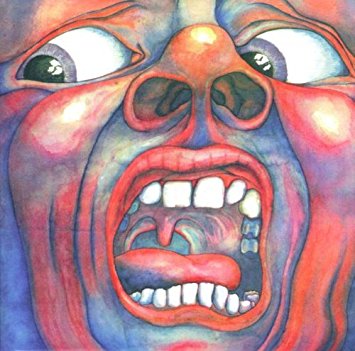
One of the most famous parts of Schizoid Man is, of course, the fast aggressive unison sections, with Fripp and McDonald racing their fast runs and Giles drumming with a nimble frenzy. McDonald tried to play the saxophone as aggressively as possible, even going so far as to play his solos in the most awkward positions possible, wincing to add more pain to the playing. McDonald’s playing has a jarring ornettecoleman-like style, and the contrast with his often rather mellow compositions is enormous. At the end of the day, this is the man who once joined the soft rock band Foreigner…!
Schizoid Man manages to combine the power of heavy and frenetic rock with the subtle technicality of jazz in a perfectly seamless and unique combination that would influence progressive musicians for decades to come.
After Schizoid Man, the mood changes completely with the serene Ian McDonald composition ”I Talk To The Wind”. The pastoral track is like a last glimpse back to the innocent hippie days after the electronic storm of ”Schizoid Man”. McDonald’s flute and Greg Lake’s melancholic vocals play a central role in the song. The song has probably been the inspiration for many of Genesis’ more pastoral songs.
Next up is the mournfully beautiful and poignant ”Epitaph”, which, along with ”Schizoid Man”, is the album’s finest offering. ”Epitaph” is considered a joint composition by the band, although both McDonald and Lake have tried to claim greater credit for its various parts. ”Mellotron, the instrument of mythical proportions in ’Epitaph’, makes its debut on the album as the song opens with the bravely lilting Mellotron strings. The string sounds produced by the Mellotron are positively different in their artificiality from real strings, so much so that the sound became a concept in its own right and an important part of the sound of many prog bands that followed in King Crimson’s footsteps. (Mellotron is a kind of analogue tape ’sampler’ played with keyboards in real time) Against the backdrop of the Mellotron-centric intro, Giles’ drums pound emphatically as if pounding nails into the coffin of humanity. Although Giles himself wasn’t happy with the drum sounds on the album, I thought they fitted in really well with the music almost throughout the album.
Actually, ”Epitaph” has three relatively equal main stars, which are Mellotron, Peter Sinfield’s lyrics and Greg Lake’s vocals singing them. The apocalyptic lyrics Sinfield wrote for ”Epitaph” balance between profound fatalism and childish teenage angst, but are ultimately heroically rescued by the plus side. Not only the elegant music, which subtly supports the lyrics, but especially Greg Lake’s truly majestic vocal performance, help. Lake’s performance, in all its fatality, is stunning, and you can’t help but feel that he was born to sing that song. It is impossible to think of anyone who could have done the job more elegantly. If the album’s opening track ”Schizoid Man” provided some kind of model for future prog bands in terms of combining energetic rock with complexity, then Epitaph is the perfect model for an epic prog ballad.
After ”Epitaph”, we move on to a slightly more wistful mood. The haunting ”Moonchild” is the most underrated song on the album, and rightly so, although it’s not a fiasco as some people seem to think. The song consists of less than three minutes of ”normal” singing. The vocal part of the song itself is composed by Robert Fripp, and at the end the whole band goes into a free improvisation that lasts almost ten minutes. Personally, I like free jazz and improvised music, but I understand that ”Moonchild” is not to everyone’s taste. The improvisation is not very hard-hitting, but more like a rambling one with all its shrieks and little noises, but every now and then it achieves something quite wonderful that is hard to put into words. A brave experiment (which should have plenty of follow ups in Crimson’s future) even if it was only partly motivated by the fact that the band didn’t feel they had enough composed material for the album. The fact that In The Court Of The Crimson King is often voted one of the best albums in the world, despite containing an almost universally rejected track like ”Moonchild”, says quite a lot about the quality of the rest of the album’s material.
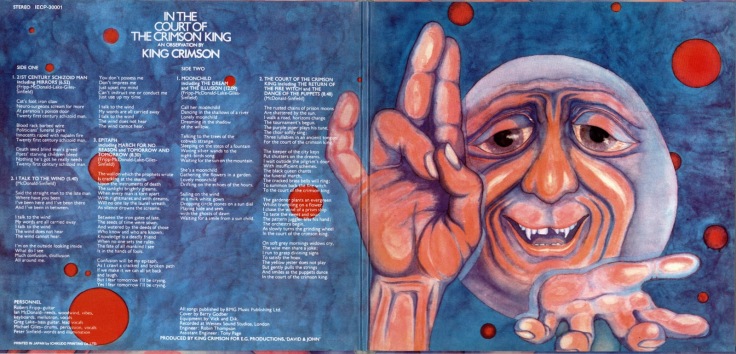
The quiet ”Moonchild” also has the advantage of giving strength to its successor and the album’s closing track ”The Court of the Crimson King”. Colourfully and richly arranged, the song is composed by Ian McDonald. The song contains many clever details and an interesting, somewhat disturbing atmosphere, supported by Sinfield’s fantasy lyrics. On the other hand, whereas Sinfield’s earlier lyrics on record, despite their esotericism, also seemed to make a strong point about the real world, the lyrics of ’The Court of the Crimson King’ seem to be a superficial, albeit imaginatively rich, description of a fantasy scenario. The structure of the song itself is also somewhat repetitive and unsurprising. Except for the very end. Right at the end, when you think the song has ended, the drum-code Giles hits is fantastic!
In The Court Of The Crimson King is an astonishingly strong and mature achievement from young musicians whose average age was only around 23. Perhaps the most remarkable thing about the album is how completely it ignores the impact of the blues at a time when its influence was almost omnipresent in rock music. Instead of blues, King Crimson hoard influences from jazz, folk and art music in particular, without actually quoting any of these genres directly. The band has an incredible ability to fuse those ingredients into a whole new blend. A blend that was eventually dubbed progressive rock. It would perhaps be an exaggeration to say that King Crimson invented progressive rock, but I would argue that In The Court Of The Crimson King can nevertheless in good conscience be called the first fully mature prog album.
The album has had a huge impact, especially on the progressive rock side, but Schizoid Man has also inspired many metal bands. While composing Trespass (1970) at a cottage, Genesis reportedly listened to In The Court Of The Crimson King through and through, and the Yes, on seeing the band live around this time, said that the bar had been raised to the next level and that they would have to practice a lot more in the future to keep up. Of the individual Yes songs, ”Heart Of The Sunrise” owes a clear debt to ”Schizoid Man”.
In The Court Of The Crimson King reached number five on the UK album charts (Crimson’s best ever chart position), and the band was on a strong upswing with intense live shows. The intensity was just too much for the young musicians, and after the American tour, Ian McDonald and Michael Giles decided to leave the band. This was of course a big blow to the band, and the future of King Crimson was in jeopardy. Fripp, Sinfield and Lake decided to carry on, however, and the following year McDonald and Giles also returned as ’guests’ to work on a follow-up to the Crimson saga – In The Wake Of Poseidon. After this, the future of King Crimson was firmly in the hands of Robert Fripp.
Best songs: ’21st Century Schizoid Man’ and ’Epitaph’
Rating: *****
Author: JANNE YLIRUUSI
More reviews can be found here

 Pienemmät Purot
Jätä kommentti