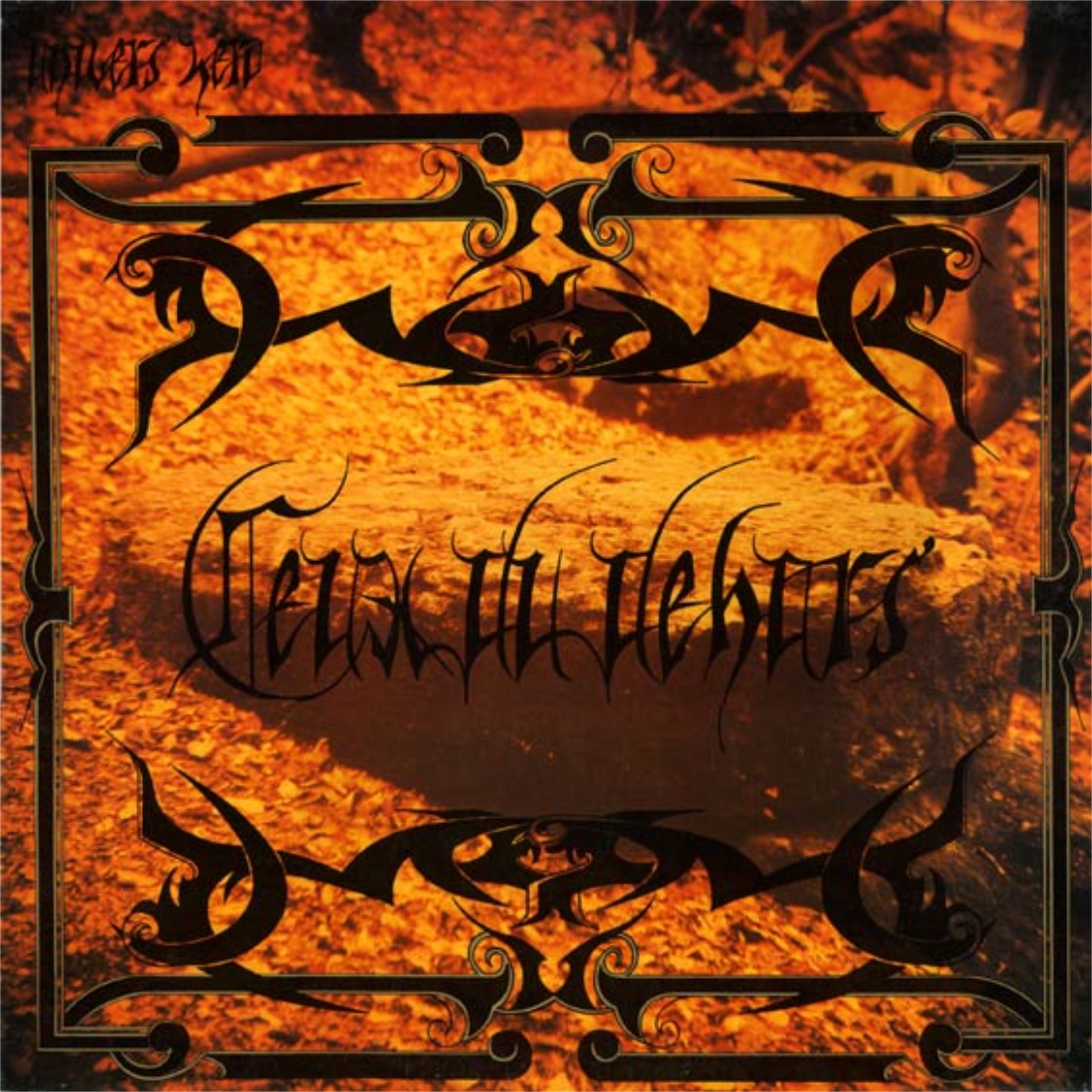
Ceux Du Dehors is Univers Zero’s third studio album.
Founded in 1974, the Belgian avant-prog band Univers Zero released their untitled debut album in 1977. That album was a groundbreaking release within the canon of dark, chamber-music-inspired rock. The music on the album was very dark and complex. On the band’s second album, Hérésie (1979), this direction was taken almost to the extreme, and the album is a downright oppressive, heavy, and dark listening experience. And in a good way, of course! Even a die-hard avant-garde fan like me, however, isn’t ready to listen to Hérésie just any old day. In a way, Univers Zero had painted itself into a corner in a very short time. Where to go from Hérésie?
On Ceux Du Dehors, Univers Zero makes the only right decision and shifts its music in a slightly lighter and less austere direction. This was likely influenced by changes in the band’s lineup as well. The leading figures of Univers Zero had been drummer Daniel Denis and guitarist/keyboardist Roger Trigaux. As I understand it, Trigaux had been frustrated from the start by the minor role of the electric guitar in the band’s music, and after Hérésie he left the band and founded his own nightmare machine, Present. Under Trigaux’s leadership, Present continued more or less in the vein of Univers Zero’s first two albums on their debut album Triskaidékaphobie (1980). Present’s music was, however, more heavily electrified and more reliant on repetition. Under Trigaux’s leadership, Present never compromised on the darkness of their music.
Under Daniel Denis’s leadership, Univers Zero became a more agile and faster-paced band, whose compositions further emphasized the influences of early 20th-century classical music; by this point at the latest, the band had become the rock world’s equivalent of chamber music. The music is, of course, still largely dark in tone, but no longer in a pitch-black way.
Trigaux, who had occasionally played keyboards as well, was replaced by a full-time keyboardist, Andy Kirk, giving the piano, organ, and harmonium more prominence than before. Even the Mellotron can be heard on a few tracks. With the electric guitar completely absent following Trigaux’s departure, the roles of Michel Berckmans’s woodwinds (bassoon, oboe, French horn) and Patrick Hanappier’s violins are further emphasized. Somewhat surprisingly, however, Ceux Du Dehors sounds more like so-called “standard symphonic progressive rock” than its more avant-garde predecessors. This is due, at least in part, to the fact that harmonically, Univers Zero steers Ceux Du Dehors in a more conventional direction than its predecessors, and atonality is no longer as integral a part of the sound as it was in its more avant-garde predecessors. Rhythmic complexity, on the other hand, is not compromised, and *Ceux Du Dehors* is indeed full of irregular time signatures, the mathematical labyrinths formed by which the tightly knit band executes with mastery. And often at very fast tempos.
The album title Ceux du Dehors roughly translates to “outsiders” or “those on the outside,” a reference to horror writer H. P. Lovecraft’s short story collection *The Outsider and Others, but it isn’t strictly a concept album, even though the band drew direct inspiration from Lovecraft for one of the tracks. Rather, “outsiderness” refers to Univers Zero’s position in the music business and a certain “us versus them” (mainstream and record labels) spirit of rebellion that was a central part of the Rock In Opposition bands’ ethos. (RIO was a loose organization launched by Henry Cow, which Univers Zero was among the first to join in March 1978.)
Read also: Review: Magma – Kãrtëhl (2022)
Dense
Ceux du Dehors kicks off with “Dense,” a 12-minute-long, intense, and truly fast-paced composition. True to its name, it’s a highly dense piece of music that’s constantly evolving and changing. And for most of the time, at a breakneck pace! It’s particularly delightful how smoothly the transitions from one section to the next are handled. For such a long and complex track, “Dense” is a surprisingly seamless and natural whole. The transitions don’t feel forced, as is unfortunately often the case with longer prog tracks. What makes this particularly impressive is that Denis was entirely self-taught as a composer and didn’t have years of conservatory training behind him—something it would be easy to mistake based on this (and other) compositions.
“Dense offers numerous opportunities for virtuoso performances, but the focus is on tight ensemble playing rather than individual performances. There are solos to be heard, however, and Berckmans’s wind instruments in particular sound truly magnificent; nor can I fail to mention Guy Segers’s intricate yet undeniably driving bass riff (the riff is occasionally handed off to Berckmans’s bassoon). Around the midpoint, the frenzied track slows down and quiets, allowing for a brief moment to catch one’s breath. Hanappier’s violin and Berckmans’s oboe bring a hint of melodic wistfulness amidst all the intensity. Denis, who composed the track, once again demonstrates with his drumming—which constantly seeks out new angles—that he is one of the best drummers in progressive rock. Denis deserves far greater acclaim than he has received.
There wasn’t any aimless noodling or jamming on Univers Zero’s previous albums either, but “Dense” takes the band’s compositional precision to a whole new level. It’s an absolutely stunning track—not only one of the best on Ceux du Dehors, but also one of the band’s finest songs overall.
Read also:
- Review: Cos – Viva Boma (1976)
- Levyarvio: King Crimson – The ConstruKction Of Light (2000)
- Review: Camel – Moonmadness (1976)
- Review: Gong – Gazeuse! (1976)
- Review: Mike Johnson – The Gardens Of Loss (2026)
- Levyarvio: Mike Johnson – The Gardens Of Loss (2026)
- Levyarvio: Led Zeppelin – Presence (1976)
- Vuosi vuodelta : Parhaat levyt 2000 – Sijat 11-20
- Review: Univers Zero – Ceux Du Dehors (1981)
La Corne du Bois des Pendus
The second track, “La Corne du Bois des Pendus,” which runs just under nine minutes, features significantly calmer music than “Dense” and bears a strong influence of medieval music. Medieval vibes have been heard in Univers Zero’s music before, but never quite this distinctly. The track paints vivid images of a medieval marketplace where, amidst the everyday bustle, something terrible is unfolding. Perhaps a public hanging. Whereas Univers Zero’s early albums cultivated an almost manic, panic-inducing, heart-pounding horror, “La Corne du Bois des Pendus” employs a more subtle and surrealistic style of terror. In the first half of the track, one begins to wonder if the composition will remain merely a medieval pastiche, but when unexpected rhythmic pauses, eerie vocals, and extended instrumental techniques (scraping violins) come into play, along with effectively used church organs, an intriguing and original tension emerges in the music. It becomes Univers Zero music rather than a pastiche. And few compositions paint such vivid imagery as the hazy nightmare known as “La Corne du Bois des Pendus.”
Bonjour Chez Vous
“Bonjour Chez Vous” (“Hello Home”) is the lightest music Univers Zero had released up to that point. The fast and short track is downright playful, yet it retains the intensity typical of the band, and even here, the tight rhythms and violently strumming violins are certainly no child’s play.
Combat
The fourth track on the album, “Combat,” was composed by new member Andy Kirk. Stylistically, it bears some resemblance to the album’s first track. Like “Dense,” “Combat” is a highly complex composition featuring numerous twists and turns. It also runs for the same 12 minutes. As the title suggests, it features a strong warlike atmosphere, emphasized particularly by the tight, driving rhythm. Between the more violent sections, there is a lengthy, contemplative acoustic interlude, after which the return to the song’s fast-paced theme feels all the more powerful. The hard/soft/hard alternation is an old prog cliché (and, of course, derived from classical music), but Univers Zero masters this technique on Ceux du Dehors in a truly compelling way. In the magnificent finale of “Combat,” Segers’ bass guitar rumbles with satisfying Magma-like intensity while Hanappier grinds out a frenzied violin riff and Denis rages wildly, yet at the same time with great control, around his drum kit. “Combat” is an impressive debut from Kirk as a composer for Univers Zero, and he would go on to assume an increasingly significant role in this capacity.
La Musique d’Erich Zann
“La musique d’Erich Zann” Univers Zero immerses itself in the atmospheres steeped in H.P. Lovecraft’s existential horror, as the band drew inspiration for its music from the cult horror writer’s short story of the same name. The band members read the story and then picked up their instruments, striving to channel the narrative through free improvisation. The result is a three-minute track that creeps along in eerie silence and scratches at the ear, painting for me images of a damp and dark catacomb where something horrifying lurks in the corridors. The music intensifies toward the end into an atonal haze and suddenly fades almost completely, except for a rusty, creaking violin. As a standalone track, ”La musique d’Erich Zann” isn’t exactly a landmark piece, but as part of the album, it works well, adding dynamism to the overall arc.
La Tete du Corbeau
The next piece is also quite understated. And entirely acoustic. The dark-toned chamber music composition “La Tete du Corbeau,” lasting just three minutes, is a slowly lingering piece reminiscent of Béla Bartók, in which Thierry Zaboitzeff—known from Art Zoyd—plays a dramatic cello that engages in a somber dialogue with Hanappier’s viola. “La Tete du Corbeau” is an impressive miniature. Originally, Ceux du Dehors ended with the melancholic “La Tete du Corbeau,” but for me, the album has always continued for one more track.
Triomphe des Mouches
The CD version released by Cuneiform in 1992 includes the bonus track “Triomphe des Mouches” (The Triumph of the Flies), which was originally released only as a single (for some reason, the idea of a Univers Zero single amuses me greatly…). I first discovered the album specifically in CD format, and it wasn’t until years later that I learned “Triomphe des Mouches” wasn’t on the original album, so it’s a bit hard for me to think of the album without it.
Like its two predecessors, “Triomphe des Mouches” also begins quite quietly and eerily, and for a moment it feels as though the album is starting to repeat itself in a tedious way, but around the two-minute mark, a clock-like ticking rhythm begins to drive the composition forward with intensity, while the organ harmonium hums alongside it in a medieval style. Somewhere far in the background, the piano rings out fatally, like church bells. The band begins to grind out multiple overlapping ostinatos, bringing to mind both the minimalist school of art music and, on the other hand, Univers Zero’s early influence, Magma. “Triomphe des Mouches” is indeed an intriguing new step toward minimalism for Univers Zero, without the band losing its distinctive characteristics. It effectively blends influences from the repetitiveness of minimalist art music into its chamber rock. And even though “Triomphe des Mouches” wasn’t originally included on the album, I think it’s a more natural closing track than “La Tête du Corbeau.”
Read also: Review: Henry Cow – Unrest (1974)
Under the direction of Etienne Conod, recorded primarily at Sunrise Studio (the same venue where many avant-prog classics were recorded, such as the entire Art Bears catalog, Henry Cow’s Western Culture, and Aksak Maboul’s Un Peu de L’Ame des Bandits) Recorded in Switzerland, the album sounds dynamic and crisp, but the soundstage feels slightly compressed and could use a touch more airiness and stereo width. Admittedly, this is nitpicking, especially when considering the small budgets that a fringe band like Univers Zero has to operate on; Ceux Du Dehors is still a highly competent work in terms of production quality.
On *Ceux Du Dehors*, Univers Zero takes a successful step toward a slightly more accessible style of music, adding just the right amount of glimmers of light to the gloom. I believe that Ceux Du Dehors is the Univers Zero album most likely to appeal to fans of more traditional symphonic progressive rock as well.
As of this writing, Univers Zero has released 11 studio albums, placing the band among the rare group of long-standing acts that have never faltered at any point in their career. Ceux Du Dehors may well be the shining gem of Univers Zero’s magnificent discography.
Best tracks: ”Dense”, ”La Corne du Bois des Pendus”, ”Combat”
Author: JANNE YLIRUUSI
Read also: Review: Henry Cow – Western Culture (1979)
Tracks
- Dense (12:26)
- La Corne du Bois des Pendus (8:42)
- Bonjour Chez Vous (3:52)
- Combat (12:53)
- La Musique d’Erich Zann (3:29)
- La Tete du Corbeau (3:11)
- Triomphe des Mouches (5:36) (ei mukana alkuperäisellä vinyylillä)
Univers Zero
Andy Kirk: piano, harmonium, organ, Saint-Jacques church organ (2), Mellotron (1,4), vocals (2,7), glockenspiel (6), Yamaha CP70 (6) Patrick Hanappier: viola, violin, vocals (2) Michel Berckmans: bassoon, oboe, French horn (1), vocals (2) Guy Segers: bass guitar, clarinet (7), vocals (2,7) Daniel Denis: drums, percussion, vocals (2,7), cymbals (6), harmonium (7), violin (7)
Guests
Ilona Chale: vocals (4) Jean-Luc Aimé: violin (3) Thierry Zaboitzeff: cello (6) Jean Debefve: hurdy-gurdy (2)
 Pienemmät Purot
Jätä kommentti