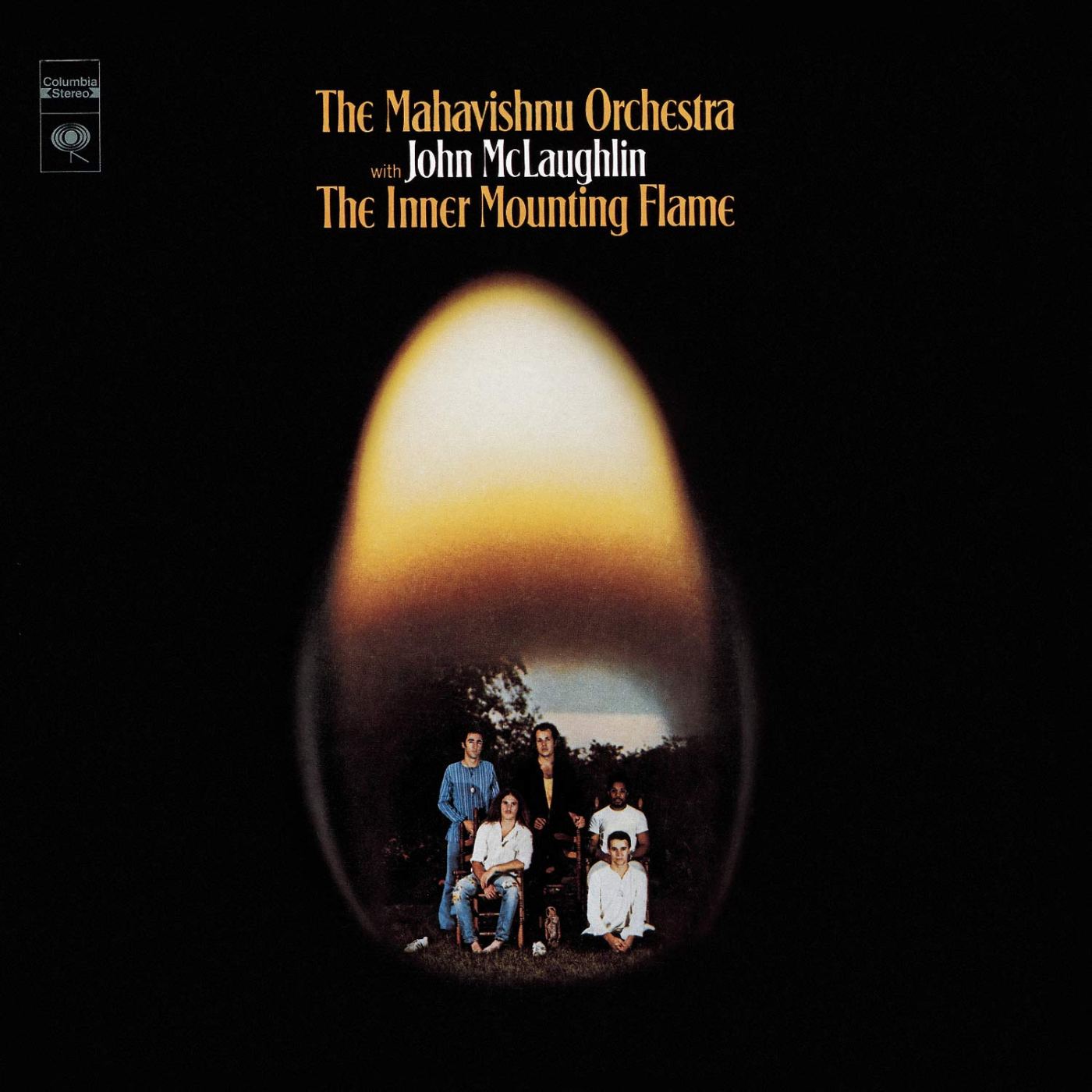
The Inner Mounting Flame is the first studio album by The Mahavishnu Orchestra, led by British guitarist John McLaughlin (b.1942).
Conceptually, The Mahavishnu Orchestra was largely a continuation of drummer Tony Williams’ jazz-rock band Lifetime, in which McLaughlin had played with bassist Jack Bruce. The Mahavishnu Orchestra continued in the Lifetime vein, playing raw and upbeat jazz rock with a predominantly rock dominating over jazz.
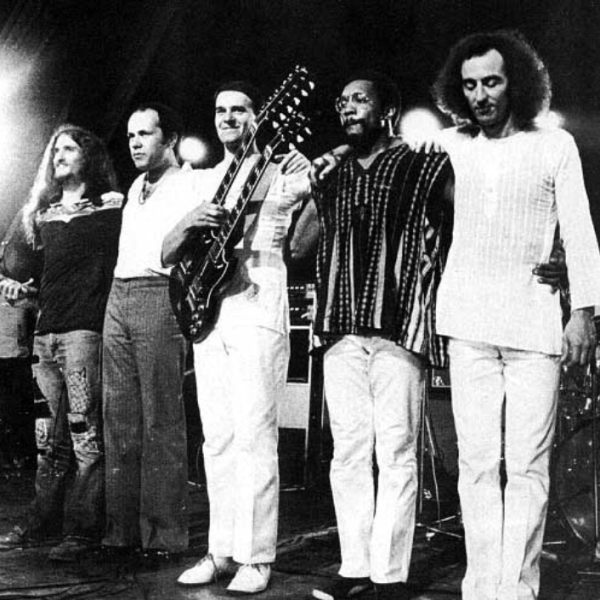
For the Mahavisnu Orchestra, McLaughlin assembled a truly multinational cast. McLaughlin’s first recruit was supposed to be American bassist Tony Levin, but after Levin declined the honour, Irishman Rick Laird (1941-2021) was chosen to lead the quartet. The drums were filled by the vigorous Panamanian Billy Cobham (b.1944), the keyboards by the Czechoslovakian Jan Hammer (b.1948) and, after Jean Luc Ponty’s entry into the band fell through due to visa problems, the violinist was the American Jerry Goodman (b.1949).
The Inner Mounting Flame is a sovereign combination of hard-rock-like crackling ferocity and jazz virtuosic agility. The album can be considered one of the first jazz-rock records that really rocks like a beast.
Indeed, the band’s rough rock sound is one of the album’s greatest strengths: although the music is full of almost superhuman performances, it still feels edgy and dangerous throughout. The album has not been polished to a sterile flawlessness, but the sound is jagged and the listener is constantly in a kind of fear that the musicians are really playing at the limits of their abilities and there is a possibility that the whole thing could crash to the rocks at any moment. Well, of course that never happens.
McLauglin’s compositions on The Inner Mounting Flame are relatively simple in structure, although the individual sections are challenging due to irregular time signatures, exotic scales and very fast tempos. The band’s unison riffing is also often very impressive to listen to.

And as impressive as the band as a whole is, it is the guitar hero himself, John McLaughlin, who is the main protagonist. McLaughlin’s super-fast guitar playing was something that had never been heard before. McLaughlin was like Jimi Hendrix to the power of two. Or maybe more like a combination of Hendrix and John Coltrane on saxophone. McLaughlin has often said that in his youth he was impressed by saxophones, not guitarists, who he felt in the 60s were nowhere near the skill of the best wind players. McLaughlin’s million-note-per-minute strumming on this album has inspired a huge number of guitarists from fusion jazz, prog and heavy metal. And not always with flattering results. But by this time it was a recent phenomenon, and McLaughlin’s playing, even on the fastest runs, is far more refined than that of almost any guitarist who followed in his footsteps.
My favourite track on the album is ”Noonward Race”, driven by Cobham’s manic drumming. Bassist Rick Laird prevents the song from going completely off the rails by bringing a hypnotic bass groove to the table and letting the four (yep, this band has a solo drummer!) soloists rip it up really tasty. Goodman kicks off the solos with a nice earthy, gruff violin sound, then Hammer gets going with a really exciting, metallically resonant ring-modulated Fender Rhodes sound. One of the most interesting aspects of the album for me is Jan Hammer’s excitingly shrill keyboard sounds. There is still something futuristic, alien and fascinating about his sounds. After Hammer and McLaughlin plays another impressive and super-fast guitar solo, on top of which Cobham forges a solid drum solo. Whoah! No notes are spared in this song. The song is like an exploding volcano that destroys everything in its path. It’s really easy to imagine how impressive the song must have sounded in 1971.
Along with ”Noonward Race”, another key track on the album is ”The Dance Of Maya” which starts with ominous chords reminiscent of King Crimson and after a few minutes turns into irregularly paced blues-rock.
The album also has its quieter aspects, the best example of which is the mainly acoustic ”A Lotus on Irish Streams” which, although it too, moves forward at times with the lightning-fast note claps that McLaughlin creates from his acoustic guitar, and then again calms down to a more lyrical mood, especially with Hammer’s beautiful piano playing. Goodman’s violin also gets a nice space in the song.
Apart from the quieter moments mentioned above, I still miss a bit more subtlety and polish in The Inner Mounting Flame’s compositions. On the other hand, the energetic and fiery jazz-rock of the album, with its virtuoso playing, is a truly moving experience to listen to from time to time.
The Inner Mounting Flame was a strong start for The Mahavishnu Orchestra and the band immediately established themselves as the most popular jazz rock band of the 70s with the only real challengers in terms of popularity being Weather Report and Return To Forever. The band also inspired numerous rock bands, and the likes of Yes and King Crimson have acknowledged their debt to The Mahavishnu Orchestra’s furious jazz-rock.
Best songs: ’Noonward Race’, ’A Lotus on Irish Streams’, ’The Dance Of Maya’
Author: JANNE YLIRUUSI
Tracks:
- Meeting of the Spirits – 6.52
- Dawn – 5.10
- Noonward Race – 6.28
- A Lotus on Irish Streams – 5.39
- Vital Transformation – 6.16
- The Dance of Maya – 7.17
- You Know, You Know – 5.07
- Awakening – 3.32
Band:
John McLaughlin: guitars Rick Laird: bass Jan Hammer: keyboards Billy Cobham: drums Jerry Goodman: violin
Producer: John McLaughlin
Label: Columbia Records
Other album reviews can be found here.

 Pienemmät Purot
Jätä kommentti