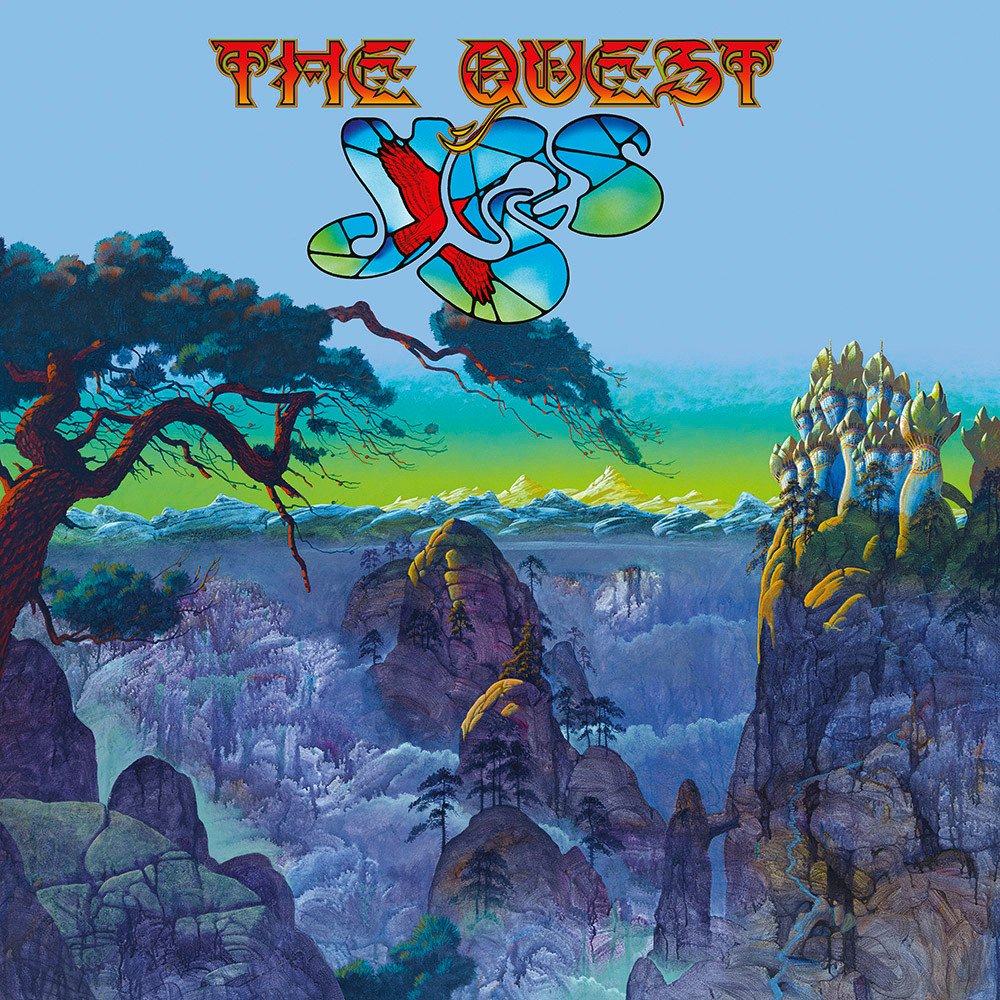
The Quest is Yes’ 20th or 21st studio album, depending on how you want to count it.
Formed in 1968, the last 20 years of Yes have been a turbulent time. To be honest, the same can be said for the last 40 years, but let’s just focus on the last two decades of the band’s life.
Yes’s journey from Magnification to The Quest: 2001-2021
The 2000s began in an artistically powerful way for Yes with Magnification, an album that beautifully combined a rock band and a symphony orchestra, released in 2001. Unfortunately, the big-budget album did not do very well commercially. In particular, the band’s founding member and one of its driving forces, vocalist Jon Anderson, took it particularly hard, leading to a situation where his and therefore Yes’s interest in new studio albums in the near future was nil.
But Yes went on a bold tour with a symphony orchestra in 2002. The tour was a success (and reached as far as Helsinki, my home town) and so were the tours that followed, and the band’s live popularity grew steadily. In 2004, the band celebrated 35 years of existence with a successful tour with Rick Wakeman, who returned to the fold few years before. However, Anderson in particular was getting tired of the endless touring and at his request the band went on hiatus for several years. It wasn’t until 2008 that plans for a return were made, when the band decided to embark on a 40th anniversary tour, which had already come up with a bold name: Close to the Edge and Back Tour.
Just before the tour started, however, disaster struck. Anderson suffered a malignant asthma attack that nearly killed him. Anderson’s lungs were badly damaged by the attack and he was forced to take a long sick leave.
Anderson’s relationship with co-founding bassist Chris Squire had been strained over the years, and in light of this, Yes’ next move is perhaps not as surprising as it might otherwise be. Yes decided to continue without Anderson, who had been with the band for all but one album and tour.
However, Wakeman remained loyal to Anderson this time and once again jumped ship (Anderson and Wakeman made an album The Living Tree in 2010 and toured on a small scale). The remaining trio of Squire, guitarist Steve Howe and drummer Alan White recruited keyboardist Oliver Wakeman (Rick’s son) and Canadian vocalist Benoît David, who had previously shown his talents in Yes tribute band Close To The Edge. The quintet toured for a while without the Yes name, but in October 2009 Squire announced that the new line-up was indeed Yes. Anderson, who was slowly recovering, was not happy but could do nothing about it.
After Anderson’s firing, the new Yes had so far only focused on touring, but in 2010 the band returned to the studio. The first attempt failed to produce a satisfactory result and the album was abandoned. Today, however, nothing ultimately goes unreleased and some of the fruits of that session were finally released in 2019 in the form of the EP called From A Page.
The next attempt proved more successful: old Yes veteran Trevor Horn, who had since become one of the most successful producers on the planet, was invited to produce and agreed on the condition that the unreleased song ”We Can Fly”, inherited from the Drama album (1980), would be included. This worked out well for Yes and eventually Horn’s composition was expanded into a full album-length suite and other material from Horn’s The Buggles days was included. At Horn’s insistence, his old keyboard partner Geoff Downes (also Asia) was also recruited for the album and Oliver Wakeman was given the opportunity to pack up his keyboard and travel home empty handed. Yes’ personnel policy has been ruthless from the start (bye Peter Banks, bye Tony Kaye, don’t call us, we’ll call you Patrick Moraz etc.) and clearly continued into the 2000s. However, 2011’s Fly From Here was a very good album and it was further improved in 2018 when Horn radically remixed it as The Return Trip, replacing Benoît David’s vocals with his own.
Poor David had already had to pack his bags in 2012 when it became clear that his voice could not cope with the rigours of touring. Jon Davison, another Yes tribute band veteran who had also sung in the prog band Glass Hammer, was hired to replace him. With Davison, Yes continued to tour extensively until early 2014, when Yes returned to the studio again. This time with Roy Thomas Baker, who had produced Queen, among others. Yes has always been slow to learn from its mistakes, having already tried to collaborate with Baker on an album that was supposed to follow 1978’s Tormato with little success. Nothing came of that album and it didn’t really work this time either. It is reported that Baker’s contribution to the sessions was non-existent and the album was eventually mixed by Billy Sherwood, who had been a member of Yes for a while in the late 90s. Heaven & Earth, released in the summer, was almost a complete failure for all but the most fanatical Yes fans. The bland Heaven & Earth sounded nothing like Yes and even the band members themselves, with Steve Howe leading the way, have admitted that the end result was less than satisfactory.
But poor albums don’t hurt the fortunes of dinosaurs like Yes, and the band continued to tour, mostly ignoring Heaven & Earth.
In May 2015, the band received bad news when Squire was diagnosed with leukaemia. Squire was hospitalised for treatment, but even this didn’t stop Yes. Squire asked Sherwood to support him on the band’s summer tour of the US. That tour had barely begun when Squire died on 27 June. Sherwood thus became an official member of Yes again and the band continued without any of the original members for the first time in its history.
After Anderson and Squire, guitarist Steve Howe took on the role of unofficial leader of the band. Under Howe’s leadership, Yes continued to tour the world and released several live albums. The band’s performances were a little uneven and, especially on the tempo side, things often fell flat. Drummer Alan White suffered from severe back problems and eventually it got so bad that he only played a few songs on stage, leaving most of the drumming to Jay Schellen. However, this did not restore the spark to Yes’s playing and in general the Yes of the 2010s has been a shadow of its former self on the road. Personally, I saw Yes live in London in 2018 and the experience was mostly ”just okay” which for me, as a big fan of the band, is not exactly what I would hope for from the band’s shows.
Read also: Yes: Mirror To The Sky (2023)
However, Yes still had enough of an audience that the band could probably have toured the halls of a few thousand people for the rest of Howe’s life and might have done so if they hadn’t finally been stopped by the same thing that stopped every other rock band on the planet: the coronavirus.
The coronavirus virtually halted almost all touring globally for almost two years. There are positives to be found in almost everything and that is possible even with coronavirus. With touring no longer an option many bands returned to recording despite the fact that a few years earlier that would not have been very attractive. Record sales have stagnated due to the rise of streaming services, among other things, to the point that for dinosaurs like Yes, touring has become the most lucrative way to build up a pension fund. This is where things have turned completely upside down compared to the 70s. Back then, big and medium-sized bands made a good profit by selling millions of records at best, and touring was mainly a promotional activity and often even a deliberately loss-making activity in itself. Nowadays, even big bands can be happy if the sales figures for a new album are measured in tens of thousands rather than thousands of copies.
The stoppage caused by the pandemic gave Yes the last necessary impetus to return to the studio, but the band had been planning it for some time and much of the material on The Quest was written before the pandemic began.
So what will Yes’ first album of new material since Squire’s death in 2015 be like? How does it compare to Squire’s swan song Heaven & Earth?
I have good and bad news for you.
First the good news: The Quest is definitely a better album than Heaven & Earth, which was lacklustre in every way. Whereas Heaven & Earth’s laid-back grandpop would hardly have been associated with Yes had it not been for the famous Roger Dean logo on the cover, The Quest is much easier to understand and accept as part of the band’s diverse continuum. The arrangements have regained their Yes-like intrigue and the old guys have managed to squeeze in at least a hint more energy. Overall, the compositions, and especially the arrangements, are a step up from their predecessor.
And what about the bad news?
The main problem with The Quest is that it still sounds very cautious when compared to Yes’ best albums. Or even the albums the band made back in the 80s and 90s. Where Yes used to rock and groove in their hippie mocassins in irregular time signatures, now it’s grandfathers sneaking around in their slippers, careful not to break a hip and wake the grandchildren from their nap.
However, it is comforting that with The Quest, the band is taking a step in the right direction, even though the members are a few years older. There still seems to be a bit of a desire to show off.

Yes today
Before we take a closer look at the music of The Quest, let’s see what kind of musicians are behind it.
Guitarist Steve Howe is the longest-standing member of the band. Having joined Yes in 1971 with The Yes Album, the 74-year-old Howe has clearly taken over the leadership of the band. Howe is one of the most important guitarists of the golden age of progressive rock. Not only a highly technically skilled but also extremely versatile guitarist, his pace and energy have faded in recent years, but at his best his playing is still elegant, though perhaps not as thrillingly wild as it was in the 70s.
In addition to Howe, drummer Alan White is also a true veteran of the band. White joined Yes in 1972 after his predecessor Bill Bruford ran away to King Crimson. White’s breakthrough album was Tales From Topographic Oceans and he soon became one of the most powerful drummers in prog rock. At his best, White was a drummer who rocked and grooved like any of his contemporaries, but he also had enough technique to handle Yes’ most complex and subtle songs.
Unfortunately, White has long suffered from serious health problems and on several Yes tours he has only been able to play a few songs, with Jay Schellen doing the majority of the gigs. When I last saw Yes in 2018 I was horrified at how frail White looked as he trudged onto the stage. Surprisingly, though, he ended up playing quite well. Albeit for only two songs. On The Quest, at least according to the credits, White plays all the drums, with Schellen playing only the occasional percussion, and although there’s nothing particularly killer on the album in terms of drums, White does a decent job of bringing it home. His playing supports the gently floating tracks quite aptly. It is then another question as to what extent the overall lightness of the music is due to White’s playing style. Personally, however, I would point the finger of blame more towards Mr Howe.
At 50, vocalist Jon Davison is by far the youngest member of the current Yes. Davison, who has been singing in the band for almost a decade, seems to be slowly emerging from the huge shadow of his predecessor Jon Anderson. Like Anderson, Davison sings in a very high-pitched voice, but contrary to what many casual listeners claim, their voices are far from identical. In my opinion, Anderson’s voice is much more complex and varied than Davison’s. Anderson’s voice has a roughness and edge in places that Davison’s sonorous voice completely lacks. Davison’s voice doesn’t seem to fit particularly well with the band’s more rocking material (fortunately for Davison, Yes’ new material doesn’t rock…). Davison’s clear voice is, however, pleasant sounding in itself and even ”exotic” in a charming way in places. On The Quest, Davison sings better than ever and his vocal delivery is more polished than it has ever been. Davison’s vocal melodies are also quite interesting in places and he doesn’t always go for the most obvious solutions. Davison is a good substitute for Anderson, and he could still become a very good vocalist if he manages to broaden his expression and get a touch of grittiness in his voice, even if only for a few moments.
Keyboardist Geoff Downes returned to Yes shortly before Davison joined.Downes, 69, was invited to Yes at the request of producer Horn during the recording sessions for 2011’s Fly From Here and has been with the band ever since. However, Downes also has an earlier Yes history, having joined Yes with Buggles partner Horn back in 1980. At that time Downes and Horn played a major role alongside Howe, Squire and White on the five-piece’s Drama, the first Yes album to be made without Anderson. However, Horn and Downes left Yes on their own after the tour that followed Drama, which left Yes in the dock for a few years.
Downes, despite his classical training, has never been a nimble-fingered virtuoso like Rick Wakeman or Patrick Moraz, but has a background more focused on sounds and moods – and rhythm – although he is capable of taking on a solo role when needed. On Heaven & Earth Downes’ role was rather thin and on The Quest he is given a bit more space as both player and composer. Downes may not always be quite at home playing the most complex repertoire in Yes history, but when he is free to create his own parts he is a relatively style-conscious player even if sound-wise he is a bit too much a prisoner of the 80s style.
And how does new bassist Billy Sherwood fill the boots of the legendary Chris Squire? In short: very well. I’m not a big fan of Sherwood in general, and I downright hate his forced-sounding and deathly-effected prog solo records, but as a bassist he’s a good one. Sherwood plays with a natural feel the melodic bass patterns typical of Squire that often figure prominently on The Quest. The gap left by Squire in the backing vocals is not filled as effectively by Sherwood, whose autotune-smoothed vocal parts are no match for Squire, who at least could actually sing. Fortunately, Sherwood’s vocals are not quite as lifeless as on his own albums and are not heard on many tracks.

The Quest
Let’s finally move on to The Quest. The album consists of eleven 4-8 minute tracks, three of which have been separated into their own independent disc. I will treat this second disc as a bonus disc in this text and concentrate on evaluating The Quest mainly on the merits of the first disc.
Compositionally, The Quest is a fairly democratic work. However, Howe and Davison’s names appear most prominently in the compositional credits and White is conspicuous by his absence. Howe has composed three of the songs on the main album on his own. Davison has composed one track on his own and four as a split, two with Sherwood and two with Downes.
The Quest is the only album in the Yes catalogue, apart from Trevor Rabin’s Talk (1994), to be credited to a single member. This time, of course, this rare honour has fallen to the band’s current leader Steve Howe. And he is performing the task quite admirably, although his previous CV in terms of producing work has previously been limited to his own solo albums. The Quest sounds much better than its rather bland and under-produced predecessor. The sounds are balanced and distinctive and there is a fair amount of dynamics. In terms of sound, The Quest actually sounds somewhat similar to Magnification, although it doesn’t have quite the same luxurious soundscape.
The album opens with ”The Ice Bridge” which was also the first single release on the album. The song’s fanfare-like synth intro, played with a trumpet-like sound, is for a moment very reminiscent of Emerson Lake & Powell’s ”Touch And Go” (1986). So much so, in fact, that you can’t help but wonder if it’s Downes’ tribute to his late hero Keith Emerson. However, Sherwood’s tasty groovy bass pattern and finally Davison’s bright and clear vocals take the music into their own waters and it’s starting to sound like Yes. Especially when Howe’s very recognisable guitar breaks spice things up.
The lyrics are obviously about climate change at least on some level and the very Jonadersonian verse ”this is exponential ancient overdrive” brings a smile to the face. It’s just a pity that Davison as a vocalist is too one-note and he doesn’t really get a proper lift to his pleasant performance at any point of the song. On the other hand, this is also partly a built-in problem of the composition. At the point where you would expect some kind of final climax to start, the band gets stuck in an entertaining jam that doesn’t really take the song anywhere, but just stagnates for a couple of minutes. This jamming is reminiscent of the guitar and synth dialogues between Howe and Wakeman that Yes used to include in their live versions of ”South Side Of The Sky” (Fragile, 1971) in the early 2000s.
”The Ice Bridge” doesn’t come close to the mastery of Yes’ best songs, but on the other hand, it avoids the deepest pitfalls. ”The Ice Bridge” is pleasant Yes-light.
There is a curious subplot to ”The Ice Bridge”. The song originated when Downes was digging through his old 70s archives and found a promising demo that he and Davison built into a finished Yes song. Unfortunately, it soon turned out that the demo he had thought was his own was actually the work of Francis Monkman, former keyboard player for Curved Air. The misconception is explained by the fact that both Downess and Monkman made library music for the same company in the late 70s, and the tapes that circulated within the company were mixed up at some point. Monkman contacted Yes management and the matter was quickly and gentlemanly settled and his name added to the credits of the song. And for good reason: a demo of Monkman’s track can be found on YouTube and the final ’The Ice Bridge’ owes a great deal to it, although its arrangement is much more refined. It’s quite tragic that the best song on the new Yes album is based on a forty-year-old demo that wasn’t even written by a band member!
Following ”The Ice Bridge”, ”Dare To Know” and ”Minus The Man” both make use of a small symphony orchestra. The former in a rather cheesy and corny way, the latter in a more subtle way. So subtle, in fact, that one wonders if Downes’ keyboards wouldn’t have done the job. The orchestrations on both tracks do not reach the same level as on the great Magnification album of 2001. Not that there’s much to cheer about in the songs anyway. The chorus of ”Minus The Man”, by Davison and Sherwood, does have a strong earworm factor.
The Quest’s orchestrations are by Paul Joyce, who also played the same role on Howe’s orchestral album Time (2012). Joyce had a 47-piece North Macedonian (orchestras are cheaper in Eastern Europe…) orchestra at his disposal for The Quest. If only it had been better used. With Magnification, Yes managed to find an excellent balance between orchestra and rock instruments and even Time And A Word’s often maligned orchestrations are actually quite powerful. On The Quest, the orchestrations sound at best like extra ornamentation and at worst like corny and flat.
Read also: Pink Floyd: A Momentary Lapse Of Reason (1987)
The album’s fourth track ”Leave Well Alone” is the longest track on the album at eight minutes. A track that bears Howe’s name alone, ”Leave Well Alone” begins a little more upbeat than its two predecessors. The basic melody of the song unfortunately sounds more like a simple guitar rehearsal and although the song offers a lot of space for Howe’s guitar playing it doesn’t really manage to raise the track to an interesting level as for some reason he plays with a really weak and downright wheezy sound. Howe was, in my opinion, one of the members of Yes back in the day who really made sure that the band’s progressive rock really rocked. Whereas in the 70s his playing was wild and unpredictable, downright wild, now it sounds mostly competent and polite. Of course, age does not come alone. Howe is already 74 years old. The build-up to ’Leave Well Alone’ is the album’s most surprising offering and while the fight against pop conventions is admirable and very Yes-ish, in the end this Howe composition falls somewhat flat.
”Leave Well Alone” is followed by ”The Western Edge”, co-written by Davison and Sherwood, which begins with majestic-sounding synthesizer notes that Howe’s guitar joins in to finger. A pleasant song in itself, it is constructed as a duet between Davison and Sherwood and herein lies its main problem: Sherwood is a lousy singer who always needs an autotune and although it is not used as heavily in this song as on his own solo albums, the synthetic effect is a nuisance to hear. It’s a shame because The ”Western Edge” could have really taken off if Davison had been paired with a more competent singer.
”Future Memores”, composed by Davison alone, is the most successful song on the album after ”The Ice Bridge”. It doesn’t rock and it’s not really prog either but that’s okay because it continues the series of ”semi-cosmic” ballads by Yes in a nice way. ”Future Memories” is a gentle semi-acoustic ballad that channels the same moods as, say, ”Wondrous Stories” on Going For The One. In this lighter music Davison is at his best and his simple vocal melody works. The accompaniment is mainly Sherwood’s bass guitar, Howe’s acoustic guitar and occasionally a nice electric guitar.
After ”Future Memories”, Howe’s own ”Music For My Ears” is a disappointing drop in quality. The banal ”Music For My Ears” is not music, at least not to my ears, and this uninteresting pop song would be more at home in the Eurovision Song Contest than on a Yes album.
Fortunately, the last track is much better. The Quest started with a composition by Davison and Downes (in case we forget a certain monk…) and it also ends with a song by the same duo. The seven minute ”A Living Island” is a quite successful composition and its arrangement has some of the intricacy that one has come to expect from Yes songs. Where Howe’s at least as intricate ”Leave Well Alone” felt aimless, ”A Living Island” culminates in a successful world-embracing final statement. ”A Living Island” has lyrics inspired by the Corona virus and both pandemic and climate change seem to be themes that many of the songs on the album refer to, at least indirectly. This kind of topicality is actually quite refreshing on a Yes album.
What about the ”bonus disc”? As I alluded to earlier, there’s not much to cheer about. The opening track of the 13-minute set, ”Sister Sleeping Soul”, is a nice little song, though, and would have been a good substitute for ”Music For My Ears”. However, since ”Music For My Ears” at least tries to be a bit more energetic, it is perhaps understandable that the light-hearted ”Sister Sleeping Soul” was relegated to the bonus disc.
The second track ”Mystery Tour” from the bonus album should have been strangled in its cradle and not released at all. The Beatles’ pastiche ”Mystery Tour” is one of Yes’ worst songs, and one of the most embarrassing, especially because of its lyrics. I myself will ignore the existence of ’Mystery Tour’ in the future.
The bonus disc ends with Howe’s composition ”Damaged World” which was supposedly the first song that started The Quest. Fortunately, the quintet recovered from this rather unremarkable mid-tempo song which less pleasantly elevates Howe’s own vocals to the lead.
Final words
My expectations for Yes’ new album were very low after the anaemic Heaven & Earth and the band’s less dazzling recent live albums, so the fact that The Quest is mostly a pleasant listen is a victory of sorts. A pretty lame victory considering Yes’ illustrious history, though.
It’s a bit sad that the best song on The Quest is based on a demo accidentally used by a composer outside the band. Leaving aside this curious accident, the main problem with the album is that it contains too many soft ballad-like compositions which, as compositions, are also rather mediocre. Only ”Future Memories” is a real success in this sector. Fortunately, Yes compensates a little by arranging their modest compositions to the best of their ability, and that is the album’s greatest achievement. The band manages to bring a Yes spirit at least for a few moments to compositions that lack it. However, the boldness and virtuosic firepower of Yes’ best days will be missed even when The Quest is at its best.
Unfortunately, The Quest remains one of Yes’ three weakest albums and the most positive thing that can be said about it is that at least it is better than its predecessor and continues Yes’ admirable habit of not repeating themselves.
Best songs: ’The Ice Bridge’, ’Future Memories’, ’A Living Island’
AUTHOR: JANNE YLIRUUSI
Tracks
- ”The Ice Bridge” Jon Davison, Francis Monkman, Geoff Downes 7:01
- ”Dare to Know” Steve Howe 6:00
- ”Minus the Man” Davison, Billy Sherwood 5:35
- ”Leave Well Alone” Howe 8:06
- ”The Western Edge” Davison, Sherwood 4:26
- ”Future Memories” Davison 5:08
- ”Music to My Ears” Howe 4:41
- ”A Living Island” Davison, Downes 6:52
- ”Sister Sleeping Soul” Davison, Howe 4:51
- ”Mystery Tour” Howe 3:33
- ”Damaged World” Howe 5:20
Yes:
Jon Davison: lead vocals (1, 3, 5, 6, 8-10), duet vocals (2, 4, 7, 11), Fender F-310-12 guitar (track 6), Martin D-28 rhythm guitar (11) Steve Howe: Guitars [Gibson J-15 acoustic (track 1), Gibson Les Paul Roland (1, 8), Gibson Les Paul Junior (2), Gibson ES-175D (2, 4, 7, 11), Gibson ES-345 (3), Variax Sitar Guitar (1), Martin MC-28 acoustic guitar (2, 5, 8, 10), Martin 12-string guitar (2, 7), Martin MC-38 SH acoustic guitar (4, 7, 11), Martin 0018 ’Nashville Tuning’ acoustic guitar (11), Fender Stratocaster (2, 4, 7), Fender Telecaster (3, 10), Telecaster volume and tone pedal rhythm guitar (track 7), Fender Stringmaster steel (4-6), Portuguese 12-string guitar (9), Steinberger GM4T (11), Sho Bud Pedal steel guitar (11), mandolin (1), Gibson F4 mandolin (4)], koto (4), autoharp (4), duet vocals (2, 4, 7, 11), vocals (9, 10) Geoff Downes: piano ( 1, 4, 7, 8), Hammond organ (1, 2, 8, 10, 11), synthesizers (1, 3-5, 7, 9, 11), organ (4, 6), Mellotron (7, 10), Fender Rhodes piano (10) Billy Sherwood: Spector bass guitar (1, 2, 4, 5, 7, 8, 10, 11), Spector fretless bass guitar (6, 9), Rickenbacker 4001 (3), vocals (5, 6, 10), Fender Rhodes piano (3), keyboards (5), acoustic guitar (5) Alan White: drums
Muut muusikot:
Jay Schellen: percussion FAMES Studio Orchestra: orchestra (2-4) Paul K. Joyce: orchestral arrangements Oleg Kondratenko: conductor
Producer: Steve Howe
Label: InsideOut Music / Sony Music

 Pienemmät Purot
Jätä kommentti